Loading page, please wait…
What are the Provisions Related to Undertrial Prisoners in India? - UPSC Social Issues
What is What are the Provisions Related to Undertrial Prisoners in India? in UPSC Social Issues?
What are the Provisions Related to Undertrial Prisoners in India? is a key topic under Social Issues for UPSC Civil Services Examination. Key points include: Undertrial prisoners are individuals awaiting trial, presumed innocent until proven guilty.. Indian prisons suffer from severe overcrowding, with undertrials constituting over 75% of inmates.. Lack of legal representation despite Article 39A is a major challenge for undertrials.. Understanding this topic is essential for both UPSC Prelims and Mains preparation.
Why is What are the Provisions Related to Undertrial Prisoners in India? important for UPSC exam?
What are the Provisions Related to Undertrial Prisoners in India? is a Medium-level topic in UPSC Social Issues. It is tested in both Prelims (factual MCQs) and Mains (analytical answer writing). Previous year UPSC questions have frequently covered aspects of What are the Provisions Related to Undertrial Prisoners in India?, making it essential for comprehensive IAS preparation.
How to prepare What are the Provisions Related to Undertrial Prisoners in India? for UPSC?
To prepare What are the Provisions Related to Undertrial Prisoners in India? for UPSC: (1) Study the comprehensive notes covering all key concepts on Vaidra. (2) Practice previous year questions on this topic. (3) Connect it with current affairs using daily updates. (4) Revise using key takeaways and mind maps available for Social Issues. (5) Write practice answers linking What are the Provisions Related to Undertrial Prisoners in India? to related GS Paper topics.
Key takeaways of What are the Provisions Related to Undertrial Prisoners in India? for UPSC
- Undertrial prisoners are individuals awaiting trial, presumed innocent until proven guilty.
- Indian prisons suffer from severe overcrowding, with undertrials constituting over 75% of inmates.
- Lack of legal representation despite Article 39A is a major challenge for undertrials.
- BNSS Section 479 (replacing CrPC 436A) allows release on bond for first-time offenders after 1/3rd sentence and others after 1/2 sentence for non-capital offenses.
- Supreme Court has consistently directed states to ensure timely release of eligible undertrials to uphold human rights.
What are the Provisions Related to Undertrial Prisoners in India?
Medium⏱️ 8 min read
social issues
📖 Introduction
Understanding Undertrial Prisoners in India: An Overview
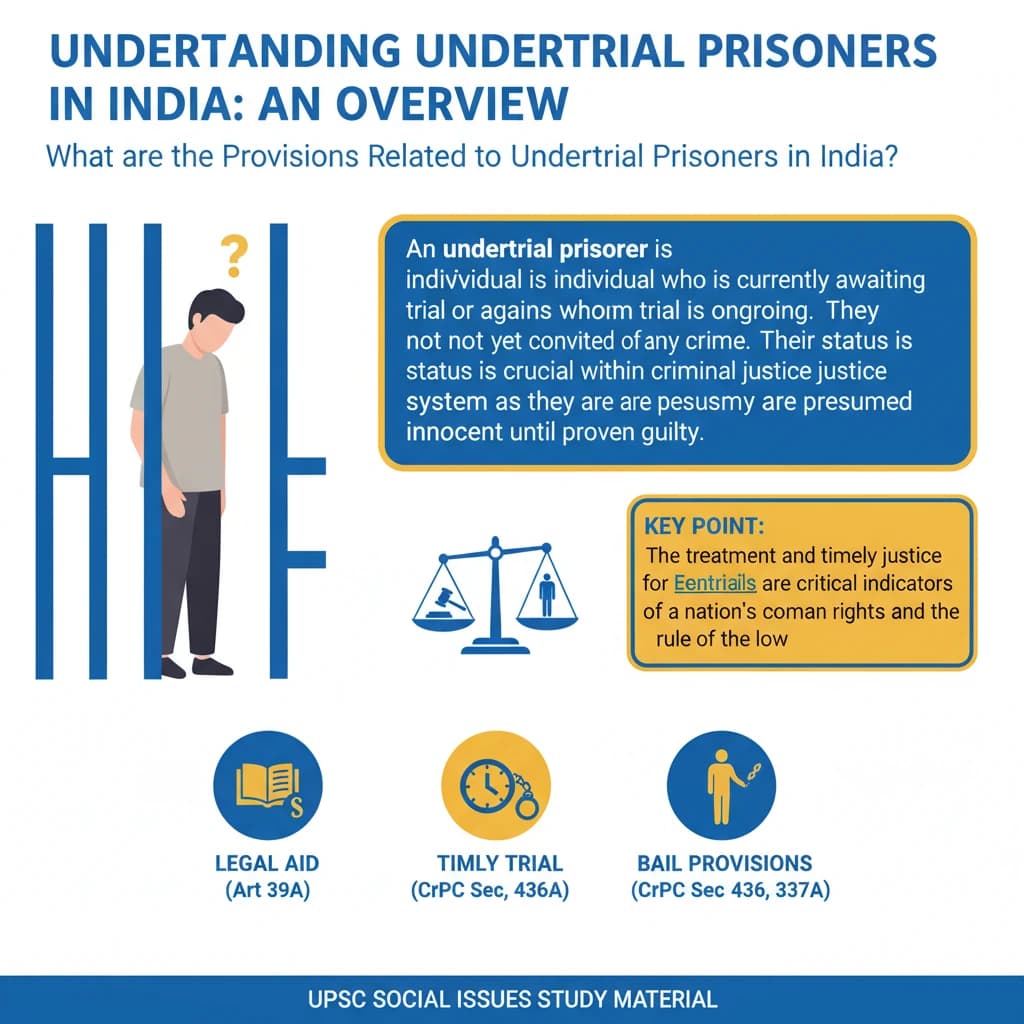
An undertrial prisoner is an individual who is currently awaiting trial or against whom a trial is ongoing. They have not yet been convicted of any crime. Their status is crucial within the criminal justice system as they are presumed innocent until proven guilty.
The treatment and timely justice for undertrials are critical indicators of a nation's commitment to human rights and rule of law.
The Challenge of Overcrowding in Indian Prisons
Indian prisons face a severe issue of overcrowding, largely due to the high number of undertrial prisoners. This situation strains resources and impacts the living conditions of inmates.
According to a report by the Supreme Court’s Centre for Research and Planning, Indian prisons operate at 131% occupancy. This means they house 573,220 inmates against a capacity of 436,266.
A significant majority of these inmates, approximately 75.7%, are undertrials. This high percentage reflects a substantial judicial backlog and slow trial processes.
Lack of Adequate Legal Representation
Many undertrial prisoners suffer from a lack of access to proper legal representation. This significantly hinders their ability to defend themselves effectively in court.
Despite Article 39A of the Indian Constitution guaranteeing free legal aid, the practical implementation is often insufficient. There is an inadequate lawyer-to-prisoner ratio, which limits the availability of legal assistance for those who need it most.
Provisions under the Bharatiya Nagarik Suraksha Sanhita (BNSS), 2023
The Bharatiya Nagarik Suraksha Sanhita (BNSS), 2023, aims to streamline the criminal justice system and reduce prolonged detention, particularly for certain categories of offenders.
Section 479 of BNSS: Reducing Prolonged Detention
Section 479 of BNSS is specifically designed to address the issue of prolonged detention by focusing on first-time offenders. It introduces provisions for their timely release on bail.
Relaxed Standards for First-Time Offenders
Under Section 479 of BNSS, first-time offenders are defined as individuals without any prior convictions. These individuals must be released on bond after serving one-third of the maximum sentence prescribed for the alleged offense.
General Rule for Bail for Non-Capital Offenses
For undertrials accused of non-capital offenses (crimes not punishable by death or life imprisonment), a general rule for bail applies. They are eligible for bail after serving half of the maximum sentence.
This provision in BNSS builds upon and replaces Section 436A of the Criminal Procedure Code (CrPC), which had similar provisions for release after serving half the sentence.
Exceptions to BNSS Provisions
It is important to note that the provisions under Section 479 of BNSS do not apply universally. There are specific exceptions:
- Cases involving multiple offenses where the cumulative sentence might be higher.
- Situations where ongoing investigations for other crimes are still underway against the undertrial.
Section 436A of the Criminal Procedure Code (CrPC), 1973
Prior to the enactment of BNSS, Section 436A of the CrPC, 1973, was the primary legal framework addressing the release of undertrial prisoners who had spent a significant period in custody.
Eligibility for Bail under CrPC 436A
Under Section 436A CrPC, undertrials who had served half of the maximum imprisonment period for their alleged offense were eligible for release. This release could be on a personal bond, either with or without sureties.
Exclusion from CrPC 436A
Similar to the BNSS provisions, Section 436A CrPC did not extend to all offenses. It specifically excluded cases involving offenses punishable by death or life imprisonment.
Judicial Directives and Interventions
The judiciary has consistently played a crucial role in highlighting and addressing the issues faced by undertrial prisoners, issuing directives to ensure their rights are protected.
Supreme Court’s PIL on Prison Conditions (2013)
In a landmark Public Interest Litigation (PIL) titled “In Re: Inhuman Conditions in 1382 Prisons (2013)”, the Supreme Court of India took suo motu cognizance of the deplorable state of prisons.
The Court highlighted critical issues such as severe overcrowding, excessively delayed trials, and the prolonged detention of undertrial prisoners.
This PIL is a significant example of judicial activism in safeguarding fundamental rights. It's crucial for understanding the judiciary's role in prison reforms for UPSC Mains GS-II.
Following this, the Supreme Court issued clear directions to state governments. These directives mandated ensuring the timely identification and release of eligible undertrials under the provisions of Section 436A CrPC (now replaced by BNSS Section 479).
💡 Key Takeaways
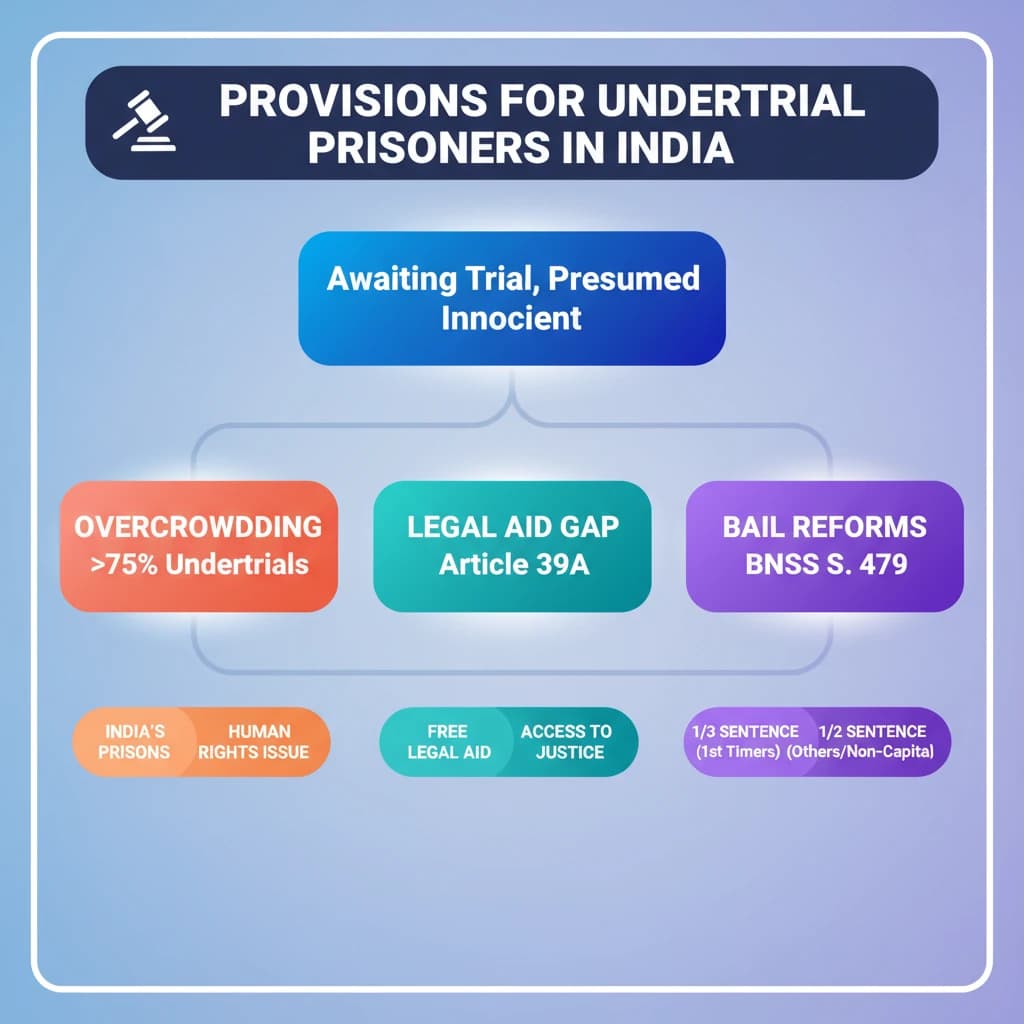
- •Undertrial prisoners are individuals awaiting trial, presumed innocent until proven guilty.
- •Indian prisons suffer from severe overcrowding, with undertrials constituting over 75% of inmates.
- •Lack of legal representation despite Article 39A is a major challenge for undertrials.
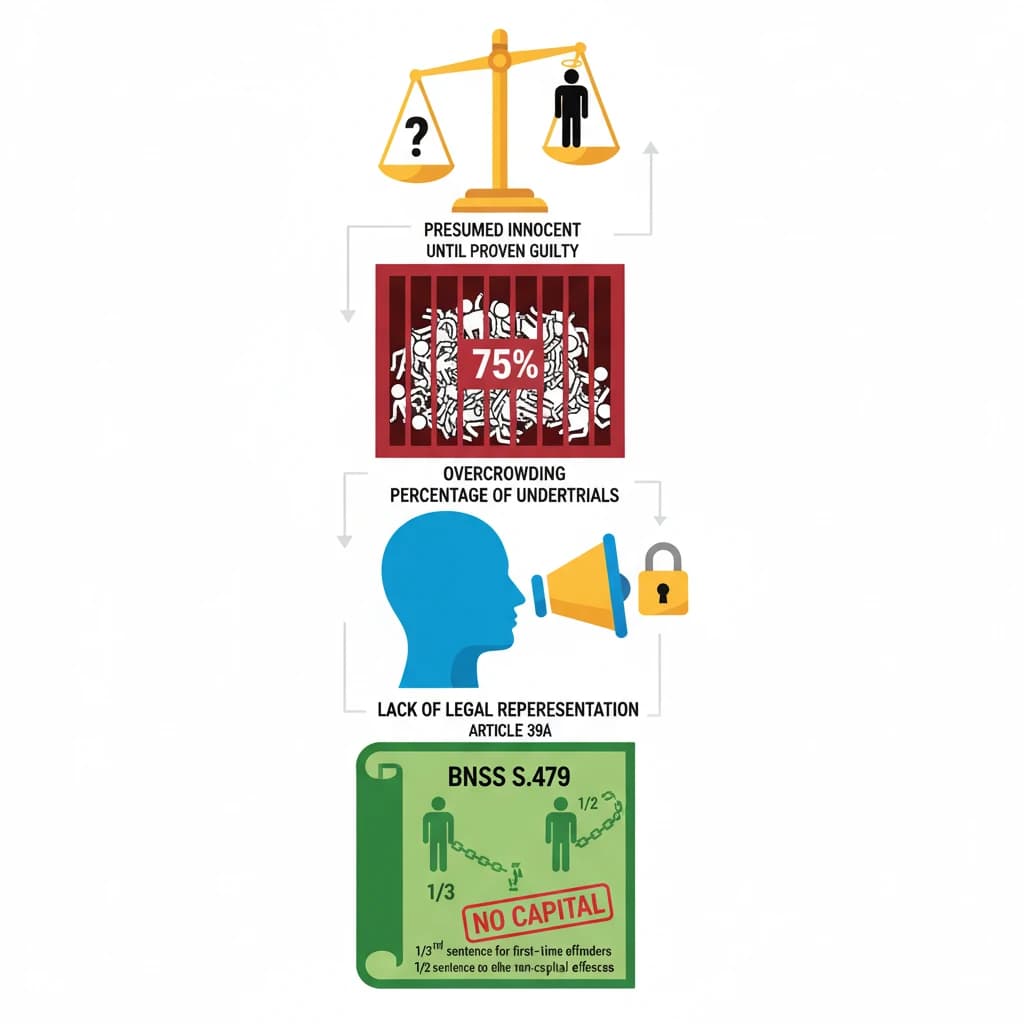
- •BNSS Section 479 (replacing CrPC 436A) allows release on bond for first-time offenders after 1/3rd sentence and others after 1/2 sentence for non-capital offenses.
- •Supreme Court has consistently directed states to ensure timely release of eligible undertrials to uphold human rights.
🧠 Memory Techniques
95% Verified Content
📚 Reference Sources
•Supreme Court of India’s Centre for Research and Planning reports
•The Criminal Procedure Code (CrPC), 1973
•The Bharatiya Nagarik Suraksha Sanhita (BNSS), 2023
•Indian Constitution (Article 39A)