Loading page, please wait…
What is India’s Approach to Tribal Development Policy? - UPSC Social Issues
What is What is India’s Approach to Tribal Development Policy? in UPSC Social Issues?
What is India’s Approach to Tribal Development Policy? is a key topic under Social Issues for UPSC Civil Services Examination. Key points include: India's tribal policy evolved from British isolation to a post-independence dual approach of autonomy and integration.. Post-independence policy is guided by Nehru's Tribal Panchsheel principles, emphasizing self-development and respect for rights.. Key autonomy measures include PESA Act, Forest Rights Act, and constitutional safeguards (Fifth & Sixth Schedules).. Understanding this topic is essential for both UPSC Prelims and Mains preparation.
Why is What is India’s Approach to Tribal Development Policy? important for UPSC exam?
What is India’s Approach to Tribal Development Policy? is a Medium-level topic in UPSC Social Issues. It is tested in both Prelims (factual MCQs) and Mains (analytical answer writing). Previous year UPSC questions have frequently covered aspects of What is India’s Approach to Tribal Development Policy?, making it essential for comprehensive IAS preparation.
How to prepare What is India’s Approach to Tribal Development Policy? for UPSC?
To prepare What is India’s Approach to Tribal Development Policy? for UPSC: (1) Study the comprehensive notes covering all key concepts on Vaidra. (2) Practice previous year questions on this topic. (3) Connect it with current affairs using daily updates. (4) Revise using key takeaways and mind maps available for Social Issues. (5) Write practice answers linking What is India’s Approach to Tribal Development Policy? to related GS Paper topics.
Key takeaways of What is India’s Approach to Tribal Development Policy? for UPSC
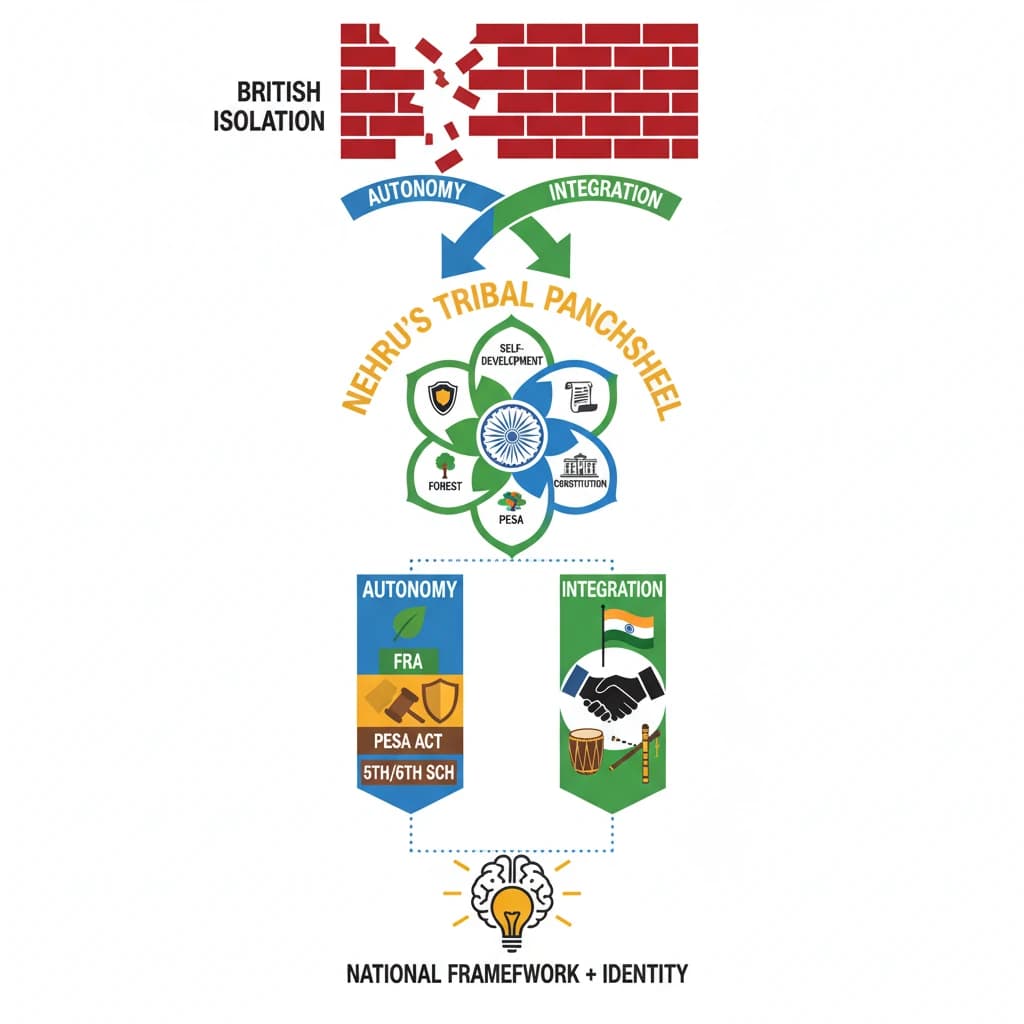
- India's tribal policy evolved from British isolation to a post-independence dual approach of autonomy and integration.
- Post-independence policy is guided by Nehru's Tribal Panchsheel principles, emphasizing self-development and respect for rights.
- Key autonomy measures include PESA Act, Forest Rights Act, and constitutional safeguards (Fifth & Sixth Schedules).
- Integration aims to incorporate tribals into the national framework while preserving their identity.
- Recent initiatives like PVTG Mission, EMRS, Van Dhan Yojana, and sickle cell anaemia mission address current developmental needs.
What is India’s Approach to Tribal Development Policy?
Medium⏱️ 5 min read
social issues
📖 Introduction
Introduction to Tribal Development Policy
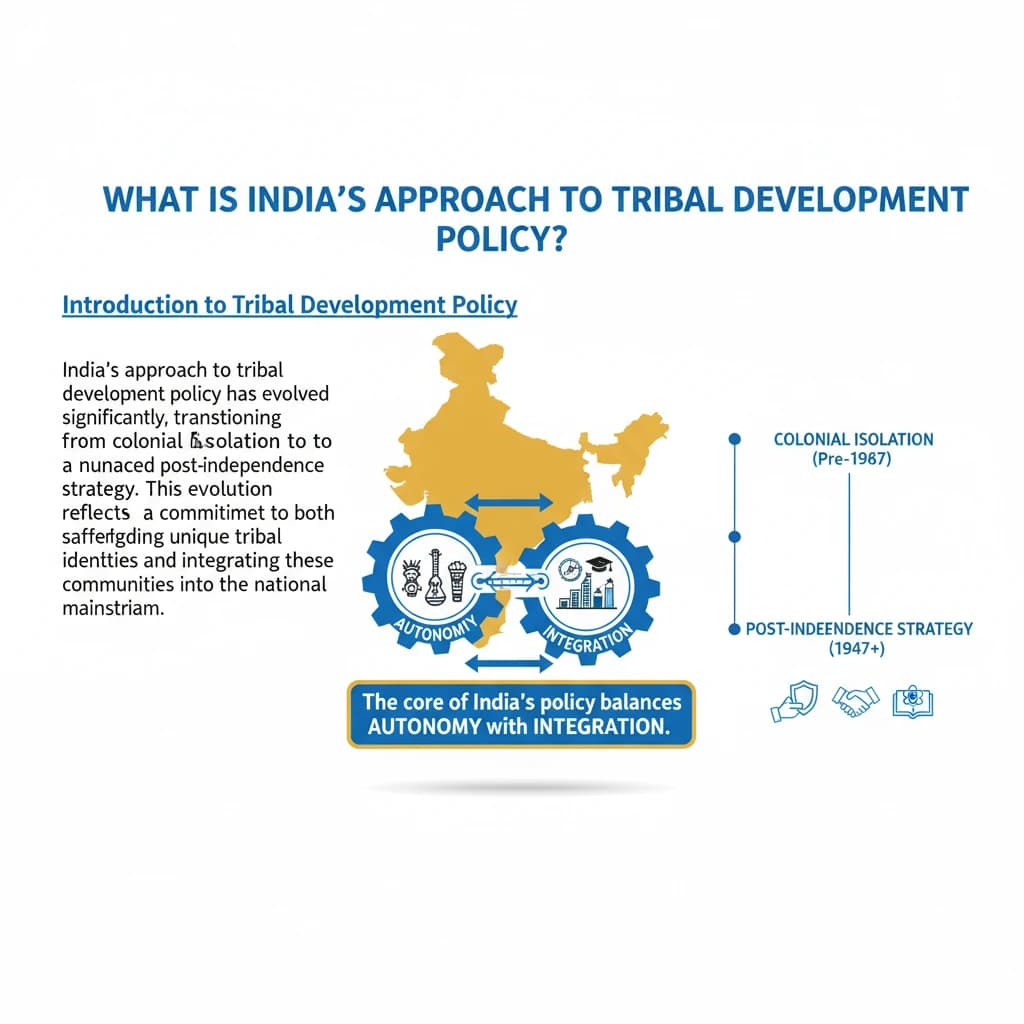
India's approach to tribal development policy has evolved significantly, transitioning from colonial isolation to a nuanced post-independence strategy.
This evolution reflects a commitment to both safeguarding unique tribal identities and integrating these communities into the national mainstream.
The core of India's policy balances autonomy with integration, recognizing the distinct cultural heritage and rights of tribal populations.
Pre-Independence Approach: Isolation and Protection
During the British colonial era, an isolationist approach was predominantly enforced for tribal areas.
These regions were often classified as “Excluded” or “Partially Excluded” zones to maintain law and order and minimize external interference.
- Scheduled District Act, 1874 (Act XIV): Introduced to exempt certain tribal areas from regular laws.
- Purpose: Primarily aimed at protecting tribal communities from exploitation by outsiders and preserving peace.
Post-Independence Paradigm: Autonomy and Integration
After gaining independence, India's government adopted a dual strategy, focusing on both autonomy and integration for tribal communities.
This approach sought to empower tribals while ensuring their participation in national development.
Policies Promoting Autonomy
Several legislative and constitutional measures have been enacted to preserve tribal self-governance and cultural integrity.
These policies aim to ensure minimal interference in their traditional practices and affirm their rights over natural resources.
Key autonomy-oriented policies include the Panchayats (Extension to the Scheduled Areas) Act, 1996 (PESA) and the Forest Rights Act, 2006.
Constitutional Safeguards:
- Fifth Schedule: Deals with administration and control of Scheduled Areas and Scheduled Tribes in any state except Assam, Meghalaya, Tripura, and Mizoram.
- Sixth Schedule: Provides for the administration of tribal areas in Assam, Meghalaya, Tripura, and Mizoram, granting significant autonomy to District Councils.
Policies Fostering Integration
The integration-oriented policy seeks to incorporate tribal communities into the broader national framework without eroding their distinct identity and autonomy.
This approach is deeply influenced by the vision of India's first Prime Minister.
The policy is guided by Jawaharlal Nehru’s Tribal Panchsheel policy, a five-point framework for tribal development.
Nehru's Tribal Panchsheel Principles:
- Tribals should develop along the lines of their own genius.
- Tribal rights in land and forests should be respected.
- We should try to train and build up a team of their own people to do the work of administration and development.
- We should not over-administer these areas or overwhelm them with a multiplicity of schemes.
- We should judge results not by statistics or the amount of money spent, but by the quality of human character that is evolved.
Recent Initiatives for Integration and Development
The government has launched several contemporary programs to further integrate and uplift tribal communities, addressing various aspects of their well-being.
These initiatives aim to bridge developmental gaps and improve quality of life.
Remember these recent initiatives for Mains answers, especially in GS Paper I (Social Issues) and GS Paper II (Governance).
Key Recent Initiatives:
- Pradhan Mantri Particularly Vulnerable Tribal Group (PVTG) Development Mission: Focuses on the holistic development of the most vulnerable tribal groups.
- Eklavya Model Residential Schools (EMRS): Aims to provide quality education to tribal children in remote areas.
- Pradhan Mantri Van Dhan Yojana: Promotes value addition, branding, and marketing of Minor Forest Produce (MFP) collected by tribals.
- Mission to eliminate sickle cell anaemia: A health initiative specifically targeting tribal populations who are disproportionately affected by the disease.
💡 Key Takeaways
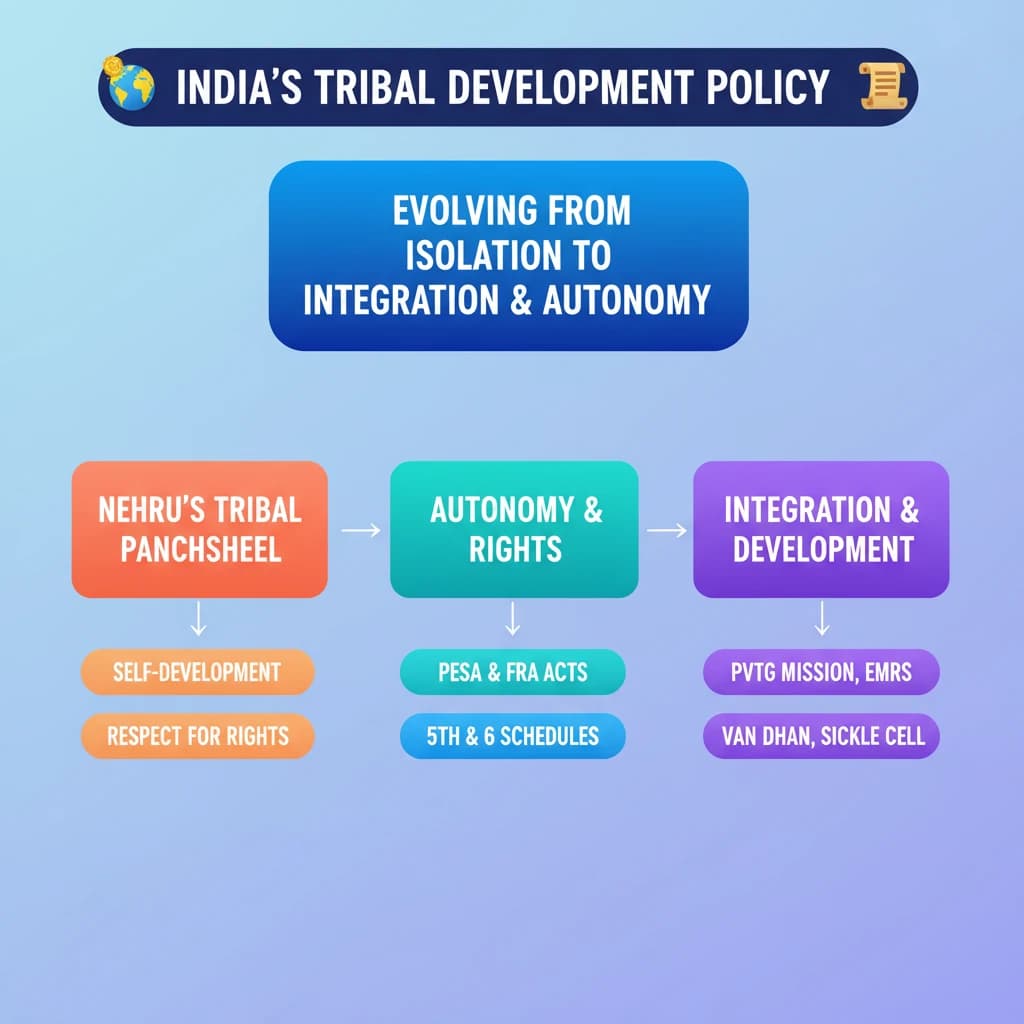
- •India's tribal policy evolved from British isolation to a post-independence dual approach of autonomy and integration.
- •Post-independence policy is guided by Nehru's Tribal Panchsheel principles, emphasizing self-development and respect for rights.
- •Key autonomy measures include PESA Act, Forest Rights Act, and constitutional safeguards (Fifth & Sixth Schedules).
- •Integration aims to incorporate tribals into the national framework while preserving their identity.
- •Recent initiatives like PVTG Mission, EMRS, Van Dhan Yojana, and sickle cell anaemia mission address current developmental needs.
🧠 Memory Techniques
95% Verified Content