Loading page, please wait…
What is MGNREGA Scheme? - UPSC Social Issues
What is What is MGNREGA Scheme? in UPSC Social Issues?
What is MGNREGA Scheme? is a key topic under Social Issues for UPSC Civil Services Examination. Key points include: MGNREGA, enacted in 2005, provides a legal guarantee for 100 days of wage employment per financial year.. Targets adult members of rural households willing to do unskilled manual labor.. Eligibility involves registration with Gram Panchayat and issuance of a job card.. Understanding this topic is essential for both UPSC Prelims and Mains preparation.
Why is What is MGNREGA Scheme? important for UPSC exam?
What is MGNREGA Scheme? is a Medium-level topic in UPSC Social Issues. It is tested in both Prelims (factual MCQs) and Mains (analytical answer writing). Previous year UPSC questions have frequently covered aspects of What is MGNREGA Scheme?, making it essential for comprehensive IAS preparation.
How to prepare What is MGNREGA Scheme? for UPSC?
To prepare What is MGNREGA Scheme? for UPSC: (1) Study the comprehensive notes covering all key concepts on Vaidra. (2) Practice previous year questions on this topic. (3) Connect it with current affairs using daily updates. (4) Revise using key takeaways and mind maps available for Social Issues. (5) Write practice answers linking What is MGNREGA Scheme? to related GS Paper topics.
Key takeaways of What is MGNREGA Scheme? for UPSC
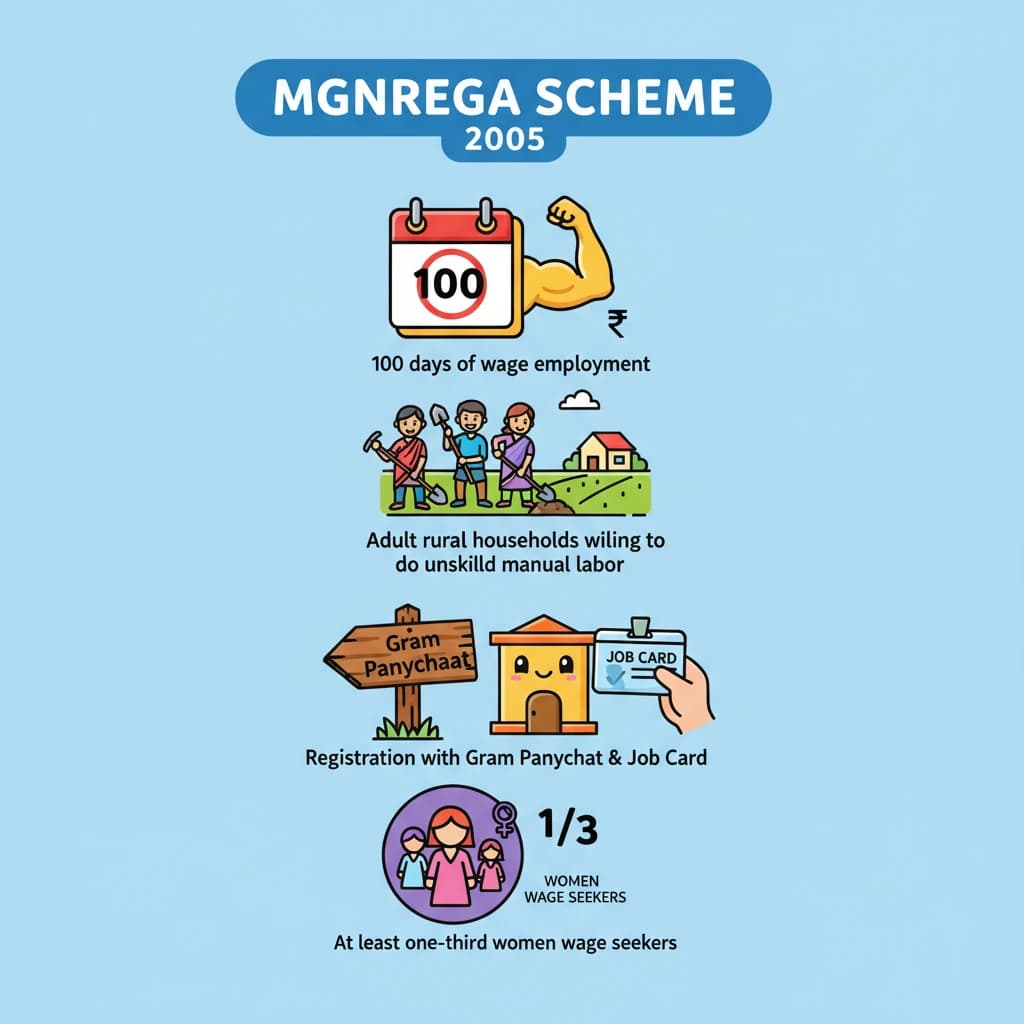
- MGNREGA, enacted in 2005, provides a legal guarantee for 100 days of wage employment per financial year.
- Targets adult members of rural households willing to do unskilled manual labor.
- Eligibility involves registration with Gram Panchayat and issuance of a job card.
- Mandates at least one-third women wage seekers.
- Work must be provided within 15 days; otherwise, unemployment allowance is paid.
- Includes a transparent due process for worker deletion and uses Aadhaar-Based Payment System (ABPS).
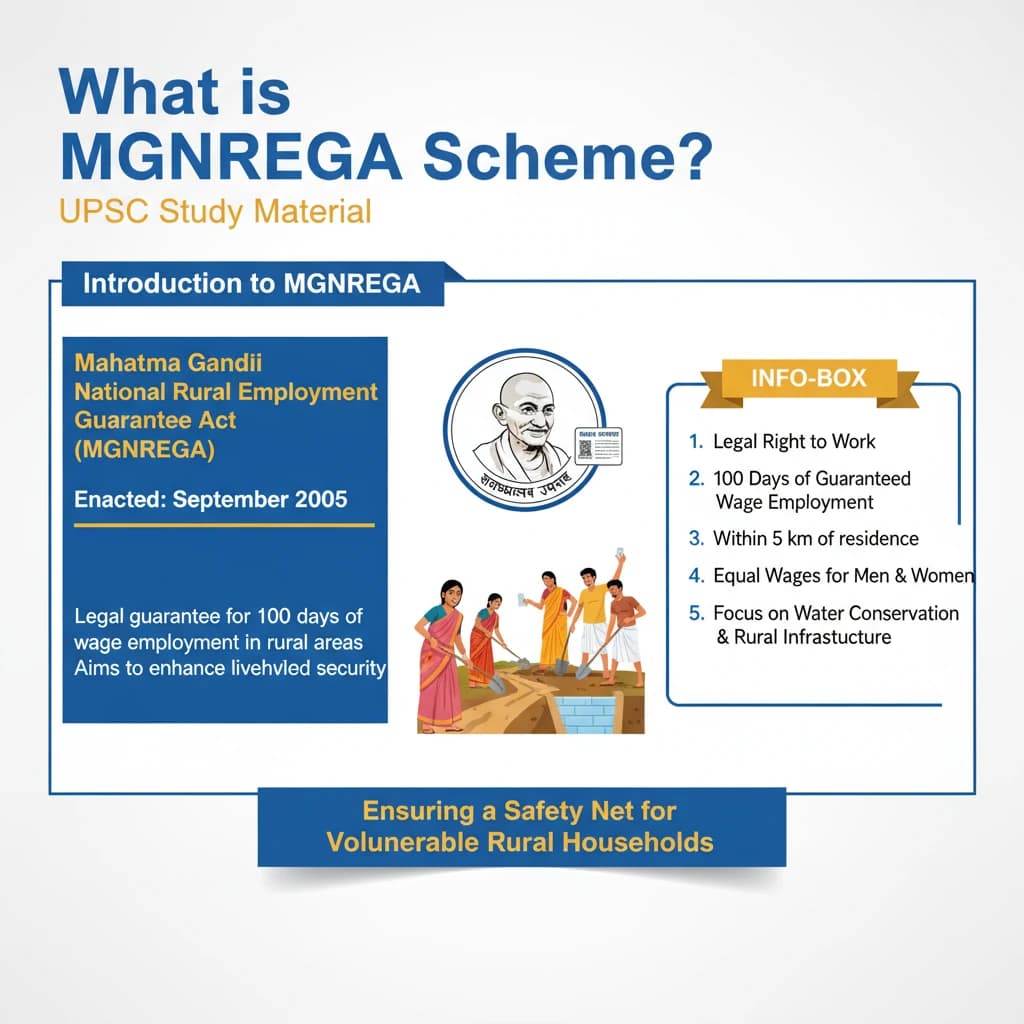
What is MGNREGA Scheme?
Medium⏱️ 8 min read
social issues
📖 Introduction
Introduction to MGNREGA
The Mahatma Gandhi National Rural Employment Guarantee Act (MGNREGA), enacted in September 2005, is a landmark legislation in India.
It provides a legal guarantee for wage employment, aiming to enhance the livelihood security of millions in rural areas.
The MGNREGA scheme operates under this Act, ensuring a safety net for vulnerable rural households.
Core Objectives of the Scheme
The primary objective of MGNREGA is to boost livelihood security in India's rural regions.
It achieves this by guaranteeing 100 days of wage employment in a financial year to adult members of rural households.
This employment is specifically for those willing to undertake unskilled manual labor.
The scheme acts as a crucial social safety net and a tool for rural development.
Eligibility Criteria and Registration
The scheme targets all rural households that require employment and are willing to perform manual, unskilled work.
To access the benefits, applicants must submit their requests to the local Gram Panchayat.
Upon verification, the Gram Panchayat registers eligible households and issues them a job card.
Priority for Women: A significant provision mandates that at least one-third of the wage seekers under the scheme should be women, promoting gender equity.
Employment Provision and Conditions
Once registered, the Gram Panchayat or Block Programme Officer is obligated to provide work within 15 days of the application.
Ideally, work should be provided within a 5-kilometer radius of the applicant’s village to minimize travel burden.
If work is assigned beyond this distance, an additional 10% wage is provided to cover transportation and living costs.
Work Duration: Employment provided should last for a minimum of 14 consecutive days, with a maximum of six workdays per week.
Unemployment Allowance
A critical feature of the scheme is the provision for an unemployment allowance.
If employment is not provided within the stipulated 15 days of application, beneficiaries are entitled to this allowance.
Allowance Structure: The allowance is one-fourth of the wage rate for the first 30 days and increases to at least half of the wage rate for the remaining period.
Due Process for Deletion of Workers
The scheme outlines a clear and transparent due process for deletion of workers from the rolls.
This ensures fairness and prevents arbitrary removal of beneficiaries.
- Hearing: Workers proposed for deletion must be heard, with two independent persons present.
- Verification: Reasons for deletion must be independently verified.
- Documentation: All actions and findings must be documented.
- Transparency: Reports are shared with the Gram Sabha or Ward Sabha for complete transparency.
Aadhaar-Based Payment System (ABPS)
The Aadhaar-Based Payment System (ABPS) is an integral part of the payment mechanism under MGNREGA.
It streamlines the transfer of wages and benefits directly to beneficiaries.
ABPS Functionality: This system uses Aadhaar numbers to electronically send government subsidies and benefits to the Aadhaar-linked bank accounts of beneficiaries, ensuring direct and efficient transfers.
💡 Key Takeaways
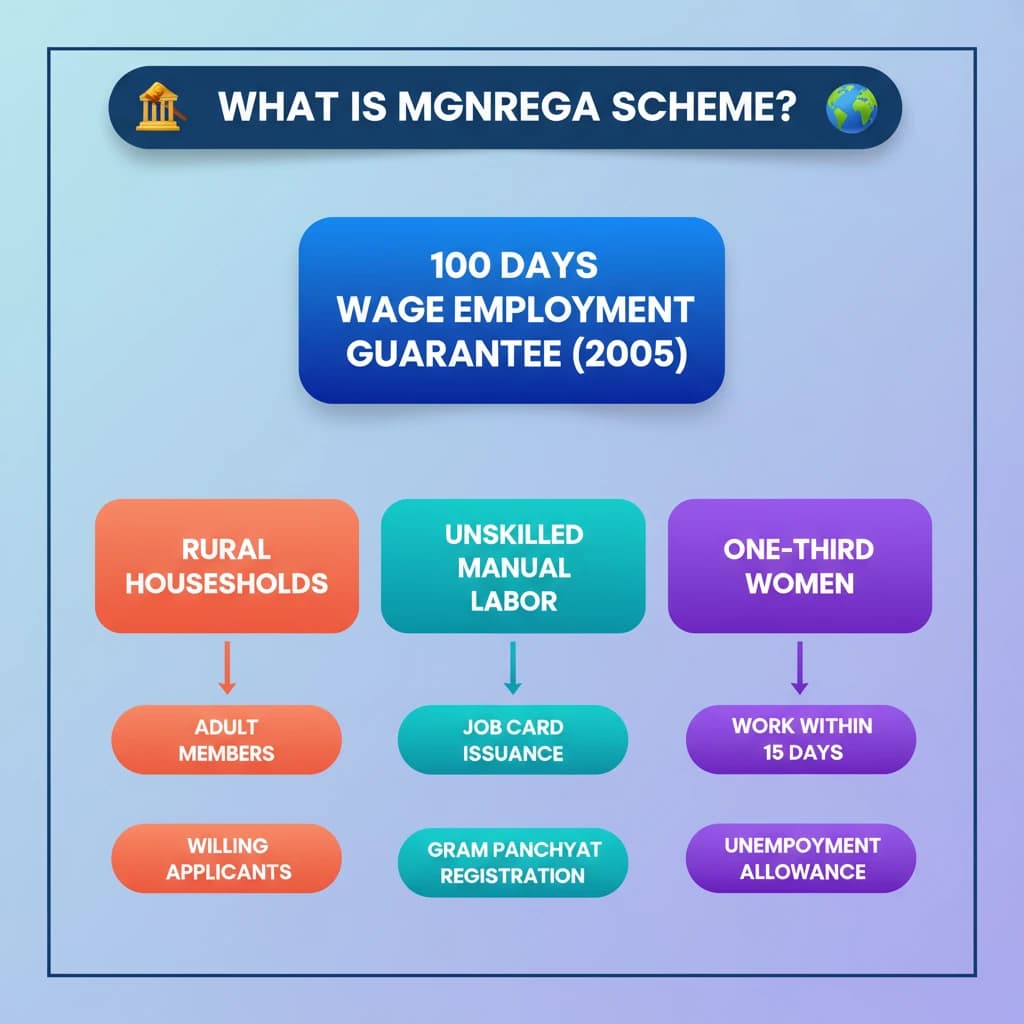
- •MGNREGA, enacted in 2005, provides a legal guarantee for 100 days of wage employment per financial year.
- •Targets adult members of rural households willing to do unskilled manual labor.
- •Eligibility involves registration with Gram Panchayat and issuance of a job card.
- •Mandates at least one-third women wage seekers.
- •Work must be provided within 15 days; otherwise, unemployment allowance is paid.
- •Includes a transparent due process for worker deletion and uses Aadhaar-Based Payment System (ABPS).
🧠 Memory Techniques
98% Verified Content
📚 Reference Sources
•Official MGNREGA Website, Ministry of Rural Development, Government of India
•Economic Survey of India (relevant years)
•Reports from NITI Aayog on rural development schemes