Loading page, please wait…
What is NITI Aayog? - UPSC Social Issues
What is What is NITI Aayog? in UPSC Social Issues?
What is NITI Aayog? is a key topic under Social Issues for UPSC Civil Services Examination. Key points include: NITI Aayog replaced the Planning Commission on Jan 1, 2015, shifting from a 'Top-Down' to a 'Bottom-Up' approach.. It functions as a premier policy 'think-tank' for the Government of India, fostering 'Cooperative Federalism'.. Its core vision is 'Maximum Governance, Minimum Government'.. Understanding this topic is essential for both UPSC Prelims and Mains preparation.
Why is What is NITI Aayog? important for UPSC exam?
What is NITI Aayog? is a Medium-level topic in UPSC Social Issues. It is tested in both Prelims (factual MCQs) and Mains (analytical answer writing). Previous year UPSC questions have frequently covered aspects of What is NITI Aayog?, making it essential for comprehensive IAS preparation.
How to prepare What is NITI Aayog? for UPSC?
To prepare What is NITI Aayog? for UPSC: (1) Study the comprehensive notes covering all key concepts on Vaidra. (2) Practice previous year questions on this topic. (3) Connect it with current affairs using daily updates. (4) Revise using key takeaways and mind maps available for Social Issues. (5) Write practice answers linking What is NITI Aayog? to related GS Paper topics.
Key takeaways of What is NITI Aayog? for UPSC
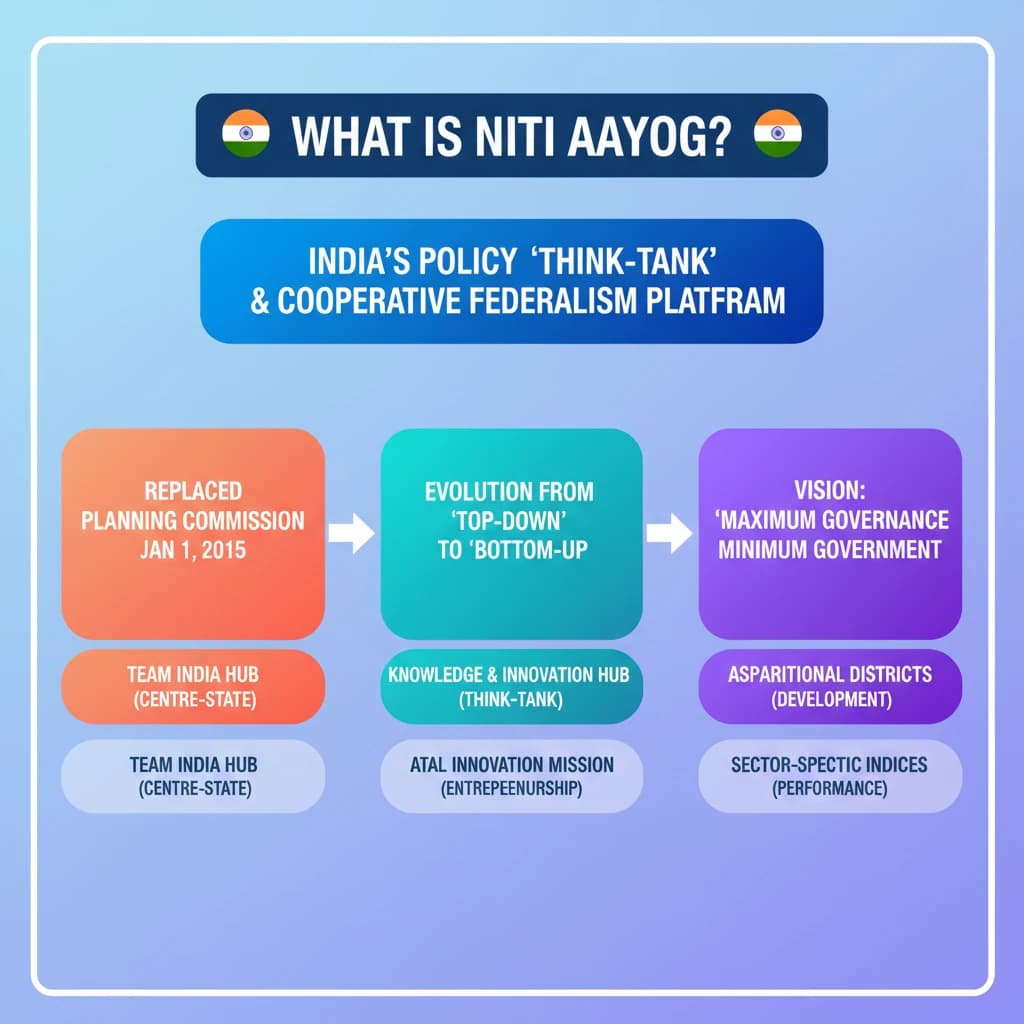
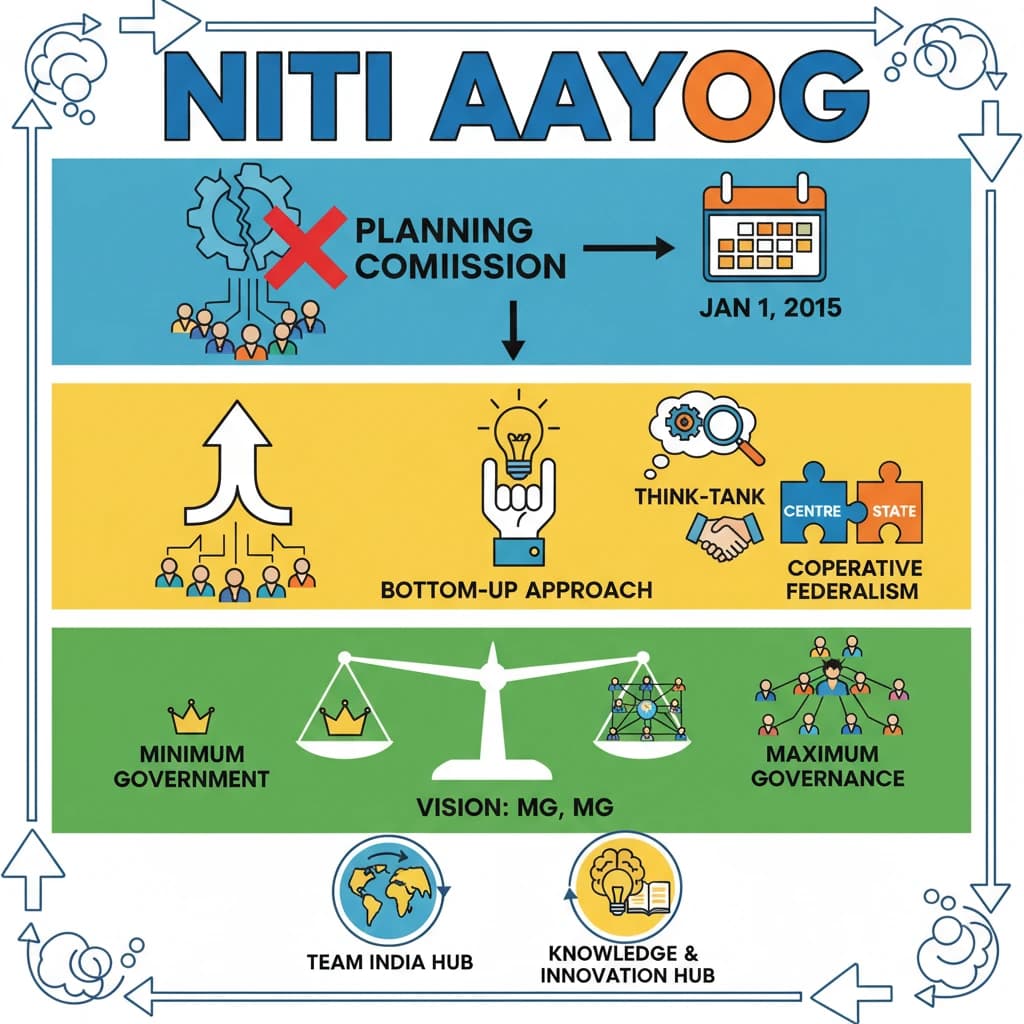
- NITI Aayog replaced the Planning Commission on Jan 1, 2015, shifting from a 'Top-Down' to a 'Bottom-Up' approach.
- It functions as a premier policy 'think-tank' for the Government of India, fostering 'Cooperative Federalism'.
- Its core vision is 'Maximum Governance, Minimum Government'.
- Comprises two main hubs: Team India Hub (Centre-State interface) and Knowledge and Innovation Hub (think-tank acumen).
- Key initiatives include SDG India Index, Atal Innovation Mission, Aspirational District Programme, and various sector-specific indices.

What is NITI Aayog?
Medium⏱️ 7 min read
social issues
📖 Introduction
Introduction to NITI Aayog
The National Institution for Transforming India (NITI) Aayog was established on January 1, 2015. It replaced the erstwhile Planning Commission, marking a significant shift in India's economic and social policy-making framework.
Formation Date: January 1, 2015
Replaced: Planning Commission
Core Philosophy: Bottom-Up Approach
NITI Aayog emphasizes a 'Bottom-Up' approach to governance and development. This contrasts with the Planning Commission's more centralized 'Top-Down' model.
The aim is to involve states and local bodies more actively in the policy-making process, ensuring that plans are more relevant and effective at the grassroots level.
Vision: Maximum Governance, Minimum Government
The institution embodies the vision of 'Maximum Governance, Minimum Government'. This principle seeks to streamline administrative processes and reduce bureaucratic hurdles, enhancing efficiency and transparency.
Key Principle: Maximum Governance, Minimum Government
This approach focuses on effective delivery of public services with minimal state intervention in day-to-day economic activities.
Spirit of Cooperative Federalism
A fundamental pillar of NITI Aayog is fostering 'Cooperative Federalism'. It acts as a platform for states to engage with the Centre on policy matters, promoting shared vision and collaborative action.
This ensures that national development strategies are formulated with inputs and consensus from all states, strengthening the federal structure of India.
Organizational Structure: Two Hubs
NITI Aayog operates through two main hubs, each with distinct functions to fulfill its mandate as a think-tank and a facilitator of inter-state cooperation.
Team India Hub
The Team India Hub serves as the primary interface between the States and the Centre. Its role is crucial in facilitating dialogue, coordination, and collaborative policy implementation across different levels of government.
Function: Interface between States and Centre
Goal: Enhance inter-state cooperation and ensure state participation in national development.
Knowledge and Innovation Hub
The Knowledge and Innovation Hub is responsible for building the think-tank acumen of NITI Aayog. It focuses on research, policy analysis, and generating new ideas for development.
This hub is instrumental in providing strategic and technical advice to the central and state governments, driving evidence-based policy formulation.
Key Initiatives by NITI Aayog
NITI Aayog has launched and overseen numerous initiatives across various sectors, reflecting its broad mandate to drive national development and reform.
- SDG India Index: Measures progress of states/UTs on Sustainable Development Goals.
- Composite Water Management Index: Assesses states' performance in water resource management.
- Atal Innovation Mission (AIM): Promotes a culture of innovation and entrepreneurship across the country.
- SATH Project (Sustainable Action for Transforming Human Capital): Focuses on improving health and education outcomes.
- Aspirational District Programme: Aims to rapidly transform underdeveloped districts.
- School Education Quality Index (SEQI): Evaluates the performance of states/UTs in the school education sector.
- District Hospital Index: Assesses the performance of district hospitals.
- Health Index: Measures overall health performance of states and UTs.
- Agriculture Marketing And Farmer Friendly Reform Index: Benchmarks states on agricultural reforms.
- India Innovation Index: Ranks states and UTs based on their innovation performance.
- Women Transforming India Awards: Recognizes and celebrates the contributions of women entrepreneurs.
- Good Governance Index: Assesses the state of governance across states and UTs.
UPSC Insight: Be prepared to discuss specific NITI Aayog initiatives and their impact. Questions often focus on how these initiatives reflect the 'Bottom-Up' approach or 'Cooperative Federalism'.
💡 Key Takeaways
- •NITI Aayog replaced the Planning Commission on Jan 1, 2015, shifting from a 'Top-Down' to a 'Bottom-Up' approach.
- •It functions as a premier policy 'think-tank' for the Government of India, fostering 'Cooperative Federalism'.
- •Its core vision is 'Maximum Governance, Minimum Government'.
- •Comprises two main hubs: Team India Hub (Centre-State interface) and Knowledge and Innovation Hub (think-tank acumen).
- •Key initiatives include SDG India Index, Atal Innovation Mission, Aspirational District Programme, and various sector-specific indices.
🧠 Memory Techniques
95% Verified Content