Loading page, please wait…
What is the National Multidimensional Poverty Index? - UPSC Social Issues
What is What is the National Multidimensional Poverty Index? in UPSC Social Issues?
What is the National Multidimensional Poverty Index? is a key topic under Social Issues for UPSC Civil Services Examination. Key points include: National MPI measures simultaneous deprivations across Health, Education, and Standard of Living.. It uses 12 indicators, aligned with Sustainable Development Goals (SDGs).. Methodology is based on the robust Alkire and Foster (AF) method.. Understanding this topic is essential for both UPSC Prelims and Mains preparation.
Why is What is the National Multidimensional Poverty Index? important for UPSC exam?
What is the National Multidimensional Poverty Index? is a Medium-level topic in UPSC Social Issues. It is tested in both Prelims (factual MCQs) and Mains (analytical answer writing). Previous year UPSC questions have frequently covered aspects of What is the National Multidimensional Poverty Index?, making it essential for comprehensive IAS preparation.
How to prepare What is the National Multidimensional Poverty Index? for UPSC?
To prepare What is the National Multidimensional Poverty Index? for UPSC: (1) Study the comprehensive notes covering all key concepts on Vaidra. (2) Practice previous year questions on this topic. (3) Connect it with current affairs using daily updates. (4) Revise using key takeaways and mind maps available for Social Issues. (5) Write practice answers linking What is the National Multidimensional Poverty Index? to related GS Paper topics.
Key takeaways of What is the National Multidimensional Poverty Index? for UPSC
- National MPI measures simultaneous deprivations across Health, Education, and Standard of Living.
- It uses 12 indicators, aligned with Sustainable Development Goals (SDGs).
- Methodology is based on the robust Alkire and Foster (AF) method.
- National MPI covers 12 indicators, while the global MPI covers 10 indicators.
- It provides a complementary perspective to conventional monetary poverty measures.
- NITI Aayog is the nodal agency for the National MPI in India.
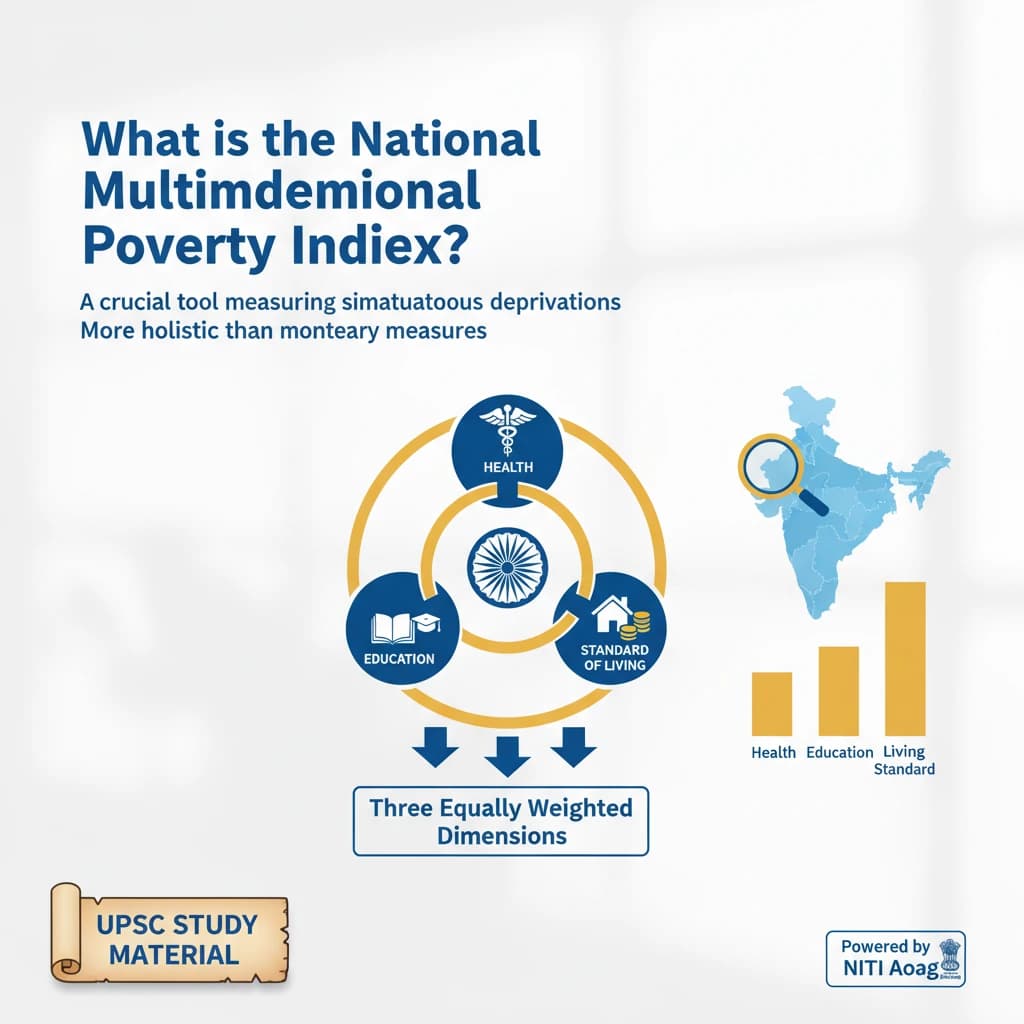
What is the National Multidimensional Poverty Index?
Medium⏱️ 8 min read
social issues
📖 Introduction
What is the National Multidimensional Poverty Index?
The National Multidimensional Poverty Index (MPI) is a crucial tool designed to measure simultaneous deprivations experienced by individuals. It provides a more holistic view of poverty than traditional monetary measures.
This index assesses poverty across three equally weighted dimensions: Health, Education, and Standard of Living. These dimensions are further broken down into 12 specific indicators.
The National MPI aligns its indicators with the global Sustainable Development Goals (SDGs), ensuring a comprehensive and internationally comparable framework for poverty measurement.
Dimensions and Indicators of National MPI
The 12 indicators covered by the National MPI span various aspects of human well-being. They are carefully chosen to reflect the acute deprivations faced by the poor.
- Health Dimension: Includes indicators such as Nutrition, Child and Adolescent mortality, and Maternal Health.
- Education Dimension: Consists of Years of schooling and School Attendance.
- Standard of Living Dimension: Encompasses Cooking fuel, Sanitation, Drinking water, Electricity, Housing, Assets, and Bank Accounts.
Each of the three dimensions (Health, Education, Standard of Living) carries an equal weight in the calculation of the National MPI, emphasizing their balanced importance.
Methodology: Alkire and Foster (AF) Method
The global methodology underpinning the MPI, including the National MPI, is based on the robust Alkire and Foster (AF) method. This method is renowned for its ability to identify people as poor based on multiple deprivations.
The AF method uses universally acknowledged metrics to assess acute poverty. It offers a complementary perspective to conventional monetary poverty measures, which often only consider income or consumption.
The Alkire and Foster method identifies individuals as multidimensionally poor if they are deprived in a certain number or combination of indicators, going beyond a simple headcount.
National MPI vs. Global MPI
While the National MPI adopts the core methodology of the global MPI, there are differences in the number of indicators used. This adaptation allows for better reflection of national contexts and policy priorities.
The National MPI covers 12 indicators, whereas the global MPI covers 10 indicators. This distinction is crucial for understanding the scope of poverty measurement in India.
For UPSC Prelims, remember the three dimensions and the 12 indicators of the National MPI. For Mains, understand its methodology and how it complements monetary poverty measures. The difference in indicator count between National and Global MPI is also a potential Prelims question.
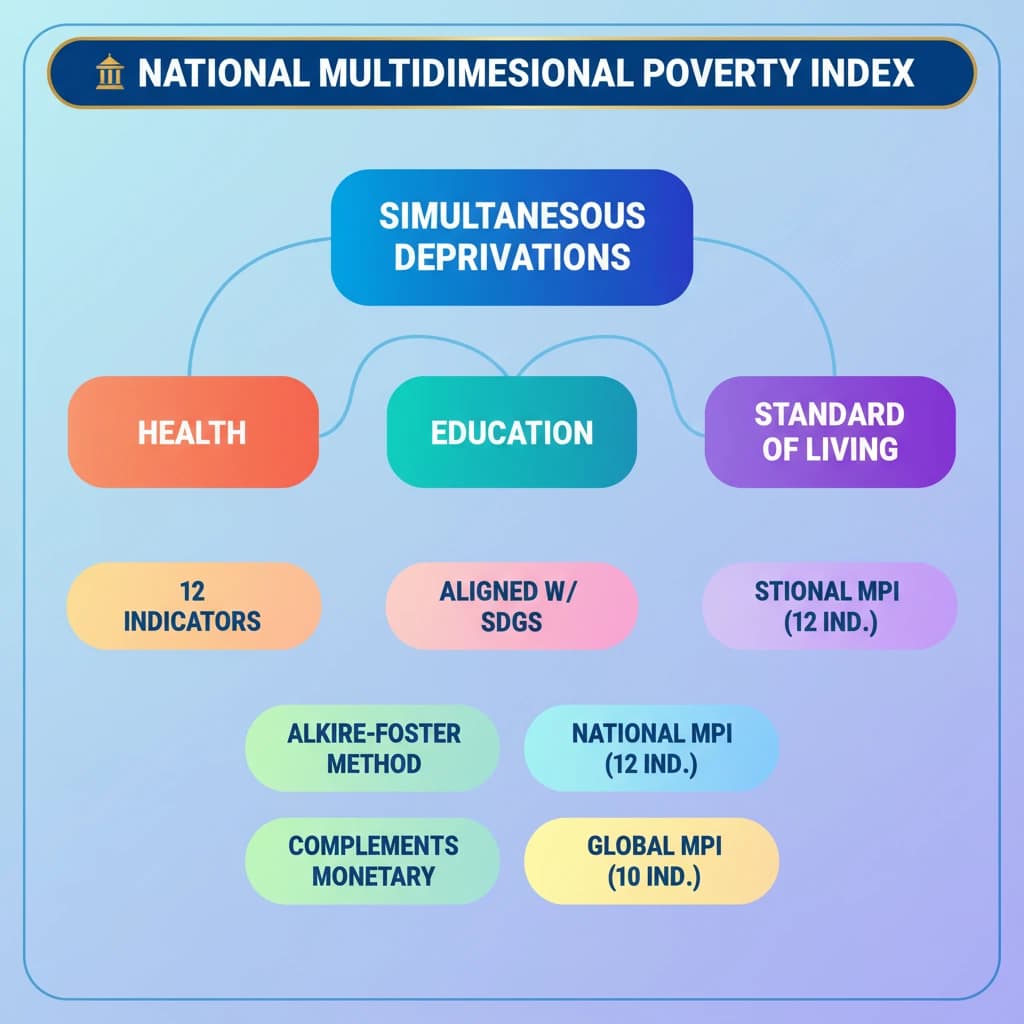
💡 Key Takeaways
- •National MPI measures simultaneous deprivations across Health, Education, and Standard of Living.
- •It uses 12 indicators, aligned with Sustainable Development Goals (SDGs).
- •Methodology is based on the robust Alkire and Foster (AF) method.
- •National MPI covers 12 indicators, while the global MPI covers 10 indicators.
- •It provides a complementary perspective to conventional monetary poverty measures.
- •NITI Aayog is the nodal agency for the National MPI in India.
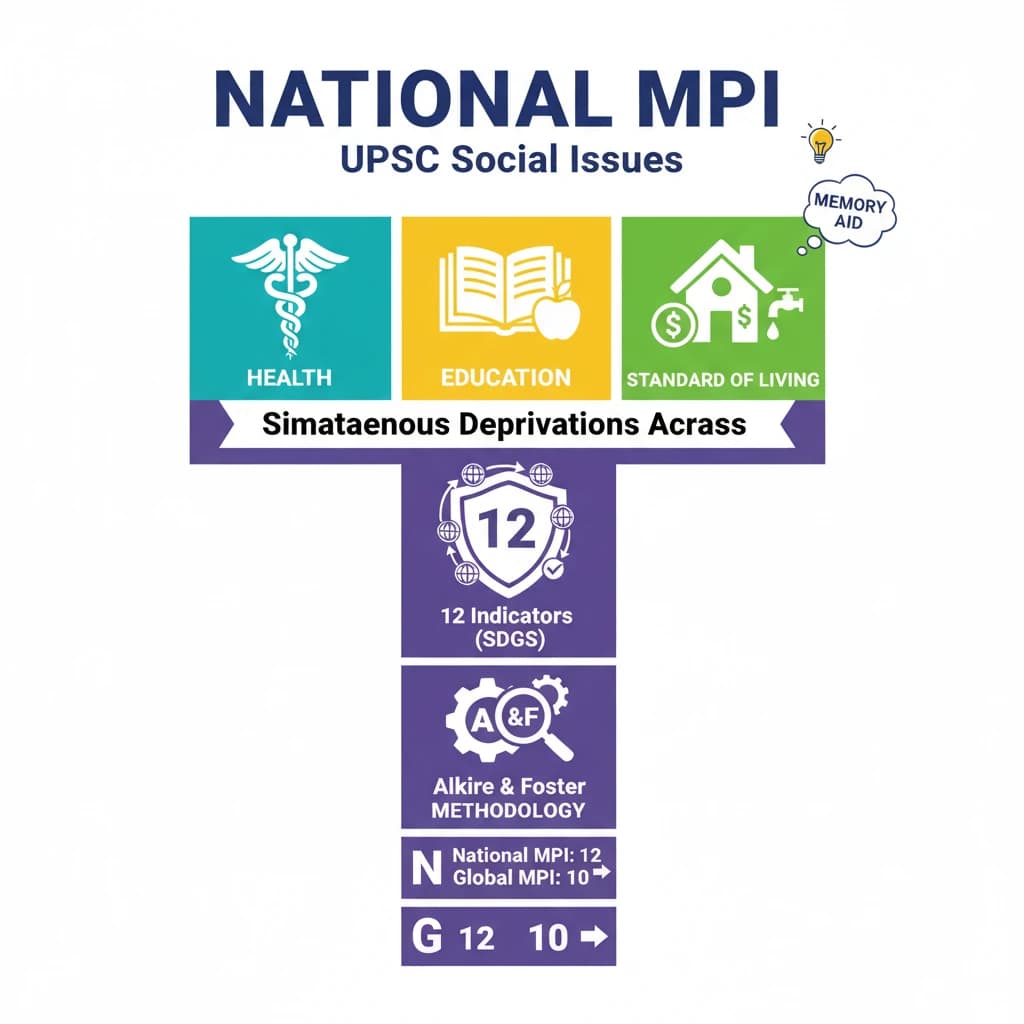
🧠 Memory Techniques
98% Verified Content
📚 Reference Sources
•Oxford Poverty and Human Development Initiative (OPHI) - Global MPI resources
•United Nations Development Programme (UNDP) - Human Development Reports
•Drishti IAS study material (provided source content)