Loading page, please wait…
What is the Universal Immunisation Programme (UIP)? - UPSC Social Issues
What is What is the Universal Immunisation Programme (UIP)? in UPSC Social Issues?
What is the Universal Immunisation Programme (UIP)? is a key topic under Social Issues for UPSC Civil Services Examination. Key points include: UIP is India's largest public health program for vaccine-preventable diseases, launched in 1985 (evolved from EPI 1978).. India achieved polio-free status in 2014 and eliminated maternal/neonatal tetanus in 2015.. New vaccines like Measles-Rubella, PCV, and Rotavirus Vaccine have been introduced.. Understanding this topic is essential for both UPSC Prelims and Mains preparation.
Why is What is the Universal Immunisation Programme (UIP)? important for UPSC exam?
What is the Universal Immunisation Programme (UIP)? is a Medium-level topic in UPSC Social Issues. It is tested in both Prelims (factual MCQs) and Mains (analytical answer writing). Previous year UPSC questions have frequently covered aspects of What is the Universal Immunisation Programme (UIP)?, making it essential for comprehensive IAS preparation.
How to prepare What is the Universal Immunisation Programme (UIP)? for UPSC?
To prepare What is the Universal Immunisation Programme (UIP)? for UPSC: (1) Study the comprehensive notes covering all key concepts on Vaidra. (2) Practice previous year questions on this topic. (3) Connect it with current affairs using daily updates. (4) Revise using key takeaways and mind maps available for Social Issues. (5) Write practice answers linking What is the Universal Immunisation Programme (UIP)? to related GS Paper topics.
Key takeaways of What is the Universal Immunisation Programme (UIP)? for UPSC
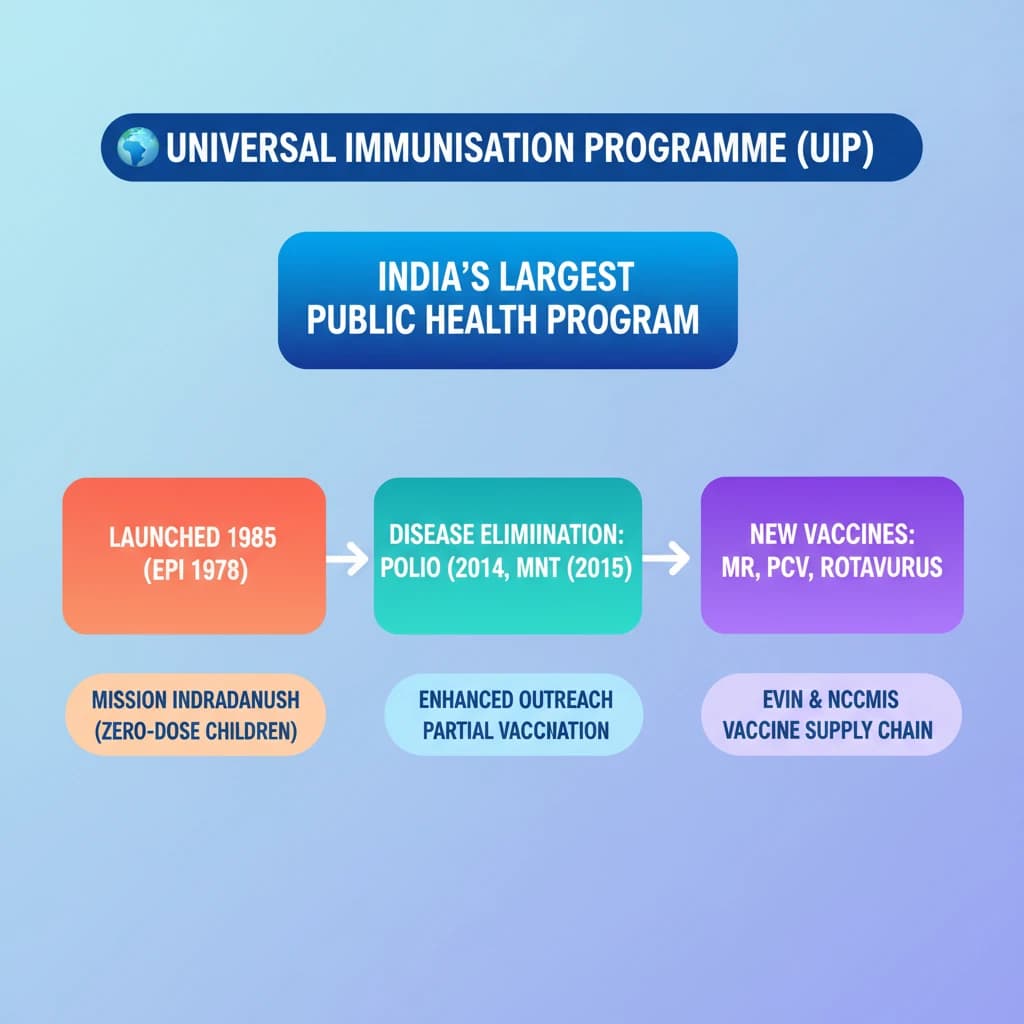
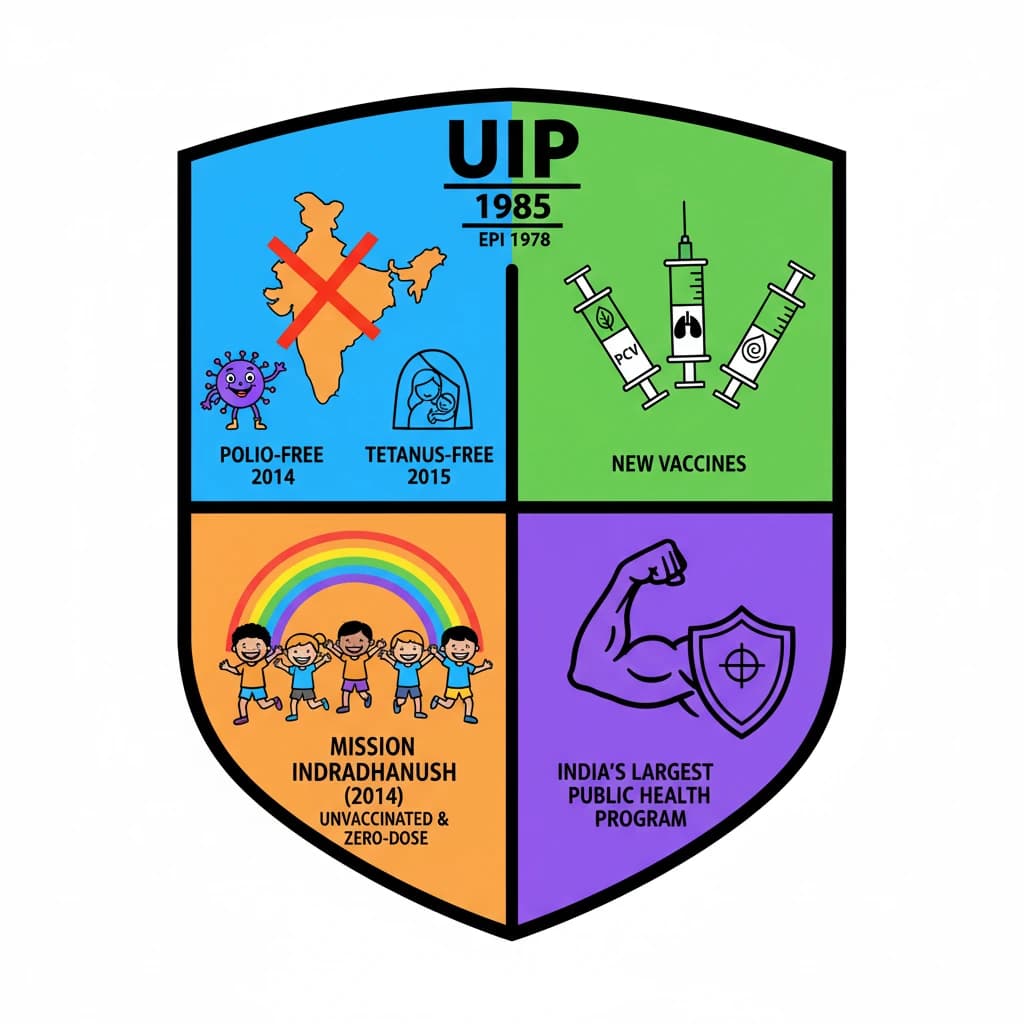
- UIP is India's largest public health program for vaccine-preventable diseases, launched in 1985 (evolved from EPI 1978).
- India achieved polio-free status in 2014 and eliminated maternal/neonatal tetanus in 2015.
- New vaccines like Measles-Rubella, PCV, and Rotavirus Vaccine have been introduced.
- Mission Indradhanush (2014) and Intensified Mission Indradhanush aim to vaccinate unvaccinated/partially vaccinated and zero-dose children.
- Supporting measures include eVIN and NCCMIS for efficient vaccine delivery and cold chain management.
- Despite progress, 65% full immunization coverage and concentration of zero-dose children in 5 states remain challenges.
What is the Universal Immunisation Programme (UIP)?
Medium⏱️ 7 min read
social issues
📖 Introduction
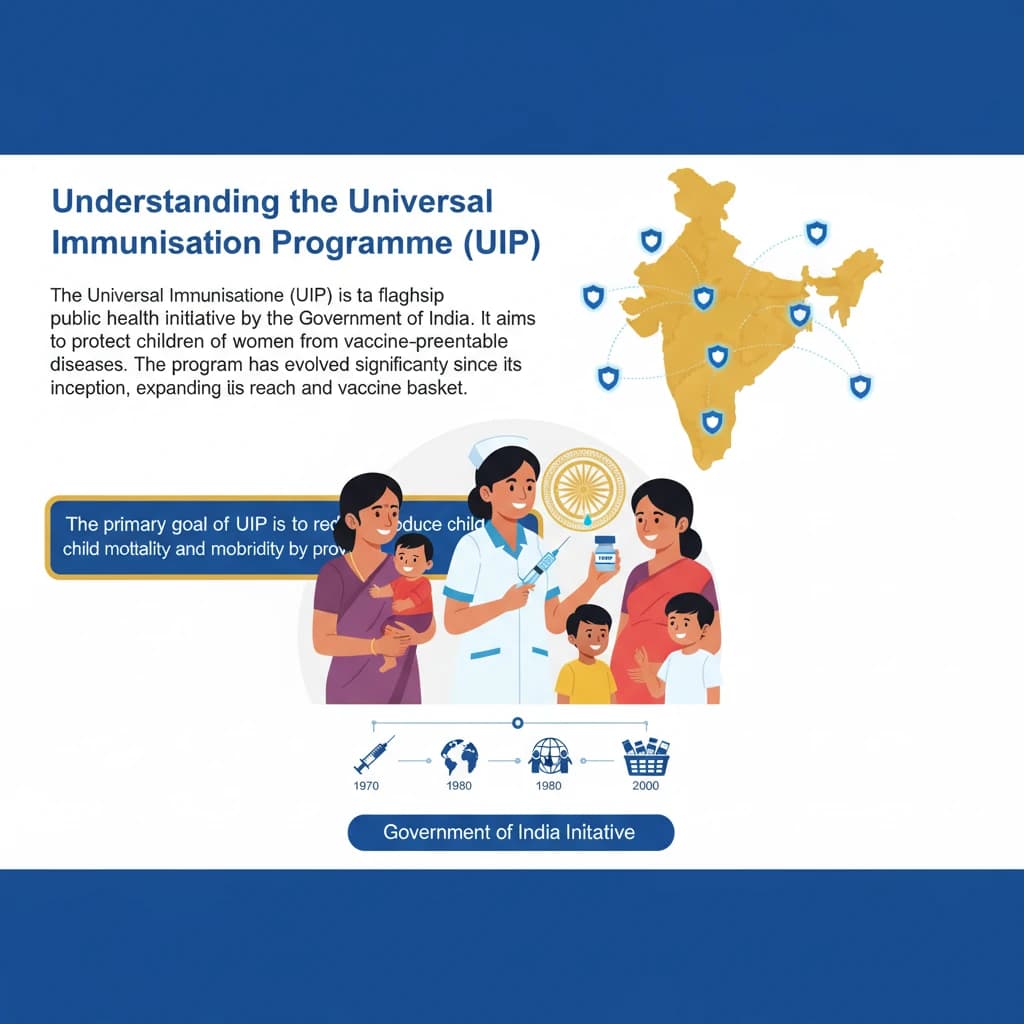
Understanding the Universal Immunisation Programme (UIP)
The Universal Immunisation Programme (UIP) is a flagship public health initiative by the Government of India. It aims to protect children and pregnant women from vaccine-preventable diseases. The program has evolved significantly since its inception, expanding its reach and vaccine basket.
The primary goal of UIP is to reduce child mortality and morbidity by providing free vaccination against 12 vaccine-preventable diseases.
Current Status and Key Achievements
India has made significant strides in public health through its robust immunization efforts. These achievements highlight the program's effectiveness and national commitment to health.
- India was certified polio-free in 2014, a monumental achievement in global health.
- The country successfully eliminated maternal and neonatal tetanus in 2015, protecting mothers and newborns.
Introduction of New Vaccines
The UIP continuously updates its vaccine portfolio to combat emerging and prevalent diseases. This ensures comprehensive protection for the target population.
New vaccines introduced and expanded nationwide include:
- Measles-Rubella (MR) Vaccine
- Pneumococcal Conjugate Vaccine (PCV)
- Rotavirus Vaccine (RVV)
Immunisation Coverage and Challenges
Despite significant progress, challenges in achieving full immunization coverage persist. Efforts are continuously being made to bridge these gaps and reach every eligible child.
According to UNICEF, only 65% of children in India receive full immunisation during their first year of life.
Addressing Zero-Dose Children
A major focus of the UIP is to reach zero-dose (ZD) children, who are those who have not received any routine vaccination. Targeted campaigns are crucial for this.
As per WU-ENIC (WHO-UNICEF Estimates National Immunization Coverage), India reduced the number of zero-dose children to 1.1 million in 2022 from 2.7 million in 2021, vaccinating an additional 1.6 million children.
A significant proportion of these zero-dose children are concentrated in specific states, requiring focused interventions.
63% of ZD children reside in five states:
- Bihar
- Madhya Pradesh
- Maharashtra
- Rajasthan
- Uttar Pradesh
Mission Indradhanush (MI)
To accelerate the pace of immunization and ensure no child is left behind, targeted missions have been launched under the UIP.
Mission Indradhanush (MI) was launched in 2014 by the Ministry of Health and Family Welfare (MoHFW). Its aim is to vaccinate all unvaccinated and partially vaccinated children under the UIP.
Intensified Mission Indradhanush (IMI)
Building on the success of MI, an intensified version was introduced to further reduce the number of zero-dose children and improve overall coverage.
Intensified Mission Indradhanush (IMI) has been launched specifically to bring down the number of zero-dose children even further, ensuring equitable access to life-saving vaccines.
Other Supporting Measures
Technological advancements and robust management systems play a vital role in the efficient delivery of vaccines across the country.
- Electronic Vaccine Intelligence Network (eVIN): A real-time system for vaccine stock management and temperature monitoring.
- National Cold Chain Management Information System (NCCMIS): Ensures the integrity of the vaccine cold chain from manufacturing to the last mile.
For UPSC Mains (GS-II), understanding the evolution of UIP, its achievements, challenges, and specific initiatives like Mission Indradhanush is crucial for questions on government policies and health programs.
💡 Key Takeaways
- •UIP is India's largest public health program for vaccine-preventable diseases, launched in 1985 (evolved from EPI 1978).
- •India achieved polio-free status in 2014 and eliminated maternal/neonatal tetanus in 2015.
- •New vaccines like Measles-Rubella, PCV, and Rotavirus Vaccine have been introduced.
- •Mission Indradhanush (2014) and Intensified Mission Indradhanush aim to vaccinate unvaccinated/partially vaccinated and zero-dose children.
- •Supporting measures include eVIN and NCCMIS for efficient vaccine delivery and cold chain management.
- •Despite progress, 65% full immunization coverage and concentration of zero-dose children in 5 states remain challenges.
🧠 Memory Techniques
95% Verified Content