Loading page, please wait…
What Laws are Made to Support the Right to Shelter in India? - UPSC Social Issues
What is What Laws are Made to Support the Right to Shelter in India? in UPSC Social Issues?
What Laws are Made to Support the Right to Shelter in India? is a key topic under Social Issues for UPSC Civil Services Examination. Key points include: Right to Shelter is implicitly derived from Article 21 (Right to Life) of the Indian Constitution.. The Slum Areas Act, 1956, enables government intervention for slum improvement and clearance.. The Forest Rights Act, 2006, recognises habitation and resource rights of forest-dwelling communities.. Understanding this topic is essential for both UPSC Prelims and Mains preparation.
Why is What Laws are Made to Support the Right to Shelter in India? important for UPSC exam?
What Laws are Made to Support the Right to Shelter in India? is a Medium-level topic in UPSC Social Issues. It is tested in both Prelims (factual MCQs) and Mains (analytical answer writing). Previous year UPSC questions have frequently covered aspects of What Laws are Made to Support the Right to Shelter in India?, making it essential for comprehensive IAS preparation.
How to prepare What Laws are Made to Support the Right to Shelter in India? for UPSC?
To prepare What Laws are Made to Support the Right to Shelter in India? for UPSC: (1) Study the comprehensive notes covering all key concepts on Vaidra. (2) Practice previous year questions on this topic. (3) Connect it with current affairs using daily updates. (4) Revise using key takeaways and mind maps available for Social Issues. (5) Write practice answers linking What Laws are Made to Support the Right to Shelter in India? to related GS Paper topics.
Key takeaways of What Laws are Made to Support the Right to Shelter in India? for UPSC
- Right to Shelter is implicitly derived from Article 21 (Right to Life) of the Indian Constitution.
- The Slum Areas Act, 1956, enables government intervention for slum improvement and clearance.
- The Forest Rights Act, 2006, recognises habitation and resource rights of forest-dwelling communities.
- RERA, 2016, regulates the real estate sector for transparency and protects homebuyers' interests.
- The LARR Act, 2013, ensures fair compensation and rehabilitation for land acquisition-affected families.
- The Model Tenancy Act, 2021, aims to formalise and streamline the rental housing market.
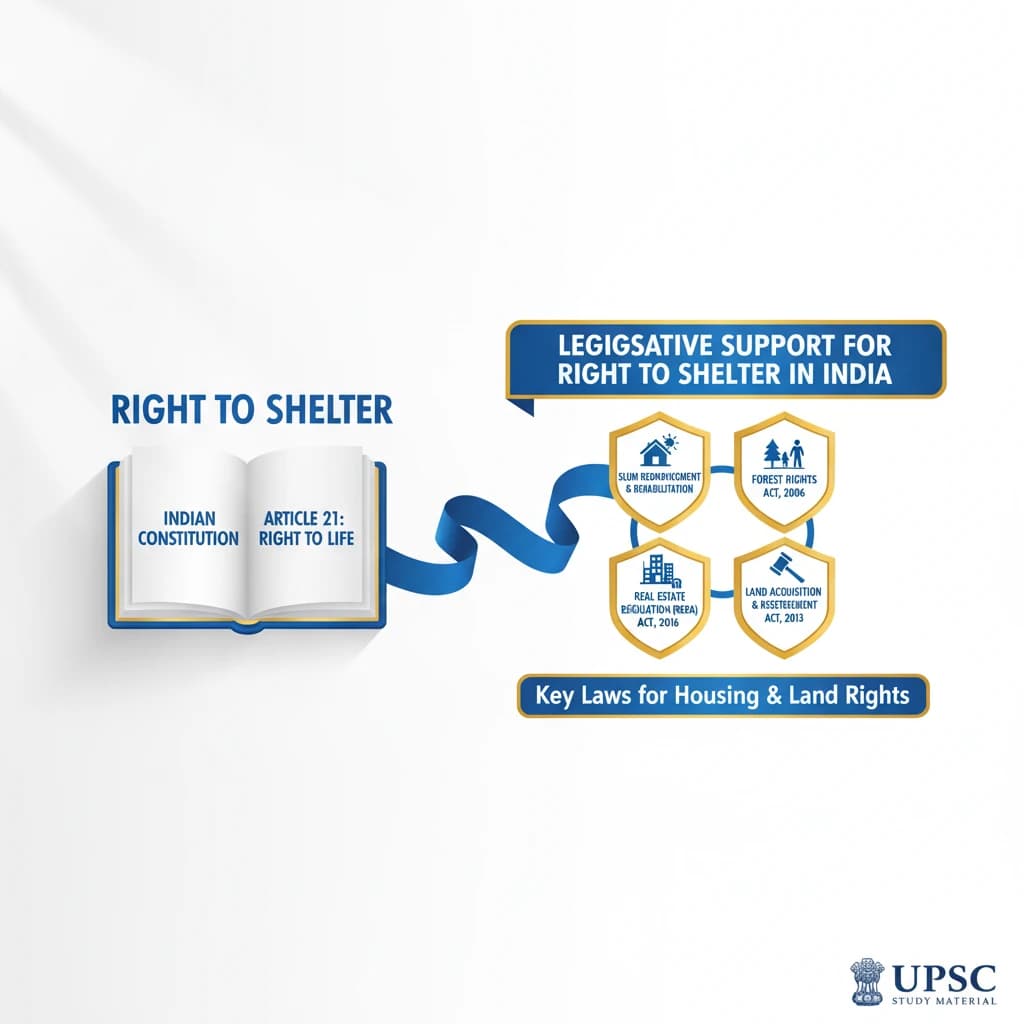
What Laws are Made to Support the Right to Shelter in India?
Medium⏱️ 8 min read
social issues
📖 Introduction
Introduction to the Right to Shelter and Legislative Support
The Right to Shelter is a fundamental aspect of human dignity, implicitly derived from the Right to Life (Article 21) under the Indian Constitution. To operationalise this right, various legislative measures have been enacted.
These laws aim to address diverse challenges related to housing, including slum redevelopment, forest dwelling rights, real estate regulation, land acquisition, and tenancy disputes.
1. Slum Areas (Improvement and Clearance) Act, 1956
This pivotal act empowers the government to intervene in areas deemed unfit for human habitation. Its primary objective is to improve living conditions in urban informal settlements.
- Authorisation: The Act authorises the government to clear slum areas that pose significant health and safety risks.
- Redevelopment: It mandates the formulation of redevelopment plans to replace substandard housing with more durable and safer structures.
Understanding this Act is crucial for questions on urbanisation, social justice, and housing policies in India, especially in the context of slum rehabilitation programs.
2. The Scheduled Tribes and Other Traditional Forest Dwellers (Recognition of Forest Rights) Act, 2006 (FRA)
The Forest Rights Act (FRA) is a landmark legislation aimed at rectifying historical injustices faced by forest-dwelling communities. It recognises their inherent rights over forest land and resources.
- Habitation Rights: Provides the right to hold and live in forest land for individual or common occupation, for habitation or self-cultivation for livelihood.
- Resource Management: Recognises the rights of forest communities to use, manage, and protect forest resources, fostering sustainable living.
The FRA is vital for understanding the intersection of environmental law, tribal rights, and the right to shelter for vulnerable populations.
3. Real Estate (Regulation and Development) Act, 2016 (RERA)
The Real Estate (Regulation and Development) Act, 2016 (RERA) was enacted to bring much-needed transparency and accountability to the burgeoning real estate sector. It aims to protect the interests of homebuyers.
- Regulation: RERA regulates the real estate sector, ensuring projects are registered and adhere to strict timelines and quality standards.
- Consumer Protection: It safeguards homebuyers by mandating project registration and establishing a robust grievance redressal mechanism.
RERA is a key topic for GS Paper III (Economy), particularly concerning urban development, consumer protection, and the ease of doing business in India.
4. Right to Fair Compensation and Transparency in Land Acquisition, Rehabilitation and Resettlement Act, 2013 (LARR Act)
The LARR Act, 2013, replaced the archaic Land Acquisition Act of 1894, bringing a more humane and equitable approach to land acquisition. It prioritises the welfare of those displaced.
- Compensation: Includes detailed provisions for fair compensation for land acquired for public purposes.
- Rehabilitation and Resettlement: Ensures comprehensive resettlement and rehabilitation of families affected by land acquisition, including provision for housing support.
This Act is fundamental for understanding social impact assessments, inclusive development, and the protection of vulnerable groups during infrastructure projects.
5. Model Tenancy Act, 2021
The Model Tenancy Act, 2021, aims to overhaul the rental housing market in India, promoting a more balanced and transparent relationship between landlords and tenants. It addresses long-standing issues in the sector.
- Dispute Resolution: Seeks to establish a speedy adjudication mechanism for the resolution of landlord-tenant disputes.
- Regulation: Regulates the renting of premises and protects the interests of both landlords and tenants, fostering a formal rental market.
The Model Tenancy Act is relevant for urban governance, housing policy, and addressing the challenges of providing affordable rental housing in rapidly urbanising India.
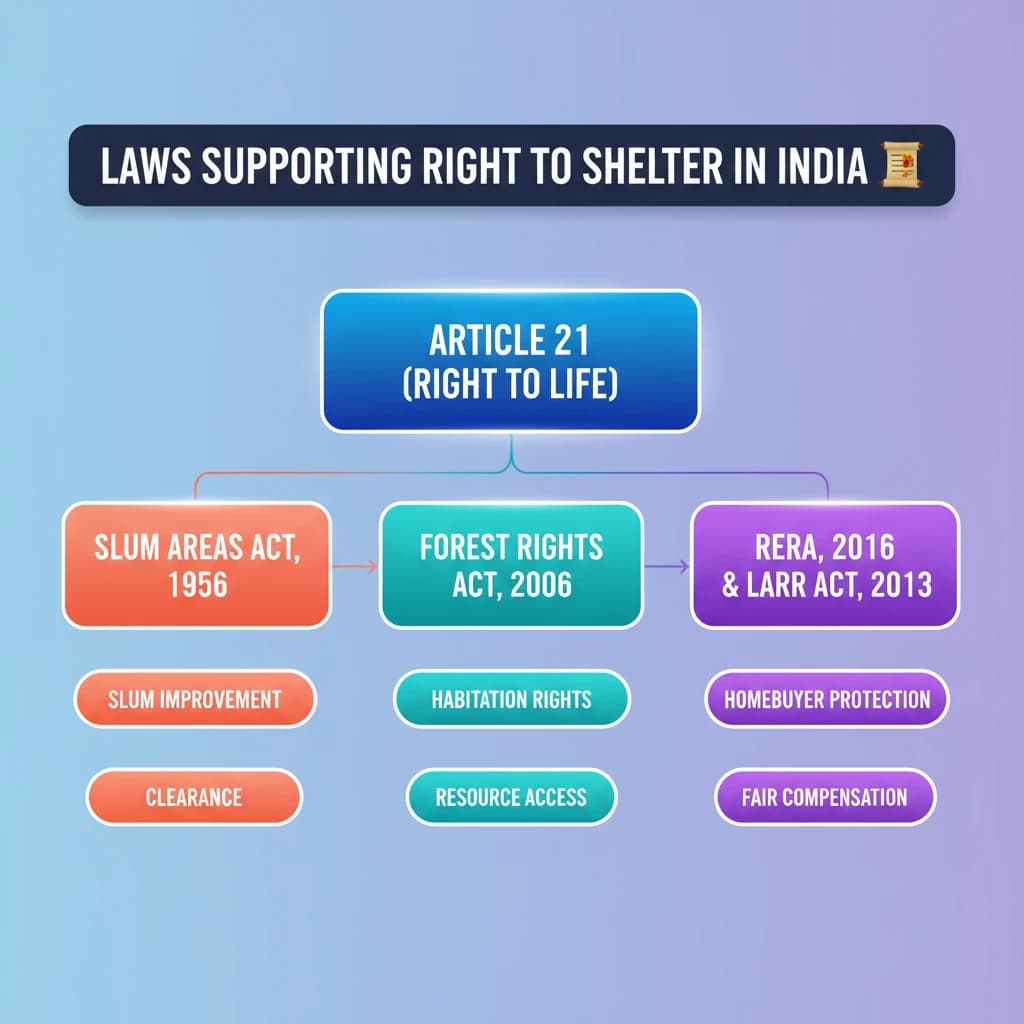
💡 Key Takeaways
- •Right to Shelter is implicitly derived from Article 21 (Right to Life) of the Indian Constitution.
- •The Slum Areas Act, 1956, enables government intervention for slum improvement and clearance.
- •The Forest Rights Act, 2006, recognises habitation and resource rights of forest-dwelling communities.
- •RERA, 2016, regulates the real estate sector for transparency and protects homebuyers' interests.
- •The LARR Act, 2013, ensures fair compensation and rehabilitation for land acquisition-affected families.
- •The Model Tenancy Act, 2021, aims to formalise and streamline the rental housing market.
🧠 Memory Techniques
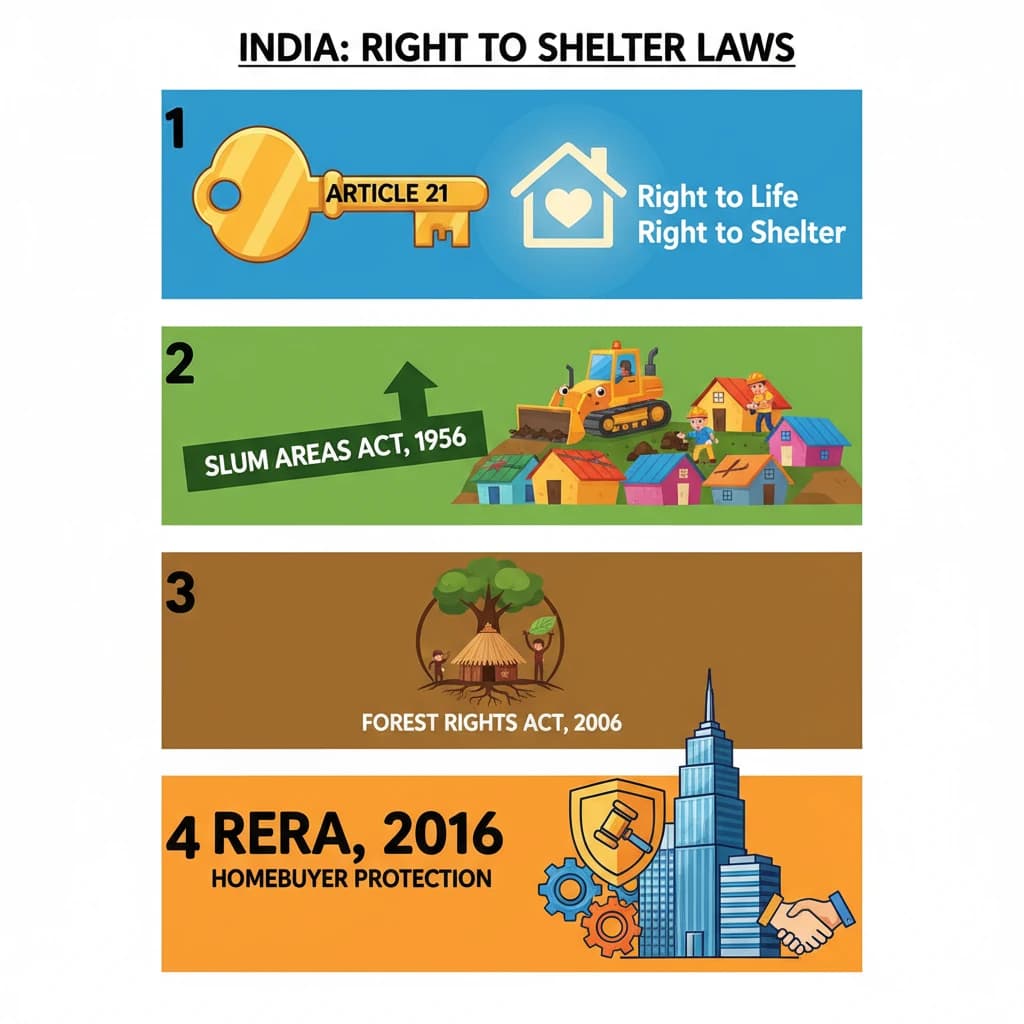
98% Verified Content
📚 Reference Sources
•The Constitution of India (Article 21, Article 19(1)(e), Article 38, Article 39)
•Slum Areas (Improvement and Clearance) Act, 1956
•The Scheduled Tribes and Other Traditional Forest Dwellers (Recognition of Forest Rights) Act, 2006
•Real Estate (Regulation and Development) Act, 2016
•Right to Fair Compensation and Transparency in Land Acquisition, Rehabilitation and Resettlement Act, 2013
•Model Tenancy Act, 2021