Loading page, please wait…
WHO Response and Goals - UPSC Social Issues
What is WHO Response and Goals in UPSC Social Issues?
WHO Response and Goals is a key topic under Social Issues for UPSC Civil Services Examination. Key points include: WHO's LF elimination strategy focuses on MDA, Morbidity Management, and Vector Control.. Mass Drug Administration (MDA) reduces microfilariae density and interrupts transmission.. Morbidity Management and Disability Prevention (MMDP) addresses chronic LF manifestations like hydrocele and lymphoedema.. Understanding this topic is essential for both UPSC Prelims and Mains preparation.
Why is WHO Response and Goals important for UPSC exam?
WHO Response and Goals is a Medium-level topic in UPSC Social Issues. It is tested in both Prelims (factual MCQs) and Mains (analytical answer writing). Previous year UPSC questions have frequently covered aspects of WHO Response and Goals, making it essential for comprehensive IAS preparation.
How to prepare WHO Response and Goals for UPSC?
To prepare WHO Response and Goals for UPSC: (1) Study the comprehensive notes covering all key concepts on Vaidra. (2) Practice previous year questions on this topic. (3) Connect it with current affairs using daily updates. (4) Revise using key takeaways and mind maps available for Social Issues. (5) Write practice answers linking WHO Response and Goals to related GS Paper topics.
Key takeaways of WHO Response and Goals for UPSC
- WHO's LF elimination strategy focuses on MDA, Morbidity Management, and Vector Control.
- Mass Drug Administration (MDA) reduces microfilariae density and interrupts transmission.
- Morbidity Management and Disability Prevention (MMDP) addresses chronic LF manifestations like hydrocele and lymphoedema.
- Global Programme to Eliminate Lymphatic Filariasis (GPELF) launched in 2000, leads global efforts.
- New GPELF goals for 2021–2030 include 80% validation, universal surveillance, and zero population needing MDA.
WHO Response and Goals
Medium⏱️ 8 min read
social issues
📖 Introduction
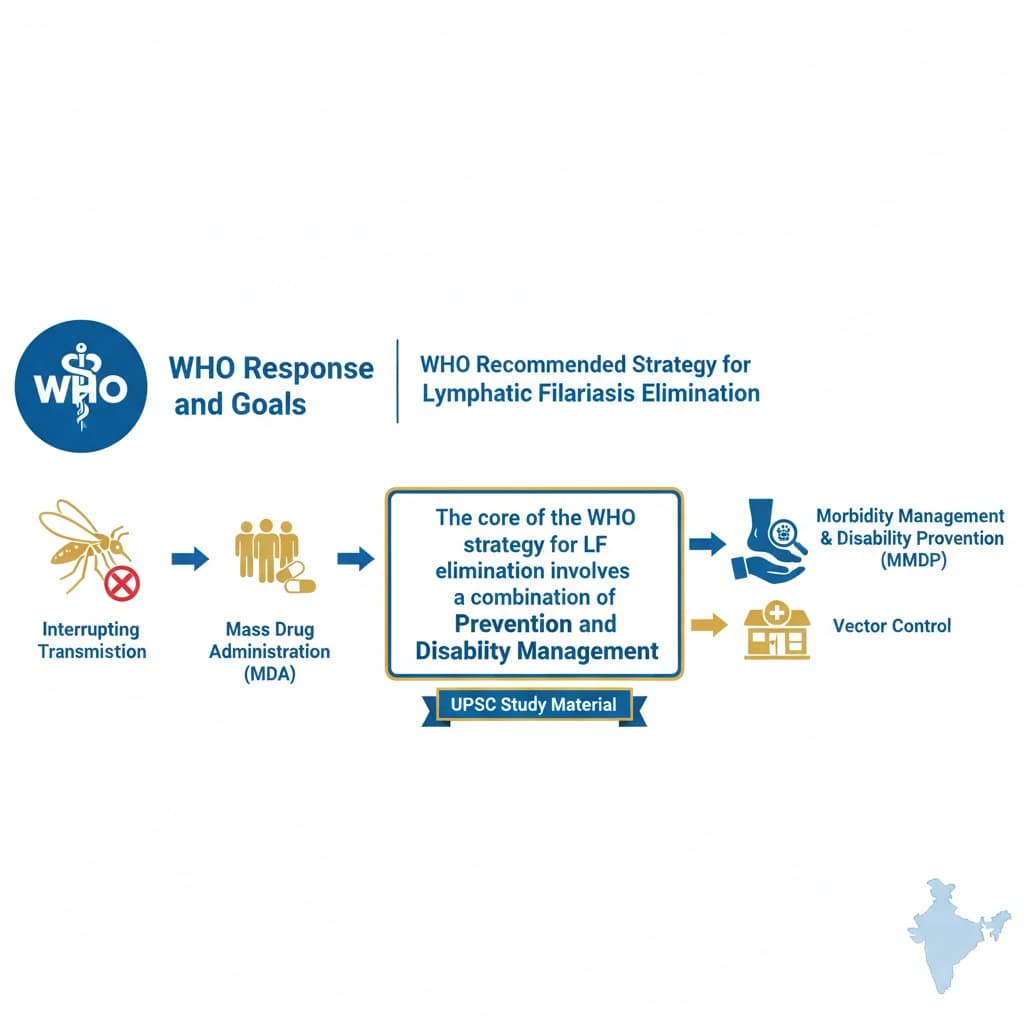
WHO Recommended Strategy for Lymphatic Filariasis Elimination
The World Health Organization (WHO) has outlined a comprehensive strategy aimed at the elimination of Lymphatic Filariasis (LF). This strategy is multi-pronged, focusing on interrupting transmission and managing the chronic manifestations of the disease.
The core of the WHO strategy for LF elimination involves a combination of Preventive Chemotherapy, Morbidity Management, and Vector Control.
Mass Drug Administration (MDA) Regimens
Mass Drug Administration (MDA) is a cornerstone of the preventive chemotherapy efforts. It involves administering anti-filarial drugs to entire populations at risk to reduce the presence of microfilariae in the blood.
Different drug regimens are recommended by WHO. These recommendations are primarily based on the co-endemicity of Lymphatic Filariasis with other filarial diseases in a particular region.
The primary goal of MDA regimens is to significantly reduce the microfilariae density within the population. This reduction is crucial for interrupting the disease transmission cycle.
Morbidity Management and Disability Prevention (MMDP)
Beyond preventing new infections, managing the existing chronic manifestations of Lymphatic Filariasis is vital. This aspect of the strategy is known as Morbidity Management and Disability Prevention (MMDP).
Effective MMDP includes a range of interventions. These are designed to alleviate suffering, prevent disease progression, and improve the quality of life for affected individuals.
- Surgery: Essential for conditions like hydrocele, a common chronic manifestation of LF.
- Hygiene Measures: Crucial for preventing secondary bacterial infections in limbs affected by lymphoedema.
- Clinical Care: Provides ongoing support and management for various chronic symptoms.
Vector Control Strategies
Vector control serves as a supplementary but important strategy in the overall elimination efforts. It targets the mosquitoes responsible for transmitting the filarial parasites.
Strategies such as mosquito control help to reduce the population of disease-carrying vectors. This complements the primary preventive chemotherapy efforts by further reducing the chances of transmission.
Global Programme to Eliminate Lymphatic Filariasis (GPELF)
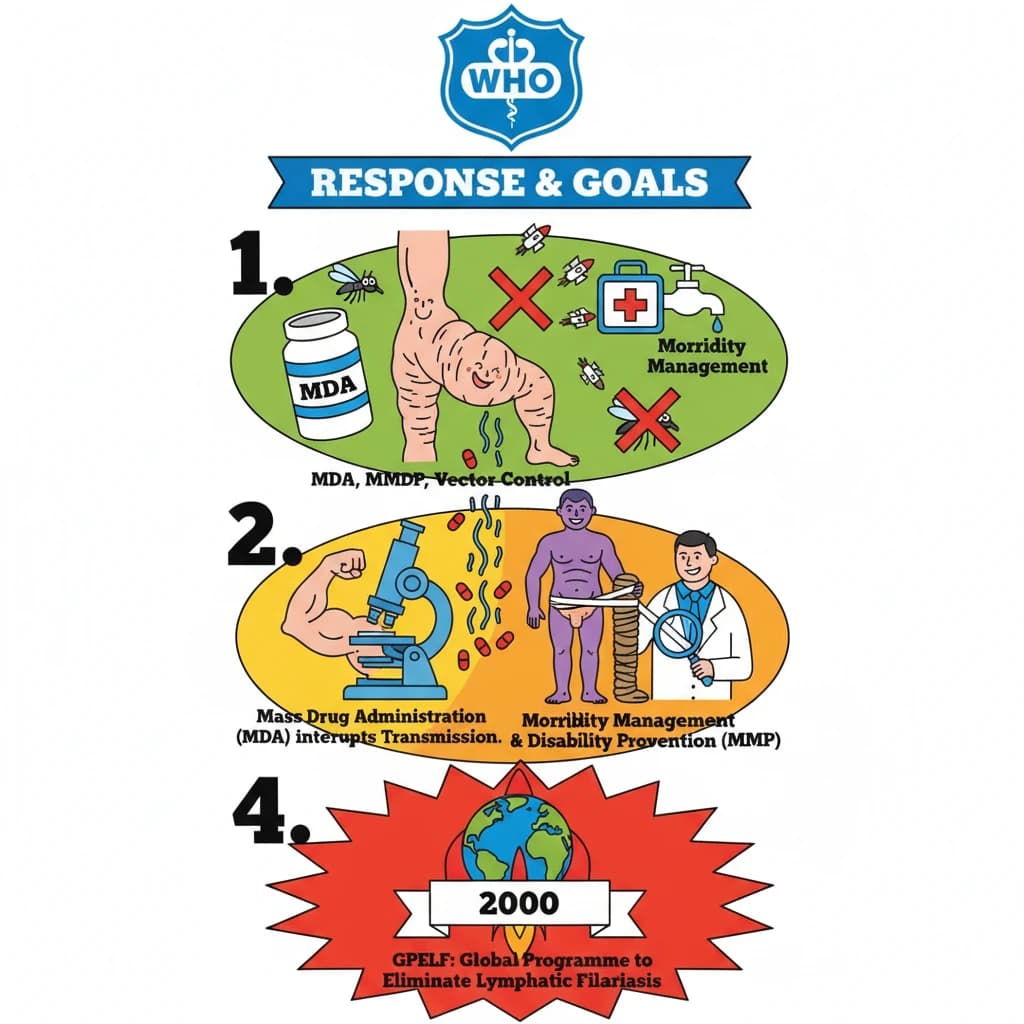
The Global Programme to Eliminate Lymphatic Filariasis (GPELF) is the overarching framework guiding global efforts. It was officially launched by WHO in 2000.
GPELF aims to eliminate Lymphatic Filariasis as a public health problem worldwide. Its twin pillars are preventive chemotherapy (MDA) and morbidity management.
GPELF Goals for the New NTD Road Map (2021–2030)
In 2020, the GPELF established updated goals. These are part of the broader WHO NTD Road Map for 2021–2030, setting ambitious targets for the coming decade.
Understanding these specific targets is crucial for UPSC. They demonstrate WHO's commitment and the global public health agenda, relevant for GS Paper 2 (Health).
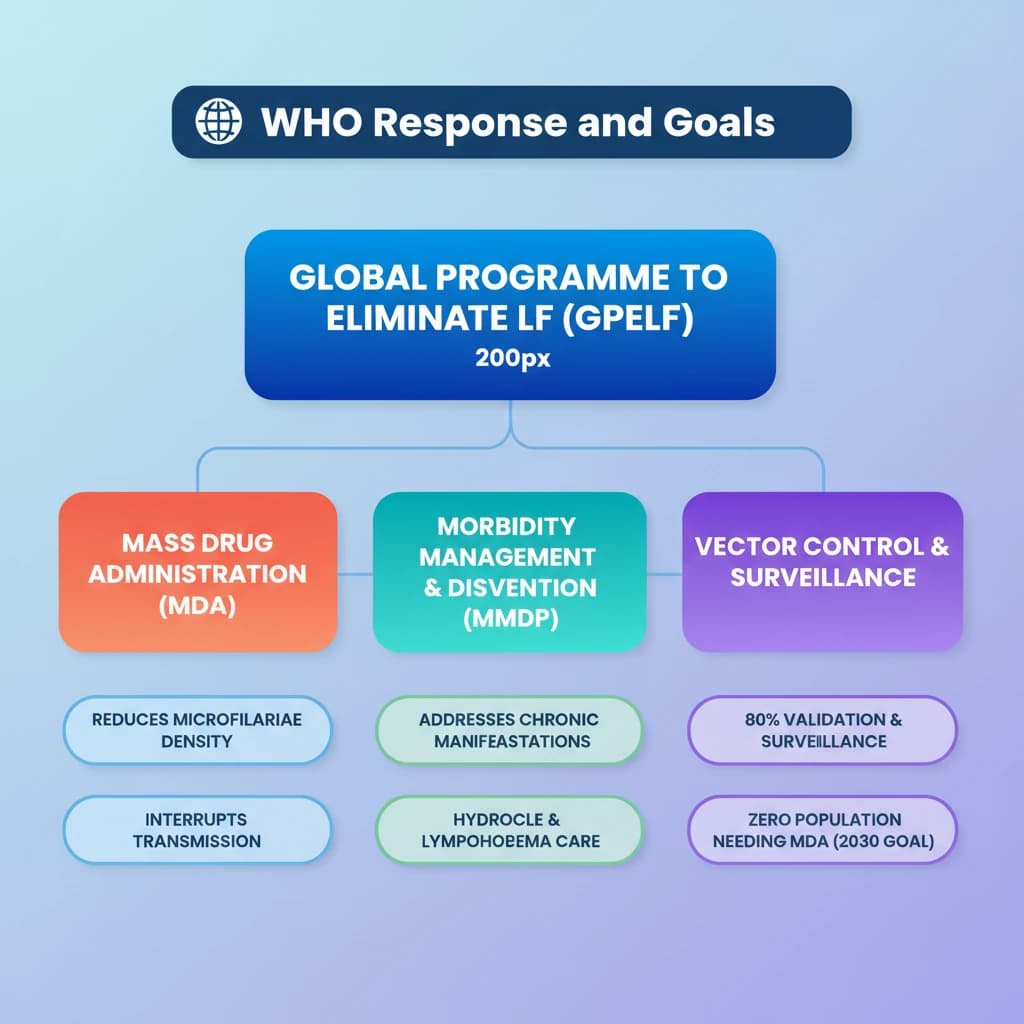
- Validation Target: To achieve validation of elimination in 80% of endemic countries (58 countries). This involves maintaining low infection rates even after stopping MDA.
- Surveillance Implementation: All 72 endemic countries are targeted to implement robust surveillance systems. This is vital to prevent any resurgence of the disease post-elimination efforts.
- MDA Reduction Goal: The ultimate aim is to reach a point where zero population requires mass drug administration for Lymphatic Filariasis.
💡 Key Takeaways
- •WHO's LF elimination strategy focuses on MDA, Morbidity Management, and Vector Control.
- •Mass Drug Administration (MDA) reduces microfilariae density and interrupts transmission.
- •Morbidity Management and Disability Prevention (MMDP) addresses chronic LF manifestations like hydrocele and lymphoedema.
- •Global Programme to Eliminate Lymphatic Filariasis (GPELF) launched in 2000, leads global efforts.
- •New GPELF goals for 2021–2030 include 80% validation, universal surveillance, and zero population needing MDA.
🧠 Memory Techniques
98% Verified Content
📚 Reference Sources
•World Health Organization (WHO) official documents on Lymphatic Filariasis and Neglected Tropical Diseases (NTDs)
•WHO NTD Road Map 2021–2030