Loading page, please wait…
World Food Day 2024 - UPSC Social Issues
What is World Food Day 2024 in UPSC Social Issues?
World Food Day 2024 is a key topic under Social Issues for UPSC Civil Services Examination. Key points include: World Food Day is observed annually on October 16th, commemorating the establishment of the FAO.. The 2024 theme is 'Right to Food for a Better Life and a Better Future', emphasizing food as a human right.. The 'Right to Food' is recognized by the Universal Declaration of Human Rights (1948).. Understanding this topic is essential for both UPSC Prelims and Mains preparation.
Why is World Food Day 2024 important for UPSC exam?
World Food Day 2024 is a Medium-level topic in UPSC Social Issues. It is tested in both Prelims (factual MCQs) and Mains (analytical answer writing). Previous year UPSC questions have frequently covered aspects of World Food Day 2024, making it essential for comprehensive IAS preparation.
How to prepare World Food Day 2024 for UPSC?
To prepare World Food Day 2024 for UPSC: (1) Study the comprehensive notes covering all key concepts on Vaidra. (2) Practice previous year questions on this topic. (3) Connect it with current affairs using daily updates. (4) Revise using key takeaways and mind maps available for Social Issues. (5) Write practice answers linking World Food Day 2024 to related GS Paper topics.
Key takeaways of World Food Day 2024 for UPSC
- World Food Day is observed annually on October 16th, commemorating the establishment of the FAO.
- The 2024 theme is 'Right to Food for a Better Life and a Better Future', emphasizing food as a human right.
- The 'Right to Food' is recognized by the Universal Declaration of Human Rights (1948).
- WWF's Living Planet Report praised India's food consumption as the most sustainable among G20 nations.
- India has robust food security initiatives including NFSA 2013, PMGKAY, PM POSHAN, and Antyodaya Anna Yojana.
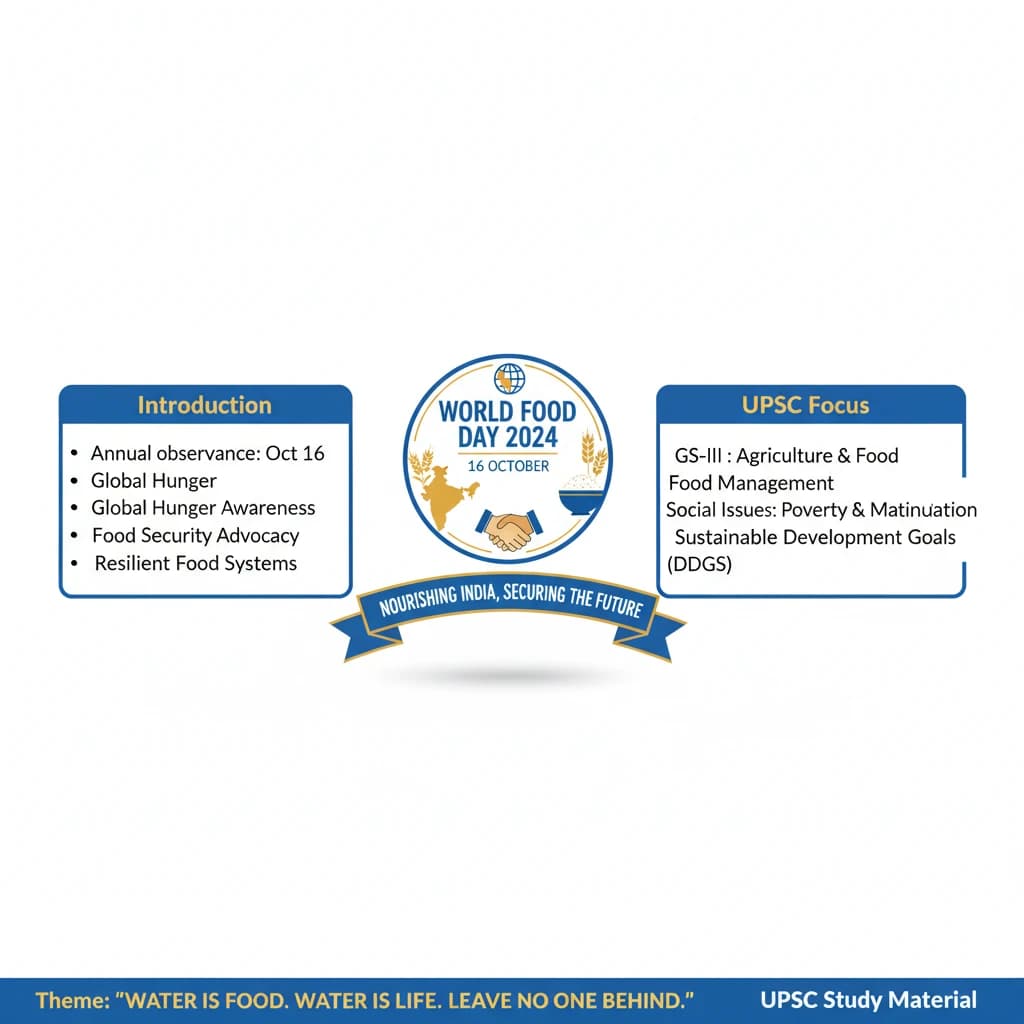
World Food Day 2024
Medium⏱️ 8 min read
social issues
📖 Introduction
Introduction to World Food Day 2024
World Food Day is an annual observance that takes place on October 16th. It serves as a crucial platform to raise awareness about the pressing global issues of hunger, food security, and the urgent need to build more resilient global food systems.
Date Observed: 16th October annually
Primary Focus: Eradicating hunger and establishing robust global food systems.
Theme for 2024: A Call to Action
Each year, World Food Day is centered around a specific theme to highlight a particular aspect of food security. The designated theme for 2024 emphasizes the fundamental right to adequate nourishment.
Theme for 2024: Right to Food for a Better Life and a Better Future.
Historical Genesis and Significance
The observance of World Food Day commemorates a pivotal moment in international cooperation. It marks the establishment of a key United Nations agency dedicated to food and agriculture.
- Founding of FAO: World Food Day celebrates the founding of the Food and Agriculture Organization (FAO) by the United Nations on October 16th, 1945.
- Establishment of World Food Day: The concept of World Food Day was officially established in 1979 during the FAO’s 20th General Conference.
- UN Endorsement: The United Nations General Assembly formally endorsed the observance of World Food Day in 1984, solidifying its global recognition.
The Right to Food: A Fundamental Human Right
The principle that every individual has a right to adequate food is a cornerstone of international human rights law. This right is explicitly recognized in a landmark global declaration.
The Right to Food is formally recognized and enshrined within the Universal Declaration of Human Rights (UDHR) 1948.
India's Exemplary Food Consumption Pattern
India has received significant international recognition for its sustainable approach to food consumption. A prominent global report highlighted India's practices as a model for other nations.
The WWF’s Living Planet Report specifically praised India’s food consumption pattern as the most sustainable among all G20 countries.
The report further illustrated the potential global impact if India's consumption patterns were widely adopted. This finding underscores the importance of sustainable practices for planetary health.
Global Impact: If the global population were to adopt India’s consumption patterns, only 0.84 Earths would be required by 2050 to sustain global food production.
India's Commitment to Food Security: Key Initiatives
India demonstrates a strong and continuous commitment to ensuring food security for its vast population through a range of comprehensive policies and welfare schemes. These initiatives aim to provide access to nutritious food and stabilize commodity prices.
- National Food Security Act (NFSA), 2013: A landmark act providing legal entitlement to food.
- Pradhan Mantri Garib Kalyan Anna Yojana (PMGKAY): A special scheme providing free food grains during crises.
- PM POSHAN Scheme: Focused on improving nutritional outcomes for school children.
- Antyodaya Anna Yojana (AAY): Aims to provide highly subsidized food grains to the poorest of the poor families.
- Rice Fortification: Enhancing the nutritional content of rice to combat micronutrient deficiencies.
- Price Stabilization Fund (PSF): Designed to manage the stock availability and moderate prices of essential commodities.
UPSC Insight: Understanding these schemes is vital for GS-II (Social Justice) and GS-III (Economy). Be prepared to discuss their objectives, impact, and challenges in promoting food security and nutritional well-being.
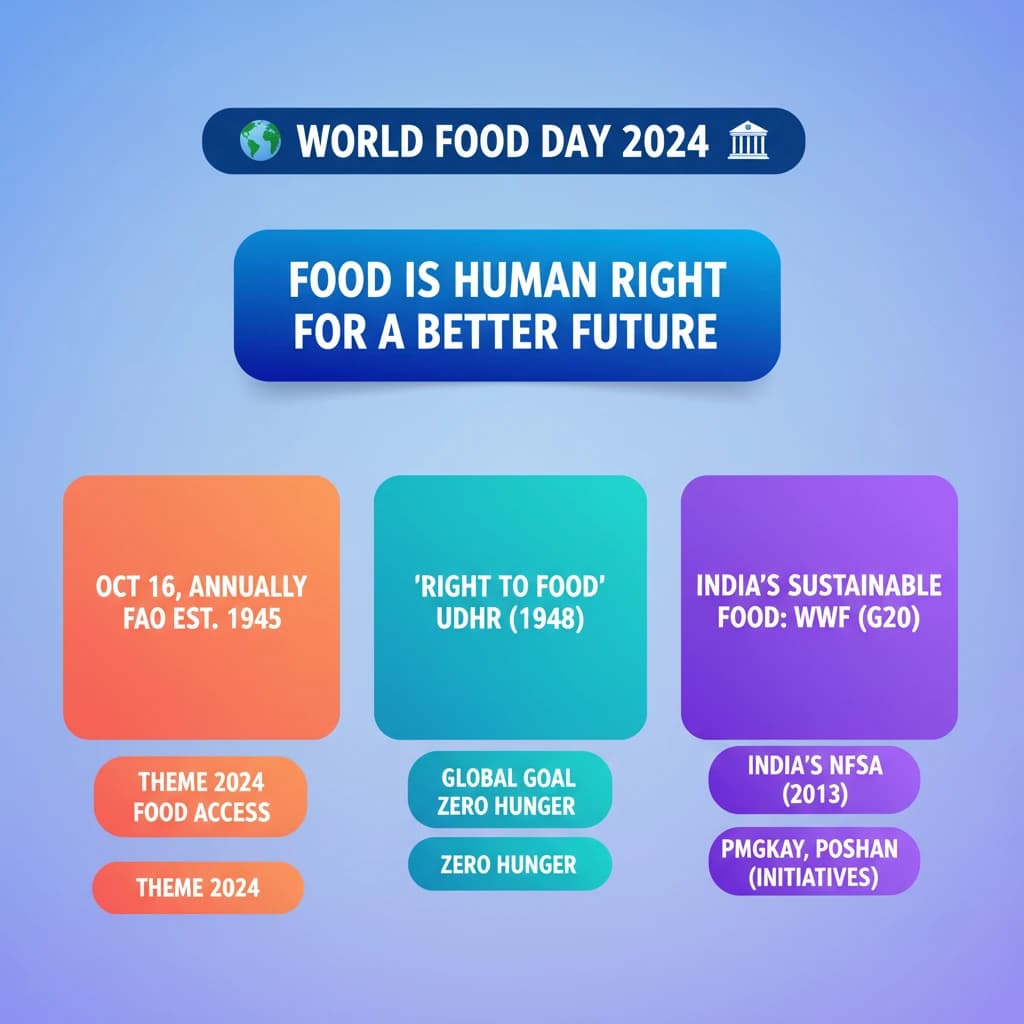
💡 Key Takeaways
- •World Food Day is observed annually on October 16th, commemorating the establishment of the FAO.
- •The 2024 theme is 'Right to Food for a Better Life and a Better Future', emphasizing food as a human right.
- •The 'Right to Food' is recognized by the Universal Declaration of Human Rights (1948).
- •WWF's Living Planet Report praised India's food consumption as the most sustainable among G20 nations.
- •India has robust food security initiatives including NFSA 2013, PMGKAY, PM POSHAN, and Antyodaya Anna Yojana.
🧠 Memory Techniques
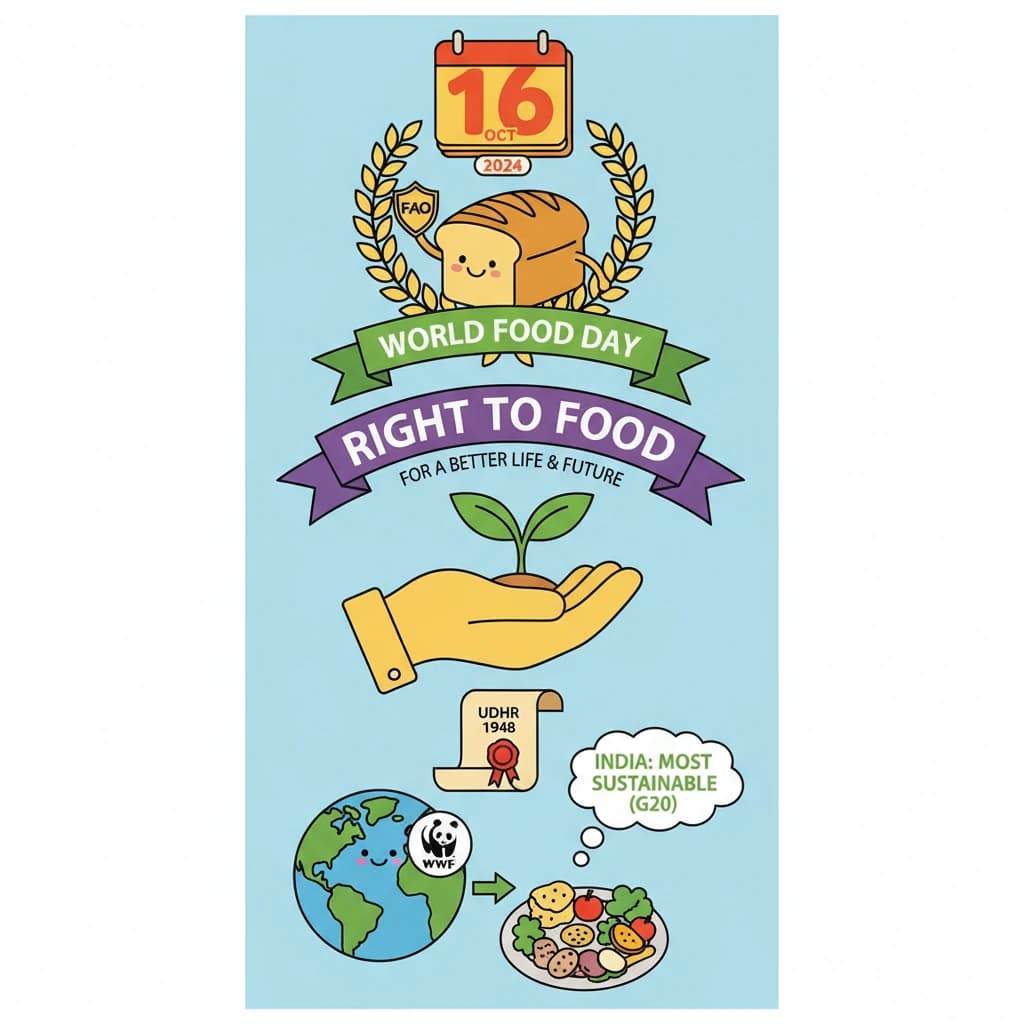
98% Verified Content
📚 Reference Sources
•Food and Agriculture Organization (FAO) official website
•United Nations official website (for UDHR and UN General Assembly endorsements)
•WWF Living Planet Report (general reference for India's consumption pattern)