Loading page, please wait…
Government Initiatives and Technological Interventions - UPSC Agriculture Allied Sector
What is Government Initiatives and Technological Interventions in UPSC Agriculture Allied Sector?
Government Initiatives and Technological Interventions is a key topic under Agriculture Allied Sector for UPSC Civil Services Examination. Key points include: Viksit Bharat Sankalp Yatra is a nationwide campaign for welfare scheme saturation.. It successfully added 34 lakh farmers to the PM-Kisan beneficiary list.. PM-Kisan provides Rs 6000 annually to land-holding farmers via Direct Benefit Transfer (DBT).. Understanding this topic is essential for both UPSC Prelims and Mains preparation.
Why is Government Initiatives and Technological Interventions important for UPSC exam?
Government Initiatives and Technological Interventions is a Medium-level topic in UPSC Agriculture Allied Sector. It is tested in both Prelims (factual MCQs) and Mains (analytical answer writing). Previous year UPSC questions have frequently covered aspects of Government Initiatives and Technological Interventions, making it essential for comprehensive IAS preparation.
How to prepare Government Initiatives and Technological Interventions for UPSC?
To prepare Government Initiatives and Technological Interventions for UPSC: (1) Study the comprehensive notes covering all key concepts on Vaidra. (2) Practice previous year questions on this topic. (3) Connect it with current affairs using daily updates. (4) Revise using key takeaways and mind maps available for Agriculture Allied Sector. (5) Write practice answers linking Government Initiatives and Technological Interventions to related GS Paper topics.
Key takeaways of Government Initiatives and Technological Interventions for UPSC
- Viksit Bharat Sankalp Yatra is a nationwide campaign for welfare scheme saturation.
- It successfully added 34 lakh farmers to the PM-Kisan beneficiary list.
- PM-Kisan provides Rs 6000 annually to land-holding farmers via Direct Benefit Transfer (DBT).
- PM-Kisan is a Central Sector Scheme implemented by the Ministry of Agriculture and Farmers Welfare.
- MGNREGA guarantees 100 days of employment to rural households willing to do unskilled manual work.
- Technological interventions in MGNREGA aim for efficiency but have raised concerns about beneficiary exclusion.
- Both schemes are vital for rural welfare, financial inclusion, and livelihood security.
Government Initiatives and Technological Interventions
Medium⏱️ 8 min read
agriculture allied sector
📖 Introduction
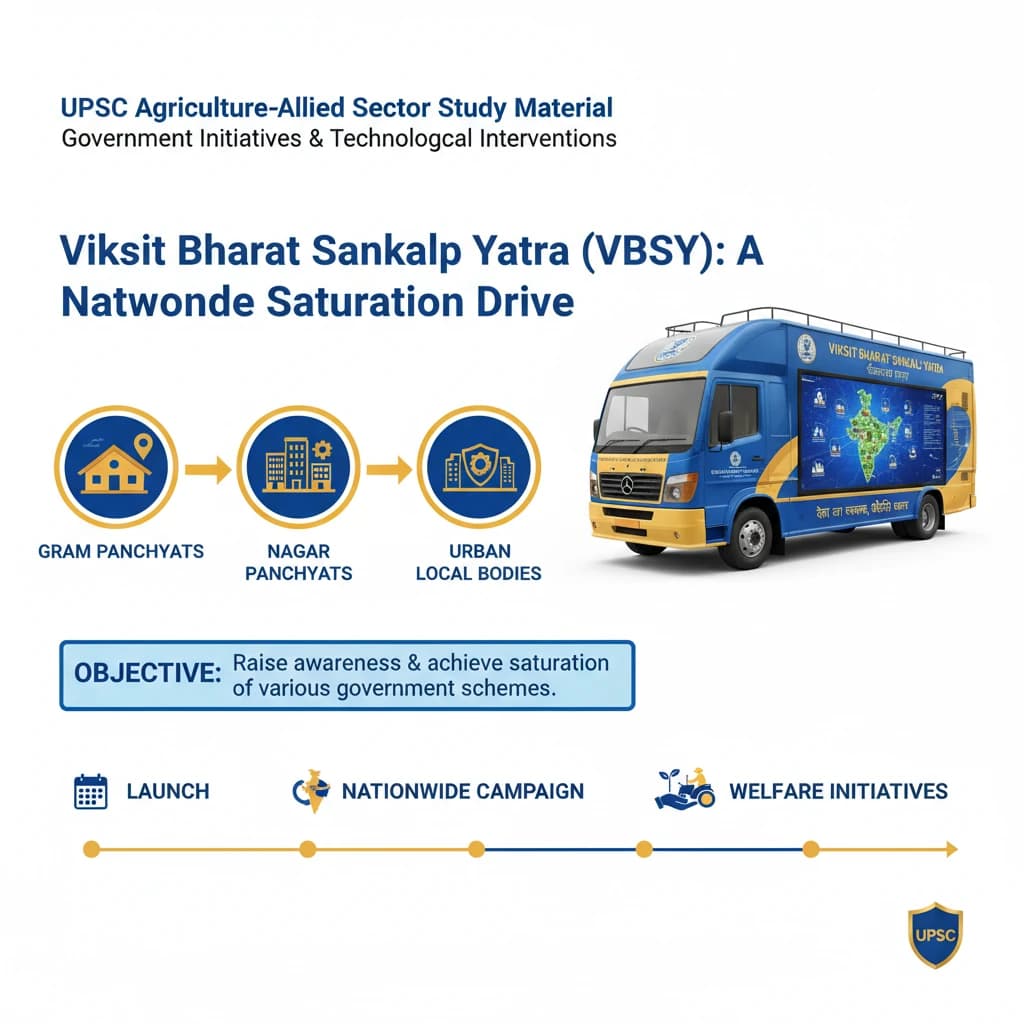
Viksit Bharat Sankalp Yatra (VBSY): A Nationwide Saturation Drive
The Viksit Bharat Sankalp Yatra is a nationwide campaign launched by the Government of India. Its primary objective is to raise awareness and achieve saturation of various government schemes across the country.
The campaign covers all Gram Panchayats, Nagar Panchayats, and Urban Local Bodies, ensuring a wide reach for welfare initiatives.
Objectives of VBSY:
- To reach out to vulnerable individuals eligible under various schemes.
- To disseminate information and generate awareness about government programs.
- To facilitate interaction with existing beneficiaries and enroll potential new ones.
A significant outcome of this "saturation drive" has been the addition of 34 lakh farmers back to the list of beneficiaries for the Pradhan Mantri Kisan Samman Nidhi (PM-Kisan) scheme.
Pradhan Mantri Kisan Samman Nidhi (PM-Kisan) Scheme
The PM-Kisan scheme was launched to supplement the financial needs of land-holding farmers across India. It became operational from December 2018.
Financial Benefits:
- A financial benefit of Rs 6000/- per year is provided.
- This amount is transferred in three equal installments (Rs 2000 each) every four months.
- Funds are transferred directly into the bank accounts of farmers’ families through Direct Benefit Transfer (DBT) mode.
Initially, the scheme was designed for Small and Marginal Farmers (SMFs) having landholding up to 2 hectares. However, its scope was later extended to cover all land-holding farmers, broadening its impact.
Funding and Implementation:
- Funding: It is a Central Sector Scheme, with 100% funding from the Government of India.
- Implementation Agency: The scheme is implemented by the Ministry of Agriculture and Farmers Welfare.
To ensure the integrity and accuracy of the beneficiary list, a mandatory physical verification of 5% of beneficiaries is conducted every year.
Technological Interventions in MGNREGA
The Ministry of Rural Development has actively addressed concerns regarding the use of technology, particularly Aadhaar, within the Mahatma Gandhi National Rural Employment Guarantee Act (MGNREGA) Scheme.
These concerns primarily revolve around potential denial of welfare benefits to vulnerable Indians and delays in wage payments due to technological issues.
Mahatma Gandhi National Rural Employment Guarantee Scheme (MGNREGS)
The MGNREGS is one of the largest work guarantee programs globally, launched in 2005 by the Ministry of Rural Development.
Key Guarantee:
- It guarantees 100 days of employment each financial year.
- This guarantee is for adult members of rural households.
- Beneficiaries must be willing to perform unskilled manual work at the statutory minimum wage.
The entire implementation of the scheme is monitored by the Ministry of Rural Development in association with state governments.
Cornerstone Feature: Legal Guarantee
The design of MGNREGA is underpinned by its legal guarantee. This ensures that any rural adult requesting work must receive it within 15 days of application.
💡 Key Takeaways
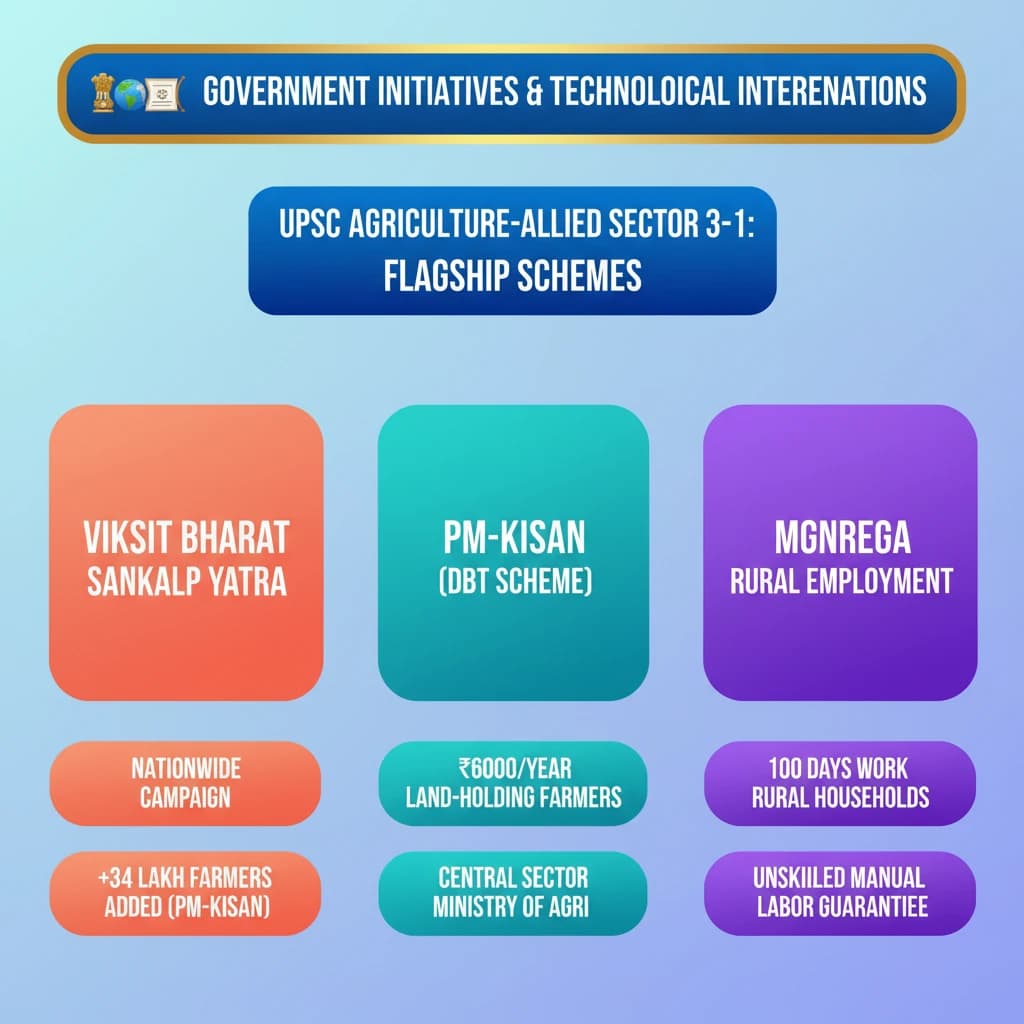
- •Viksit Bharat Sankalp Yatra is a nationwide campaign for welfare scheme saturation.
- •It successfully added 34 lakh farmers to the PM-Kisan beneficiary list.
- •PM-Kisan provides Rs 6000 annually to land-holding farmers via Direct Benefit Transfer (DBT).
- •PM-Kisan is a Central Sector Scheme implemented by the Ministry of Agriculture and Farmers Welfare.
- •MGNREGA guarantees 100 days of employment to rural households willing to do unskilled manual work.
- •Technological interventions in MGNREGA aim for efficiency but have raised concerns about beneficiary exclusion.
- •Both schemes are vital for rural welfare, financial inclusion, and livelihood security.
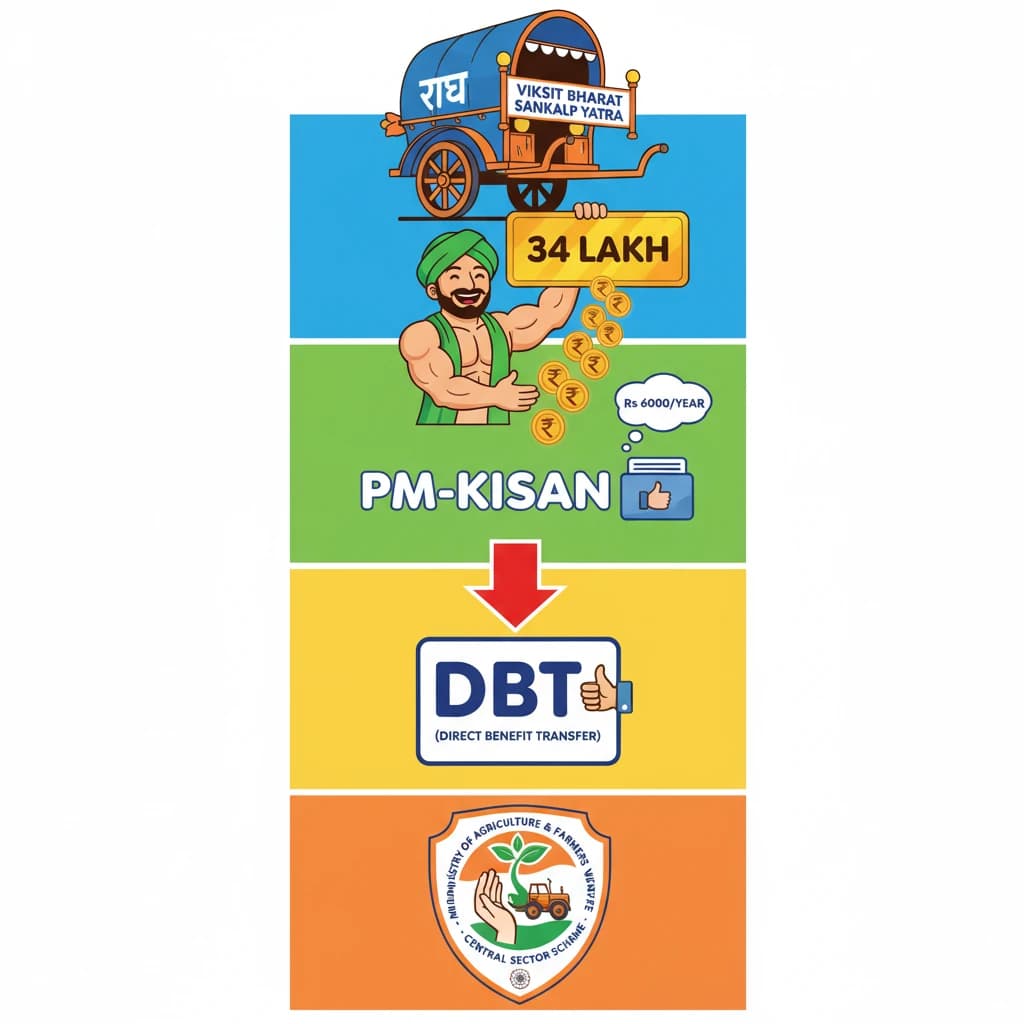
🧠 Memory Techniques
98% Verified Content
📚 Reference Sources
•Drishti IAS Summary: Technological Interventions and MGNREGA Scheme
•Ministry of Agriculture & Farmers Welfare (for PM-Kisan details)
•Ministry of Rural Development (for MGNREGA details)