Loading page, please wait…
South Asian Free Trade Area (SAFTA) agreement - UPSC Agriculture Allied Sector
What is South Asian Free Trade Area (SAFTA) agreement in UPSC Agriculture Allied Sector?
South Asian Free Trade Area (SAFTA) agreement is a key topic under Agriculture Allied Sector for UPSC Civil Services Examination. Key points include: SAFTA is a free trade agreement among SAARC nations, aiming for duty-free trade.. It came into effect in 2006, with goals to reduce tariffs to zero for member countries.. Duty-free import provisions allow goods meeting Rules of Origin to enter without customs duties.. Understanding this topic is essential for both UPSC Prelims and Mains preparation.
Why is South Asian Free Trade Area (SAFTA) agreement important for UPSC exam?
South Asian Free Trade Area (SAFTA) agreement is a Medium-level topic in UPSC Agriculture Allied Sector. It is tested in both Prelims (factual MCQs) and Mains (analytical answer writing). Previous year UPSC questions have frequently covered aspects of South Asian Free Trade Area (SAFTA) agreement , making it essential for comprehensive IAS preparation.
How to prepare South Asian Free Trade Area (SAFTA) agreement for UPSC?
To prepare South Asian Free Trade Area (SAFTA) agreement for UPSC: (1) Study the comprehensive notes covering all key concepts on Vaidra. (2) Practice previous year questions on this topic. (3) Connect it with current affairs using daily updates. (4) Revise using key takeaways and mind maps available for Agriculture Allied Sector. (5) Write practice answers linking South Asian Free Trade Area (SAFTA) agreement to related GS Paper topics.
Key takeaways of South Asian Free Trade Area (SAFTA) agreement for UPSC
- SAFTA is a free trade agreement among SAARC nations, aiming for duty-free trade.
- It came into effect in 2006, with goals to reduce tariffs to zero for member countries.
- Duty-free import provisions allow goods meeting Rules of Origin to enter without customs duties.
- Misuse involves exploiting these provisions, often by circumventing Rules of Origin or through illegal transshipment.
- Such misuse leads to revenue loss for governments and harms domestic industries.
- Effective enforcement of Rules of Origin and regional cooperation are crucial to prevent misuse.
- The issue highlights challenges in achieving genuine economic integration in South Asia.
South Asian Free Trade Area (SAFTA) agreement
Medium⏱️ 10 min read
agriculture allied sector
📖 Introduction
Introduction to SAFTA
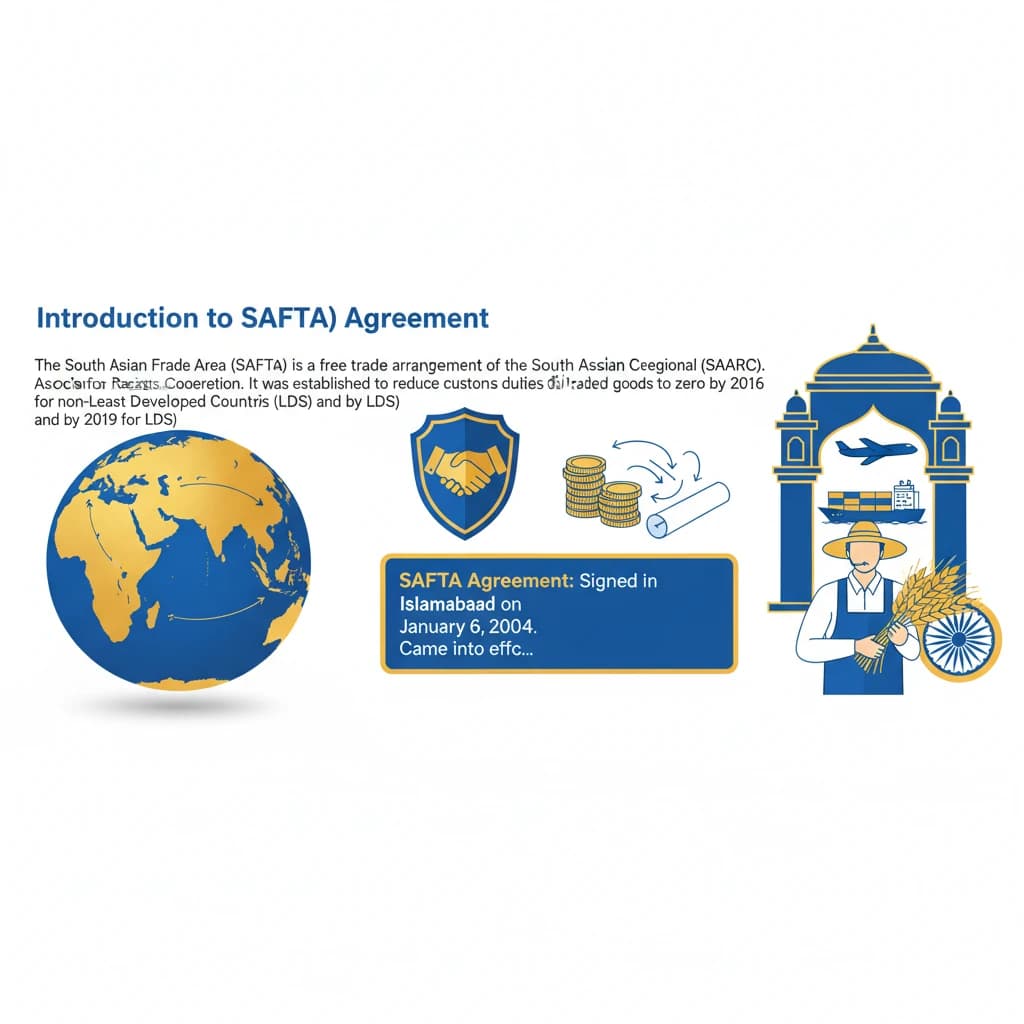
The South Asian Free Trade Area (SAFTA) is a free trade arrangement of the South Asian Association for Regional Cooperation (SAARC). It was established to reduce customs duties of all traded goods to zero by 2016 for non-Least Developed Countries (LDCs) and by 2019 for LDCs.
SAFTA Agreement: Signed in Islamabad on January 6, 2004.
Came into effect: January 1, 2006.
Member States: Afghanistan, Bangladesh, Bhutan, India, Maldives, Nepal, Pakistan, Sri Lanka.
Came into effect: January 1, 2006.
Member States: Afghanistan, Bangladesh, Bhutan, India, Maldives, Nepal, Pakistan, Sri Lanka.
Understanding Duty-Free Import Provisions
Duty-free import provisions under SAFTA mean that goods originating from member countries can be imported into other member countries without incurring customs duties. This aims to boost intra-regional trade and economic cooperation among SAARC nations.
The core idea is to eliminate trade barriers, making goods cheaper and more accessible across the region. This fosters economic integration and mutual benefit.
The Issue of Misuse of SAFTA's Provisions
The provided information highlights a concern regarding the misuse of SAFTA's duty-free import provisions. This implies that certain entities or practices are exploiting the agreement's benefits in ways unintended by its framers.
Such misuse can undermine the integrity of the trade agreement, distort regional trade patterns, and lead to revenue losses for member states. It often involves circumventing rules of origin or other regulatory frameworks.
When discussing SAFTA, UPSC often looks for a nuanced understanding, including its successes, failures, and challenges like misuse of provisions. Focus on how such issues impact regional cooperation and India's trade policy.
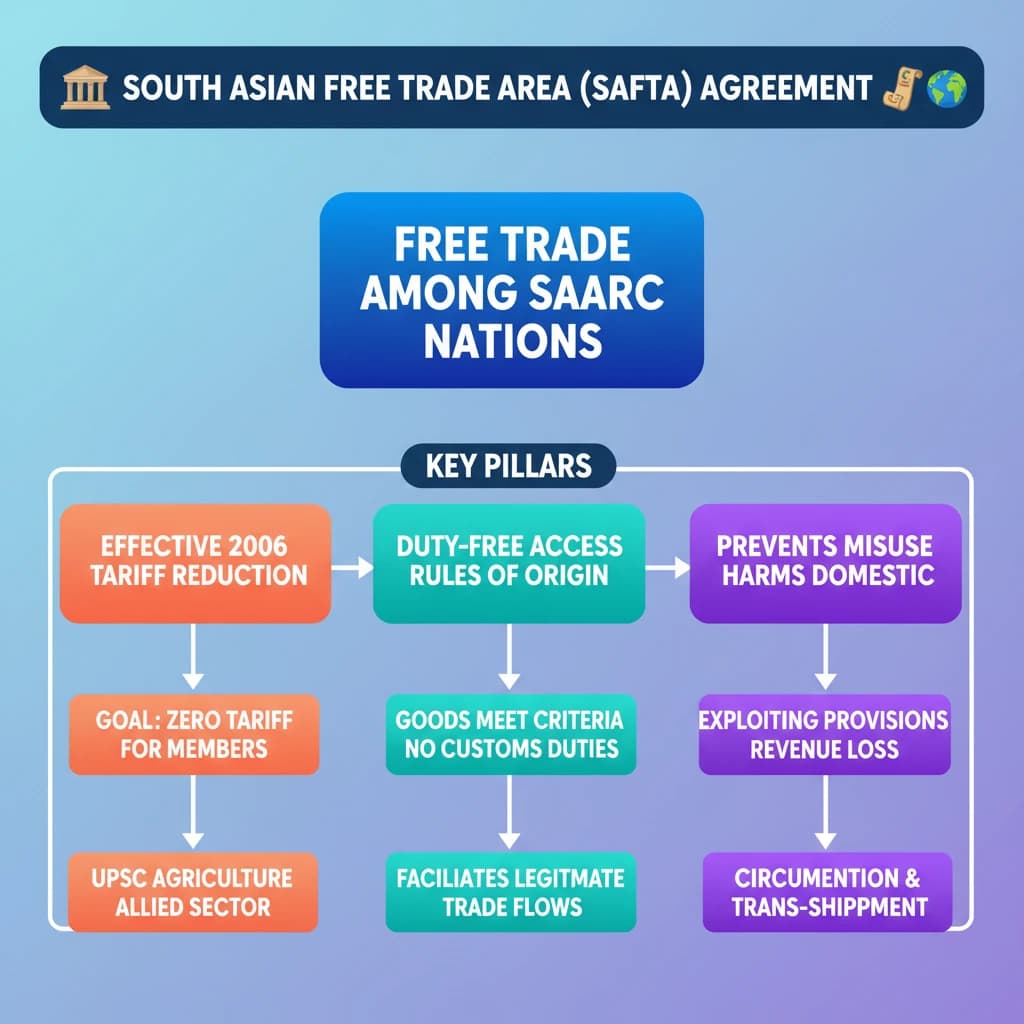
💡 Key Takeaways
- •SAFTA is a free trade agreement among SAARC nations, aiming for duty-free trade.
- •It came into effect in 2006, with goals to reduce tariffs to zero for member countries.
- •Duty-free import provisions allow goods meeting Rules of Origin to enter without customs duties.
- •Misuse involves exploiting these provisions, often by circumventing Rules of Origin or through illegal transshipment.
- •Such misuse leads to revenue loss for governments and harms domestic industries.
- •Effective enforcement of Rules of Origin and regional cooperation are crucial to prevent misuse.
- •The issue highlights challenges in achieving genuine economic integration in South Asia.
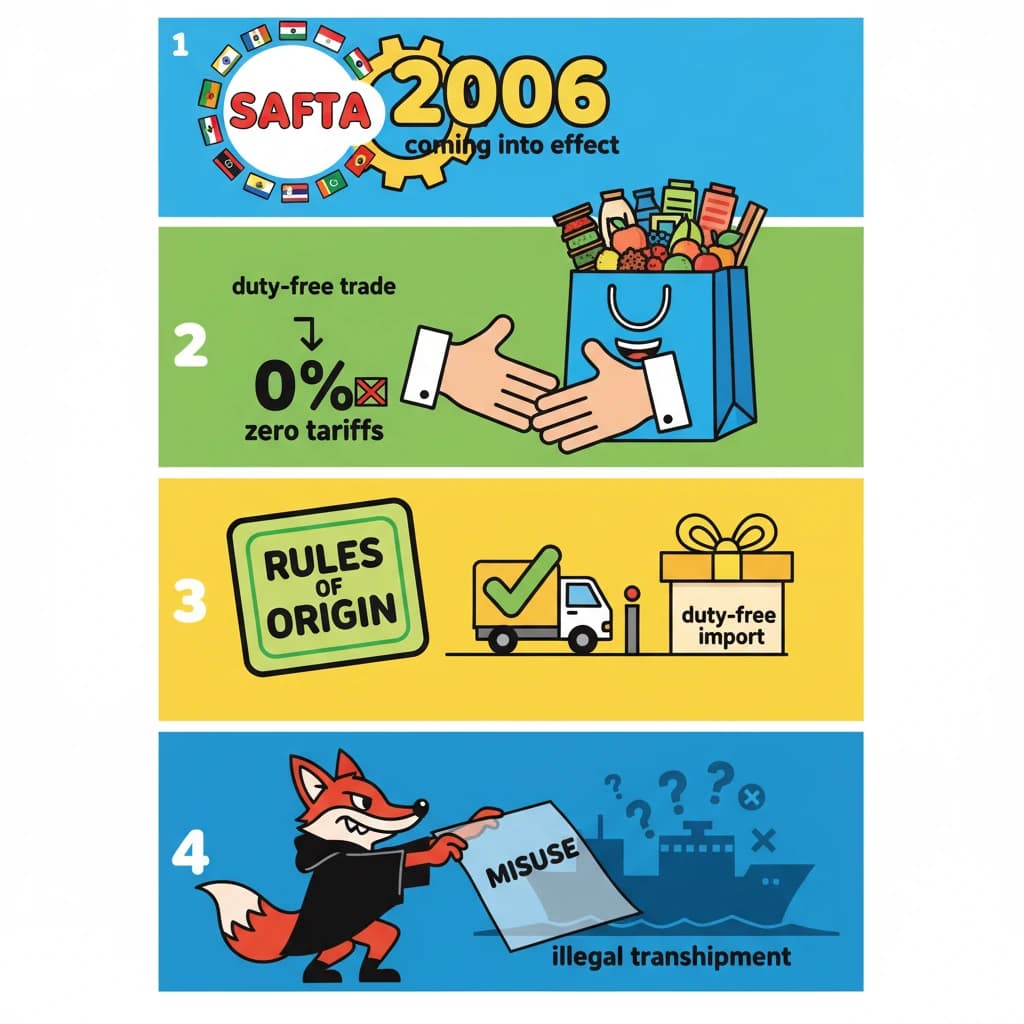
🧠 Memory Techniques
95% Verified Content
📚 Reference Sources
•Ministry of Commerce and Industry, Government of India Reports
•World Trade Organization (WTO) Publications on Regional Trade Agreements
•Economic Surveys of India (various years)
•Academic papers on South Asian economic integration