Loading page, please wait…
What are Agriculture Related Findings of Economic Survey 2024-25? - UPSC Agriculture Allied Sector
What is What are Agriculture Related Findings of Economic Survey 2024-25? in UPSC Agriculture Allied Sector?
What are Agriculture Related Findings of Economic Survey 2024-25? is a key topic under Agriculture Allied Sector for UPSC Civil Services Examination. Key points include: Indian agriculture grew 5% annually (2016-23), increasing its GVA share to 30.23% (2022-23).. Agricultural income saw 5.23% annual growth over the last decade.. Fisheries (13.67%) and Livestock (12.99%) were top-performing sectors.. Understanding this topic is essential for both UPSC Prelims and Mains preparation.
Why is What are Agriculture Related Findings of Economic Survey 2024-25? important for UPSC exam?
What are Agriculture Related Findings of Economic Survey 2024-25? is a Medium-level topic in UPSC Agriculture Allied Sector. It is tested in both Prelims (factual MCQs) and Mains (analytical answer writing). Previous year UPSC questions have frequently covered aspects of What are Agriculture Related Findings of Economic Survey 2024-25?, making it essential for comprehensive IAS preparation.
How to prepare What are Agriculture Related Findings of Economic Survey 2024-25? for UPSC?
To prepare What are Agriculture Related Findings of Economic Survey 2024-25? for UPSC: (1) Study the comprehensive notes covering all key concepts on Vaidra. (2) Practice previous year questions on this topic. (3) Connect it with current affairs using daily updates. (4) Revise using key takeaways and mind maps available for Agriculture Allied Sector. (5) Write practice answers linking What are Agriculture Related Findings of Economic Survey 2024-25? to related GS Paper topics.
Key takeaways of What are Agriculture Related Findings of Economic Survey 2024-25? for UPSC
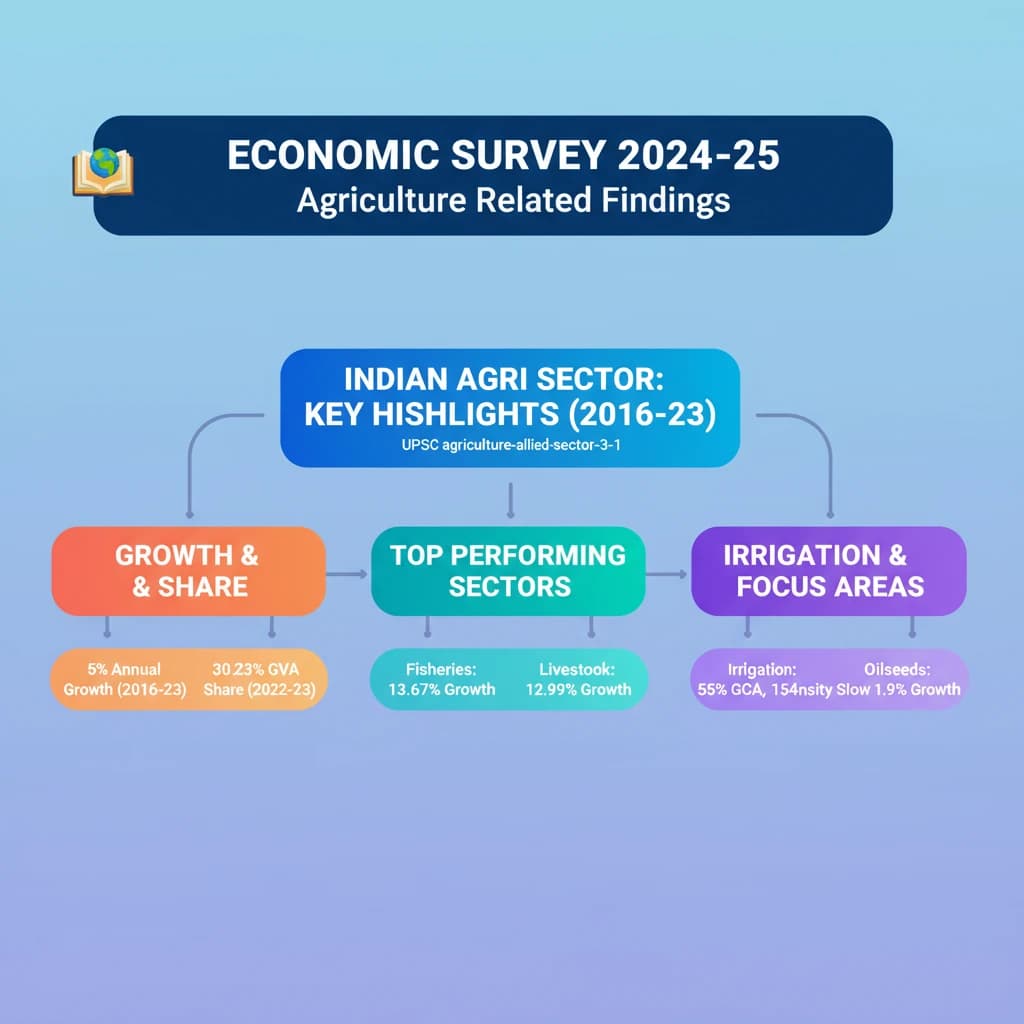
- Indian agriculture grew 5% annually (2016-23), increasing its GVA share to 30.23% (2022-23).
- Agricultural income saw 5.23% annual growth over the last decade.
- Fisheries (13.67%) and Livestock (12.99%) were top-performing sectors.
- Oilseeds sector showed slow growth at 1.9%, indicating a need for focus.
- Irrigation coverage increased to 55% of GCA, with intensity rising to 154.5%.
- Significant regional disparities exist in irrigation, with states like Jharkhand and Assam having very low coverage.
- The Economic Survey provides crucial data for understanding agricultural trends and policy implications.
What are Agriculture Related Findings of Economic Survey 2024-25?
Medium⏱️ 7 min read
agriculture allied sector
📖 Introduction
Agricultural Growth: An Overview
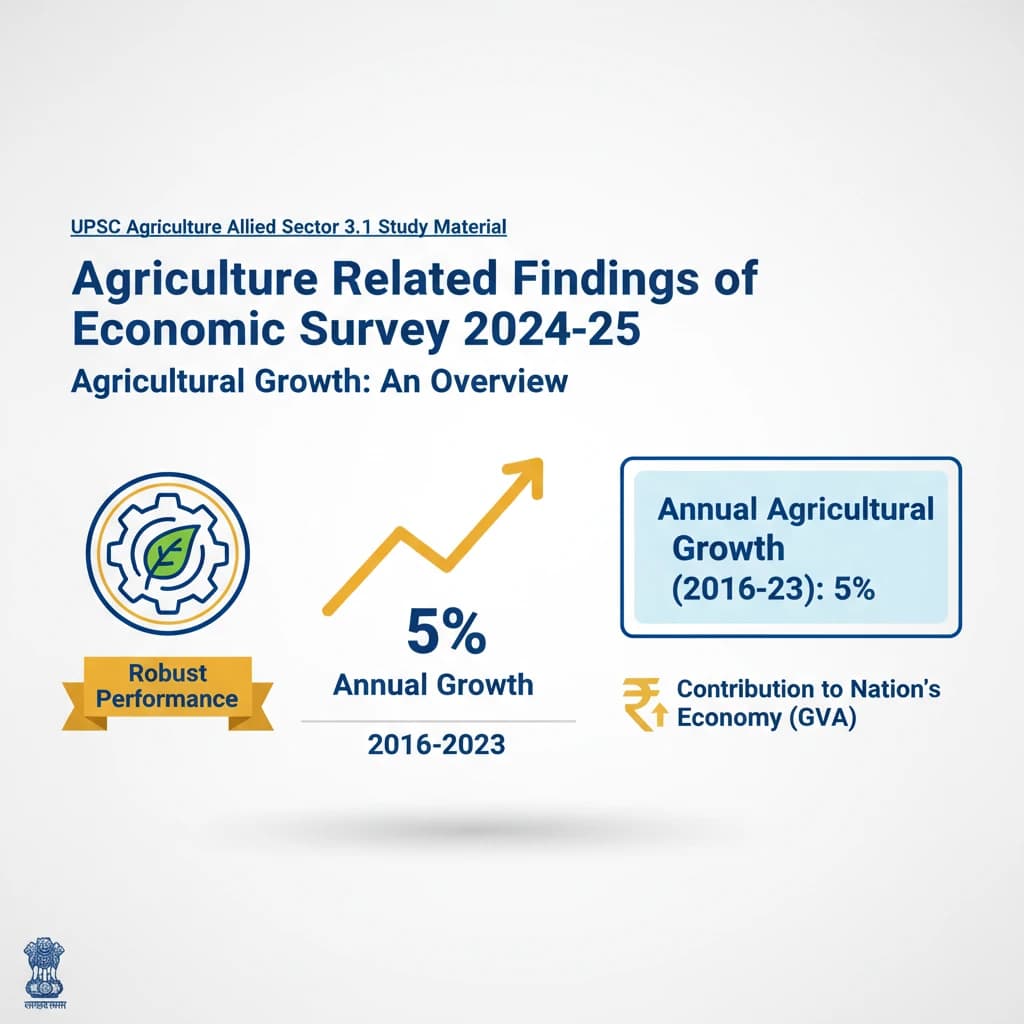
The agriculture sector has demonstrated robust performance, growing at an impressive 5% annually between 2016 and 2023. This consistent growth underscores the sector's resilience and its pivotal role in the Indian economy.
Annual Agricultural Growth (2016-23): 5%
The sector's contribution to the nation's economy, measured by Gross Value Added (GVA), has also significantly increased. Its share rose from 24.38% in 2014-15 to a substantial 30.23% in 2022-23, highlighting its expanding economic footprint.
GVA Share of Agriculture:
- 2014-15: 24.38%
- 2022-23: 30.23%
Furthermore, agricultural income has shown a steady upward trajectory, growing at an average rate of 5.23% annually over the past decade. This indicates improved economic well-being for those dependent on agriculture.
Key Takeaway: Agriculture is not only growing steadily but also increasing its share in the national GVA, signifying its enhanced importance.
Sectoral Performance Highlights
Within the broad agriculture sector, certain sub-sectors have exhibited exceptional growth. The fisheries sector recorded the highest growth rate, expanding by 13.67% between 2013-14 and 2022-23.
Following closely, the livestock sector also showed strong performance, with a growth rate of 12.99% during the same period. These sectors are crucial for nutritional security and farmer diversification.
Top Performing Sectors (2013-14 to 2022-23):
- Fisheries: 13.67%
- Livestock: 12.99%
In contrast, the oilseeds sector experienced relatively slower growth, with an annual rate of only 1.9%. This highlights a potential area for policy intervention to boost domestic production and reduce import dependence.
UPSC Insight: Questions often focus on reasons for disparities in sectoral growth and government initiatives to address them. Be prepared to discuss policies related to fisheries, livestock, and oilseeds.
Irrigation Coverage and Intensity
Significant progress has been made in extending irrigation coverage across the country. The proportion of Gross Cropped Area (GCA) under irrigation increased from 49.3% in 2015-16 to 55% in 2020-21.
Alongside coverage, irrigation intensity also improved, rising from 144.2% to 154.5%. This indicates more efficient and multiple use of irrigated land throughout the year.
Irrigation Trends:
- Coverage (GCA): 49.3% (2015-16) to 55% (2020-21)
- Intensity: 144.2% to 154.5%
However, there are notable regional disparities in irrigation coverage. States like Punjab (98%), Haryana (94%), Uttar Pradesh (84%), and Telangana (86%) boast very high irrigation coverage.
Conversely, states such as Jharkhand and Assam report irrigation coverage below 20%. These disparities underscore the need for targeted regional strategies for water resource management.
Definition: Gross Cropped Area (GCA)
GCA refers to the total area cultivated in an agricultural year, accounting for all cropping cycles on the same land. If a farmer cultivates wheat and then rice on the same plot in a year, that plot's area is counted twice in GCA.
GCA refers to the total area cultivated in an agricultural year, accounting for all cropping cycles on the same land. If a farmer cultivates wheat and then rice on the same plot in a year, that plot's area is counted twice in GCA.
💡 Key Takeaways
- •Indian agriculture grew 5% annually (2016-23), increasing its GVA share to 30.23% (2022-23).
- •Agricultural income saw 5.23% annual growth over the last decade.
- •Fisheries (13.67%) and Livestock (12.99%) were top-performing sectors.
- •Oilseeds sector showed slow growth at 1.9%, indicating a need for focus.
- •Irrigation coverage increased to 55% of GCA, with intensity rising to 154.5%.
- •Significant regional disparities exist in irrigation, with states like Jharkhand and Assam having very low coverage.
- •The Economic Survey provides crucial data for understanding agricultural trends and policy implications.
🧠 Memory Techniques

95% Verified Content