Loading page, please wait…
What is the Edible Oil Scenario in India’s Economy? - UPSC Agriculture Allied Sector
What is What is the Edible Oil Scenario in India’s Economy? in UPSC Agriculture Allied Sector?
What is the Edible Oil Scenario in India’s Economy? is a key topic under Agriculture Allied Sector for UPSC Civil Services Examination. Key points include: India is the world's fourth largest vegetable oil economy but heavily relies on imports.. Domestic production meets only 40-45% of India's edible oil requirements.. Major oilseeds include groundnut, soybean, sunflower, and mustard.. Understanding this topic is essential for both UPSC Prelims and Mains preparation.
Why is What is the Edible Oil Scenario in India’s Economy? important for UPSC exam?
What is the Edible Oil Scenario in India’s Economy? is a Medium-level topic in UPSC Agriculture Allied Sector. It is tested in both Prelims (factual MCQs) and Mains (analytical answer writing). Previous year UPSC questions have frequently covered aspects of What is the Edible Oil Scenario in India’s Economy?, making it essential for comprehensive IAS preparation.
How to prepare What is the Edible Oil Scenario in India’s Economy? for UPSC?
To prepare What is the Edible Oil Scenario in India’s Economy? for UPSC: (1) Study the comprehensive notes covering all key concepts on Vaidra. (2) Practice previous year questions on this topic. (3) Connect it with current affairs using daily updates. (4) Revise using key takeaways and mind maps available for Agriculture Allied Sector. (5) Write practice answers linking What is the Edible Oil Scenario in India’s Economy? to related GS Paper topics.
Key takeaways of What is the Edible Oil Scenario in India’s Economy? for UPSC
- India is the world's fourth largest vegetable oil economy but heavily relies on imports.
- Domestic production meets only 40-45% of India's edible oil requirements.
- Major oilseeds include groundnut, soybean, sunflower, and mustard.
- Edible oils are categorized into traditional, plantation-based, non-conventional, and forest-based types.
- The National Mission on Oilseeds and Oil Palm (NMEO-OP) aims to boost domestic production to 69.7 million tonnes by 2030-31.
- Reducing import dependency is vital for India's food security, farmer income, and trade balance.
What is the Edible Oil Scenario in India’s Economy?
Medium⏱️ 6 min read
agriculture allied sector
📖 Introduction
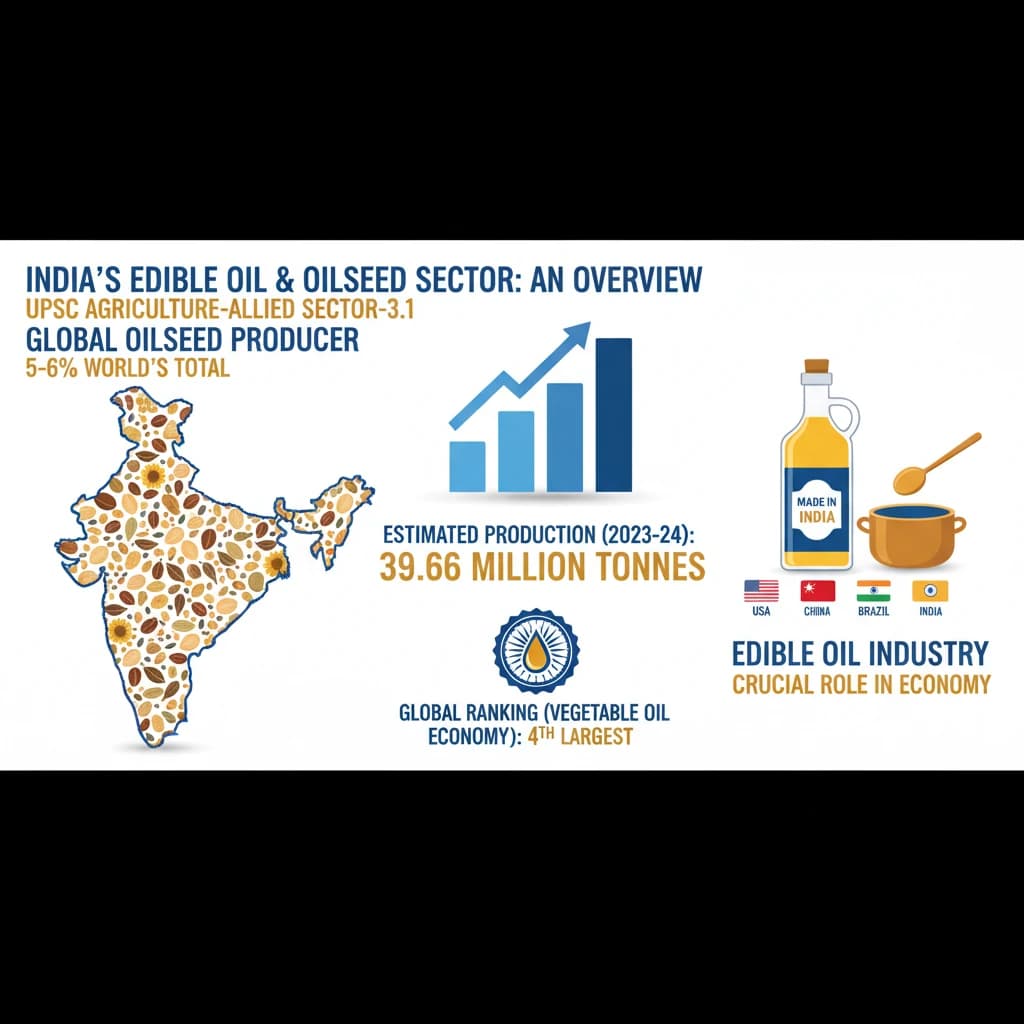
India's Edible Oil and Oilseed Sector: An Overview
India stands as one of the largest oilseed producers globally, contributing approximately 5-6% to the world's total production.
Estimated Production (2023-24): 39.66 million tonnes
Global Ranking (Vegetable Oil Economy): Fourth largest (after USA, China, Brazil)
Global Ranking (Vegetable Oil Economy): Fourth largest (after USA, China, Brazil)
The edible oil industry plays a crucial role in India's agriculture and trade sectors, impacting both rural livelihoods and national economics.
Oilseed & Oil Meal Imports (2023-24): Valued at Rs 29,587 crore
Edible Oil Imports (2022-23): 16.5 million tonnes (MT)
Edible Oil Imports (2022-23): 16.5 million tonnes (MT)
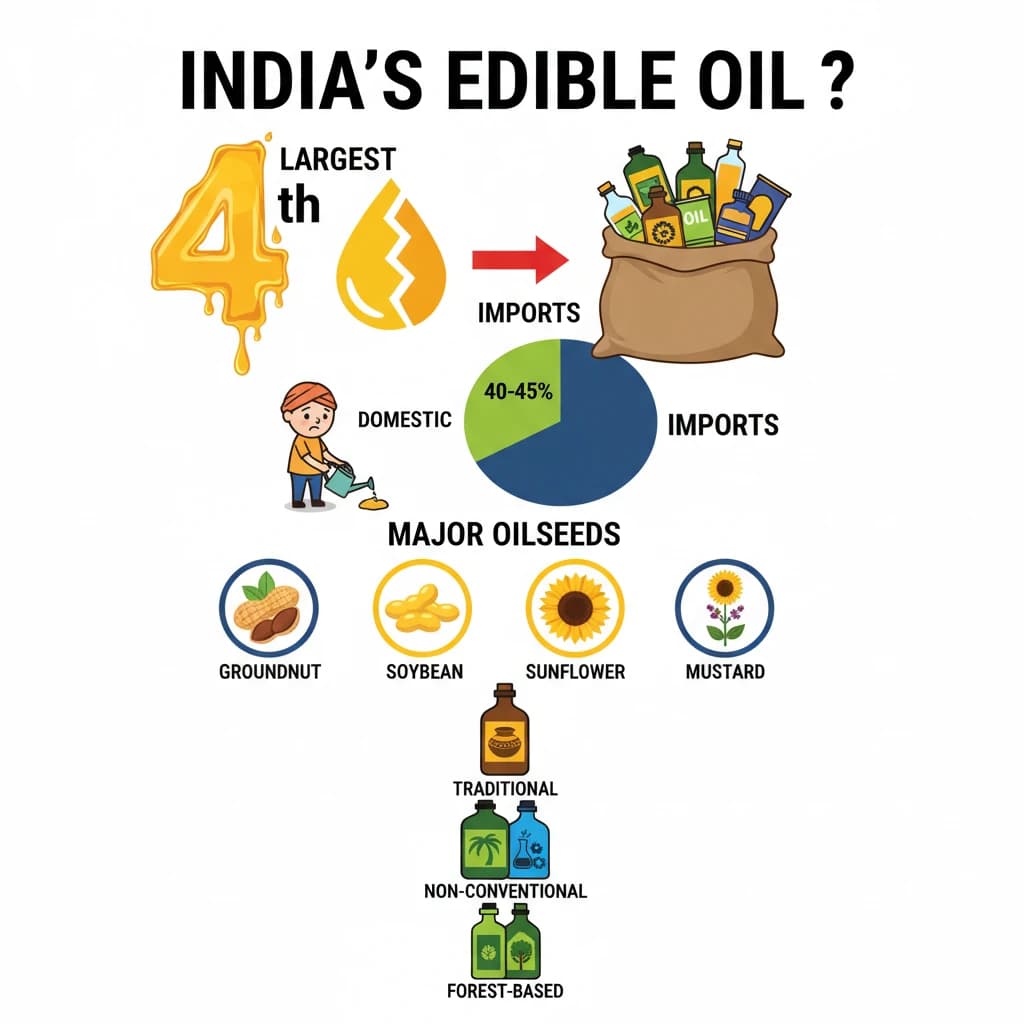
Despite significant domestic production, India's supply fulfills only 40-45% of its edible oil requirements. This leads to a substantial import dependency, with 57% of consumption met through imports.
Major Oilseeds Cultivated in India
India cultivates a diverse range of oilseeds, which are vital for domestic edible oil production and agricultural diversity.
- Groundnut
- Soybean
- Sunflower
- Mustard
- Sesame
- Niger
- Safflower
Categories of Edible Oils in India
Edible oils in India are broadly categorized based on their source, cultivation methods, and traditional usage.
Understanding these categories is crucial for analyzing India's diverse agricultural landscape and consumption patterns.
- Traditional Oils: These are derived from widely cultivated oilseeds and form the backbone of domestic edible oil production.
- Examples: Groundnut, Mustard/Rapeseed, Sesame, Safflower, Linseed, Niger seed, Castor, Soybean, Sunflower.
- Plantation-based Oils: Derived from perennial crops, typically cultivated in specific agro-climatic zones.
- Examples: Coconut, Oil Palm.
- Key growing regions for Oil Palm include Andhra Pradesh, Karnataka, Tamil Nadu, Kerala, Andaman and Nicobar.
- Non-conventional Oils: These are often by-products or lesser-known sources that contribute to the overall edible oil supply.
- Examples: Rice bran oil, Cottonseed oil.
- Forest-based Oils: These oils are collected from various tree and forest sources, primarily in tribal regions, offering unique regional contributions.
Government Initiatives to Boost Domestic Production
The Indian government is actively pursuing strategies to reduce the country's high import dependency on edible oils and achieve greater self-reliance.
The primary objective of these initiatives is to enhance domestic oilseed production and ensure food security.
A significant initiative in this direction is the National Mission on Oilseeds and Oil Palm (NMEO-OP), launched to boost indigenous production.
NMEO-OP Target: Boost oilseed production from 39 million tonnes to 69.7 million tonnes by 2030-31.
Goal: Meet 72% of the country's edible oil demand through domestic production.
Goal: Meet 72% of the country's edible oil demand through domestic production.
Remember NMEO-OP as a key policy initiative. Its targets and objectives are crucial for Mains answers on agricultural policy, food security, and economic self-reliance.
💡 Key Takeaways
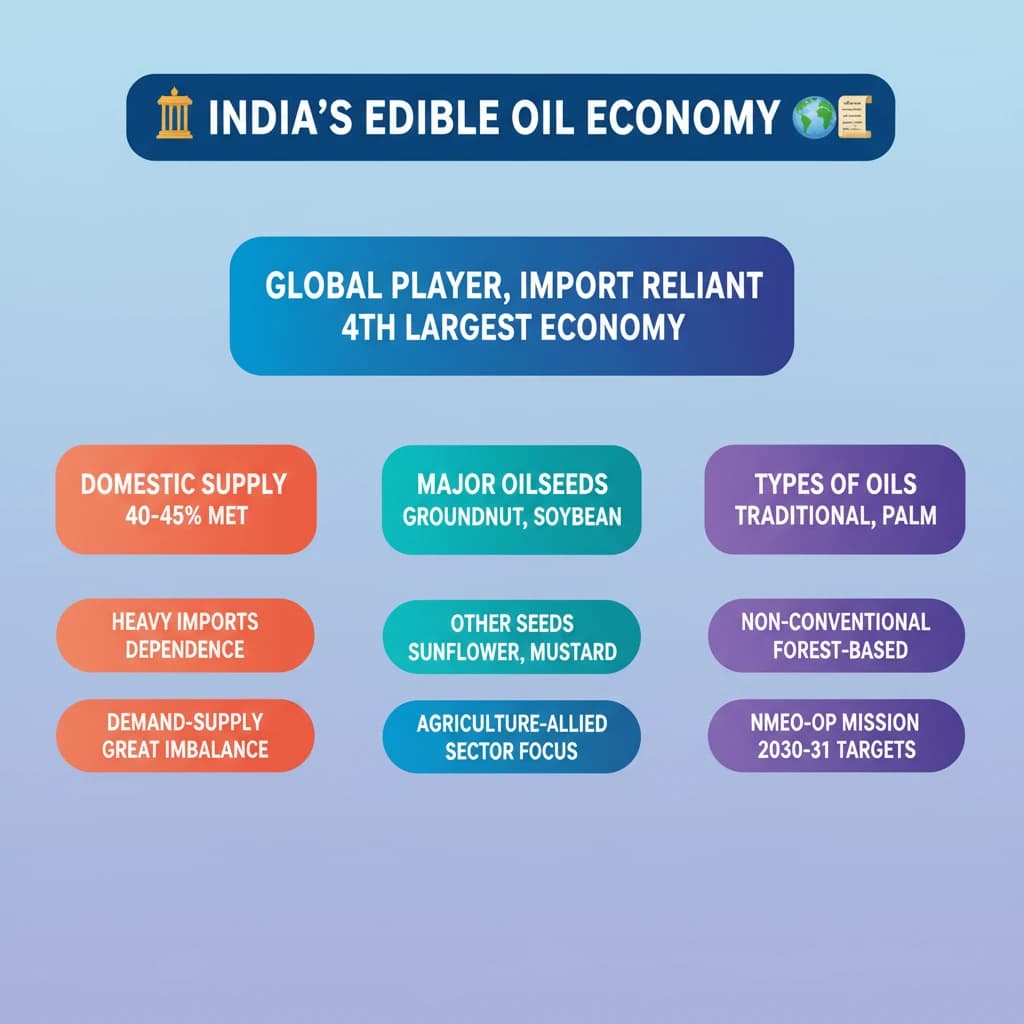
- •India is the world's fourth largest vegetable oil economy but heavily relies on imports.
- •Domestic production meets only 40-45% of India's edible oil requirements.
- •Major oilseeds include groundnut, soybean, sunflower, and mustard.
- •Edible oils are categorized into traditional, plantation-based, non-conventional, and forest-based types.
- •The National Mission on Oilseeds and Oil Palm (NMEO-OP) aims to boost domestic production to 69.7 million tonnes by 2030-31.
- •Reducing import dependency is vital for India's food security, farmer income, and trade balance.
🧠 Memory Techniques
98% Verified Content