Loading page, please wait…
Group of Monuments at Hampi - UPSC Art And Culture
What is Group of Monuments at Hampi in UPSC Art And Culture?
Group of Monuments at Hampi is a key topic under Art And Culture for UPSC Civil Services Examination. Key points include: Hampi is a UNESCO World Heritage Site in central Karnataka, once the capital of the Vijayanagara Empire.. It features over 1,600 monuments, including forts, temples, and palaces, spread over 4,200 hectares.. Hampi's architecture is a unique blend of Dravidian and Indo-Islamic styles.. Understanding this topic is essential for both UPSC Prelims and Mains preparation.
Why is Group of Monuments at Hampi important for UPSC exam?
Group of Monuments at Hampi is a Medium-level topic in UPSC Art And Culture. It is tested in both Prelims (factual MCQs) and Mains (analytical answer writing). Previous year UPSC questions have frequently covered aspects of Group of Monuments at Hampi, making it essential for comprehensive IAS preparation.
How to prepare Group of Monuments at Hampi for UPSC?
To prepare Group of Monuments at Hampi for UPSC: (1) Study the comprehensive notes covering all key concepts on Vaidra. (2) Practice previous year questions on this topic. (3) Connect it with current affairs using daily updates. (4) Revise using key takeaways and mind maps available for Art And Culture. (5) Write practice answers linking Group of Monuments at Hampi to related GS Paper topics.
Key takeaways of Group of Monuments at Hampi for UPSC
- Hampi is a UNESCO World Heritage Site in central Karnataka, once the capital of the Vijayanagara Empire.
- It features over 1,600 monuments, including forts, temples, and palaces, spread over 4,200 hectares.
- Hampi's architecture is a unique blend of Dravidian and Indo-Islamic styles.
- Key structures include the Vitthala Temple with its Stone Chariot, the Royal Enclosure with Lotus Mahal, and the Virupaksha Temple.
- The site was rediscovered by Colonel Colin Mackenzie in 1800 and designated a UNESCO site in 1986.
- Its strategic location on the Tungabhadra River provided natural defenses.
- Hampi represents the pinnacle of Vijayanagara cultural and architectural achievements.

Group of Monuments at Hampi
Medium⏱️ 7 min read
art and culture
📖 Introduction
Introduction to Hampi
The Group of Monuments at Hampi is a renowned UNESCO World Heritage Site located in central Karnataka, India. It stands as a testament to the grandeur of a bygone era.
Location: On the banks of the Tungabhadra River📍
Area: Approximately 4,200 hectares
Monuments: Over 1,600 surviving structures, including forts, temples, palaces, and other architectural marvels.
Area: Approximately 4,200 hectares
Monuments: Over 1,600 surviving structures, including forts, temples, palaces, and other architectural marvels.
Hampi served as the magnificent capital of the powerful Vijayanagara Empire, holding immense historical and archaeological significance. Its ruins attract scholars, tourists, and pilgrims alike.
The strategic location of Hampi, nestled amidst craggy hills and the Tungabhadra River, provided a natural defensive advantage, making it an ideal capital for the imperial city.
Architectural Style: Vijayanagara Grandeur
The monuments at Hampi represent the zenith of Vijayanagara architecture. This unique style is a remarkable synthesis, blending elements of the indigenous Dravidian style with distinct Indo-Islamic influences.
This fusion created a distinctive architectural language characterized by elaborate carvings, grand scale, and innovative structural designs.
The blend of Dravidian and Indo-Islamic architectural elements is a defining characteristic of Hampi's structures, reflecting the cultural dynamism and cosmopolitan nature of the Vijayanagara Empire.
Key Architectural Marvels
Hampi is home to several iconic structures that showcase the empire's architectural prowess:
- Vitthala Temple Complex: Renowned for its exquisitely carved musical pillars and the iconic Stone Chariot, a symbol of Karnataka tourism.
- Royal Enclosure: Features majestic structures such as the elegant Lotus Mahal, a queen's palace, and the grand Elephant Stables, which housed the royal elephants.
- Hazara Rama Temple: Distinguished by its intricate stone carvings and beautifully sculpted panels depicting scenes from the Ramayana, making it a visual narrative.
- Virupaksha Temple: One of the oldest and most sacred active temples in Hampi, dedicated to Lord Shiva, and a major pilgrimage center.
Other Significant Monuments
Beyond the primary marvels, Hampi boasts numerous other notable structures that contribute to its rich tapestry:
- Krishna Temple Complex
- Massive monolithic statues of Narasimha (Ugra Narasimha) and Ganesa (Sasivekalu Ganesa and Kadalekalu Ganesa)
- Hemakuta Group of Temples, featuring early Vijayanagara and pre-Vijayanagara structures.
- Achyutaraya Temple Complex
- Pattabhirama Temple Complex
- And the aforementioned Lotus Mahal Complex (part of the Royal Enclosure)
Rediscovery and UNESCO Recognition
The magnificent ruins of Hampi remained largely unknown to the wider world for centuries until their rediscovery by colonial administrators.
Rediscovered by: Colonel Colin Mackenzie, a British engineer and antiquarian.
Year of Rediscovery: 1800, when he conducted the first survey of the site.
Year of Rediscovery: 1800, when he conducted the first survey of the site.
Recognizing its unparalleled cultural and historical significance, the international community bestowed a prestigious status upon Hampi, ensuring its preservation for future generations.
UNESCO World Heritage Site: Hampi was inscribed by the United Nations Educational, Scientific and Cultural Organization (UNESCO) in 1986. This designation acknowledges its outstanding universal value as a cultural landscape.
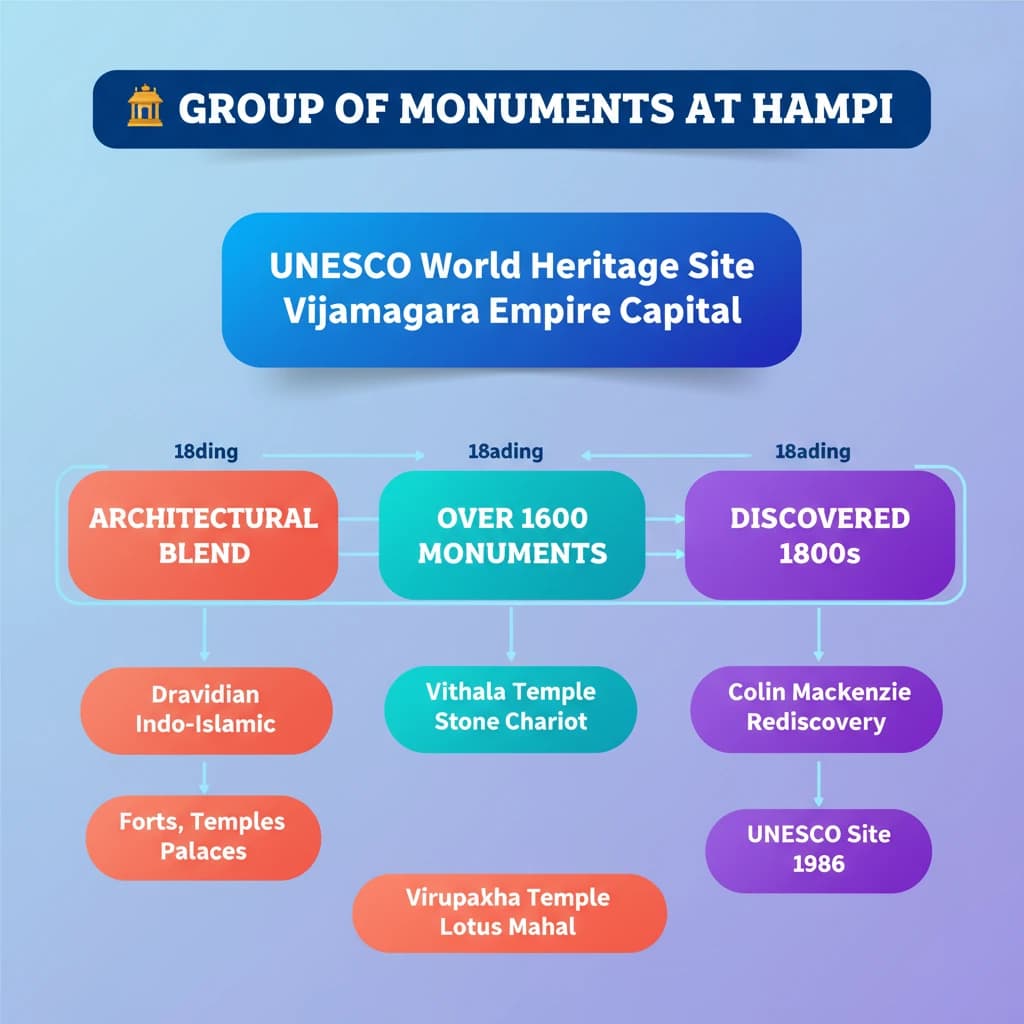
💡 Key Takeaways
- •Hampi is a UNESCO World Heritage Site in central Karnataka, once the capital of the Vijayanagara Empire.
- •It features over 1,600 monuments, including forts, temples, and palaces, spread over 4,200 hectares.
- •Hampi's architecture is a unique blend of Dravidian and Indo-Islamic styles.
- •Key structures include the Vitthala Temple with its Stone Chariot, the Royal Enclosure with Lotus Mahal, and the Virupaksha Temple.
- •The site was rediscovered by Colonel Colin Mackenzie in 1800 and designated a UNESCO site in 1986.
- •Its strategic location on the Tungabhadra River provided natural defenses.
- •Hampi represents the pinnacle of Vijayanagara cultural and architectural achievements.
🧠 Memory Techniques

98% Verified Content
📚 Reference Sources
•UNESCO World Heritage Centre - Hampi
•Archaeological Survey of India (ASI) publications on Hampi
•NCERT textbooks for Ancient and Medieval Indian History