Loading page, please wait…
Major Military Exercises of India - UPSC Defence And Security
What is Major Military Exercises of India in UPSC Defence And Security?
Major Military Exercises of India is a key topic under Defence And Security for UPSC Civil Services Examination. Key points include: CDS is India's single-point military advisor to the Defence Minister, fostering inter-service synergy.. The CDS post was created in 2019, following recommendations from the Kargil Review Committee (1999) and subsequent expert panels.. CDS heads the Department of Military Affairs (DMA) and prioritizes inter-service procurement but lacks command authority over forces.. Understanding this topic is essential for both UPSC Prelims and Mains preparation.
Why is Major Military Exercises of India important for UPSC exam?
Major Military Exercises of India is a Medium-level topic in UPSC Defence And Security. It is tested in both Prelims (factual MCQs) and Mains (analytical answer writing). Previous year UPSC questions have frequently covered aspects of Major Military Exercises of India, making it essential for comprehensive IAS preparation.
How to prepare Major Military Exercises of India for UPSC?
To prepare Major Military Exercises of India for UPSC: (1) Study the comprehensive notes covering all key concepts on Vaidra. (2) Practice previous year questions on this topic. (3) Connect it with current affairs using daily updates. (4) Revise using key takeaways and mind maps available for Defence And Security. (5) Write practice answers linking Major Military Exercises of India to related GS Paper topics.
Key takeaways of Major Military Exercises of India for UPSC
- CDS is India's single-point military advisor to the Defence Minister, fostering inter-service synergy.
- The CDS post was created in 2019, following recommendations from the Kargil Review Committee (1999) and subsequent expert panels.
- CDS heads the Department of Military Affairs (DMA) and prioritizes inter-service procurement but lacks command authority over forces.
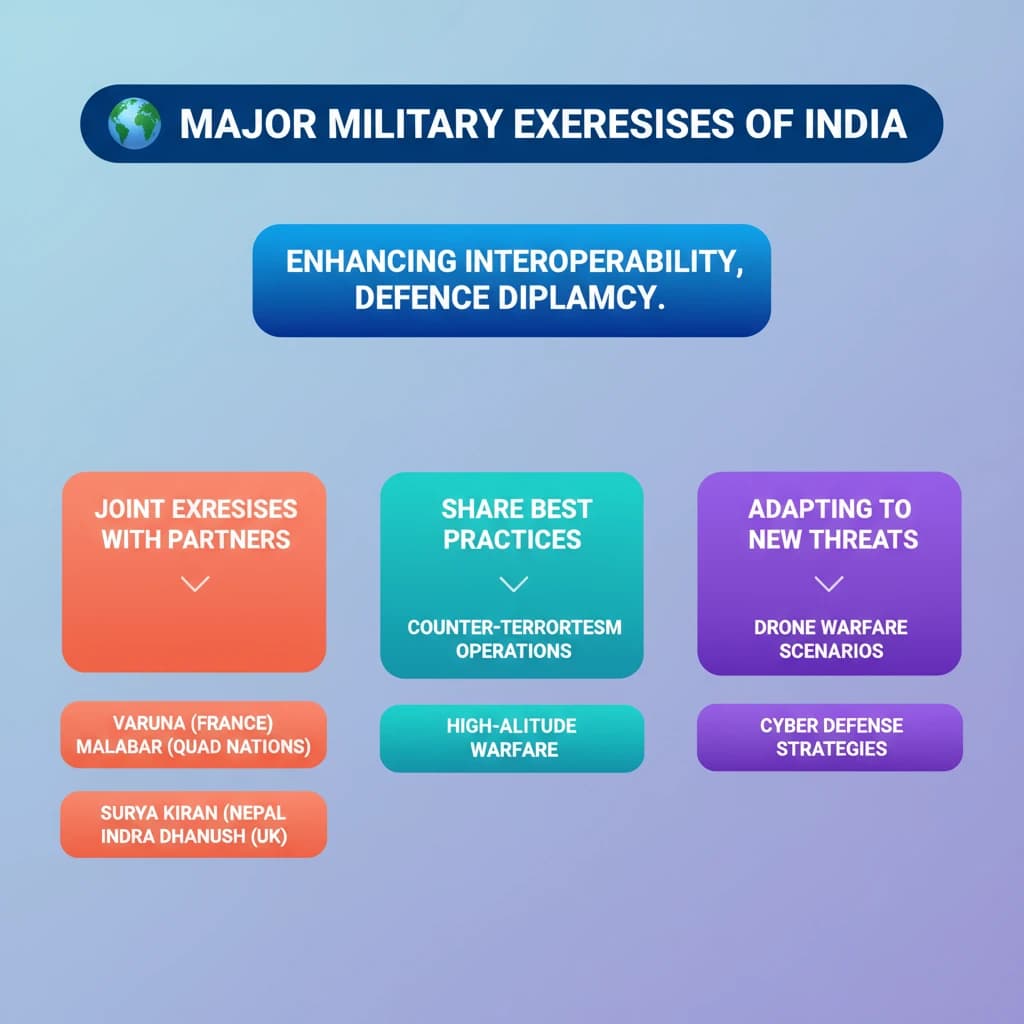
- Joint Military Exercises enhance interoperability, share best practices, and strengthen defence diplomacy with partner nations.
- Exercises cover diverse scenarios from counter-terrorism to high-altitude warfare, adapting to new threats like drone warfare.
- Key exercises include NOMADIC ELEPHANT (Mongolia), YUDHABHAYAS/VAJRA PRAHAR (USA), SAMPRITI (Bangladesh), and SHAKTI (France).

Major Military Exercises of India
Medium⏱️ 10 min read
defence and security
📖 Introduction
Understanding the Chief of Defence Staff (CDS)
The Chief of Defence Staff (CDS) is a pivotal position in India's defence architecture, designed to bring greater synergy and integration among the three armed services: the Indian Army, Indian Navy, and Indian Air Force.
The primary role of the CDS is to serve as the single-point military adviser to the Defence Minister, streamlining military counsel and decision-making.
Historical Evolution of the CDS Post
The recommendation for creating the CDS post first emerged in 2001. This was a direct outcome of the Group of Ministers (GoM) report, which was tasked with reviewing the findings of the Kargil Review Committee (1999).
Following the GoM's recommendations, the government established the Integrated Defence Staff (IDS) in 2002. The IDS was envisioned to eventually function as the secretariat for the future CDS.
In 2012, the Naresh Chandra Committee proposed an alternative: the appointment of a Permanent Chairman of the Chiefs of Staff Committee. This was suggested as a compromise to address initial apprehensions regarding the CDS role.
The post of CDS was finally created in 2019, based on the recommendations of a committee of defence experts led by Lt General DB Shekatkar. This marked a significant reform in India's higher defence management.
General Bipin Rawat became the first CDS of India, appointed on December 31, 2019. His appointment underscored the government's commitment to military integration.
Roles and Responsibilities of the CDS
The CDS holds several critical responsibilities aimed at enhancing operational efficiency and inter-service cooperation. He heads the newly established Department of Military Affairs (DMA) within the Ministry of Defence.
As the single-point military adviser, the CDS provides comprehensive counsel to the Defence Minister on matters concerning all three services. The individual service chiefs are expected to advise only on issues specific to their respective forces.
The CDS, as the head of the DMA and Permanent Chairman-Chiefs of Staff Committee, is empowered to prioritize inter-service procurement decisions. This ensures optimal allocation of resources across the armed forces.
While the CDS can issue directives to the three service chiefs, it is crucial to note that he does not possess any command authority over the forces themselves. This distinction maintains the operational autonomy of the individual services.
The CDS is considered 'first among equals' among the service chiefs. He holds the rank of Secretary within the Department of Defence (DoD), and his financial powers are primarily confined to the revenue budget.
Additionally, the CDS plays an important advisory role within the Nuclear Command Authority (NCA), contributing to strategic decision-making regarding India's nuclear arsenal.
Major Joint Military Exercises of India
Joint Military Exercises are crucial components of India's defence cooperation strategy. These exercises serve as flagship events that showcase the Indian Army's professional competence across various operational scenarios.
These exercises provide invaluable opportunities for participating forces to learn best practices, enhance interoperability, and build mutual understanding with partner nations.
Scope and Evolution of Joint Exercises
The scope of these joint exercises is both realistic and highly diversified. They cover a wide array of operational environments and challenges.
- Counter Terrorist Operations: Training for combating insurgency and terrorism.
- Humanitarian Assistance & Disaster Relief (HADR): Preparing for rapid response during natural calamities or crises.
- UN Peacekeeping: Practicing protocols and procedures for international peacekeeping missions.
- High Altitude Operations: Specialised training for warfare in mountainous and extreme cold conditions.
- Desert Warfare: Exercises conducted in arid and semi-arid environments.
- Urban Warfare: Training for combat operations in densely populated urban areas.
- Jungle Warfare: Developing tactics and skills for operations in dense forest regions.
The complexity of these exercises is continually increased to incorporate the latest advancements in warfighting. This includes integrating scenarios like Drone Warfare and understanding tactics related to Grey Zone Warfare.
UPSC aspirants should pay close attention to the purpose and specific focus of different exercises, as well as the participating countries. Questions often test understanding of these aspects.
Key Joint Exercises of the Indian Army with Partner Nations
India conducts numerous bilateral and multilateral exercises with various countries to bolster defence ties and operational readiness. Below is a list of major joint exercises involving the Indian Army:
| Country | Exercise Name | |
|---|---|---|
| Australia | Ex AUSTRA HIND | |
| Bangladesh | Ex SAMPRITI | |
| China | Ex HAND IN HAND | |
| France | Ex SHAKTI | |
| Indonesia | Ex GARUDA SHAKTI | |
| Kazakhstan | Ex PRABAL DOSTYK | |
| Kyrgyzstan | Ex KHANJAR | |
| Maldives | Ex EKUVERIN | |
| Mongolia | Ex NOMADIC ELEPHANT | |
| Myanmar | IMBEX | |
| Nepal | Ex SURYA KIRAN | |
| Oman | AL NAGAH | |
| Russia | Ex INDRA | |
| Seychelles | Ex LAMITYE | |
| Sri Lanka | Ex MITRA SHAKTI | |
| Thailand | Ex MAITREE | |
| UK | Ex AJEYA WARRIOR | |
| USA | Ex YUDHABHAYAS | |
| USA | Ex VAJRA PRAHAR |
Recently, the 16th edition of the India-Mongolia Joint Military Exercise NOMADIC ELEPHANT commenced at the Foreign Training Node, Umroi (Meghalaya). This highlights the ongoing nature and importance of these engagements.
💡 Key Takeaways
- •CDS is India's single-point military advisor to the Defence Minister, fostering inter-service synergy.
- •The CDS post was created in 2019, following recommendations from the Kargil Review Committee (1999) and subsequent expert panels.
- •CDS heads the Department of Military Affairs (DMA) and prioritizes inter-service procurement but lacks command authority over forces.
- •Joint Military Exercises enhance interoperability, share best practices, and strengthen defence diplomacy with partner nations.
- •Exercises cover diverse scenarios from counter-terrorism to high-altitude warfare, adapting to new threats like drone warfare.
- •Key exercises include NOMADIC ELEPHANT (Mongolia), YUDHABHAYAS/VAJRA PRAHAR (USA), SAMPRITI (Bangladesh), and SHAKTI (France).
🧠 Memory Techniques

95% Verified Content
📚 Reference Sources
•Official Government of India (Ministry of Defence) releases (general knowledge base)
•Reputable defence news outlets and strategic think tanks (general knowledge base)