Loading page, please wait…
Terrorism and Counter-Terrorism - UPSC Defence And Security
What is Terrorism and Counter-Terrorism in UPSC Defence And Security?
Terrorism and Counter-Terrorism is a key topic under Defence And Security for UPSC Civil Services Examination. Key points include: The NIA is India's primary federal agency for investigating Scheduled Offences related to terrorism.. NIA's mandate expanded in 2020 to include NDPS Act offenses connected to terrorism, addressing the terror-narcotics nexus.. Special Courts are designated by the Central Government to ensure expeditious trials for NIA cases.. Understanding this topic is essential for both UPSC Prelims and Mains preparation.
Why is Terrorism and Counter-Terrorism important for UPSC exam?
Terrorism and Counter-Terrorism is a Medium-level topic in UPSC Defence And Security. It is tested in both Prelims (factual MCQs) and Mains (analytical answer writing). Previous year UPSC questions have frequently covered aspects of Terrorism and Counter-Terrorism, making it essential for comprehensive IAS preparation.
How to prepare Terrorism and Counter-Terrorism for UPSC?
To prepare Terrorism and Counter-Terrorism for UPSC: (1) Study the comprehensive notes covering all key concepts on Vaidra. (2) Practice previous year questions on this topic. (3) Connect it with current affairs using daily updates. (4) Revise using key takeaways and mind maps available for Defence And Security. (5) Write practice answers linking Terrorism and Counter-Terrorism to related GS Paper topics.
Key takeaways of Terrorism and Counter-Terrorism for UPSC
- The NIA is India's primary federal agency for investigating Scheduled Offences related to terrorism.
- NIA's mandate expanded in 2020 to include NDPS Act offenses connected to terrorism, addressing the terror-narcotics nexus.
- Special Courts are designated by the Central Government to ensure expeditious trials for NIA cases.
- Operation Dhvast is a key NIA initiative targeting the terror-gangster nexus.
- India's counter-terrorism framework has evolved significantly, with UAPA and NIA Act being central pillars.
Terrorism and Counter-Terrorism
Medium⏱️ 7 min read
defence and security
📖 Introduction
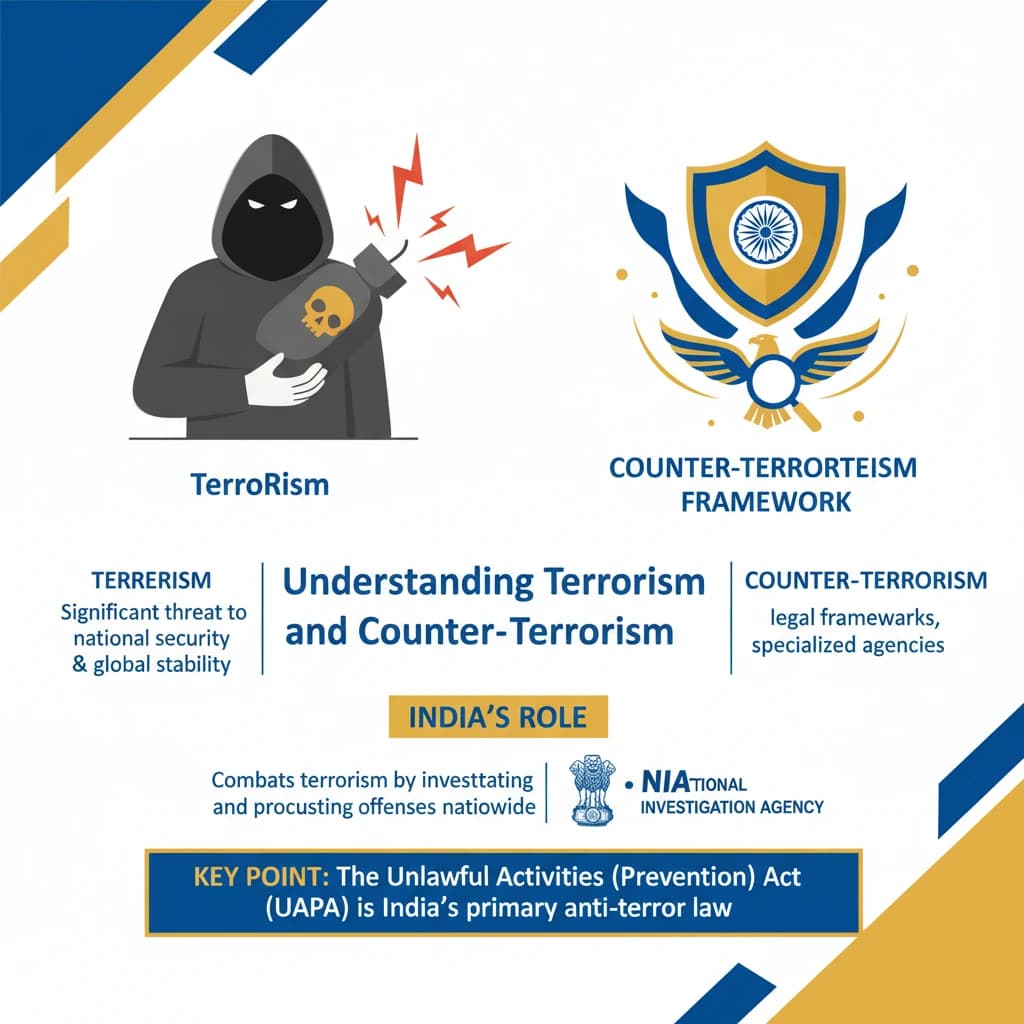
Understanding Terrorism and Counter-Terrorism Framework
Terrorism poses a significant threat to national security and global stability. Counter-terrorism efforts involve a multi-faceted approach, including legal frameworks and specialized agencies.
In India, the National Investigation Agency (NIA) plays a crucial role in combating terrorism by investigating and prosecuting related offenses across the country.
The NIA was established in 2009 in the wake of the 2008 Mumbai terror attacks, specifically to deal with terror-related crimes and strengthen India's counter-terrorism capabilities.
Scheduled Offences Investigated by NIA
The NIA is empowered to investigate a specific list of offenses, known as Scheduled Offences, which are defined under the National Investigation Agency Act, 2008.
These offenses cover a wide range of activities that pose a threat to India's sovereignty, security, and integrity.
Key Acts under which NIA investigates Scheduled Offences include:
- Explosive Substances Act, 1908
- Atomic Energy Act, 1962
- Unlawful Activities (Prevention) Act, 1967 (UAPA)
- Anti-Hijacking Act, 2016
- Suppression of Unlawful Acts Against Safety of Civil Aviation Act, 1982
- SAARC Convention (Suppression of Terrorism) Act, 1993
- Weapons of Mass Destruction and their Delivery Systems (Prohibition of Unlawful Activities) Act, 2005
Expansion of NIA's Mandate
The scope of the NIA's investigative powers has been progressively expanded to address emerging threats and interconnected criminal activities.
This expansion reflects the evolving nature of terrorism, which often relies on various illicit means for funding and logistics.
In September 2020, the NIA's mandate was significantly expanded.
- It now includes offenses under the Narcotic Drugs and Psychotropic Substances (NDPS) Act, 1985.
- This inclusion is specifically for cases where drug trafficking is directly connected to terrorism.
The expansion to include NDPS Act offenses highlights the growing nexus between narcotics trade and terror financing, a critical aspect for UPSC Mains GS-III Internal Security.
Special Courts for Terror Trials
To ensure expeditious and effective prosecution of terror-related cases, specific judicial mechanisms are put in place.
These mechanisms are designed to handle the sensitive and complex nature of terrorism trials.
Trials for NIA cases are conducted in Special Courts.
- These courts are designated by the Central Government.
- The designation is made in consultation with the Chief Justice of the High Court of the respective State.
The establishment of Special Courts aims to streamline the judicial process, ensuring faster trials and better conviction rates in terror-related cases.
Operation Dhvast: Countering Terror-Gangster Nexus
Law enforcement agencies often conduct targeted operations to dismantle criminal networks that support or engage in terrorist activities.
One such operation specifically targeted the dangerous convergence of organized crime and terrorism.
Operation Dhvast is a significant initiative by the NIA.
- It focuses on disrupting the intricate nexus between terrorist groups and gangsters.
- This operation aims to dismantle infrastructure, funding channels, and recruitment networks that bridge organized crime with terrorism.
Mentioning specific operations like Operation Dhvast can add value to answers in GS-III Internal Security, demonstrating knowledge of practical counter-terrorism measures.
💡 Key Takeaways
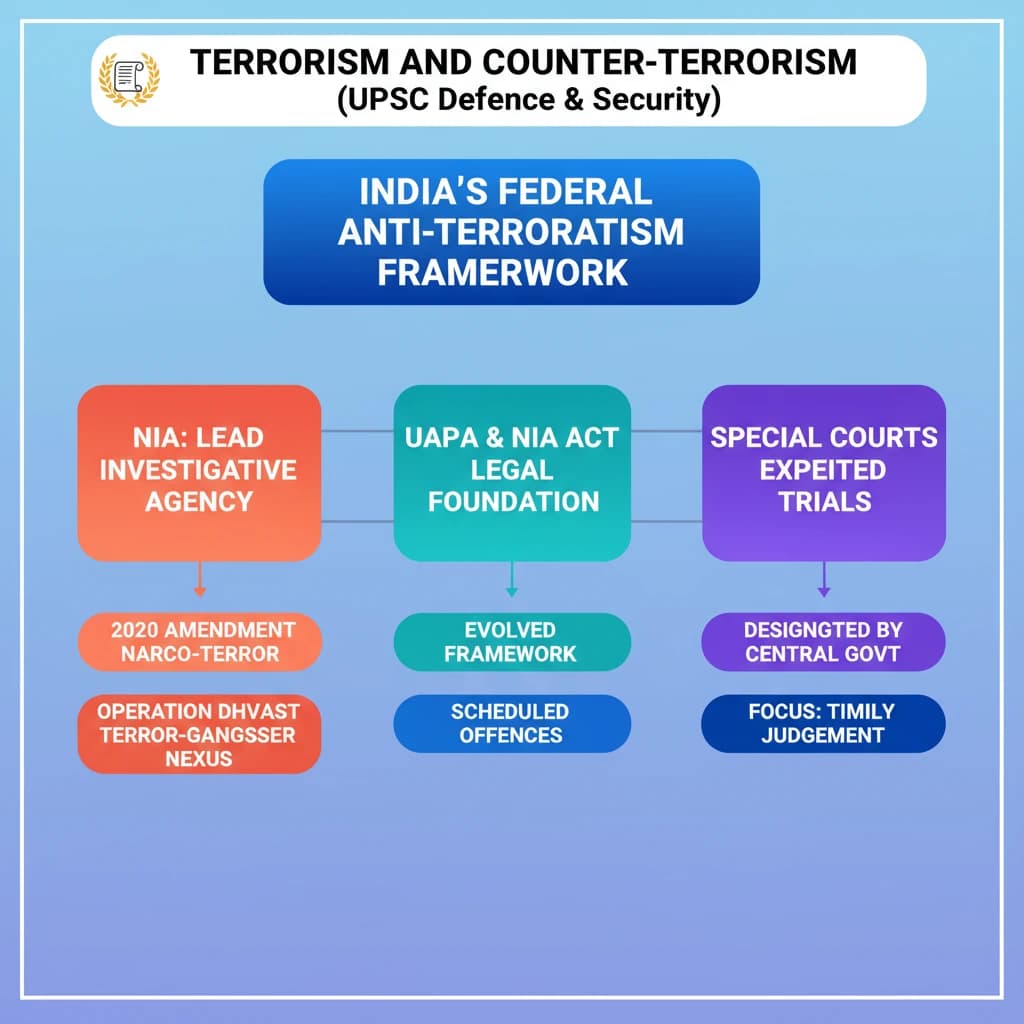
- •The NIA is India's primary federal agency for investigating Scheduled Offences related to terrorism.
- •NIA's mandate expanded in 2020 to include NDPS Act offenses connected to terrorism, addressing the terror-narcotics nexus.
- •Special Courts are designated by the Central Government to ensure expeditious trials for NIA cases.
- •Operation Dhvast is a key NIA initiative targeting the terror-gangster nexus.
- •India's counter-terrorism framework has evolved significantly, with UAPA and NIA Act being central pillars.
🧠 Memory Techniques

95% Verified Content
📚 Reference Sources
•National Investigation Agency Act, 2008
•Unlawful Activities (Prevention) Act, 1967
•Narcotic Drugs and Psychotropic Substances Act, 1985