Loading page, please wait…
FATF Mutual Evaluation Report on India - UPSC Economy
What is FATF Mutual Evaluation Report on India in UPSC Economy?
FATF Mutual Evaluation Report on India is a key topic under Economy for UPSC Civil Services Examination. Key points include: India achieved 'high level of technical compliance' in FATF's Mutual Evaluation Report, placed in 'regular follow-up' category.. India is the only major federal economy to achieve the highest FATF rating, alongside UK, France, Italy.. Key vulnerabilities identified in Gems and Jewellery sector due to low registration and cross-border smuggling risks.. Understanding this topic is essential for both UPSC Prelims and Mains preparation.
Why is FATF Mutual Evaluation Report on India important for UPSC exam?
FATF Mutual Evaluation Report on India is a Medium-level topic in UPSC Economy. It is tested in both Prelims (factual MCQs) and Mains (analytical answer writing). Previous year UPSC questions have frequently covered aspects of FATF Mutual Evaluation Report on India, making it essential for comprehensive IAS preparation.
How to prepare FATF Mutual Evaluation Report on India for UPSC?
To prepare FATF Mutual Evaluation Report on India for UPSC: (1) Study the comprehensive notes covering all key concepts on Vaidra. (2) Practice previous year questions on this topic. (3) Connect it with current affairs using daily updates. (4) Revise using key takeaways and mind maps available for Economy. (5) Write practice answers linking FATF Mutual Evaluation Report on India to related GS Paper topics.
Key takeaways of FATF Mutual Evaluation Report on India for UPSC
- India achieved 'high level of technical compliance' in FATF's Mutual Evaluation Report, placed in 'regular follow-up' category.
- India is the only major federal economy to achieve the highest FATF rating, alongside UK, France, Italy.
- Key vulnerabilities identified in Gems and Jewellery sector due to low registration and cross-border smuggling risks.
- Significant terrorist financing threats from ISIL, Al-Qaeda, NE insurgencies, and LWE groups; need to expedite prosecutions.
- FATF recommendations include faster money laundering trials, improved targeted financial sanctions, and defining domestic PEPs.
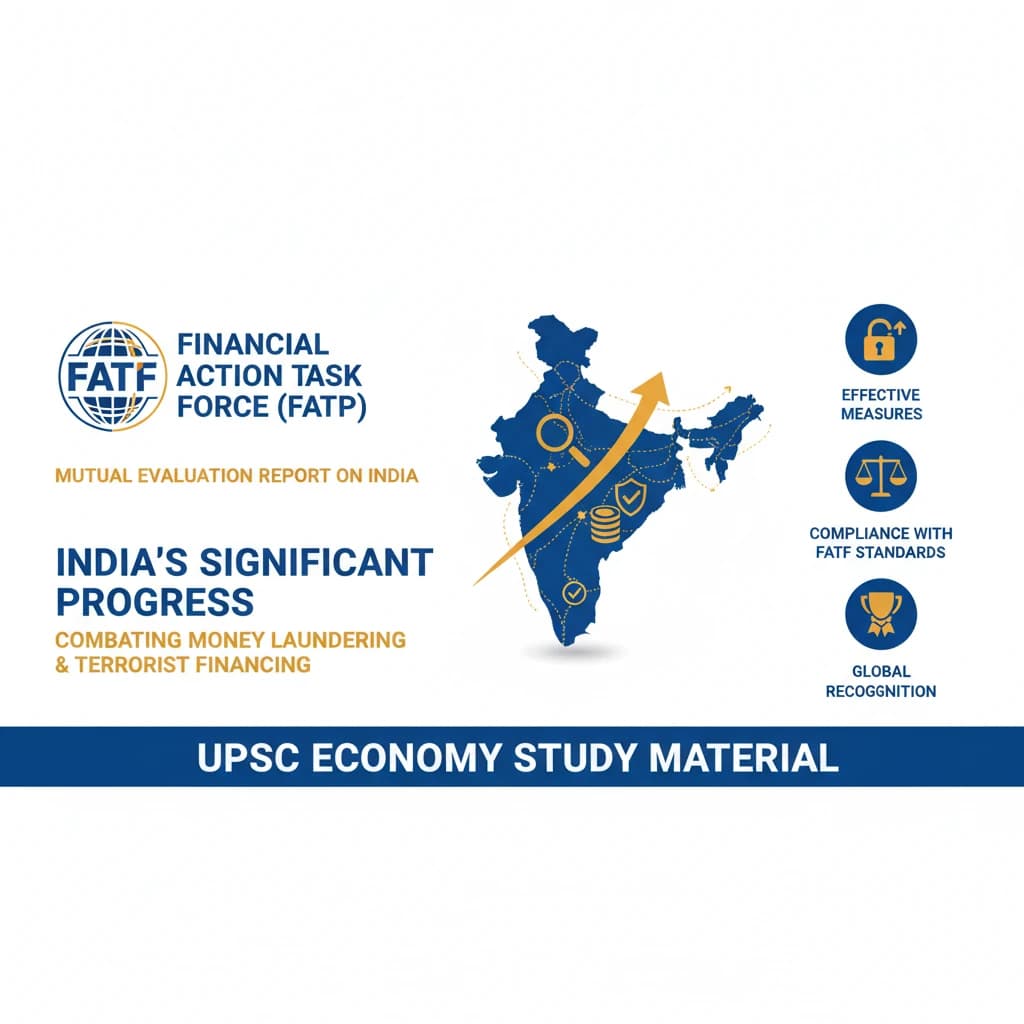
FATF Mutual Evaluation Report on India
Medium⏱️ 10 min read
economy
📖 Introduction
Introduction to FATF Mutual Evaluation Report
The Financial Action Task Force (FATF) recently released its Mutual Evaluation Report on India. This report assesses a country's compliance with FATF's recommendations to combat money laundering (ML) and terrorist financing (TF).
The report highlights India's significant progress in its efforts against illicit finance. This recognition underscores the country's commitment to global financial integrity.
India's Achievement: High Level of Technical Compliance
During its plenary in Singapore in June 2024, the FATF adopted India's Mutual Evaluation Report. The report specifically noted that India achieved a “high level of technical compliance” with the requirements set by the global money laundering watchdog.
FATF Plenary, June 2024, Singapore: Officially adopted India's Mutual Evaluation Report, acknowledging its strong technical compliance.
Consequently, the FATF placed India in the “regular follow-up” category. This is the highest rating category awarded by FATF, signifying robust anti-money laundering and counter-terrorist financing frameworks.
Regular Follow-Up Category: India is the only major economy with a federal structure to achieve this top status. This places India alongside other G-20 nations like the UK, France, and Italy in this esteemed category.
Key Areas of Concern: Gems and Jewellery Sector
The Gems and Jewellery (G&J) sector in India was identified as highly vulnerable to money laundering (ML) and terrorist financing (TF) risks. This sector is particularly susceptible due to its nature and scale.
The sector encompasses approximately 1,75,000 dealers. However, only about 9,500 of these are registered with the Gems and Jewellery Export Promotion Council (GJEPC), indicating a significant unregulated segment.
G&J Sector Statistics:
- Total Dealers: ~1,75,000
- Registered with GJEPC: ~9,500
- Vulnerability: High risk for ML/TF due to potential for fraud and smuggling.
The FATF report also noted that criminal networks operating cross-border in the precious metals and stones (PMS) sector might be under-investigated by law enforcement agencies. This gap needs to be addressed effectively.
Given India's global significance as a major consumer and producer of refined diamonds and gems, continuous monitoring of fraud and smuggling techniques is crucial. This is essential to prevent these activities from being exploited for money laundering.
There is a recognized need for a better risk understanding and deeper quantitative and qualitative data. This data is vital for assessing the ML/TF risks specifically associated with gold and diamond smuggling.
Terrorist Financing Threats
India confronts significant terrorism threats, primarily from groups such as the Islamic State of Iraq and the Levant (ISIL) and Al-Qaeda-linked groups. These groups are notably active in and around Jammu and Kashmir.
Additional terrorism risks stem from regional insurgencies in the Northeast and various Left-Wing Extremist groups operating within the country. These diverse threats necessitate a comprehensive approach.
While India places strong emphasis on the prevention and disruption of terrorist financing, more concerted efforts are required. Specifically, there is a need to expedite the conclusion of prosecutions and secure convictions for terrorist financiers.
FATF's Key Recommendations for India
The FATF report provided several crucial recommendations for India to further strengthen its anti-money laundering and counter-terrorist financing framework.
- Pending Trials: India needs to expedite the conclusion of pending money laundering trials. It also needs to improve its handling of crimes such as human trafficking and drug-related offences, which are often linked to illicit finance.
- Targeted Financial Sanctions: India must enhance its framework to ensure the freezing of funds and assets without delay. Furthermore, communication regarding sanctions needs to be streamlined for greater effectiveness.
- Domestic Politically Exposed Persons (PEPs): India needs to clearly define domestic PEPs under its existing anti-money laundering laws. Once defined, it must implement risk-based enhanced measures for these individuals to mitigate potential ML/TF risks.
UPSC Insight: Understanding FATF's recommendations is crucial for GS Paper 3 (Internal Security & Economy). Be prepared to discuss India's compliance and areas for improvement in your answers.
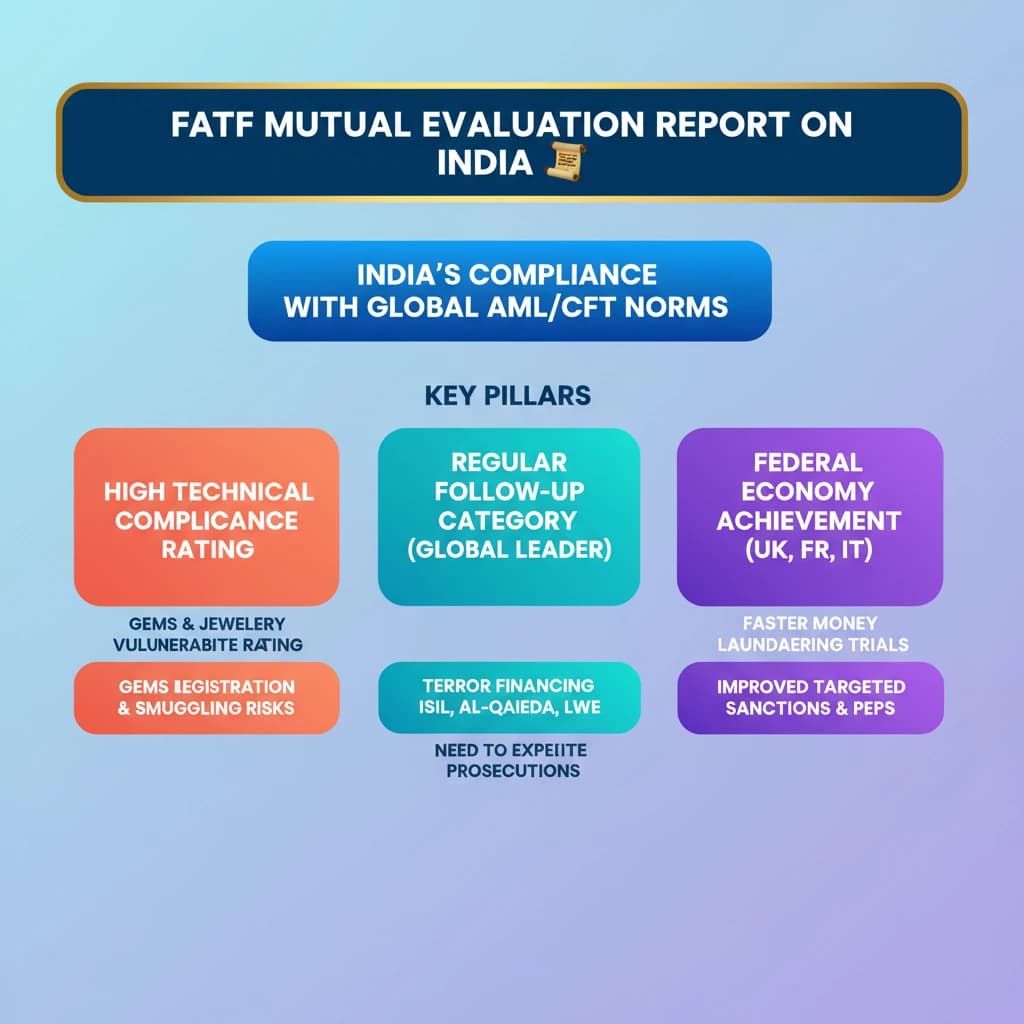
💡 Key Takeaways
- •India achieved 'high level of technical compliance' in FATF's Mutual Evaluation Report, placed in 'regular follow-up' category.
- •India is the only major federal economy to achieve the highest FATF rating, alongside UK, France, Italy.
- •Key vulnerabilities identified in Gems and Jewellery sector due to low registration and cross-border smuggling risks.
- •Significant terrorist financing threats from ISIL, Al-Qaeda, NE insurgencies, and LWE groups; need to expedite prosecutions.
- •FATF recommendations include faster money laundering trials, improved targeted financial sanctions, and defining domestic PEPs.
🧠 Memory Techniques

95% Verified Content
📚 Reference Sources
•FATF Official Website (General information on FATF and Mutual Evaluations)
•Publicly available information on FATF's 2024 Plenary and India's status (inferred from the summary)