Loading page, please wait…
FDI and FPI: Foreign Investment Routes in India - UPSC Economy - UPSC Economy
What is FDI and FPI: Foreign Investment Routes in India - UPSC Economy in UPSC Economy?
FDI and FPI: Foreign Investment Routes in India - UPSC Economy is a key topic under Economy for UPSC Civil Services Examination. Key points include: FDI involves active management control and long-term investment in tangible assets like factories.. FPI is passive, short-term investment in financial assets (stocks, bonds), often called 'hot money' due to its volatility.. FDI in India operates via Automatic Route (no prior approval) and Government Route (prior approval required for sensitive sectors).. Understanding this topic is essential for both UPSC Prelims and Mains preparation.
Why is FDI and FPI: Foreign Investment Routes in India - UPSC Economy important for UPSC exam?
FDI and FPI: Foreign Investment Routes in India - UPSC Economy is a Medium-level topic in UPSC Economy. It is tested in both Prelims (factual MCQs) and Mains (analytical answer writing). Previous year UPSC questions have frequently covered aspects of FDI and FPI: Foreign Investment Routes in India - UPSC Economy, making it essential for comprehensive IAS preparation.
How to prepare FDI and FPI: Foreign Investment Routes in India - UPSC Economy for UPSC?
To prepare FDI and FPI: Foreign Investment Routes in India - UPSC Economy for UPSC: (1) Study the comprehensive notes covering all key concepts on Vaidra. (2) Practice previous year questions on this topic. (3) Connect it with current affairs using daily updates. (4) Revise using key takeaways and mind maps available for Economy. (5) Write practice answers linking FDI and FPI: Foreign Investment Routes in India - UPSC Economy to related GS Paper topics.
Key takeaways of FDI and FPI: Foreign Investment Routes in India - UPSC Economy for UPSC
- FDI involves active management control and long-term investment in tangible assets like factories.
- FPI is passive, short-term investment in financial assets (stocks, bonds), often called 'hot money' due to its volatility.
- FDI in India operates via Automatic Route (no prior approval) and Government Route (prior approval required for sensitive sectors).
- Government approval is mandatory for FDI from countries sharing a land border with India for national security reasons.
- SEBI regulates FPI, while DPIIT and RBI administer FDI policies and approvals.
- FDI brings sustainable growth, technology, and jobs; FPI provides market liquidity but can lead to capital market volatility.
FDI and FPI: Foreign Investment Routes in India - UPSC Economy
Medium⏱️ 8 min read
economy
📖 Introduction
Understanding Foreign Direct Investment (FDI)
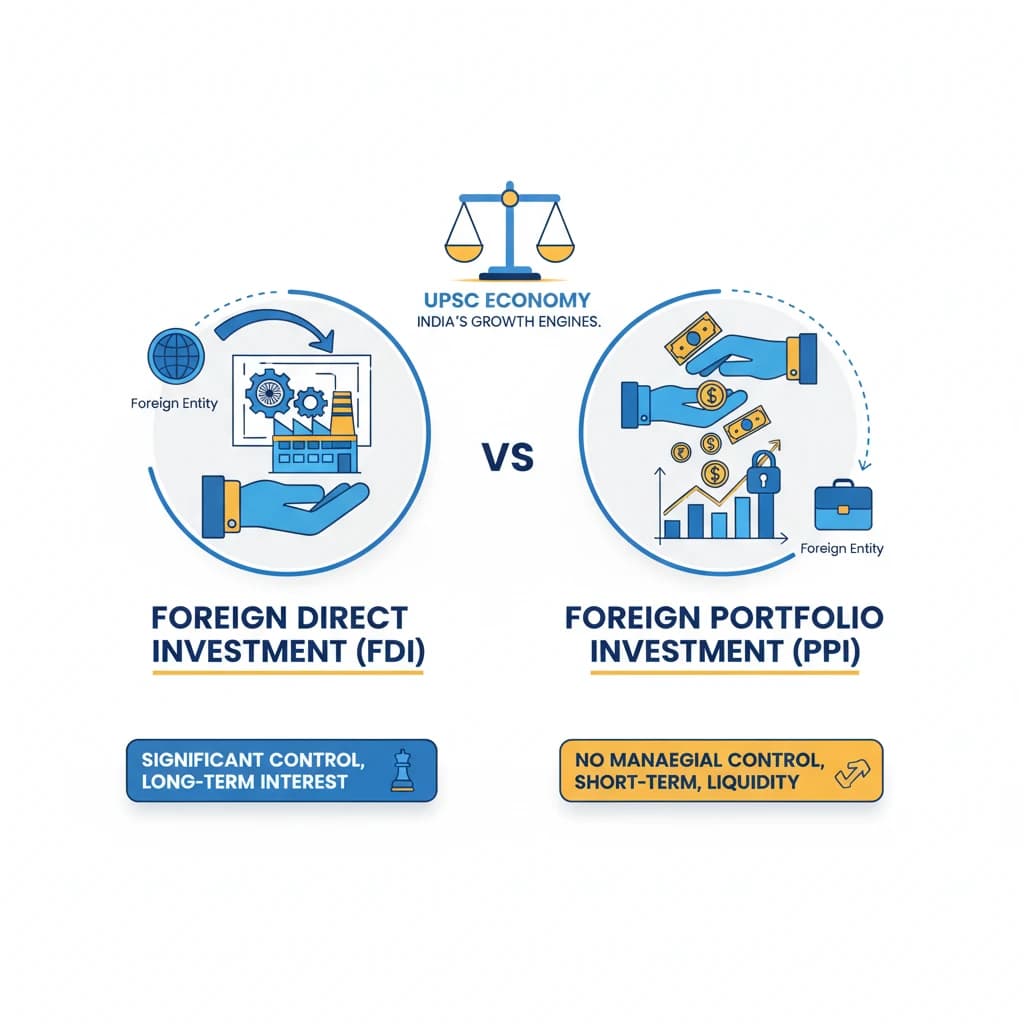
Foreign Direct Investment (FDI) refers to an investment made by a foreign entity or individual in a business or asset located in a different country. This typically involves gaining a lasting management interest and a significant degree of influence.
FDI implies a significant degree of control over the management of the domestic company, unlike portfolio investments which are purely financial.
FDI Routes in India
In India, FDI can be made through two primary routes, depending on the sector and investment threshold, ensuring a structured approach to foreign capital.
Automatic Route
Under the Automatic Route, foreign investors do not require prior approval from the Government of India or the Reserve Bank of India (RBI) for their investments.
Up to 100% FDI is allowed in many non-critical sectors via this route, streamlining the investment process and promoting ease of doing business.
Government Route
The Government Route necessitates prior approval from the Government of India. This is mandatory for investments in certain sensitive sectors or when investment limits exceed specific thresholds, ensuring strategic oversight.
Proposals under this route are administered by the Department for Promotion of Industry and Internal Trade (DPIIT) and the RBI, which review and recommend approvals.
Sector-Specific FDI Approvals
FDI limits and routes vary significantly across different sectors, reflecting India's calibrated approach to foreign investment.
- Banking (Private Sector): Up to 49% via Automatic Route; above 49% and above 74% require Government approval.
- Defence: Up to 74% via Automatic Route; above 74% requires Government approval, particularly for critical technologies.
- Healthcare (Brownfield): Up to 74% via Automatic Route; above 74% requires Government approval, ensuring domestic control in key services.
- Insurance: Up to 74% via Automatic Route; above 74% requires Government approval, maintaining regulatory oversight.
Role of Foreign Investment Promotion Board (FIPB) & FIFP
Historically, the Foreign Investment Promotion Board (FIPB), under the Ministry of Finance, was responsible for processing FDI proposals requiring government approval.
Although FIPB was abolished in 2017, its functions are now facilitated through the Foreign Investment Facilitation Portal (FIFP), ensuring a single-window clearance for government-approved FDI proposals.
Government's prior approval is mandatory for FDIs from countries sharing a land border with India. These countries include Pakistan, China, Nepal, Bhutan, Myanmar, and Afghanistan. This measure enhances national security and prevents opportunistic takeovers.
Key FDI Trends in India (FY 2022-23)
Understanding the sources and sectors attracting FDI provides crucial insight into India's economic landscape and investment priorities.
India’s Top 5 FDI Sources (FY 2022-23):
- Mauritius
- Singapore
- USA
- Netherlands
- Japan
India’s Top Sectors Attracting FDI (FY 2022-23):
- Service Sector
- Computer Software & Hardware
- Trading
- Telecommunications
- Automobile Industry
Understanding Foreign Portfolio Investment (FPI)
Foreign Portfolio Investment (FPI) involves investments made by foreign individuals, institutions, or funds in the financial assets of another country.
Unlike FDI, FPI is often characterized as “Hot Money” due to its short-term nature and quick entry/exit from the market, driven by immediate returns and market sentiments.
Important Features of FPI
FPI has distinct characteristics that differentiate it significantly from Foreign Direct Investment.
- No Ownership Control: Investors purchase financial assets without gaining ownership or significant control over the management of the underlying company.
- Passive Investment: It is a passive investment approach, focusing purely on financial returns rather than operational involvement or strategic influence.
- Returns: Investors earn returns primarily through dividends, interest payments, and capital gains from the appreciation of asset values.
- Examples: Common FPI instruments include publicly traded stocks, bonds, mutual funds, and other marketable securities.
Regulatory Body for FPI
In India, the primary regulatory body overseeing Foreign Portfolio Investments is the Securities and Exchange Board of India (SEBI), which ensures market integrity and investor protection.
Key Differences Between FDI and FPI
Understanding the fundamental distinctions between FDI and FPI is crucial for UPSC aspirants to grasp their economic implications.
| Features | FDI (Foreign Direct Investment) | FPI (Foreign Portfolio Investment) |
|---|---|---|
| Nature of Investment | Long-term, strategic commitment | Short-term, speculative in nature |
| Objective | Long-term presence, operational control, and market expansion in the host country | Earning quick returns through price movements in the stock market |
| Control | Significant control over the management and operations of the invested entity | No or limited control over the management; purely financial stake |
| Investments in | Tangible assets (e.g., factories, buildings, machinery, real estate) | Financial assets (e.g., stocks, bonds, mutual funds, derivatives) |
| Returns | Profits, Dividends, and Capital appreciation over an extended period | Dividends, Interest, and Capital appreciation, often with higher volatility |
| Policy Regulations | Strict policies and sector-specific regulations; often requires government approval for sensitive sectors | Easier entry/exit; regulated by capital market authorities (e.g., SEBI) with less stringent entry barriers |
| Impact on Economy | Sustainable technology transfer, job creation, infrastructure development, and economic growth | Short-term impact; primarily affects stock market performance, currency volatility, and capital market liquidity |
💡 Key Takeaways
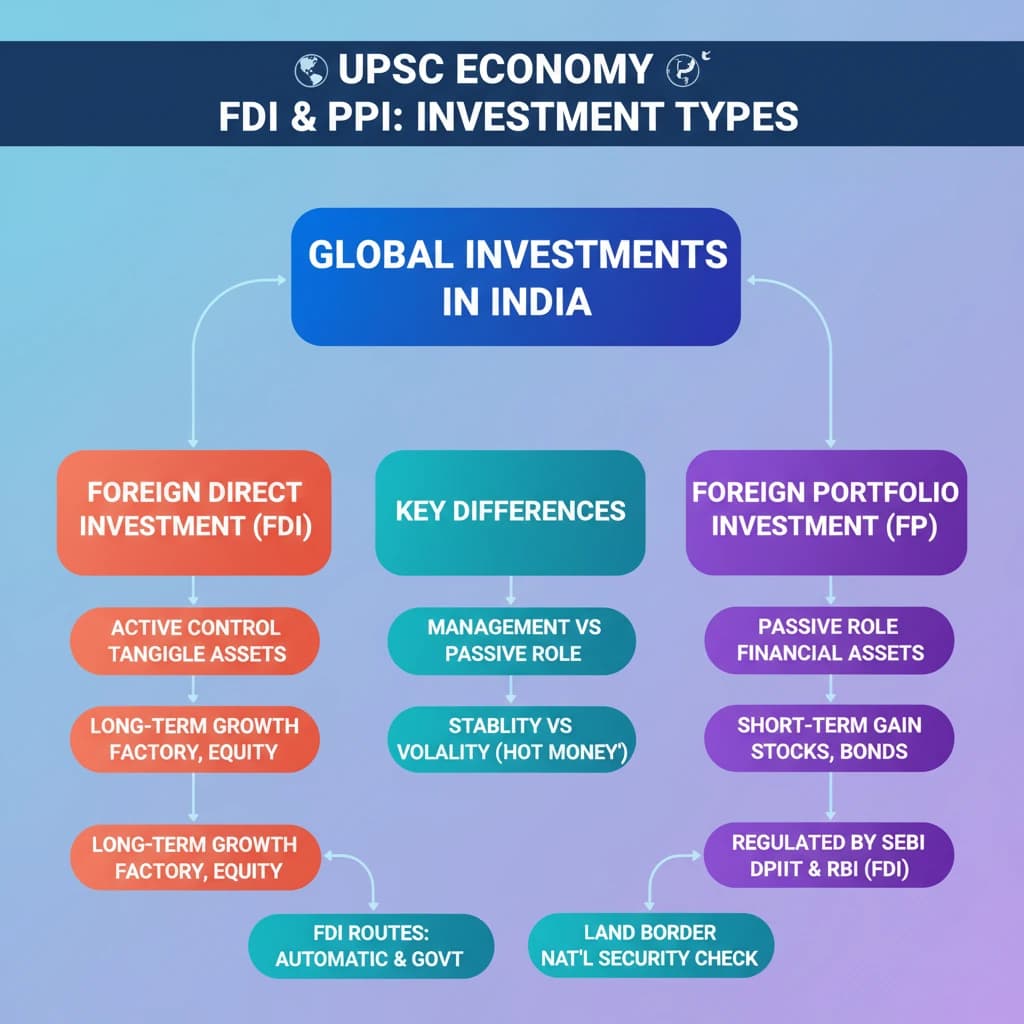
- •FDI involves active management control and long-term investment in tangible assets like factories.
- •FPI is passive, short-term investment in financial assets (stocks, bonds), often called 'hot money' due to its volatility.
- •FDI in India operates via Automatic Route (no prior approval) and Government Route (prior approval required for sensitive sectors).
- •Government approval is mandatory for FDI from countries sharing a land border with India for national security reasons.
- •SEBI regulates FPI, while DPIIT and RBI administer FDI policies and approvals.
- •FDI brings sustainable growth, technology, and jobs; FPI provides market liquidity but can lead to capital market volatility.
🧠 Memory Techniques

95% Verified Content
📚 Reference Sources
•Reserve Bank of India (RBI) official publications
•Department for Promotion of Industry and Internal Trade (DPIIT) annual reports
•Securities and Exchange Board of India (SEBI) regulations