Loading page, please wait…
HomeCurrent AffairsEditorialsGovt SchemesLearning ResourcesUPSC SyllabusPricingAboutBest UPSC AIUPSC AI ToolAI for UPSCUPSC ChatGPT

© 2026 Vaidra. All rights reserved.

PrivacyTerms
Vaidra Logo
Vaidra

Top 4 items + smart groups

UPSC GPT
New
Current Affairs
Daily Solutions
Daily Puzzle
Mains Evaluator

Version 2.0.0 • Built with ❤️ for UPSC aspirants

Indian Delegation Visits Washington (20‑23 Apr 2026) to Finalise Interim Trade Deal with the United States

Indian Delegation Visits Washington (20‑23 Apr 2026) to Finalise Interim Trade Deal with the United States
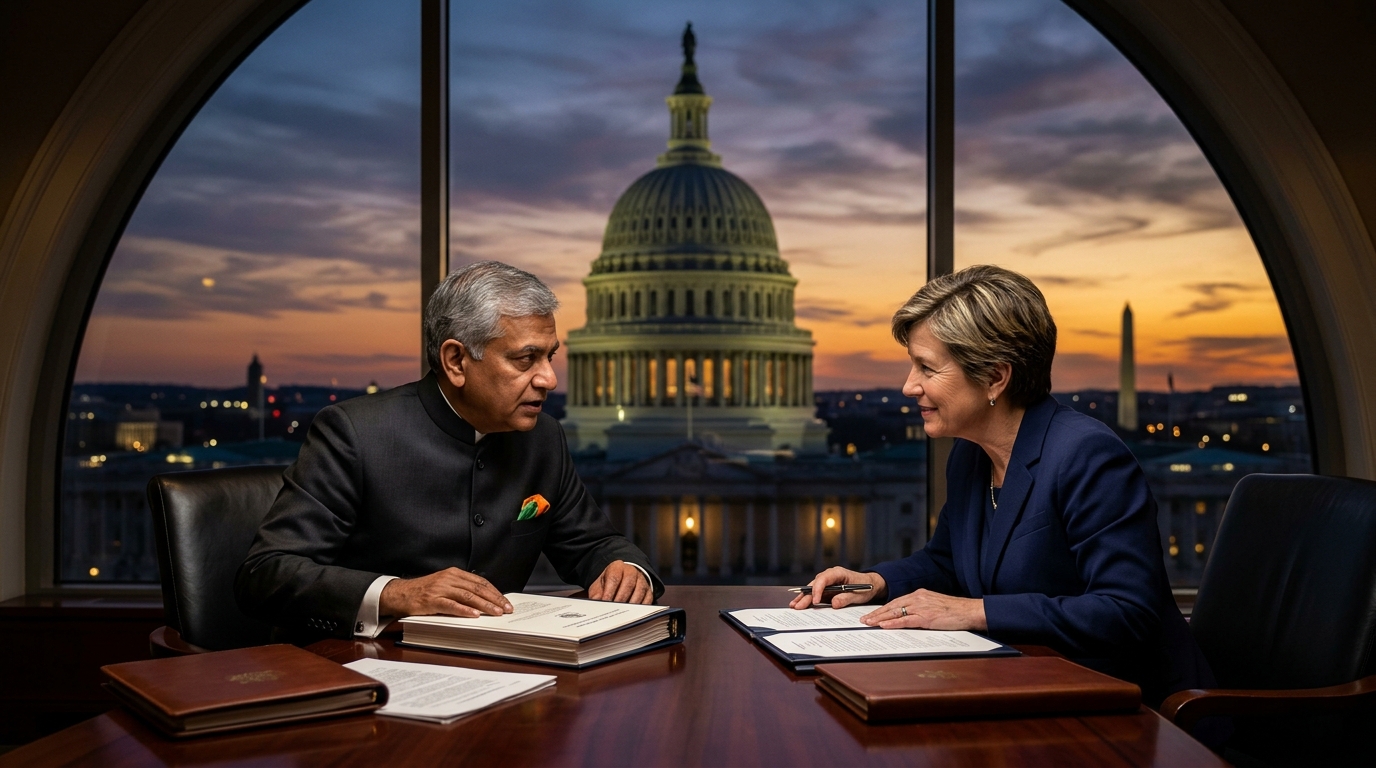
From 20‑23 April 2026, an Indian delegation met U.S. officials in Washington to finalise an Interim Agreement under the broader India‑U.S. Bilateral Trade Agreement. Discussions spanned market access, non‑tariff measures, technical barriers, customs facilitation, investment and digital trade, with both sides committing to sustain the momentum of negotiations.
India‑U.S. Trade Talks: Interim Agreement Progress From 20‑23 April 2026 , an Indian delegation led by senior officials of the Ministry of Commerce & Industry met U.S. counterparts in Washington D.C. to cement the details of an Interim Agreement under the larger Bilateral Trade Agreement (BTA) between India and the United States. Key Developments Both sides reaffirmed the 7 February 2026 Joint Statement that set the framework for the Interim Agreement. Discussions covered Market Access , Non‑Tariff Measures , and Technical Barriers to Trade . Areas of cooperation on Customs and Trade Facilitation , investment promotion, economic‑security alignment, and Digital trade were also on the agenda. Meetings were described as constructive, with both parties committing to maintain momentum and continue negotiations. Important Facts The delegation’s visit was the first in‑person round of talks since the February Joint Statement. No quantitative concessions were disclosed, but the emphasis on forward‑looking dialogue signals a willingness to address lingering trade barriers. The discussions were held in a "positive spirit" and aimed at finalising the Interim Agreement’s operational details. UPSC Relevance Understanding the India‑U.S. trade trajectory is vital for GS‑3 (Economy) and GS‑2 (Polity) aspirants. The negotiations illustrate how bilateral treaties are used to deepen economic ties, diversify export markets, and attract foreign investment. They also highlight the role of non‑tariff measures and technical standards in shaping trade policy – topics frequently examined in the UPSC syllabus under "International Trade" and "Trade Agreements". Way Forward Both governments have pledged to stay engaged, with the expectation that the Interim Agreement will be signed shortly, paving the way for a comprehensive BTA. Continued dialogue on digital trade and investment promotion is likely to feature in future rounds, reinforcing the strategic partnership between the two economies.
  1. Home
  2. Prepare
  3. Current Affairs
  4. Indian Delegation Visits Washington (20‑23 Apr 2026) to Finalise Interim Trade Deal with the United States
Must Review
Login to bookmark articles
Login to mark articles as complete

Overview

gs.gs180% UPSC Relevance

India‑U.S. interim trade talks aim to boost market access and strategic economic partnership.

Key Facts

  1. 20‑23 April 2026: Indian senior officials from the Ministry of Commerce & Industry met U.S. counterparts in Washington D.C.
  2. The talks reaffirmed the 7 February 2026 Joint Statement that set the framework for an Interim Trade Agreement.
  3. Key agenda items included market access, non‑tariff measures, technical barriers to trade, customs and trade facilitation, investment promotion and digital trade.
  4. It was the first in‑person round of negotiations since the February Joint Statement; no quantitative concessions were disclosed.
  5. The delegation aimed to finalise operational details of the Interim Agreement, a provisional step towards a comprehensive Bilateral Trade Agreement (BTA).
  6. Both sides pledged to maintain momentum, with the Interim Agreement expected to be signed shortly, paving the way for a full BTA.
  7. The negotiations underscore India’s strategy to diversify export markets, attract FDI and align economic‑security interests with the United States.

Background & Context

Bilateral trade agreements are a core tool for deepening economic ties and shaping trade policy. An interim pact allows immediate, mutually beneficial measures while broader negotiations on tariffs, services, investment and regulatory alignment continue, reflecting India's push for market diversification and strategic partnership with the U.S.

Mains Answer Angle

GS‑3 (Economy) – Analyse how the India‑U.S. interim trade agreement can influence India’s export competitiveness, foreign investment inflows and regulatory reforms, and discuss the strategic implications for India’s economic security.

Full Article

<h2>India‑U.S. Trade Talks: Interim Agreement Progress</h2> <p>From <strong>20‑23 April 2026</strong>, an Indian delegation led by senior officials of the <strong>Ministry of Commerce &amp; Industry</strong> met U.S. counterparts in Washington D.C. to cement the details of an <span class="key-term" data-definition="Interim Agreement – A provisional trade pact that outlines immediate, mutually beneficial measures while broader negotiations continue (GS3: Economy)">Interim Agreement</span> under the larger <span class="key-term" data-definition="Bilateral Trade Agreement (BTA) – A negotiated treaty between two countries to enhance trade flows, covering tariffs, services, investment and regulatory issues (GS3: Economy)">Bilateral Trade Agreement (BTA)</span> between India and the United States.</p> <h3>Key Developments</h3> <ul> <li>Both sides reaffirmed the <strong>7 February 2026</strong> Joint Statement that set the framework for the Interim Agreement.</li> <li>Discussions covered <span class="key-term" data-definition="Market Access – The ability of exporters to sell goods and services in a partner country without undue restrictions (GS3: Economy)">Market Access</span>, <span class="key-term" data-definition="Non‑Tariff Measures (NTMs) – Policy tools other than tariffs, such as quotas or standards, that can affect trade flows (GS3: Economy)">Non‑Tariff Measures</span>, and <span class="key-term" data-definition="Technical Barriers to Trade (TBT) – Standards, testing and certification requirements that can impede the free flow of goods (GS3: Economy)">Technical Barriers to Trade</span>.</li> <li>Areas of cooperation on <span class="key-term" data-definition="Customs and Trade Facilitation – Procedures that simplify customs clearance and reduce transaction costs, enhancing trade efficiency (GS3: Economy)">Customs and Trade Facilitation</span>, investment promotion, economic‑security alignment, and <span class="key-term" data-definition="Digital trade – Commercial transactions conducted electronically, encompassing data flows, e‑services and cross‑border digital platforms (GS3: Economy)">Digital trade</span> were also on the agenda.</li> <li>Meetings were described as constructive, with both parties committing to maintain momentum and continue negotiations.</li> </ul> <h3>Important Facts</h3> <p>The delegation’s visit was the first in‑person round of talks since the February Joint Statement. No quantitative concessions were disclosed, but the emphasis on forward‑looking dialogue signals a willingness to address lingering trade barriers. The discussions were held in a "positive spirit" and aimed at finalising the Interim Agreement’s operational details.</p> <h3>UPSC Relevance</h3> <p>Understanding the India‑U.S. trade trajectory is vital for GS‑3 (Economy) and GS‑2 (Polity) aspirants. The negotiations illustrate how bilateral treaties are used to deepen economic ties, diversify export markets, and attract foreign investment. They also highlight the role of non‑tariff measures and technical standards in shaping trade policy – topics frequently examined in the UPSC syllabus under "International Trade" and "Trade Agreements".</p> <h3>Way Forward</h3> <p>Both governments have pledged to stay engaged, with the expectation that the Interim Agreement will be signed shortly, paving the way for a comprehensive BTA. Continued dialogue on digital trade and investment promotion is likely to feature in future rounds, reinforcing the strategic partnership between the two economies.</p>
Read Original on pib

Analysis

Practice Questions

Prelims
Easy
Prelims MCQ

India‑U.S. Bilateral Trade Agreement

1 marks
5 keywords
GS3
Medium
Mains Short Answer

Trade negotiations – agenda items

5 marks
6 keywords
GS3
Hard
Mains Essay

Strategic economic partnership and trade policy reforms

20 marks
6 keywords
Related:Daily•Weekly

Loading related articles...

Loading related articles...

Tip: Click articles above to read more from the same date, or use the back button to see all articles.

Quick Reference

Key Insight

India‑U.S. interim trade talks aim to boost market access and strategic economic partnership.

Key Facts

  1. 20‑23 April 2026: Indian senior officials from the Ministry of Commerce & Industry met U.S. counterparts in Washington D.C.
  2. The talks reaffirmed the 7 February 2026 Joint Statement that set the framework for an Interim Trade Agreement.
  3. Key agenda items included market access, non‑tariff measures, technical barriers to trade, customs and trade facilitation, investment promotion and digital trade.
  4. It was the first in‑person round of negotiations since the February Joint Statement; no quantitative concessions were disclosed.
  5. The delegation aimed to finalise operational details of the Interim Agreement, a provisional step towards a comprehensive Bilateral Trade Agreement (BTA).
  6. Both sides pledged to maintain momentum, with the Interim Agreement expected to be signed shortly, paving the way for a full BTA.
  7. The negotiations underscore India’s strategy to diversify export markets, attract FDI and align economic‑security interests with the United States.

Background

Bilateral trade agreements are a core tool for deepening economic ties and shaping trade policy. An interim pact allows immediate, mutually beneficial measures while broader negotiations on tariffs, services, investment and regulatory alignment continue, reflecting India's push for market diversification and strategic partnership with the U.S.

Mains Angle

GS‑3 (Economy) – Analyse how the India‑U.S. interim trade agreement can influence India’s export competitiveness, foreign investment inflows and regulatory reforms, and discuss the strategic implications for India’s economic security.

Explore:Current Affairs·Editorial Analysis·Govt Schemes·Study Materials·Previous Year Questions·UPSC GPT
Indian Delegation Visits Washington (20‑23... | UPSC Current Affairs

Related Topics

  • 📰Current AffairsIndia-U.S. Trade Talks Conclude in Washington; Interim Agreement Framework Set
  • 📚Subject TopicFDI and FPI: Foreign Investment Routes in India - UPSC Economy
  • 📰Current AffairsMinistry of Commerce & Industry’s ICI Shows 0.4% Decline in March 2026 – Sectoral Highlights