Loading page, please wait…
Hybrid Electric Vehicle (HEV) - UPSC Economy
What is Hybrid Electric Vehicle (HEV) in UPSC Economy?
Hybrid Electric Vehicle (HEV) is a key topic under Economy for UPSC Civil Services Examination. Key points include: Hybrid Electric Vehicles (HEVs) are also known as Strong Hybrid EVs.. They combine an internal combustion (petrol) engine and a battery-powered electric motor.. The petrol engine drives the vehicle and recharges the battery when empty.. Understanding this topic is essential for both UPSC Prelims and Mains preparation.
Why is Hybrid Electric Vehicle (HEV) important for UPSC exam?
Hybrid Electric Vehicle (HEV) is a Easy-level topic in UPSC Economy. It is tested in both Prelims (factual MCQs) and Mains (analytical answer writing). Previous year UPSC questions have frequently covered aspects of Hybrid Electric Vehicle (HEV), making it essential for comprehensive IAS preparation.
How to prepare Hybrid Electric Vehicle (HEV) for UPSC?
To prepare Hybrid Electric Vehicle (HEV) for UPSC: (1) Study the comprehensive notes covering all key concepts on Vaidra. (2) Practice previous year questions on this topic. (3) Connect it with current affairs using daily updates. (4) Revise using key takeaways and mind maps available for Economy. (5) Write practice answers linking Hybrid Electric Vehicle (HEV) to related GS Paper topics.
Key takeaways of Hybrid Electric Vehicle (HEV) for UPSC
- Hybrid Electric Vehicles (HEVs) are also known as Strong Hybrid EVs.
- They combine an internal combustion (petrol) engine and a battery-powered electric motor.
- The petrol engine drives the vehicle and recharges the battery when empty.
- HEVs are more efficient than conventional cars but less efficient than fully electric or plug-in hybrid vehicles.
- They serve as a crucial transitional technology towards cleaner mobility.
Hybrid Electric Vehicle (HEV)
Easy⏱️ 5 min read
economy
📖 Introduction
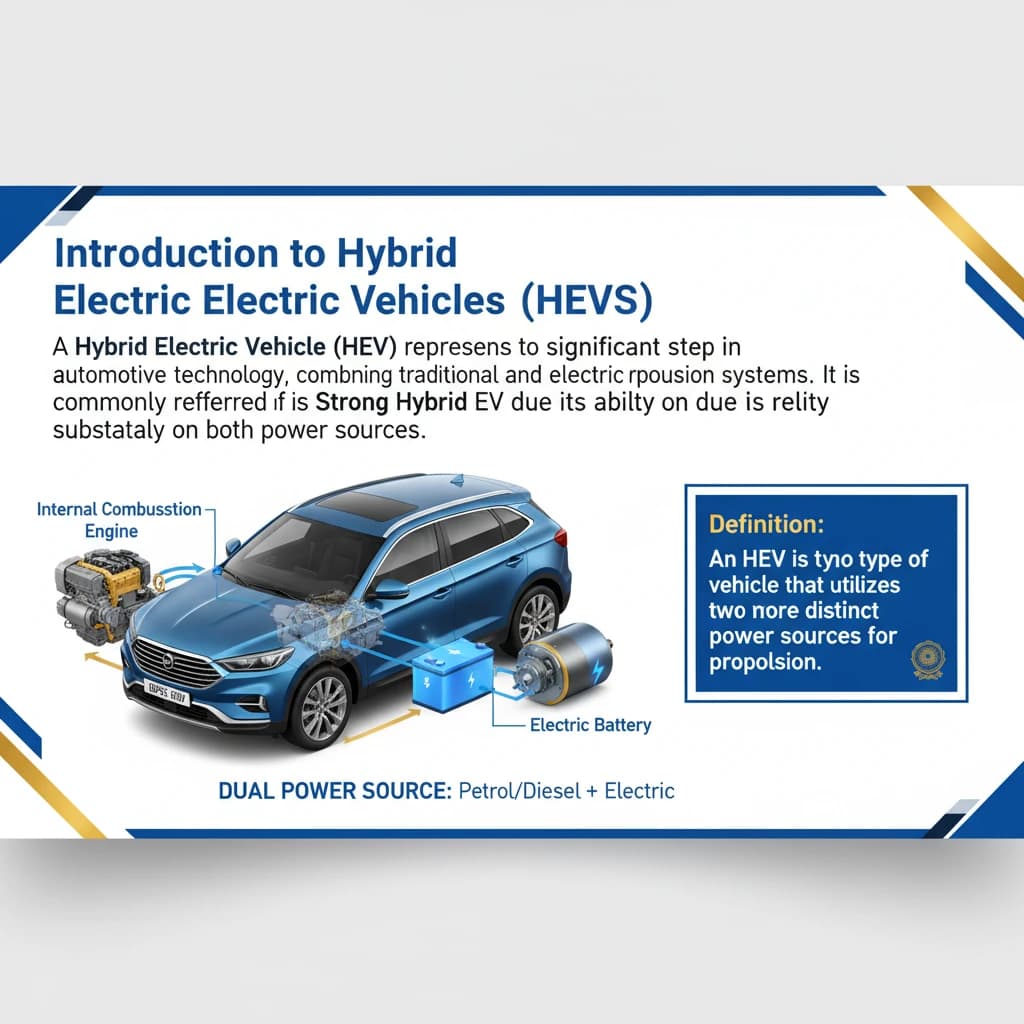
Introduction to Hybrid Electric Vehicles (HEVs)
A Hybrid Electric Vehicle (HEV) represents a significant step in automotive technology, combining traditional and electric propulsion systems. It is commonly referred to as a Strong Hybrid EV due to its ability to rely substantially on both power sources.
Definition: An HEV is a type of vehicle that utilizes two or more distinct power sources to propel the vehicle, most commonly an Internal Combustion Engine (ICE) and an electric motor.
Core Components and Powertrain
The fundamental design of an HEV integrates a conventional internal combustion (usually petrol) engine with a battery-powered electric motor powertrain. This dual-system approach allows for optimized performance and efficiency under various driving conditions.
Key Feature: The powertrain of an HEV is characterized by its hybrid nature, seamlessly switching between or combining power from the petrol engine and the electric motor.
Operational Mechanism of HEVs
In an HEV, the petrol engine serves a dual purpose. It not only provides power to drive the vehicle directly but also acts as a generator to charge the battery when its energy levels are low. This ensures continuous operation without the need for external charging infrastructure.
- The electric motor can propel the vehicle at lower speeds or assist the engine during acceleration.
- The petrol engine takes over at higher speeds or when more power is required, simultaneously recharging the battery.
Efficiency Considerations of HEVs
While offering improved fuel economy compared to conventional ICE vehicles, HEVs are generally not as efficient as their fully electric counterparts or Plug-in Hybrid Electric Vehicles (PHEVs). This is primarily due to the continued reliance on fossil fuels and the energy losses associated with converting mechanical energy to electrical energy for battery charging.
UPSC Insight: When comparing vehicle technologies, remember that HEVs offer a middle ground. They provide better efficiency than traditional cars but fall short of the environmental benefits and energy efficiency of Battery Electric Vehicles (BEVs) and PHEVs, which have larger batteries and external charging capabilities. This distinction is crucial for questions on sustainable transportation.
💡 Key Takeaways
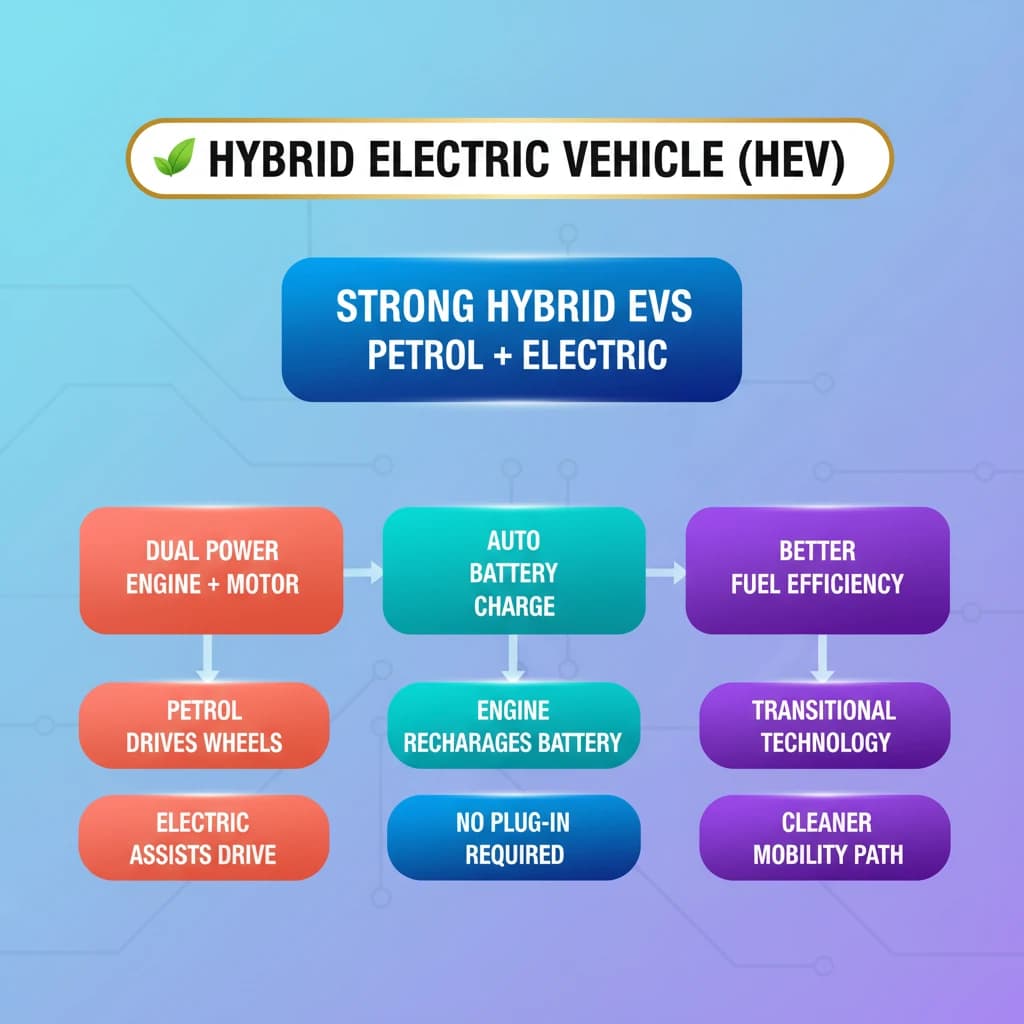
- •Hybrid Electric Vehicles (HEVs) are also known as Strong Hybrid EVs.
- •They combine an internal combustion (petrol) engine and a battery-powered electric motor.
- •The petrol engine drives the vehicle and recharges the battery when empty.
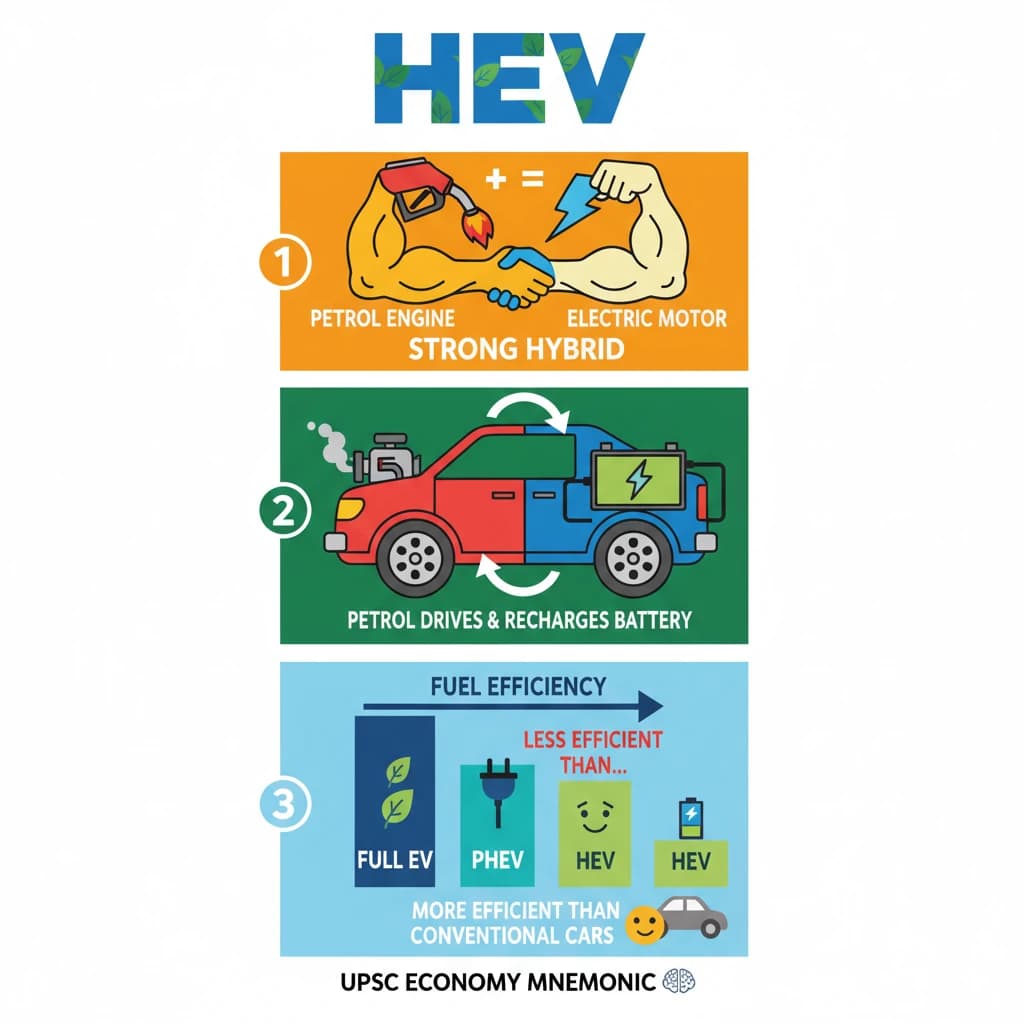
- •HEVs are more efficient than conventional cars but less efficient than fully electric or plug-in hybrid vehicles.
- •They serve as a crucial transitional technology towards cleaner mobility.
🧠 Memory Techniques
95% Verified Content
📚 Reference Sources
•General knowledge of automotive technology and environmental policies (e.g., FAME India)