Loading page, please wait…
Infrastructure Development in India - UPSC Economy
What is Infrastructure Development in India in UPSC Economy?
Infrastructure Development in India is a key topic under Economy for UPSC Civil Services Examination. Key points include: India's infrastructure investment is projected to reach Rs 11.2 lakh crore in 2025-26, showing significant growth.. Budget 2025-26 introduced key initiatives like the National Monetisation Plan (Rs 10 lakh crore assets) and Urban Challenge Fund (Rs 1 lakh crore).. Railways aim for 100% electrification by FY 2025-26 and becoming the 2nd-largest cargo carrier globally.. Understanding this topic is essential for both UPSC Prelims and Mains preparation.
Why is Infrastructure Development in India important for UPSC exam?
Infrastructure Development in India is a Medium-level topic in UPSC Economy. It is tested in both Prelims (factual MCQs) and Mains (analytical answer writing). Previous year UPSC questions have frequently covered aspects of Infrastructure Development in India, making it essential for comprehensive IAS preparation.
How to prepare Infrastructure Development in India for UPSC?
To prepare Infrastructure Development in India for UPSC: (1) Study the comprehensive notes covering all key concepts on Vaidra. (2) Practice previous year questions on this topic. (3) Connect it with current affairs using daily updates. (4) Revise using key takeaways and mind maps available for Economy. (5) Write practice answers linking Infrastructure Development in India to related GS Paper topics.
Key takeaways of Infrastructure Development in India for UPSC
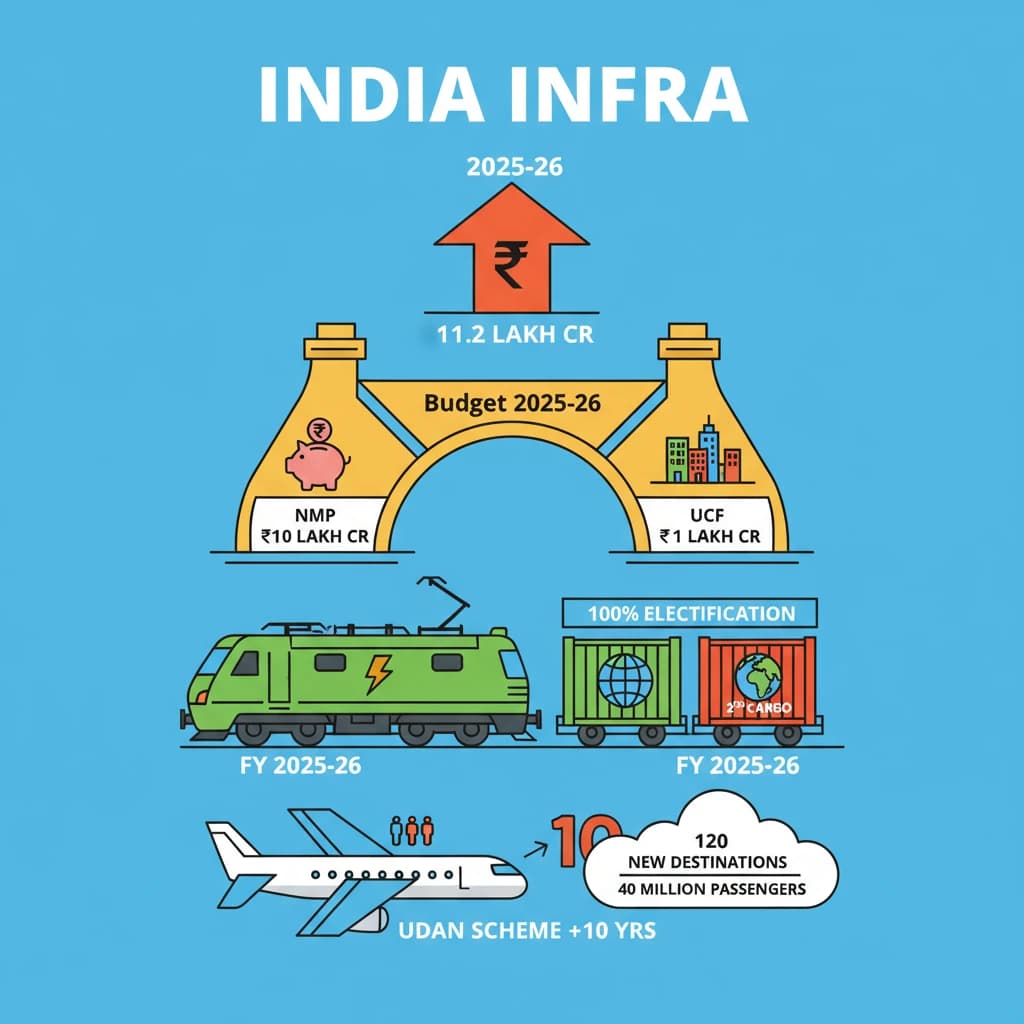
- India's infrastructure investment is projected to reach Rs 11.2 lakh crore in 2025-26, showing significant growth.
- Budget 2025-26 introduced key initiatives like the National Monetisation Plan (Rs 10 lakh crore assets) and Urban Challenge Fund (Rs 1 lakh crore).
- Railways aim for 100% electrification by FY 2025-26 and becoming the 2nd-largest cargo carrier globally.
- UDAN scheme extended for 10 years, targeting 120 new destinations and 40 million more passengers.
- India has the 2nd-largest road network globally, with NH construction pace increasing significantly to ~28.6 km/day.
- Operational airports increased from 74 (2014) to 157 (2024), making India the 3rd-largest domestic aviation market.
Infrastructure Development in India
Medium⏱️ 10 min read
economy
📖 Introduction
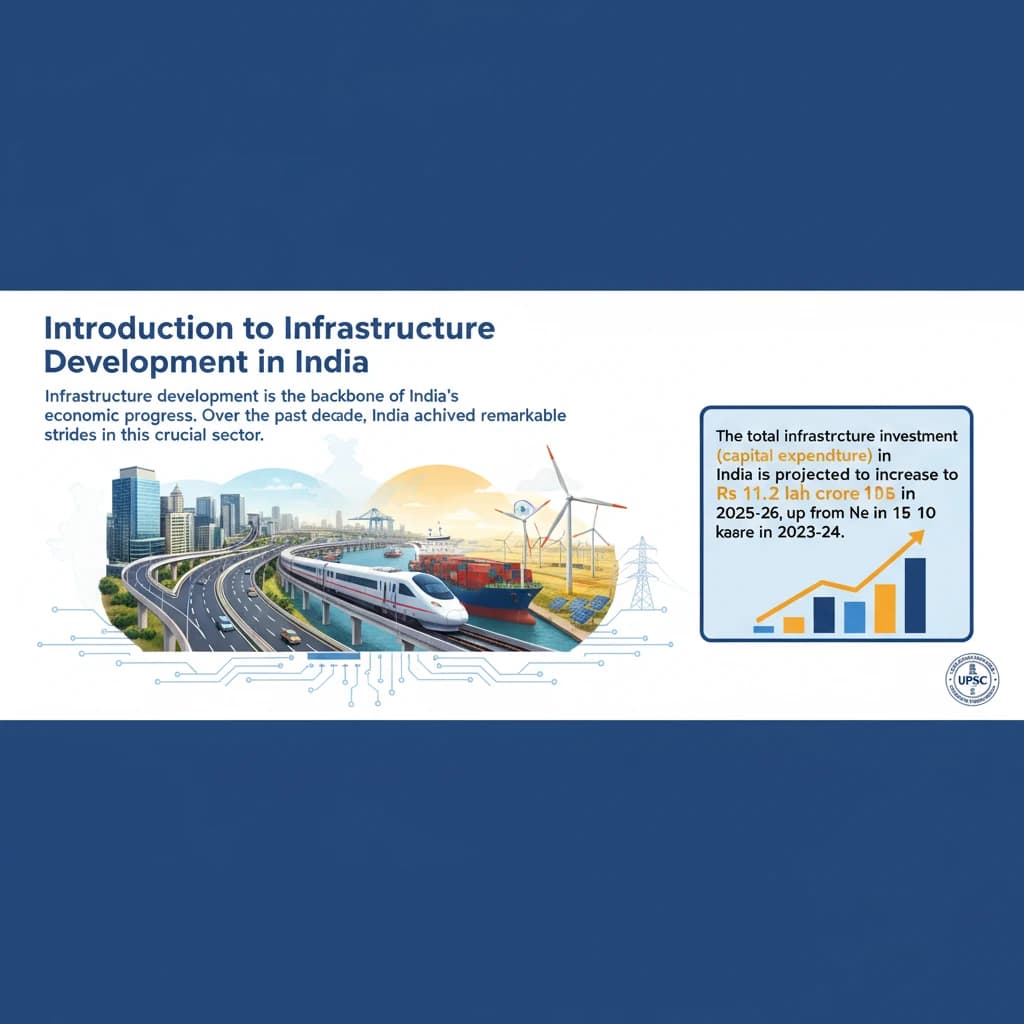
Introduction to Infrastructure Development in India
Infrastructure development is the backbone of India's economic progress. Over the past decade, India has achieved remarkable strides in this crucial sector.
The total infrastructure investment (capital expenditure) in India is projected to increase to Rs 11.2 lakh crore in 2025-26, up from Rs 10 lakh crore in 2023-24.
Budget 2025-26: Key Infrastructure Initiatives
The Budget 2025-26 introduced several significant initiatives aimed at bolstering infrastructure across various sectors.
Infrastructure Financing
A major focus is on innovative financing mechanisms to fund large-scale projects.
- Under the National Monetisation Plan, assets worth Rs 10 lakh crore are targeted for monetisation over the next five years (2025-30).
- The government will provide certainty in the taxation of Alternative Investment Funds (AIFs) specifically for infrastructure projects, encouraging private investment.
- States are encouraged to propose projects for funding through India Infrastructure Project Development Fund (IIPDF) loans.
Urban Development Initiatives
To address the challenges and opportunities in urban areas, new funds and strategies are being implemented.
- An Urban Challenge Fund of Rs 1 lakh crore will be established.
- This fund aims to implement proposals focused on 'cities as growth hubs', 'creative redevelopment of cities', and 'smart urbanisation'.
Railways Sector Enhancements
The Indian Railways is set for significant upgrades and expansion.
- India aims to become the 2nd-largest cargo-carrying railway globally, after China.
- There is a push towards producing indigenous high-speed ‘bullet’ trains.
- The Indian Railways is on track to achieve 100% electrification of its network by FY 2025-26.
Shipbuilding Industry Support
Measures are being introduced to boost the domestic shipbuilding sector.
- A fund of Rs 25,000 crore will be established to support the maritime industry, promoting competition and long-term financing.
- Large ships will be granted infrastructure status, which can reduce financial costs by up to 10 percentage points.
Infrastructure status enables better financing options, tax benefits, enhanced government support, and fewer regulatory hurdles for projects.
- Credit notes will be introduced for shipbuilding in Indian yards to foster a circular economy.
Credit notes are typically used when goods are returned. In shipbuilding, they can help companies involved in shipbreaking to return or recycle materials like steel, copper, and aluminum obtained from dismantled ships.
Aviation Sector Expansion
The civil aviation sector continues its growth trajectory with renewed schemes.
- The UDAN scheme has been extended for another 10 years.
- A revamped UDAN scheme aims to connect 120 new destinations, serving an additional 40 million passengers.
- New greenfield airports in Bihar will complement the expansions of Patna and Bihta (in Patna) airports.
Housing Sector Acceleration
Efforts are underway to complete pending housing projects.
- SWAMIH Fund 2, with a corpus of Rs 15,000 crore, will be set up.
- This fund, with contributions from the government, banks, and private investors, aims to speed up the completion of 1 lakh incomplete housing units.
Local Economy Empowerment
Support for street vendors and small businesses is being enhanced.
- The PM-SVANidhi scheme will be revamped to provide enhanced loans from banks.
- It will also introduce UPI-linked credit cards with a limit of Rs 30,000 for beneficiaries.
Current Status of Infrastructure Development in India
India has made significant progress across various infrastructure sectors, demonstrating robust growth.
Highways and Roads
India boasts one of the largest road networks globally, with continuous expansion.
- India possesses the 2nd-largest road network globally, surpassed only by the United States.
- The length of National Highways (NH) stood at 1,46,145 km in 2024.
- Operational high-speed corridors have expanded to 2,138 km in 2024.
The pace of NH construction has significantly increased from 12.1 km/day in 2014-15 to an average of 28.6 km/day, reaching 33.8 km/day in 2023-24. Capital expenditure in this sector has risen 5.7 times between 2013-14 and 2023-24.
Railways Electrification and Modernisation
Indian Railways continues its electrification drive and modernisation efforts.
- As of December 2023, 93.83% of the broad-gauge tracks were electrified. This is a substantial increase from 21,801 km in 2014.
A broad-gauge track is also known as a large line, with the distance between the two tracks being 5 feet 6 inches.
- The provision of Bio-toilets in coaches has reached 80,478 coaches between 2014 and 2023, enhancing sanitation.
Civil Aviation Growth
India's civil aviation market has seen rapid expansion, becoming a global leader.
- India is now the 3rd-largest domestic aviation market globally.
- The number of operational airports has increased from 74 in 2014 to 157 in 2024.
- Under the Regional Connectivity Scheme (RCS) - UDAN, approximately 147 lakh passengers had benefited as of December 2024.
💡 Key Takeaways
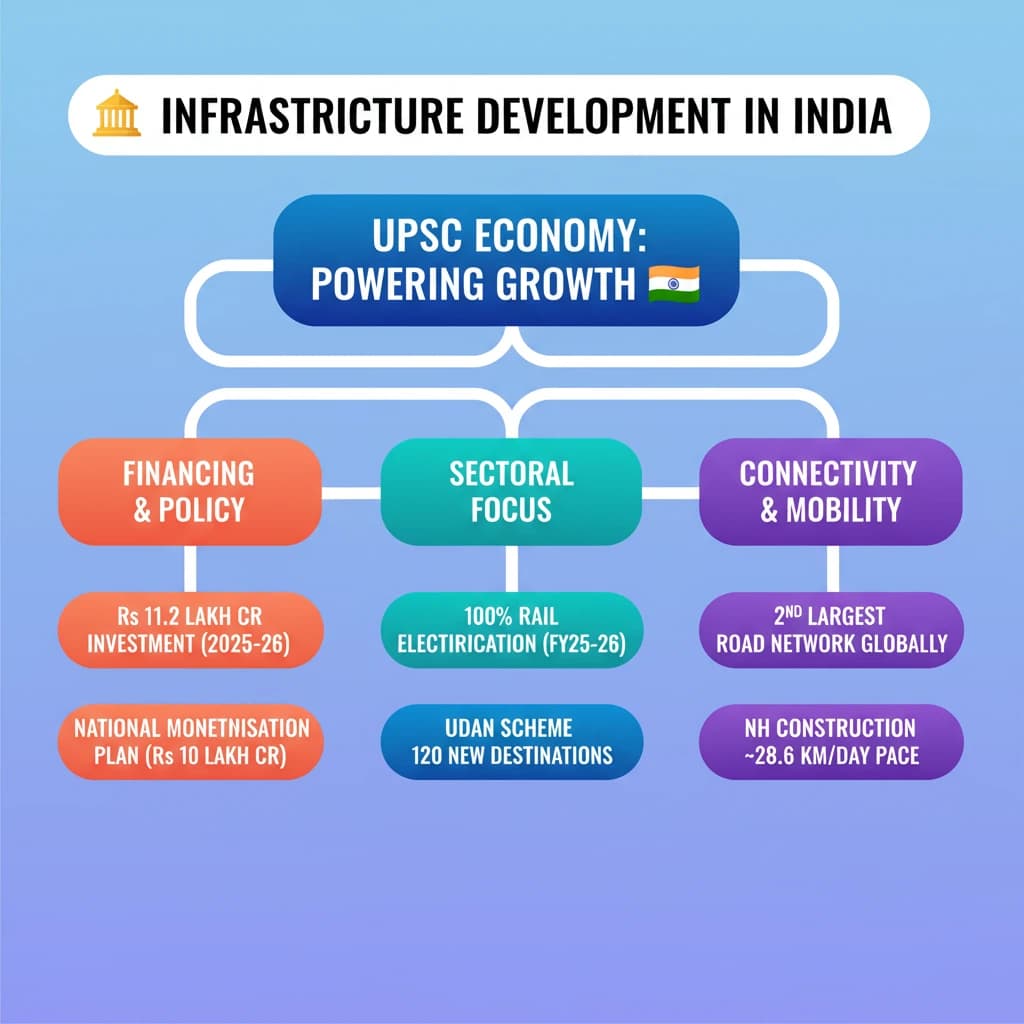
- •India's infrastructure investment is projected to reach Rs 11.2 lakh crore in 2025-26, showing significant growth.
- •Budget 2025-26 introduced key initiatives like the National Monetisation Plan (Rs 10 lakh crore assets) and Urban Challenge Fund (Rs 1 lakh crore).
- •Railways aim for 100% electrification by FY 2025-26 and becoming the 2nd-largest cargo carrier globally.
- •UDAN scheme extended for 10 years, targeting 120 new destinations and 40 million more passengers.
- •India has the 2nd-largest road network globally, with NH construction pace increasing significantly to ~28.6 km/day.
- •Operational airports increased from 74 (2014) to 157 (2024), making India the 3rd-largest domestic aviation market.
🧠 Memory Techniques
95% Verified Content