Loading page, please wait…
HomeCurrent AffairsEditorialsGovt SchemesLearning ResourcesUPSC SyllabusPricingAboutBest UPSC AIUPSC AI ToolAI for UPSCUPSC ChatGPT

© 2026 Vaidra. All rights reserved.

PrivacyTerms
Vaidra Logo
Vaidra

Top 4 items + smart groups

UPSC GPT
New
Current Affairs
Daily Solutions
Daily Puzzle
Mains Evaluator

Version 2.0.0 • Built with ❤️ for UPSC aspirants

TBM Deployment Begins for 16 km Mumbai‑Ahmedabad Bullet Train Tunnel – NHSRCL Progress — UPSC Current Affairs | April 9, 2026
TBM Deployment Begins for 16 km Mumbai‑Ahmedabad Bullet Train Tunnel – NHSRCL Progress
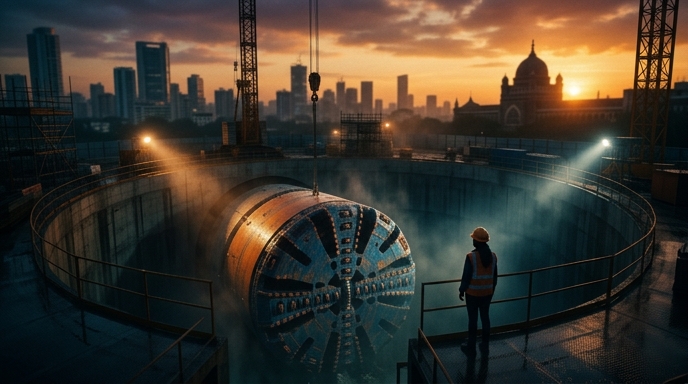
NHSRCL has begun lowering a 170‑tonne shield segment and assembling two massive TBMs to excavate a 16 km tunnel for the Mumbai‑Ahmedabad Bullet Train, including India’s first seven‑km under‑sea stretch. The project highlights advanced tunnelling methods (TBM, NATM) and underscores the importance of high‑speed rail infrastructure for India’s transport agenda (GS3).
Overview The National High Speed Rail Corporation Limited (NHSRCL) has started lowering and assembling a TBM for a 16 km stretch of the Mumbai‑Ahmedabad Bullet Train corridor. The work marks a critical phase in constructing a 21 km tunnel that includes India’s first seven‑km under‑sea segment beneath Thane Creek. Key Developments Lowering of one 170‑tonne shield segment (8.66 m × 7 m) at a depth of 56 m in Vikhroli. Two TBMs will be launched from three shafts: retrieval shaft at BKC, and shafts at Vikhroli and Sawli (near Ghansoli). TBM‑1 will advance from Vikhroli towards BKC; TBM‑2 will move from Sawli towards Vikhroli, creating a single‑tube tunnel of 13.1 m diameter for twin tracks. The tunnel depth will vary between 25 m and 57 m, reaching a maximum of 114 m below Parsik Hill. Important Facts • The 21 km tunnel comprises 5 km built using the NATM and the remaining 16 km via TBM. • Each TBM measures 95.32 m in length and includes a cutter wheel, main bearing, jaw crusher, erector, main shield, tail shield, and four specialised gantries. • Maximum cutter‑head speed is four RPM, delivering an excavation rate of up to 49 mm per minute, ensuring controlled progress and safety. UPSC Relevance The project illustrates the intersection of infrastructure development (GS3) and technology adoption . Understanding TBM technology, NATM, and under‑sea tunnelling helps answer questions on large‑scale transport projects, financing mechanisms, and environmental clearances. The involvement of NHSRCL showcases the role of a dedicated public sector undertaking in executing strategic rail corridors, a topic relevant to governance and public‑private partnership discussions (GS2, GS3). Way Forward • Completion of the remaining TBM‑driven stretch is expected to follow rigorous testing and commissioning, with an emphasis on safety and minimal disruption to surrounding areas. • Continuous monitoring of geological conditions will guide adjustments in tunnelling parameters, especially for the under‑sea segment. • Successful execution will set a precedent for future high‑speed rail and metro projects across India, encouraging the adoption of advanced tunnelling technologies and strengthening the nation’s transport infrastructure.
  1. Home
  2. Prepare
  3. Current Affairs
  4. TBM Deployment Begins for 16 km Mumbai‑Ahmedabad Bullet Train Tunnel – NHSRCL Progress
Login to bookmark articles
Login to mark articles as complete

Overview

gs.gs378% UPSC Relevance

TBM deployment kick‑starts 16 km underground stretch of Mumbai‑Ahmedabad bullet train, boosting high‑speed rail infrastructure

Key Facts

  1. National High Speed Rail Corporation Ltd (NHSRCL) began lowering a 170‑tonne TBM shield segment (8.66 m × 7 m) at 56 m depth in Vikhroli, 2026.
  2. Two TBMs, each over 3,000 tonnes and 95.32 m long, will excavate a 16 km tunnel segment for the Mumbai‑Ahmedabad HSR corridor.
  3. The tunnel will be a single‑tube, 13.1 m diameter, twin‑track tunnel with depth ranging from 25 m to 57 m and a maximum of 114 m below Parsik Hill.
  4. India’s first 7 km under‑sea stretch beneath Thane Creek is part of the 21 km tunnel; 5 km will be built using NATM, the rest by TBM.
  5. Maximum cutter‑head speed of the TBM is 4 rpm, achieving an excavation rate of up to 49 mm per minute.
  6. TBM launch shafts are at BKC (retrieval), Vikhroli and Sawli (near Ghansoli); TBM‑1 advances Vikhroli→BKC, TBM‑2 Sawli→Vikhroli.

Background & Context

The Mumbai‑Ahmedabad bullet train is India's flagship high‑speed rail project, linking two megacities and showcasing advanced tunnelling technologies like TBM and NATM. It aligns with GS‑3's focus on infrastructure development, technology adoption, and the role of PSUs such as NHSRCL in executing strategic transport corridors.

UPSC Syllabus Connections

GS3•Infrastructure - Energy, Ports, Roads, Airports, Railways

Mains Answer Angle

GS‑3: Discuss the challenges and opportunities of deploying advanced tunnelling technologies in large‑scale transport projects, citing the Mumbai‑Ahmedabad bullet train as a case study.

Full Article

<h3>Overview</h3> <p>The <strong>National High Speed Rail Corporation Limited (NHSRCL)</strong> has started lowering and assembling a <span class="key-term" data-definition="Tunnel Boring Machine — a massive mechanized device used to excavate circular tunnels, essential for high‑speed rail and metro projects (GS3: Infrastructure)">TBM</span> for a 16 km stretch of the Mumbai‑Ahmedabad Bullet Train corridor. The work marks a critical phase in constructing a 21 km tunnel that includes India’s first seven‑km under‑sea segment beneath Thane Creek.</p> <h3>Key Developments</h3> <ul> <li>Lowering of one 170‑tonne shield segment (8.66 m × 7 m) at a depth of 56 m in Vikhroli.</li> <li>Two <span class="key-term" data-definition="TBM – the machines, each weighing over 3,000 tonnes, are among the most advanced tunnelling units in India, employing Mix Shield or Slurry technology for difficult geology (GS3: Infrastructure)">TBMs</span> will be launched from three shafts: retrieval shaft at BKC, and shafts at Vikhroli and Sawli (near Ghansoli).</li> <li>TBM‑1 will advance from Vikhroli towards BKC; TBM‑2 will move from Sawli towards Vikhroli, creating a single‑tube tunnel of 13.1 m diameter for twin tracks.</li> <li>The tunnel depth will vary between 25 m and 57 m, reaching a maximum of 114 m below Parsik Hill.</li> </ul> <h3>Important Facts</h3> <p>• The 21 km tunnel comprises 5 km built using the <span class="key-term" data-definition="New Austrian Tunnelling Method — a flexible excavation technique that adapts support to ground conditions, widely taught in civil engineering (GS3: Infrastructure)">NATM</span> and the remaining 16 km via TBM. </p> <p>• Each TBM measures 95.32 m in length and includes a cutter wheel, main bearing, jaw crusher, erector, main shield, tail shield, and four specialised gantries.</p> <p>• Maximum cutter‑head speed is four RPM, delivering an excavation rate of up to 49 mm per minute, ensuring controlled progress and safety.</p> <h3>UPSC Relevance</h3> <p>The project illustrates the intersection of <strong>infrastructure development</strong> (GS3) and <strong>technology adoption</strong>. Understanding TBM technology, NATM, and under‑sea tunnelling helps answer questions on large‑scale transport projects, financing mechanisms, and environmental clearances. The involvement of NHSRCL showcases the role of a dedicated public sector undertaking in executing strategic rail corridors, a topic relevant to governance and public‑private partnership discussions (GS2, GS3).</p> <h3>Way Forward</h3> <p>• Completion of the remaining TBM‑driven stretch is expected to follow rigorous testing and commissioning, with an emphasis on safety and minimal disruption to surrounding areas.</p> <p>• Continuous monitoring of geological conditions will guide adjustments in tunnelling parameters, especially for the under‑sea segment.</p> <p>• Successful execution will set a precedent for future high‑speed rail and metro projects across India, encouraging the adoption of advanced tunnelling technologies and strengthening the nation’s transport infrastructure.</p>
Read Original on hindu

Analysis

Practice Questions

GS1
Medium
Prelims MCQ

Infrastructure – Railways

1 marks
5 keywords
GS3
Easy
Mains Short Answer

Infrastructure – Railways

5 marks
5 keywords
GS3
Hard
Mains Essay

Infrastructure – Railways, Technology Adoption

20 marks
7 keywords
Related:Daily•Weekly

Loading related articles...

Loading related articles...

Tip: Click articles above to read more from the same date, or use the back button to see all articles.

Explore:Current Affairs·Editorial Analysis·Govt Schemes·Study Materials·Previous Year Questions·UPSC GPT