Loading page, please wait…
Loan Write-Offs and NPA Reduction in PSBs - UPSC Economy
What is Loan Write-Offs and NPA Reduction in PSBs in UPSC Economy?
Loan Write-Offs and NPA Reduction in PSBs is a key topic under Economy for UPSC Civil Services Examination. Key points include: Loan write-offs are an accounting measure to clean bank balance sheets, not loan waivers.. Large-scale write-offs have significantly reduced NPAs in Public Sector Banks (PSBs).. India's NPA ratio reached a 12-year low of 2.8% of advances by March 2024.. Understanding this topic is essential for both UPSC Prelims and Mains preparation.
Why is Loan Write-Offs and NPA Reduction in PSBs important for UPSC exam?
Loan Write-Offs and NPA Reduction in PSBs is a Medium-level topic in UPSC Economy. It is tested in both Prelims (factual MCQs) and Mains (analytical answer writing). Previous year UPSC questions have frequently covered aspects of Loan Write-Offs and NPA Reduction in PSBs, making it essential for comprehensive IAS preparation.
How to prepare Loan Write-Offs and NPA Reduction in PSBs for UPSC?
To prepare Loan Write-Offs and NPA Reduction in PSBs for UPSC: (1) Study the comprehensive notes covering all key concepts on Vaidra. (2) Practice previous year questions on this topic. (3) Connect it with current affairs using daily updates. (4) Revise using key takeaways and mind maps available for Economy. (5) Write practice answers linking Loan Write-Offs and NPA Reduction in PSBs to related GS Paper topics.
Key takeaways of Loan Write-Offs and NPA Reduction in PSBs for UPSC
- Loan write-offs are an accounting measure to clean bank balance sheets, not loan waivers.
- Large-scale write-offs have significantly reduced NPAs in Public Sector Banks (PSBs).
- India's NPA ratio reached a 12-year low of 2.8% of advances by March 2024.
- This improvement enhances banks' lending capacity and investor confidence.
- Key mechanisms like IBC and SARFAESI Act complement write-offs in NPA resolution.
Loan Write-Offs and NPA Reduction in PSBs
Medium⏱️ 6 min read
economy
📖 Introduction
Introduction to Loan Write-Offs and NPAs
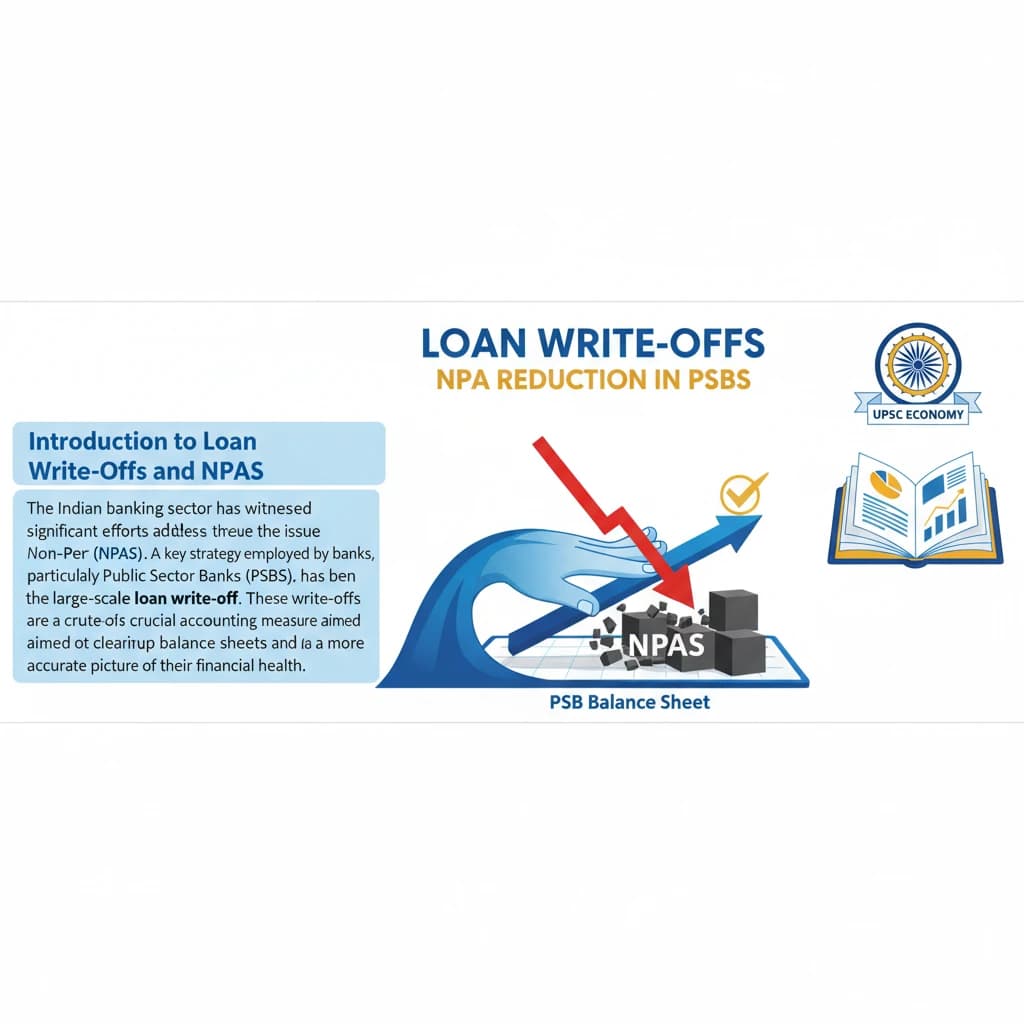
The Indian banking sector has witnessed significant efforts to address the issue of Non-Performing Assets (NPAs). A key strategy employed by banks, particularly Public Sector Banks (PSBs), has been the large-scale loan write-off.
These write-offs are a crucial accounting measure aimed at cleaning up bank balance sheets and presenting a more accurate picture of their financial health. They do not, however, absolve borrowers of their repayment obligations.
Loan write-offs refer to the removal of non-performing loans from a bank's balance sheet. This is done when the bank believes that the chances of recovery are minimal, even after sustained efforts.
Impact on NPA Reduction
The concerted efforts, including these large-scale write-offs, have yielded positive results in reducing the overall NPA burden on banks. This strategy has been implemented over the past few years, contributing to a noticeable improvement in asset quality.
As a direct consequence of these measures, banks have successfully achieved a remarkable reduction in their NPA ratio. This indicates a healthier financial position for the banking system.
Significant Achievement: Banks have achieved a 12-year low NPA ratio of 2.8% of advances by March 2024. This marks a substantial improvement in the asset quality of Indian banks.
UPSC Insight: Understanding loan write-offs and their impact on NPA reduction is vital for GS Paper 3 (Economy). Be prepared to discuss the mechanisms, implications, and government/RBI policies related to banking sector health.
💡 Key Takeaways
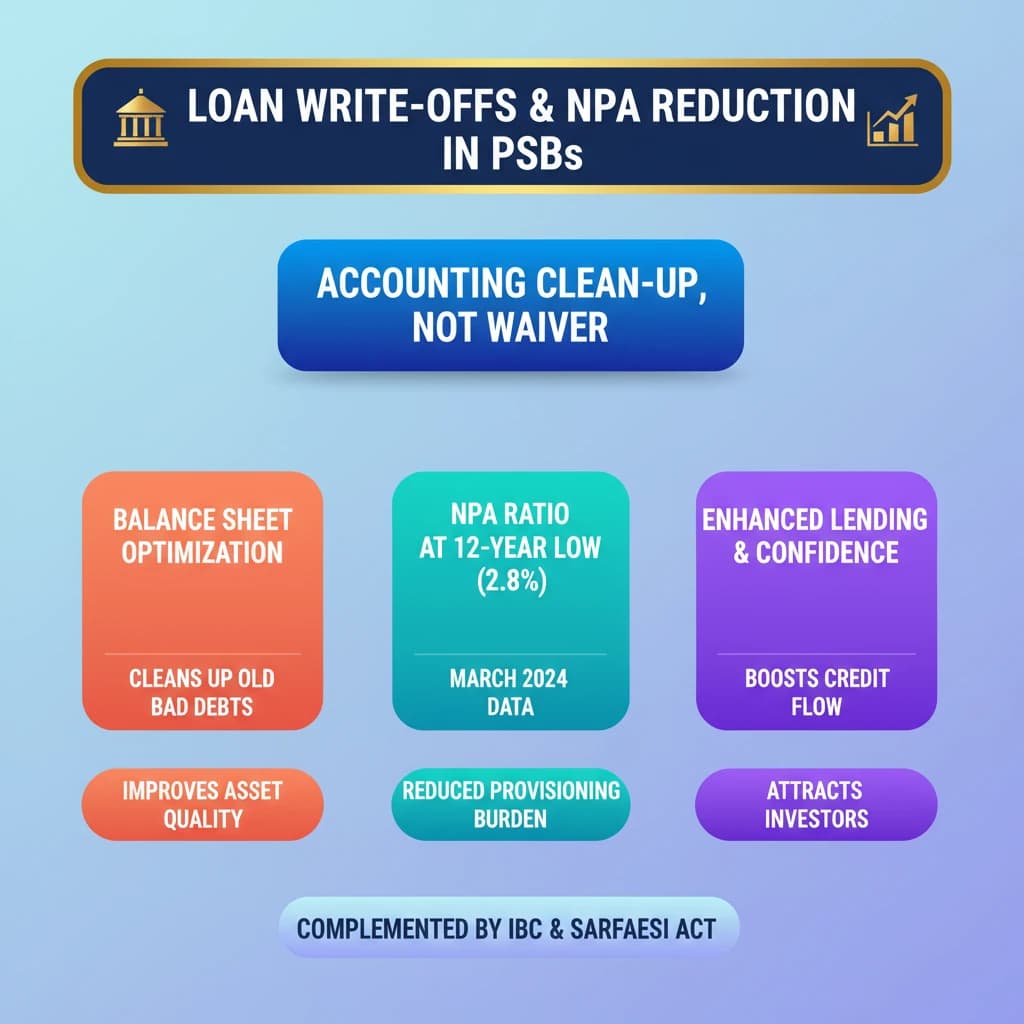
- •Loan write-offs are an accounting measure to clean bank balance sheets, not loan waivers.
- •Large-scale write-offs have significantly reduced NPAs in Public Sector Banks (PSBs).
- •India's NPA ratio reached a 12-year low of 2.8% of advances by March 2024.
- •This improvement enhances banks' lending capacity and investor confidence.
- •Key mechanisms like IBC and SARFAESI Act complement write-offs in NPA resolution.
🧠 Memory Techniques

95% Verified Content
📚 Reference Sources
•Reserve Bank of India (RBI) Annual Reports and Financial Stability Reports
•Ministry of Finance, Government of India Publications
•Economic Survey of India