Loading page, please wait…
Money Laundering - UPSC Economy
What is Money Laundering in UPSC Economy?
Money Laundering is a key topic under Economy for UPSC Civil Services Examination. Key points include: Money laundering is the process of disguising illegally acquired funds as legitimate money.. Key methods include Structuring (Smurfing), Trade-Based Laundering, Shell Companies, and Real Estate investments.. India's primary legal framework to combat this is the Prevention of Money Laundering Act (PMLA), 2002.. Understanding this topic is essential for both UPSC Prelims and Mains preparation.
Why is Money Laundering important for UPSC exam?
Money Laundering is a Medium-level topic in UPSC Economy. It is tested in both Prelims (factual MCQs) and Mains (analytical answer writing). Previous year UPSC questions have frequently covered aspects of Money Laundering, making it essential for comprehensive IAS preparation.
How to prepare Money Laundering for UPSC?
To prepare Money Laundering for UPSC: (1) Study the comprehensive notes covering all key concepts on Vaidra. (2) Practice previous year questions on this topic. (3) Connect it with current affairs using daily updates. (4) Revise using key takeaways and mind maps available for Economy. (5) Write practice answers linking Money Laundering to related GS Paper topics.
Key takeaways of Money Laundering for UPSC
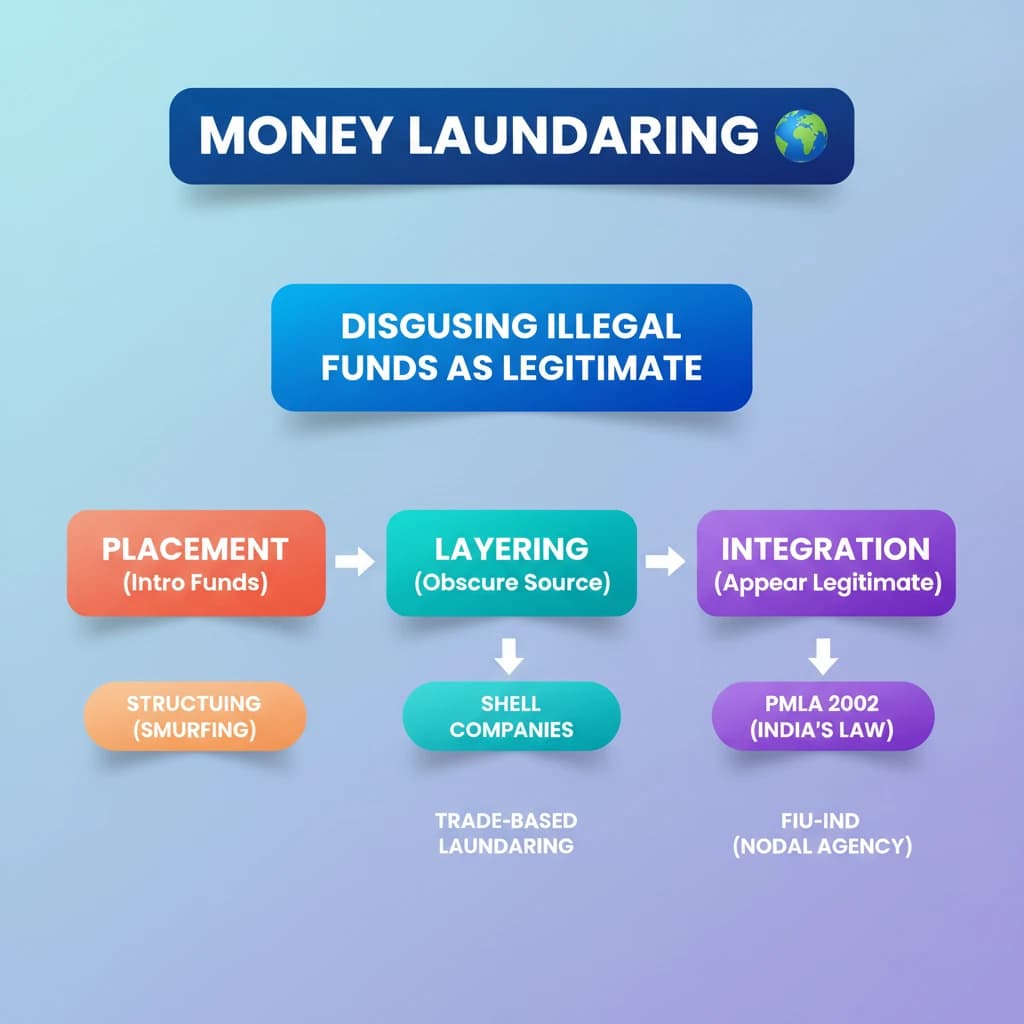
- Money laundering is the process of disguising illegally acquired funds as legitimate money.
- Key methods include Structuring (Smurfing), Trade-Based Laundering, Shell Companies, and Real Estate investments.
- India's primary legal framework to combat this is the Prevention of Money Laundering Act (PMLA), 2002.
- The Financial Intelligence Unit – India (FIU-IND) is the nodal agency for receiving and analyzing suspicious transaction reports.
- Strict KYC norms and international cooperation, particularly with FATF, are crucial for effective prevention.
- The Information Technology Rules, 2021, extend oversight to the online gaming industry to address new laundering risks.
Money Laundering
Medium⏱️ 7 min read
economy
📖 Introduction
Understanding Money Laundering
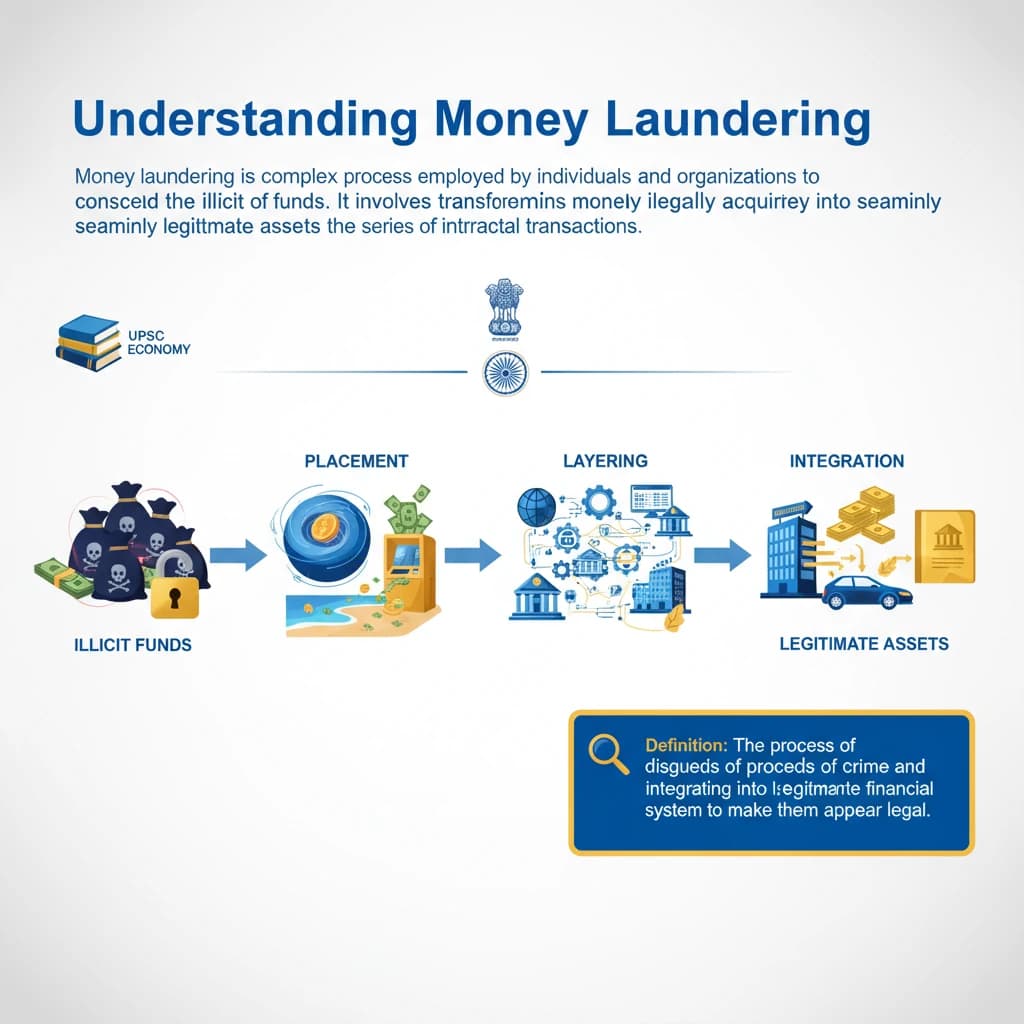
Money laundering is a complex process employed by individuals and organizations to conceal the illicit origins of funds.
It involves transforming illegally acquired money into seemingly legitimate assets through a series of intricate financial transactions.
Definition: The process of disguising the proceeds of crime and integrating them into the legitimate financial system to make them appear legal.
Methods of Money Laundering
Criminals utilize various sophisticated techniques to clean their illicit money, making it difficult to trace its true source.
Structuring (Smurfing)
Structuring, also known as Smurfing, involves breaking down large sums of cash into smaller, less noticeable amounts.
These smaller amounts are then deposited into bank accounts, often across multiple banks or by various individuals, to avoid detection thresholds for large transactions.
Trade-Based Laundering
Trade-Based Laundering utilizes international trade transactions to transfer value across borders while masking the origins of illegal funds.
This method involves manipulating invoices, over-invoicing, under-invoicing, or creating fictitious trades to obscure the illicit nature of the funds.
Shell Companies
Shell companies are businesses established with no real operational activity or assets.
They are used as fronts to route illicit funds through seemingly legitimate transactions, making it challenging to identify the true beneficial owner.
Real Estate
The acquisition of real estate is a common method where illegal funds are used to purchase properties.
Later, these properties are sold, converting the illicit cash into legitimate assets that appear to have originated from a property sale.
Steps to Prevent Money Laundering in India
India has implemented a robust framework to combat money laundering activities and strengthen its financial integrity.
- Enforcement of the Prevention of Money Laundering Act (PMLA): This is the principal legislation in India, enacted in 2002, to prevent money laundering and confiscate property derived from it.
- Formation of the Financial Intelligence Unit (FIU): The FIU-IND was established in 2004 as the central national agency responsible for receiving, processing, analyzing, and disseminating information relating to suspicious financial transactions.
- Mandatory Reporting: Banks and financial institutions are required to report cash transactions above a certain threshold and any suspicious activities to the FIU-IND.
- Strict KYC Guidelines: Know Your Customer (KYC) norms mandate financial institutions to verify the identity of their clients, thereby reducing anonymity and preventing misuse.
- Coordination with International Organisations: India collaborates with global bodies like the Financial Action Task Force (FATF) to align its anti-money laundering efforts with international standards and share intelligence.
- Information Technology Rules, 2021: These rules provide regulatory oversight, particularly in the online gaming industry, to prevent its misuse for money laundering activities.
Understanding the interplay between PMLA, FIU-IND, and FATF is crucial for Mains answers on economic crimes and national security in India.
💡 Key Takeaways
- •Money laundering is the process of disguising illegally acquired funds as legitimate money.
- •Key methods include Structuring (Smurfing), Trade-Based Laundering, Shell Companies, and Real Estate investments.
- •India's primary legal framework to combat this is the Prevention of Money Laundering Act (PMLA), 2002.
- •The Financial Intelligence Unit – India (FIU-IND) is the nodal agency for receiving and analyzing suspicious transaction reports.
- •Strict KYC norms and international cooperation, particularly with FATF, are crucial for effective prevention.
- •The Information Technology Rules, 2021, extend oversight to the online gaming industry to address new laundering risks.
🧠 Memory Techniques

95% Verified Content