Loading page, please wait…
National Bank for Financing Infrastructure and Development - UPSC Economy
What is National Bank for Financing Infrastructure and Development in UPSC Economy?
National Bank for Financing Infrastructure and Development is a key topic under Economy for UPSC Civil Services Examination. Key points include: NaBFID is India's fifth AIFI, established in 2021 by an Act of Parliament.. It is a specialized DFI focused on long-term infrastructure financing and developing bonds/derivatives markets.. Notified as a 'public financial institution' under the Companies Act, 2013, enhancing its funding capacity.. Understanding this topic is essential for both UPSC Prelims and Mains preparation.
Why is National Bank for Financing Infrastructure and Development important for UPSC exam?
National Bank for Financing Infrastructure and Development is a Medium-level topic in UPSC Economy. It is tested in both Prelims (factual MCQs) and Mains (analytical answer writing). Previous year UPSC questions have frequently covered aspects of National Bank for Financing Infrastructure and Development, making it essential for comprehensive IAS preparation.
How to prepare National Bank for Financing Infrastructure and Development for UPSC?
To prepare National Bank for Financing Infrastructure and Development for UPSC: (1) Study the comprehensive notes covering all key concepts on Vaidra. (2) Practice previous year questions on this topic. (3) Connect it with current affairs using daily updates. (4) Revise using key takeaways and mind maps available for Economy. (5) Write practice answers linking National Bank for Financing Infrastructure and Development to related GS Paper topics.
Key takeaways of National Bank for Financing Infrastructure and Development for UPSC
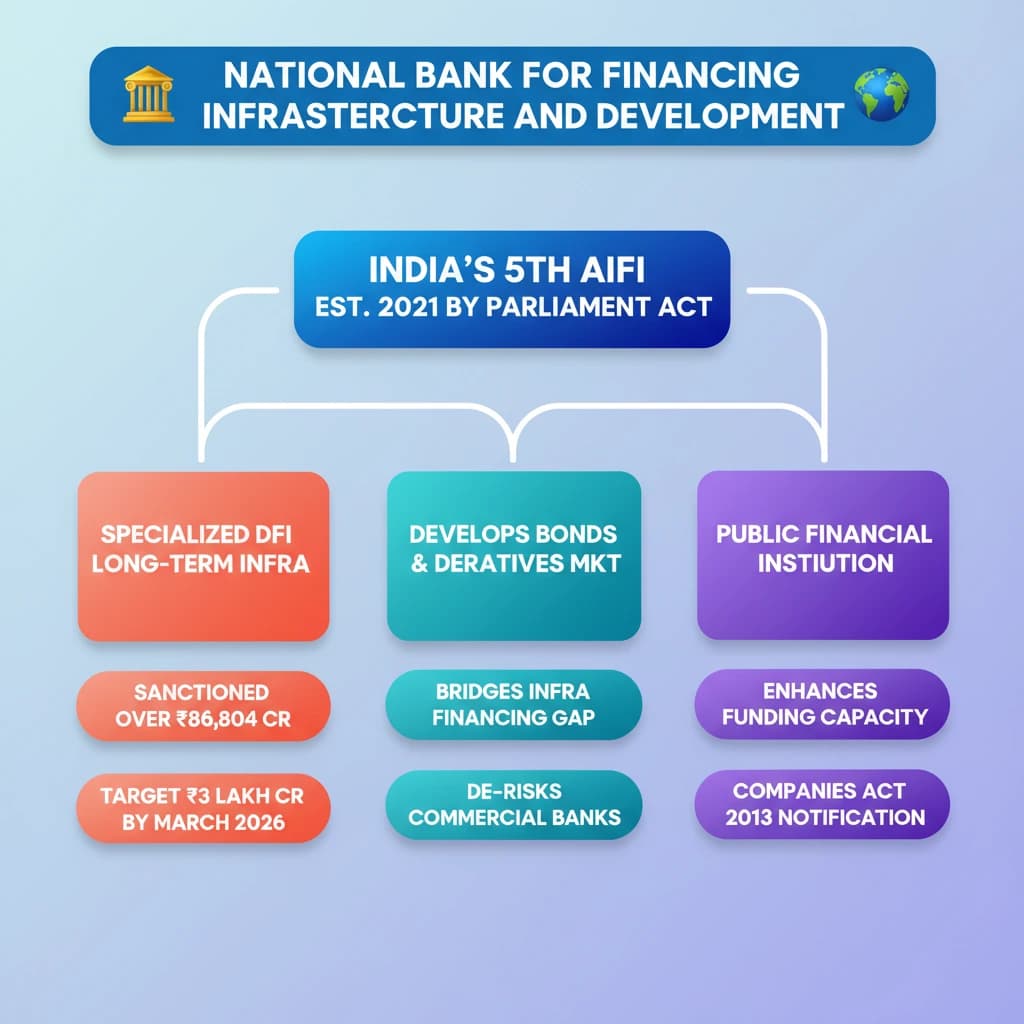
- NaBFID is India's fifth AIFI, established in 2021 by an Act of Parliament.
- It is a specialized DFI focused on long-term infrastructure financing and developing bonds/derivatives markets.
- Notified as a 'public financial institution' under the Companies Act, 2013, enhancing its funding capacity.
- Sanctioned over Rs 86,804 crore by Feb 2024, with a target of Rs 3 lakh crore by March 2026.
- Aims to bridge the infrastructure financing gap and de-risk commercial banks.

National Bank for Financing Infrastructure and Development
Medium⏱️ 8 min read
economy
📖 Introduction
Introduction to NaBFID
The National Bank for Financing Infrastructure and Development (NaBFID) has been officially designated as a “public financial institution”. This notification was issued by the Government of India in collaboration with the Reserve Bank of India (RBI).
The primary objective behind establishing NaBFID and granting it this status is to significantly enhance infrastructure financing capabilities across the country.
Establishment and Core Mandate
NaBFID was formally established in 2021 under the specific legislation of the National Bank for Financing Infrastructure and Development Act, 2021. It holds the crucial position as India’s fifth All India Financial Institution (AIFI).
Key Mandate of NaBFID:
- To support long-term infrastructure financing.
- To facilitate the development of bonds and derivatives markets, crucial for robust infrastructure funding.
Status as Public Financial Institution
The designation of NaBFID as a “public financial institution” falls under the ambit of the Companies Act, 2013. This legal classification is pivotal for its operational framework and regulatory compliance.
About the Companies Act, 2013:
- It governs the incorporation, responsibilities, directors, and dissolution of companies in India.
- This Act partially superseded the earlier Companies Act, 1956, introducing modern corporate governance principles.
Impact of the Notification
The official notification significantly bolsters NaBFID’s capacity to provide funding for large-scale infrastructure projects. This move is a strategic step towards strengthening India's overall national infrastructure finance system.
Enhanced Capacity: The "public financial institution" status grants NaBFID greater flexibility and authority in mobilizing and deploying capital for critical infrastructure development.
Key Achievements and Future Outlook
As of February 2024, NaBFID, functioning as a specialized Development Finance Institution (DFI), has already made substantial progress. It has sanctioned over Rs 86,804 crore for various infrastructure projects nationwide.
A notable characteristic of these sanctions is their long tenure, with 50% of the approved funds having repayment periods ranging from 20 to 50 years. This long-term commitment is vital for infrastructure development.
Future Targets: NaBFID aims to sanction over Rs 3 lakh crore for infrastructure projects by March 2026, indicating ambitious growth plans.
NaBFID's Role as an All India Financial Institution (AIFI)
As the fifth AIFI, NaBFID joins a select group of institutions critical for India's financial architecture. These institutions play specialized roles in economic development.
Other Noted AIFIs (as per source):
- Export-Import Bank of India (EXIM Bank)
UPSC Insight: Understanding the roles and mandates of All India Financial Institutions (AIFIs) is crucial for GS Paper III (Indian Economy). Questions often revolve around their functions, impact on specific sectors, and their evolution.
💡 Key Takeaways
- •NaBFID is India's fifth AIFI, established in 2021 by an Act of Parliament.
- •It is a specialized DFI focused on long-term infrastructure financing and developing bonds/derivatives markets.
- •Notified as a 'public financial institution' under the Companies Act, 2013, enhancing its funding capacity.
- •Sanctioned over Rs 86,804 crore by Feb 2024, with a target of Rs 3 lakh crore by March 2026.
- •Aims to bridge the infrastructure financing gap and de-risk commercial banks.
🧠 Memory Techniques

95% Verified Content