Loading page, please wait…
RBI Imposes Restrictions on Paytm Payments Bank - UPSC Economy
What is RBI Imposes Restrictions on Paytm Payments Bank in UPSC Economy?
RBI Imposes Restrictions on Paytm Payments Bank is a key topic under Economy for UPSC Civil Services Examination. Key points include: RBI imposed strict restrictions on Paytm Payments Bank (PPBL) due to non-compliance and supervisory concerns.. PPBL is barred from accepting new deposits, top-ups, or credit transactions from Feb 29, 2024.. Restrictions extend to services like FASTag, NCMC, AePS, IMPS, bill payments, and UPI transactions.. Understanding this topic is essential for both UPSC Prelims and Mains preparation.
Why is RBI Imposes Restrictions on Paytm Payments Bank important for UPSC exam?
RBI Imposes Restrictions on Paytm Payments Bank is a Medium-level topic in UPSC Economy. It is tested in both Prelims (factual MCQs) and Mains (analytical answer writing). Previous year UPSC questions have frequently covered aspects of RBI Imposes Restrictions on Paytm Payments Bank, making it essential for comprehensive IAS preparation.
How to prepare RBI Imposes Restrictions on Paytm Payments Bank for UPSC?
To prepare RBI Imposes Restrictions on Paytm Payments Bank for UPSC: (1) Study the comprehensive notes covering all key concepts on Vaidra. (2) Practice previous year questions on this topic. (3) Connect it with current affairs using daily updates. (4) Revise using key takeaways and mind maps available for Economy. (5) Write practice answers linking RBI Imposes Restrictions on Paytm Payments Bank to related GS Paper topics.
Key takeaways of RBI Imposes Restrictions on Paytm Payments Bank for UPSC
- RBI imposed strict restrictions on Paytm Payments Bank (PPBL) due to non-compliance and supervisory concerns.
- PPBL is barred from accepting new deposits, top-ups, or credit transactions from Feb 29, 2024.
- Restrictions extend to services like FASTag, NCMC, AePS, IMPS, bill payments, and UPI transactions.
- PPBL must settle all pipeline transactions by March 29, 2024, and terminate nodal accounts by Feb 29, 2024.
- The action highlights RBI's vigilant regulatory role and the importance of compliance in the fintech sector.
- Concepts like CMBs, G-Secs, SDLs, and OMOs are fundamental to understanding government finance and RBI's monetary policy tools.
RBI Imposes Restrictions on Paytm Payments Bank
Medium⏱️ 8 min read
economy
📖 Introduction
Introduction to RBI's Action on Paytm Payments Bank
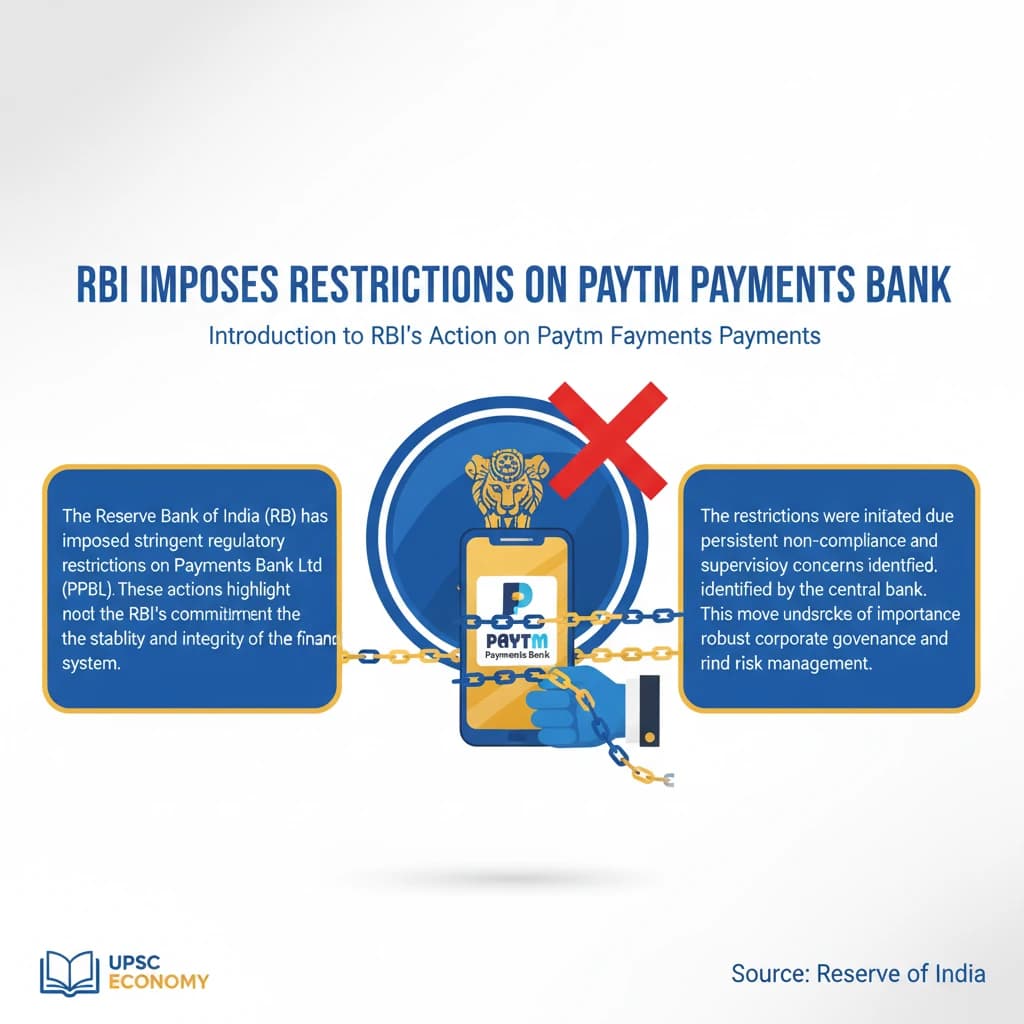
The Reserve Bank of India (RBI) has imposed stringent regulatory restrictions on Paytm Payments Bank Ltd (PPBL). These actions highlight the RBI's commitment to maintaining the stability and integrity of the financial system.
The restrictions were initiated due to persistent non-compliance and supervisory concerns identified by the central bank. This move underscores the importance of robust compliance frameworks for all financial institutions.
UPSC Insight: Questions on RBI's regulatory powers and the functioning of Payments Banks are common in GS Paper III (Economy). Understanding such actions provides practical context to theoretical concepts.
Key Restrictions Imposed on PPBL
The RBI's directive outlines several critical restrictions impacting PPBL's operations and its ability to serve customers. These measures are designed to safeguard consumer interests and ensure adherence to banking regulations.
Deposit and Top-Up Bar
Effective February 29, 2024, PPBL is prohibited from accepting new deposits or credit transactions. This includes any form of top-ups into customer accounts or wallets.
This restriction also extends to prepaid instruments such as FASTag and National Common Mobility Cards (NCMC) issued by Paytm Payments Bank.
Service Limitations
The ban encompasses a range of banking services provided by PPBL. This significantly curtails its operational scope for customers.
- Aadhaar Enabled Payment System (AePS) transactions are halted.
- Immediate Payment Service (IMPS) is no longer permitted.
- Services related to bill payments and UPI transactions are also restricted.
All pending transactions in pipeline and nodal accounts must be settled by March 29, 2024, with no further transactions allowed thereafter.
Closure of Nodal Accounts
PPBL has been instructed to terminate the nodal accounts of its parent company, One97 Communications Ltd., and Paytm Payments Services Ltd. This termination must be completed before February 29, 2024.
The closure of nodal accounts is a significant step, impacting the flow of funds between the bank and its associated entities, particularly affecting the broader Paytm ecosystem.
Related Financial Instruments and RBI Operations
The original source material also touched upon various financial instruments and RBI operations, which are fundamental to understanding India's financial market. While seemingly distinct from the Paytm issue, these concepts are crucial for a holistic understanding of the economy.
Cash Management Bills (CMBs)
CMBs are a new short-term instrument introduced by the government. Their primary purpose is to address temporary mismatches in the cash flow of the Government of India.
CMBs are typically issued for maturities of less than 91 days, making them a flexible tool for short-term liquidity management.
Dated Government Securities (G-Secs)
Dated G-Secs are long-term debt instruments issued by the central government. They represent a significant component of government borrowing.
These securities carry either a fixed or floating coupon rate (interest rate), which is paid on their face value on a half-yearly basis. Their tenor generally ranges from 5 years to 40 years.
State Development Loans (SDLs)
Similar to central government securities, State Development Loans (SDLs) are market borrowings undertaken by State Governments. These funds are raised to finance their developmental projects and budgetary needs.
Both G-Secs and SDLs are crucial for government financing and are traded in the debt market, influencing bond yields and interest rates.
Open Market Operations (OMOs)
The RBI utilizes Open Market Operations (OMOs) as a key tool of monetary policy. OMOs involve the sale or purchase of G-Secs in the open market.
- When the RBI sells G-Secs, it aims to remove liquidity from the market, thereby tightening money supply.
- Conversely, when the RBI buys back G-Secs, it seeks to infuse liquidity into the market, expanding money supply.
UPSC Insight: Understanding OMOs is vital for GS Paper III (Economy), especially for questions on monetary policy tools and their impact on inflation and economic growth.
💡 Key Takeaways
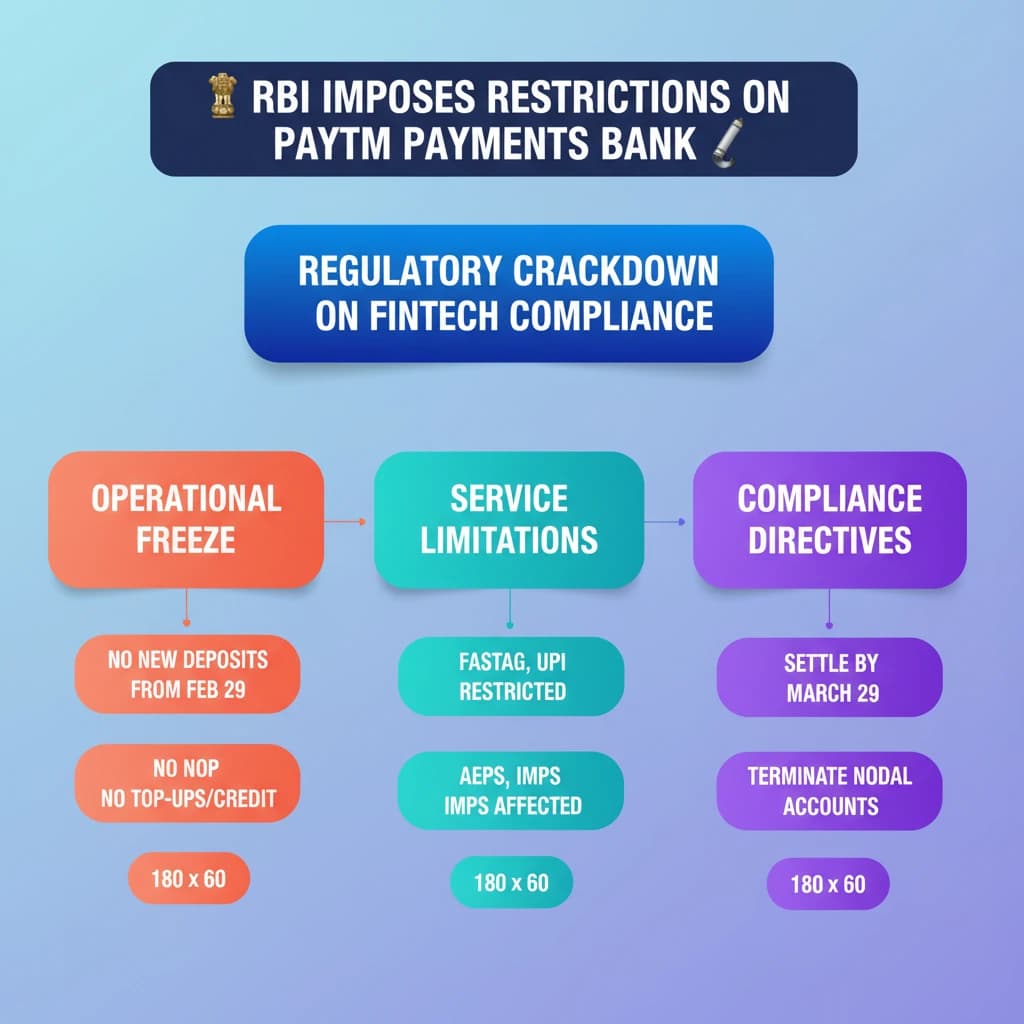
- •RBI imposed strict restrictions on Paytm Payments Bank (PPBL) due to non-compliance and supervisory concerns.
- •PPBL is barred from accepting new deposits, top-ups, or credit transactions from Feb 29, 2024.
- •Restrictions extend to services like FASTag, NCMC, AePS, IMPS, bill payments, and UPI transactions.
- •PPBL must settle all pipeline transactions by March 29, 2024, and terminate nodal accounts by Feb 29, 2024.
- •The action highlights RBI's vigilant regulatory role and the importance of compliance in the fintech sector.
- •Concepts like CMBs, G-Secs, SDLs, and OMOs are fundamental to understanding government finance and RBI's monetary policy tools.
🧠 Memory Techniques

98% Verified Content
📚 Reference Sources
•The Economic Times - Reports on Paytm Payments Bank
•Livemint - Analysis of RBI's actions
•Drishti IAS - Economy Notes