Loading page, please wait…
Social Welfare and Inclusion - UPSC Economy
What is Social Welfare and Inclusion in UPSC Economy?
Social Welfare and Inclusion is a key topic under Economy for UPSC Civil Services Examination. Key points include: PM SVA Nidhi provides UPI-linked credit cards up to ₹30,000 for street vendors, boosting financial inclusion.. e-Shram portal registers gig workers for social security and health benefits under PM Jan Arogya Yojana.. 50,000 new Atal Tinkering Labs in government schools aim to foster innovation among students.. Understanding this topic is essential for both UPSC Prelims and Mains preparation.
Why is Social Welfare and Inclusion important for UPSC exam?
Social Welfare and Inclusion is a Medium-level topic in UPSC Economy. It is tested in both Prelims (factual MCQs) and Mains (analytical answer writing). Previous year UPSC questions have frequently covered aspects of Social Welfare and Inclusion, making it essential for comprehensive IAS preparation.
How to prepare Social Welfare and Inclusion for UPSC?
To prepare Social Welfare and Inclusion for UPSC: (1) Study the comprehensive notes covering all key concepts on Vaidra. (2) Practice previous year questions on this topic. (3) Connect it with current affairs using daily updates. (4) Revise using key takeaways and mind maps available for Economy. (5) Write practice answers linking Social Welfare and Inclusion to related GS Paper topics.
Key takeaways of Social Welfare and Inclusion for UPSC
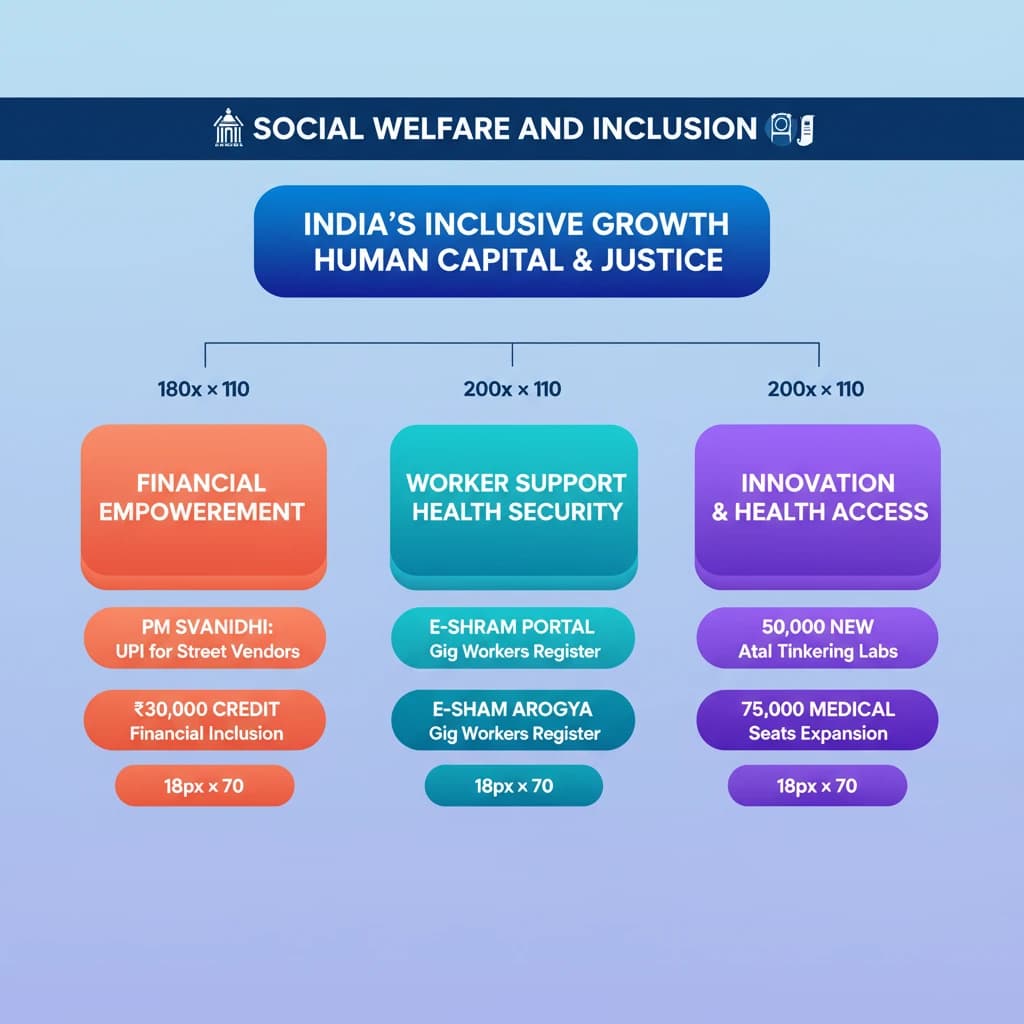
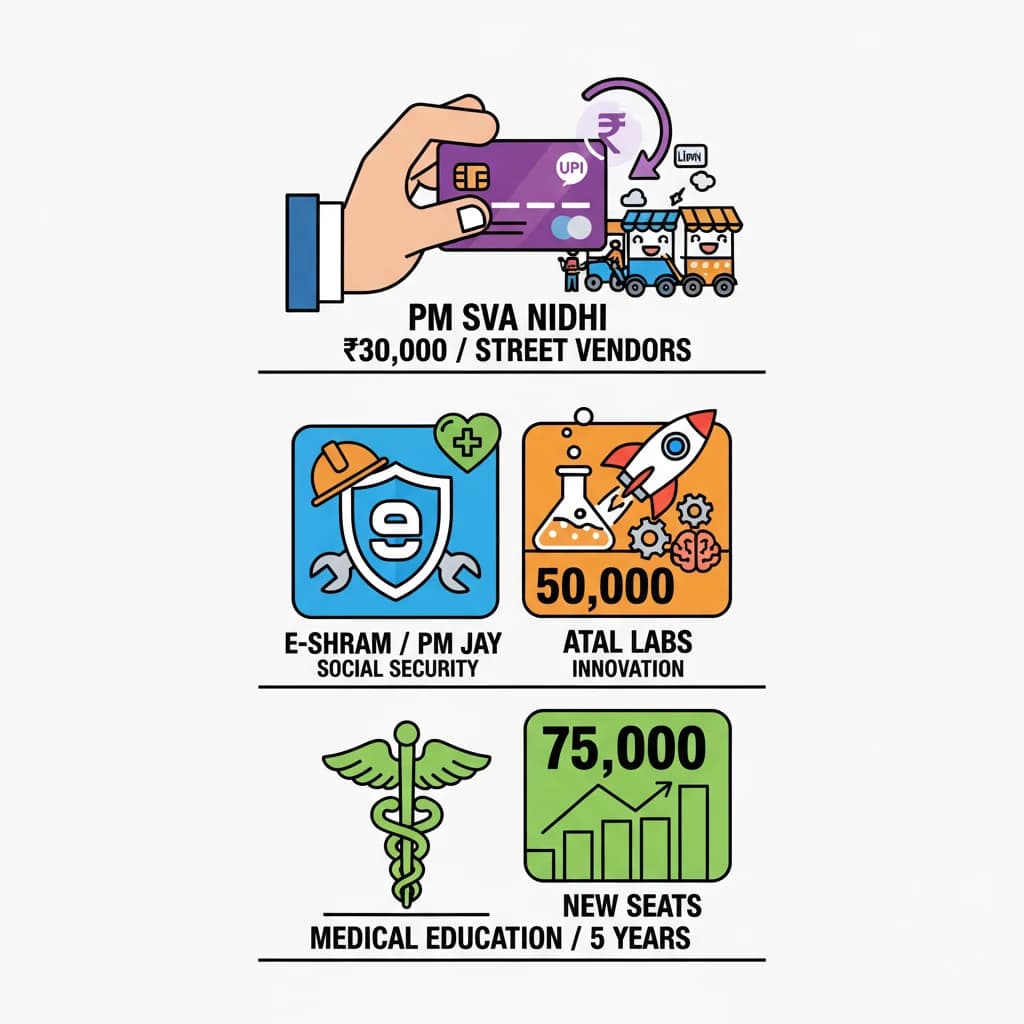
- PM SVA Nidhi provides UPI-linked credit cards up to ₹30,000 for street vendors, boosting financial inclusion.
- e-Shram portal registers gig workers for social security and health benefits under PM Jan Arogya Yojana.
- 50,000 new Atal Tinkering Labs in government schools aim to foster innovation among students.
- Expansion of medical education targets 75,000 new seats in five years to strengthen healthcare.
- These initiatives are critical for India's inclusive growth, human capital development, and social justice goals.
Social Welfare and Inclusion
Medium⏱️ 7 min read
economy
📖 Introduction
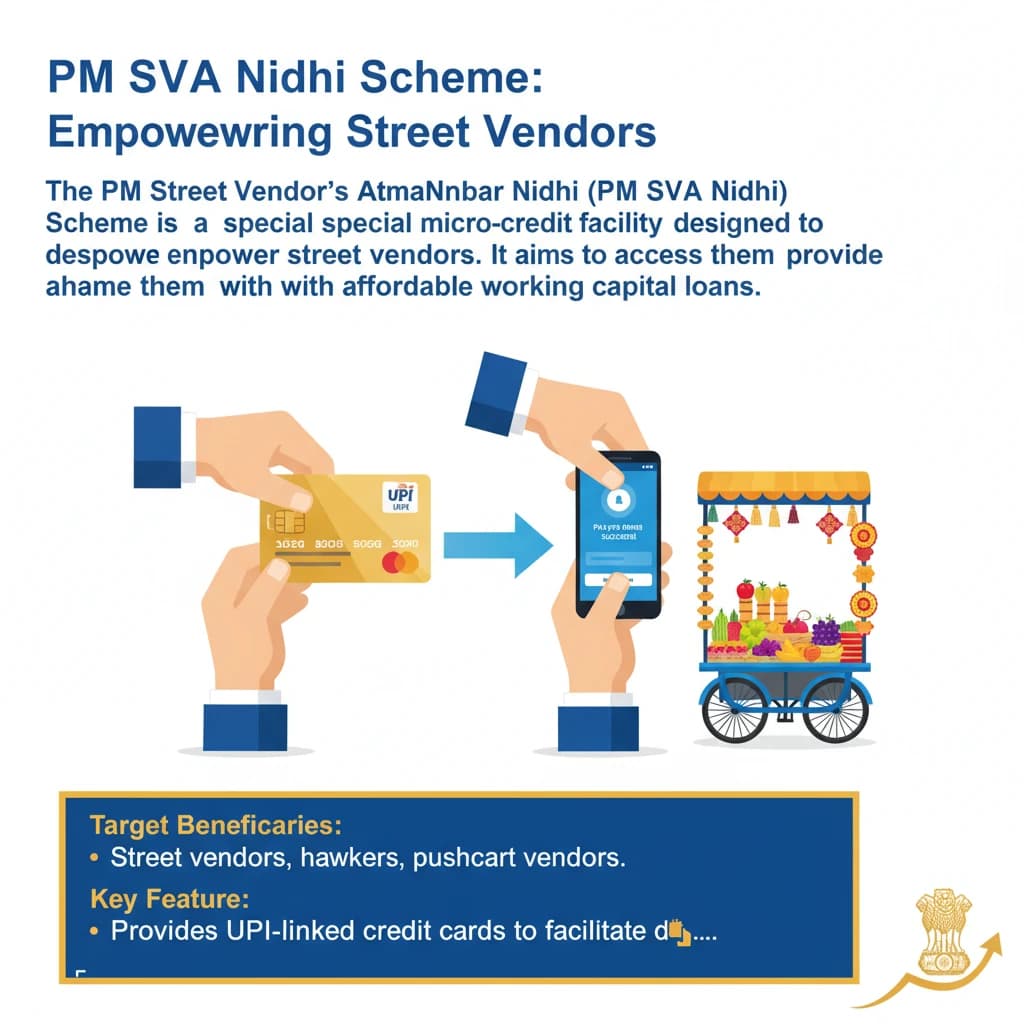
PM SVA Nidhi Scheme: Empowering Street Vendors
The PM Street Vendor's AtmaNirbhar Nidhi (PM SVA Nidhi) Scheme is a special micro-credit facility designed to empower street vendors. It aims to provide them with access to affordable working capital loans.
- Target Beneficiaries: Street vendors, hawkers, pushcart vendors.
- Key Feature: Provides UPI-linked credit cards to facilitate digital transactions.
- Credit Limit: Offers a credit limit of up to ₹30,000 for working capital needs.
This initiative is crucial for enhancing the financial inclusion of an often-marginalized segment of the urban informal economy. It helps them rebuild their livelihoods and integrate into the formal financial system.
Identity Cards for Gig Workers: Ensuring Social Security
The government is focused on extending social security benefits to the rapidly growing segment of gig workers. This involves a robust registration process to bring them under a protective umbrella.
- Registration Platform: Gig workers are encouraged to register on the e-Shram portal.
- Benefits Ensured: Registration provides access to essential social security and health benefits.
- Health Coverage: Benefits are primarily provided under the PM Jan Arogya Yojana (PMJAY), offering health insurance coverage.
This move addresses the vulnerabilities faced by gig workers, providing them with a safety net and formal recognition of their contribution to the economy.
Atal Tinkering Labs: Fostering Innovation in Schools
To cultivate a culture of innovation and entrepreneurship from a young age, the government is significantly expanding the reach of Atal Tinkering Labs (ATLs) across the country.
- Expansion Target: 50,000 new Atal Tinkering Labs are planned for establishment.
- Implementation Timeline: These labs are to be set up in the next five years.
- Location: Primarily established in government schools.
These labs provide students with hands-on experience in science, technology, engineering, and mathematics (STEM), encouraging creativity and problem-solving skills.
Expansion of Medical Education: Boosting Healthcare Capacity
Recognizing the critical need for more healthcare professionals, the government is undertaking a significant expansion of medical education infrastructure and capacity.
- Immediate Increase: An addition of 10,000 new medical seats is targeted.
- Long-term Goal: The aim is to achieve a total increase of 75,000 medical seats within a five-year period.
This expansion is vital for addressing the doctor-patient ratio, improving healthcare access, and strengthening the public health system across India.
For UPSC Mains, these schemes can be cited as examples of government efforts towards inclusive growth, human resource development, and social justice. Remember to link them to relevant Sustainable Development Goals (SDGs).
💡 Key Takeaways
- •PM SVA Nidhi provides UPI-linked credit cards up to ₹30,000 for street vendors, boosting financial inclusion.
- •e-Shram portal registers gig workers for social security and health benefits under PM Jan Arogya Yojana.
- •50,000 new Atal Tinkering Labs in government schools aim to foster innovation among students.
- •Expansion of medical education targets 75,000 new seats in five years to strengthen healthcare.
- •These initiatives are critical for India's inclusive growth, human capital development, and social justice goals.
🧠 Memory Techniques
95% Verified Content
📚 Reference Sources
•Official websites of Ministry of Housing and Urban Affairs (PM SVA Nidhi)
•Official e-Shram portal and Ministry of Labour & Employment
•NITI Aayog (Atal Innovation Mission)
•Ministry of Health & Family Welfare