Loading page, please wait…
What are Decarbonisation Strategies to Reduce Carbon Emissions in the Indian Steel Industry? - UPSC Economy
What is What are Decarbonisation Strategies to Reduce Carbon Emissions in the Indian Steel Industry? in UPSC Economy?
What are Decarbonisation Strategies to Reduce Carbon Emissions in the Indian Steel Industry? is a key topic under Economy for UPSC Civil Services Examination. Key points include: Decarbonisation of the Indian steel industry is crucial for achieving India's climate goals and enhancing global competitiveness.. Key strategies include Energy Efficiency, Material Efficiency, Green Hydrogen integration, Carbon Capture, Utilisation, and Storage (CCUS), and Biochar.. The Perform, Achieve, and Trade (PAT) scheme has successfully driven significant energy savings in the steel sector.. Understanding this topic is essential for both UPSC Prelims and Mains preparation.
Why is What are Decarbonisation Strategies to Reduce Carbon Emissions in the Indian Steel Industry? important for UPSC exam?
What are Decarbonisation Strategies to Reduce Carbon Emissions in the Indian Steel Industry? is a Medium-level topic in UPSC Economy. It is tested in both Prelims (factual MCQs) and Mains (analytical answer writing). Previous year UPSC questions have frequently covered aspects of What are Decarbonisation Strategies to Reduce Carbon Emissions in the Indian Steel Industry?, making it essential for comprehensive IAS preparation.
How to prepare What are Decarbonisation Strategies to Reduce Carbon Emissions in the Indian Steel Industry? for UPSC?
To prepare What are Decarbonisation Strategies to Reduce Carbon Emissions in the Indian Steel Industry? for UPSC: (1) Study the comprehensive notes covering all key concepts on Vaidra. (2) Practice previous year questions on this topic. (3) Connect it with current affairs using daily updates. (4) Revise using key takeaways and mind maps available for Economy. (5) Write practice answers linking What are Decarbonisation Strategies to Reduce Carbon Emissions in the Indian Steel Industry? to related GS Paper topics.
Key takeaways of What are Decarbonisation Strategies to Reduce Carbon Emissions in the Indian Steel Industry? for UPSC
- Decarbonisation of the Indian steel industry is crucial for achieving India's climate goals and enhancing global competitiveness.
- Key strategies include Energy Efficiency, Material Efficiency, Green Hydrogen integration, Carbon Capture, Utilisation, and Storage (CCUS), and Biochar.
- The Perform, Achieve, and Trade (PAT) scheme has successfully driven significant energy savings in the steel sector.
- Green hydrogen and biochar offer sustainable alternatives to traditional fossil fuels, reducing direct carbon emissions.
- CCUS is vital for deep decarbonisation of existing plants but faces challenges related to high costs and technical requirements.
- Government support, policy incentives, and continuous R&D are critical for accelerating the adoption of these green technologies.
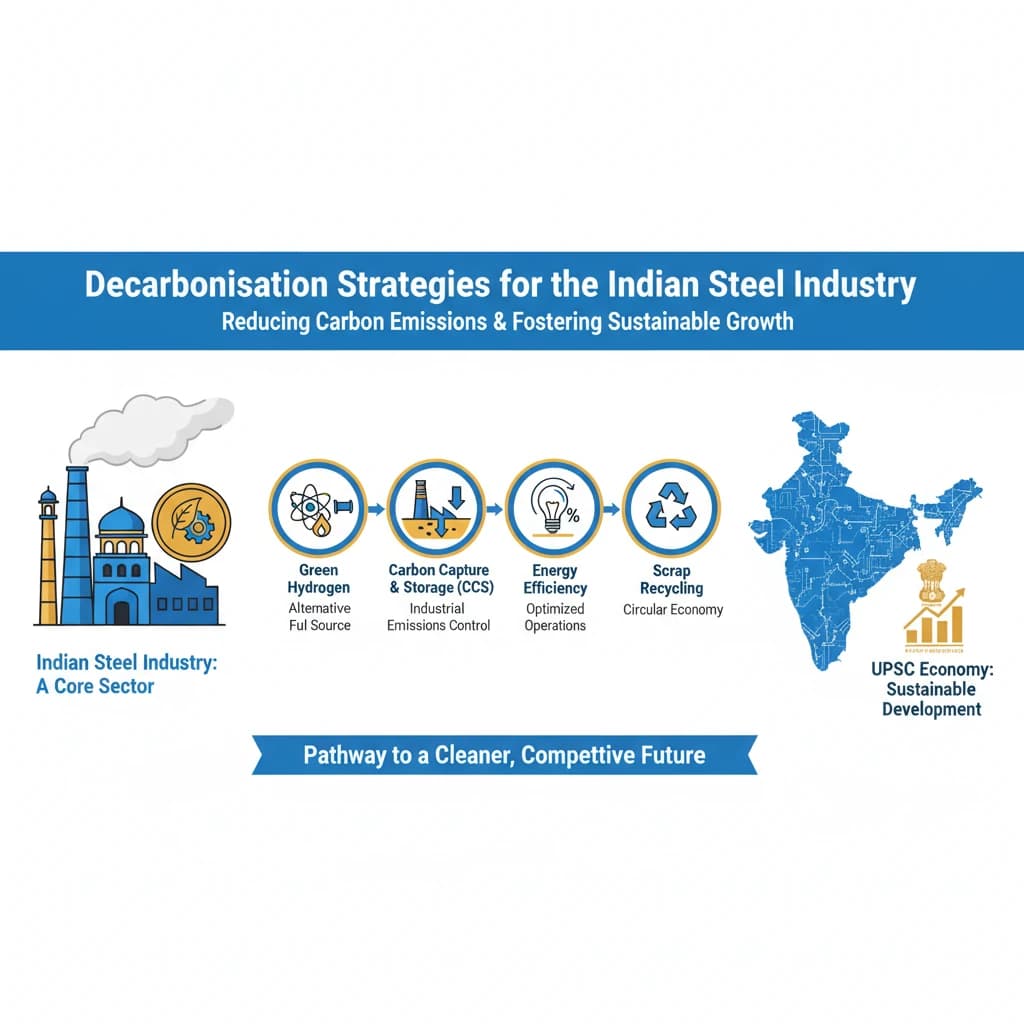
What are Decarbonisation Strategies to Reduce Carbon Emissions in the Indian Steel Industry?
Medium⏱️ 9 min read
economy
📖 Introduction
Decarbonisation Strategies for the Indian Steel Industry
The Indian steel industry, a vital component of the nation's economy, is also a significant contributor to carbon emissions. Addressing this challenge requires a multi-faceted approach involving various innovative strategies.
These strategies aim to reduce the industry's environmental footprint while maintaining its growth trajectory and competitiveness. The focus is on adopting cleaner technologies and processes.
Energy Efficiency (EE) in Steel Production
Energy Efficiency (EE) is a foundational strategy for reducing emissions. Improving energy utilization directly lowers the consumption of fossil fuels and, consequently, carbon output.
The Perform, Achieve, and Trade (PAT) scheme has been instrumental in driving significant energy savings within the sector. The scheme incentivizes industries to reduce their specific energy consumption.
Under the PAT scheme, the Indian steel sector has achieved substantial savings, reaching 6.137 million tonnes of oil equivalent (Mtoe). This figure notably surpassed the initial targets set for the industry.
Further reductions in energy intensity are achievable through the adoption of Best Available Technologies (BATs). These advanced technologies offer superior energy performance.
However, challenges persist, including low penetration rates of BATs, constraints in retrofitting existing plants, and high associated capital costs for implementation.
Material Efficiency Enhancements
Material efficiency focuses on optimizing the use of raw materials to reduce waste and energy consumption. This approach has a direct impact on the overall carbon footprint.
Enhancing processes like beneficiation and pelletisation of iron ore can significantly improve productivity. These improvements lead to a reduction in the consumption of coke, a major source of emissions.
The Ministry of Steel is actively considering providing incentives and support for the adoption of these advanced material efficiency technologies. This aims to accelerate their widespread implementation.
Green Hydrogen Integration
Green hydrogen is emerging as a critical decarbonisation pathway, offering a clean alternative to traditional fossil fuels in steelmaking. It is produced through electrolysis powered by renewable energy.
It can effectively substitute fossil fuels in key steel production units such as blast furnaces and shaft furnaces. This direct replacement significantly lowers carbon emissions.
Exploration is underway for developing 100% hydrogen-based direct reduced iron (DRI) processes. This represents a significant leap towards completely decarbonized steel production.
Leading Indian steel manufacturers like Tata Steel and JSW are at the forefront of research and development efforts in India to integrate green hydrogen into their operations.
Hydrogen injection into furnaces can reduce coke consumption and directly lower CO2 emissions. This method offers an immediate benefit in existing infrastructure.
A significant increase in green hydrogen consumption is projected if its costs decrease to around USD 1/kg. Cost reduction is a key enabler for its widespread adoption.
Carbon Capture, Utilisation, and Storage (CCUS)
Carbon Capture, Utilisation, and Storage (CCUS) is a crucial technology for achieving deep decarbonisation, especially in sectors with hard-to-abate emissions like steel.
CCUS has the potential to mitigate up to 56% of emissions from existing steel production technologies. This makes it a powerful tool for transitioning current plants.
India possesses some experience with CCUS, including the implementation of a few pilot projects. These projects are vital for understanding the technology's feasibility in the Indian context.
Significant obstacles to CCUS adoption include its high costs and the stringent requirement for high-purity CO2 streams. These factors pose considerable technical and economic challenges.
The Ministry of Steel is actively exploring iron-ore green hydrogen-based CCU applications. They are also investigating new technologies such as carbon recycling to enhance CCUS effectiveness.
Role of Biochar
Biochar presents an innovative and sustainable alternative for reducing carbon emissions in the iron and steel sector. It is derived from various forms of biomass.
Biochar is produced from diverse biomass sources, including crop residues, bamboo, forest residues, and bagasse. This utilizes agricultural and forest waste streams.
It offers comparable metallurgical properties to traditional fossil fuels like coal and coke. This makes it a viable substitute without compromising steel quality.
The potential of biochar lies in its ability to partially or fully substitute these fossil fuels in steelmaking processes, thereby significantly reducing the sector's carbon footprint.
Understanding these diverse strategies is crucial for UPSC Mains GS-III Economy and Environment. Questions often focus on India's industrial decarbonisation efforts and sustainable development goals. Be prepared to discuss both the potential and challenges of each strategy.
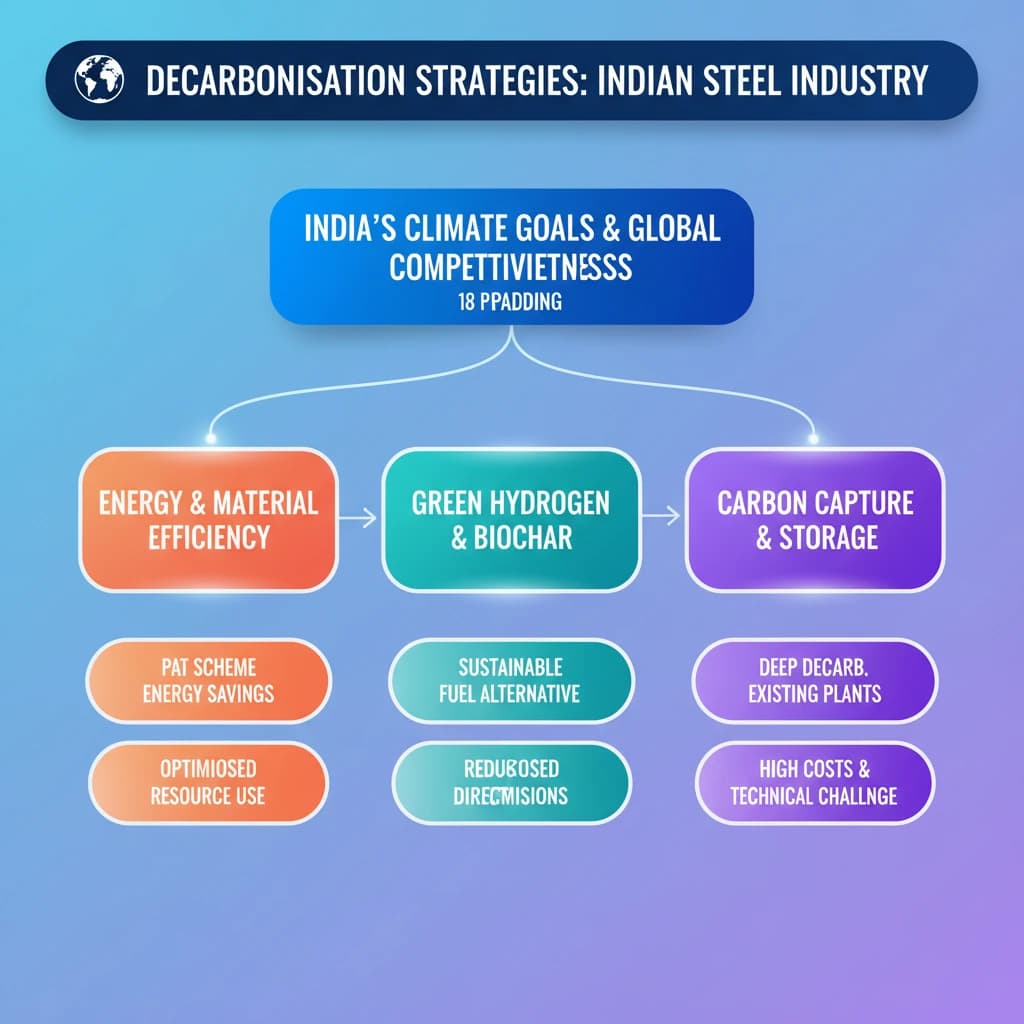
💡 Key Takeaways
- •Decarbonisation of the Indian steel industry is crucial for achieving India's climate goals and enhancing global competitiveness.
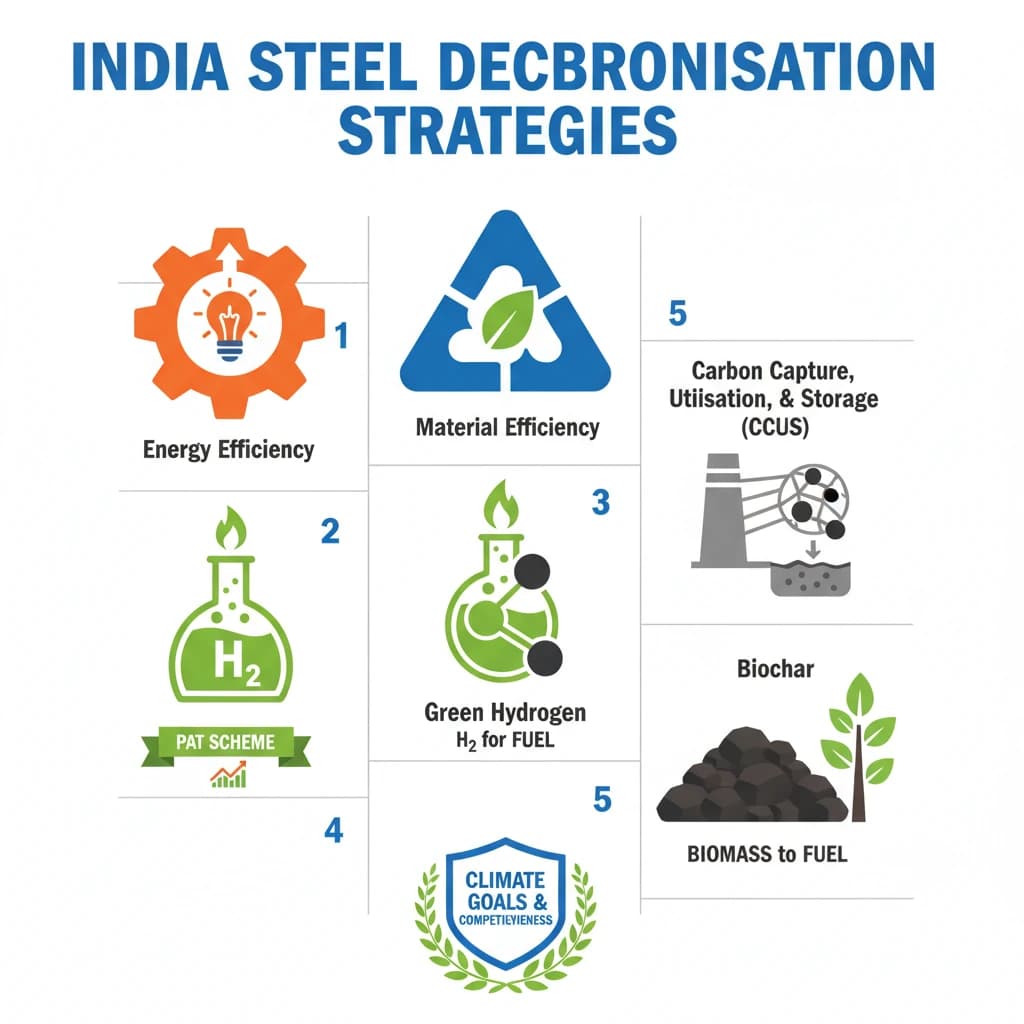
- •Key strategies include Energy Efficiency, Material Efficiency, Green Hydrogen integration, Carbon Capture, Utilisation, and Storage (CCUS), and Biochar.
- •The Perform, Achieve, and Trade (PAT) scheme has successfully driven significant energy savings in the steel sector.
- •Green hydrogen and biochar offer sustainable alternatives to traditional fossil fuels, reducing direct carbon emissions.
- •CCUS is vital for deep decarbonisation of existing plants but faces challenges related to high costs and technical requirements.
- •Government support, policy incentives, and continuous R&D are critical for accelerating the adoption of these green technologies.
🧠 Memory Techniques
95% Verified Content
📚 Reference Sources
•General knowledge on Indian steel industry and climate policy