Loading page, please wait…
HomeCurrent AffairsEditorialsGovt SchemesLearning ResourcesUPSC SyllabusPricingAboutBest UPSC AIUPSC AI ToolAI for UPSCUPSC ChatGPT

© 2026 Vaidra. All rights reserved.

PrivacyTerms
Vaidra Logo
Vaidra

Top 4 items + smart groups

UPSC GPT
New
Current Affairs
Daily Solutions
Daily Puzzle
Mains Evaluator

Version 2.0.0 • Built with ❤️ for UPSC aspirants

Karnataka Becomes India's 2nd Largest Hub for EV Public Charging Stations – OMC‑Led Expansion — UPSC Current Affairs | April 2, 2026
Karnataka Becomes India's 2nd Largest Hub for EV Public Charging Stations – OMC‑Led Expansion
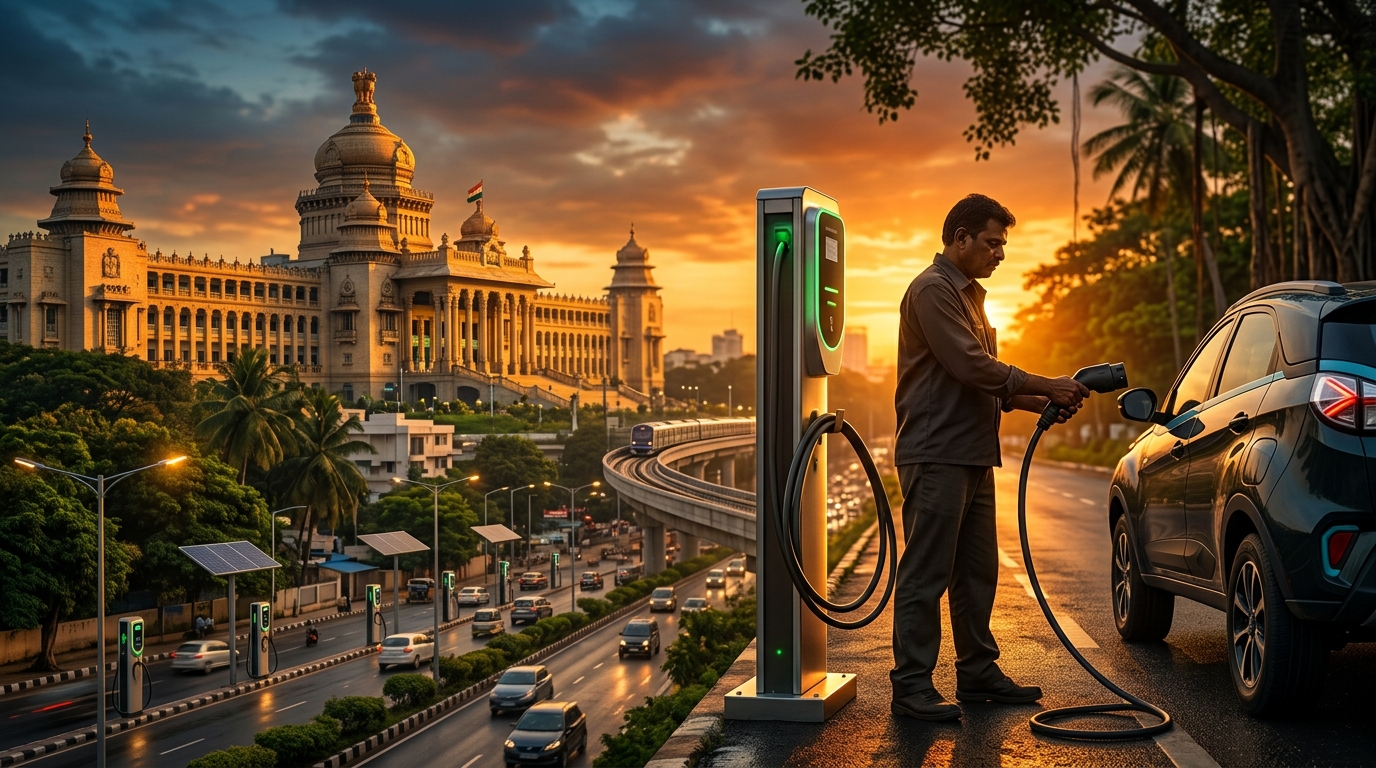
Karnataka now hosts 2,039 operational OMC‑run EV public charging stations, making it India's second‑largest hub after Uttar Pradesh. The surge, driven by schemes like FAME‑II and pending PM E‑DRIVE funds, underscores the need for a centralised assessment and coordinated rollout to match the growing EV fleet, a key focus for UPSC aspirants studying sustainable transport and fiscal policy.
Karnataka now hosts 2,039 operational EV PCS installed by OMCs , making it the second‑largest state after Uttar Pradesh (2,893 stations). This marks a significant shift in India's sustainable‑transport landscape. Key Developments (Year‑wise) 2020‑21: 36 stations operational. 2021‑22: 153 stations – >4× growth. 2022‑23: 542 stations – rapid acceleration. 2023‑24: Slight dip to 478 stations. 2024‑25: Surge to 1,034 stations – largest single‑year addition. 2025‑26 (till 1 Mar): Additional 157 stations, bringing cumulative installations over five years to 2,400 , of which 2,039 are functional. Important Facts Karnataka now outpaces Maharashtra , Tamil Nadu and Gujarat in OMC‑run EV PCS . Nationwide, OMCs have installed 27,737 stations; 22,753 are operational, with only 21 decommissioned. Under the FAME‑II scheme, ₹912.5 crore sanctioned for charging infrastructure; ₹895.48 crore released, of which ₹655.43 crore utilised. The PM E‑DRIVE scheme earmarks ₹2,000 crore for nationwide expansion, but funds are yet to be released. The Ministry of Heavy Industries provides the data source for these rankings. UPSC Relevance The rapid growth of EV charging infrastructure illustrates several core UPSC themes: Policy Implementation : Coordination between central schemes (FAME‑II, PM E‑DRIVE) and state execution. Fiscal Management : Large capital outlays, tranche releases, and utilisation efficiency. Urban Planning & Transport : Alignment of charging points with urban centres like Bengaluru and major highways. Public‑Private Partnership : OMCs leading rollout while private players are encouraged, reflecting the unlicensed‑activity model. Data‑Driven Governance : Absence of a centralised adequacy assessment highlights gaps in monitoring and planning. Way Forward Establish a centralised dashboard to compare charging‑station density with registered EV numbers across states. Release the pending ₹2,000 crore under PM E‑DRIVE to accelerate rural and highway corridors. Encourage state‑level road‑maps that integrate EV PCS with renewable‑energy sourcing. Promote incentives for private sector participation beyond OMCs, ensuring competition and service quality. Regularly audit utilisation of FAME‑II funds to improve fiscal accountability.
  1. Home
  2. Prepare
  3. Current Affairs
  4. Karnataka Becomes India's 2nd Largest Hub for EV Public Charging Stations – OMC‑Led Expansion
Login to bookmark articles
Login to mark articles as complete

Overview

Karnataka emerges as India’s second‑largest EV charging hub, underscoring OMC‑driven green transport push

Key Facts

  1. Karnataka has 2,039 operational EV public charging stations (EV PCS) as of 1 Mar 2026, second only to Uttar Pradesh (2,893).
  2. Oil Marketing Companies (OMCs) have installed 27,737 EV PCS nationwide; 22,753 are operational and only 21 have been decommissioned.
  3. Cumulative installations in Karnataka over FY 2020‑21 to FY 2025‑26 total 2,400, with a single‑year surge of 1,034 stations in FY 2024‑25.
  4. Under the FAME‑II scheme, ₹912.5 crore was sanctioned for charging infrastructure; ₹895.48 crore released, of which ₹655.43 crore has been utilised.
  5. The PM E‑DRIVE scheme earmarks ₹2,000 crore for EV charging expansion, but the funds remain unreleased as of 2026.
  6. Karnataka now outpaces Maharashtra, Tamil Nadu and Gujarat in OMC‑run EV PCS, indicating a shift in state‑level green mobility leadership.
  7. Data is sourced from the Ministry of Heavy Industries, highlighting the need for a centralised dashboard linking station density with EV registrations.

Background & Context

The rapid expansion of EV charging infrastructure aligns with India's climate‑change mitigation commitments and the push for sustainable urban transport under GS‑3. It reflects coordinated policy implementation between central schemes (FAME‑II, PM E‑DRIVE) and state execution, while also showcasing the emerging role of traditionally fossil‑fuel‑centric OMCs in the green economy.

UPSC Syllabus Connections

Prelims_GS•Environmental Issues and Climate ChangePrelims_CSAT•Data InterpretationEssay•Economy, Development and Inequality

Mains Answer Angle

In a GS‑3 answer, discuss how Karnataka’s OMC‑led charging network illustrates the challenges of fiscal management, public‑private partnership and data‑driven governance in scaling green mobility. Possible question: "Evaluate the effectiveness of central and state initiatives in building EV charging infrastructure in India."

Full Article

Read Original on hindu

Analysis

Practice Questions

GS1
Easy
Prelims MCQ

Environment – Sustainable Transport

1 marks
3 keywords
GS3
Medium
Mains Short Answer

Economy – Fiscal Management of Green Schemes

5 marks
4 keywords
GS3
Hard
Mains Essay

Governance – Public‑Private Partnership in Green Infrastructure

25 marks
6 keywords
Related:Daily•Weekly

Loading related articles...

Loading related articles...

Tip: Click articles above to read more from the same date, or use the back button to see all articles.

Explore:Current Affairs·Editorial Analysis·Govt Schemes·Study Materials·Previous Year Questions·UPSC GPT