Loading page, please wait…
What are India’s Economic Challenges According to the Economic Survey 2024-25? - UPSC Economy
What is What are India’s Economic Challenges According to the Economic Survey 2024-25? in UPSC Economy?
What are India’s Economic Challenges According to the Economic Survey 2024-25? is a key topic under Economy for UPSC Civil Services Examination. Key points include: India's social sector spending grew at 15% CAGR (FY21-FY25), reaching ₹25.7 lakh crore in FY25, indicating significant welfare focus.. Gini coefficient declined for both rural (0.237) and urban (0.284) areas in 2023-24, suggesting reduced inequality due to fiscal policies.. Education spending rose 12% CAGR, with reduced dropout rates and increased higher education GER to 28.4%.. Understanding this topic is essential for both UPSC Prelims and Mains preparation.
Why is What are India’s Economic Challenges According to the Economic Survey 2024-25? important for UPSC exam?
What are India’s Economic Challenges According to the Economic Survey 2024-25? is a Medium-level topic in UPSC Economy. It is tested in both Prelims (factual MCQs) and Mains (analytical answer writing). Previous year UPSC questions have frequently covered aspects of What are India’s Economic Challenges According to the Economic Survey 2024-25?, making it essential for comprehensive IAS preparation.
How to prepare What are India’s Economic Challenges According to the Economic Survey 2024-25? for UPSC?
To prepare What are India’s Economic Challenges According to the Economic Survey 2024-25? for UPSC: (1) Study the comprehensive notes covering all key concepts on Vaidra. (2) Practice previous year questions on this topic. (3) Connect it with current affairs using daily updates. (4) Revise using key takeaways and mind maps available for Economy. (5) Write practice answers linking What are India’s Economic Challenges According to the Economic Survey 2024-25? to related GS Paper topics.
Key takeaways of What are India’s Economic Challenges According to the Economic Survey 2024-25? for UPSC
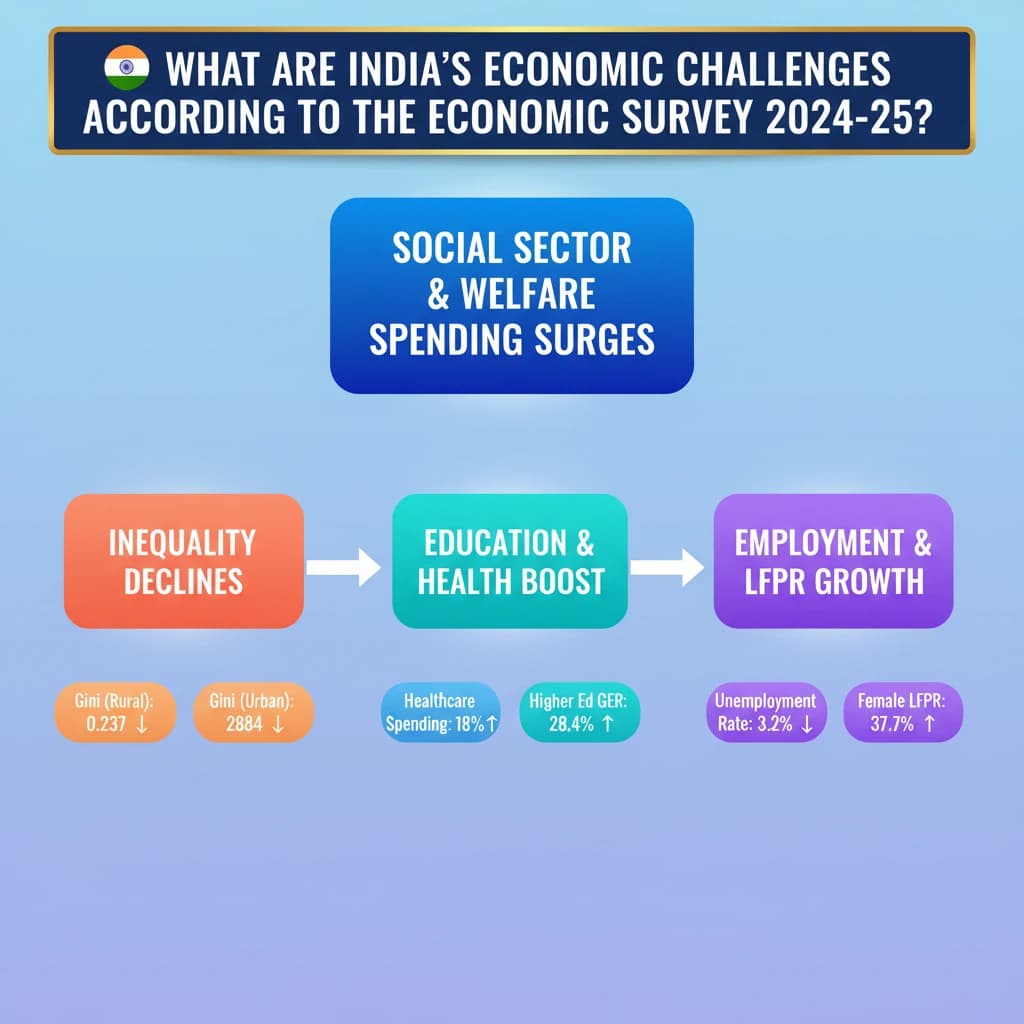
- India's social sector spending grew at 15% CAGR (FY21-FY25), reaching ₹25.7 lakh crore in FY25, indicating significant welfare focus.
- Gini coefficient declined for both rural (0.237) and urban (0.284) areas in 2023-24, suggesting reduced inequality due to fiscal policies.
- Education spending rose 12% CAGR, with reduced dropout rates and increased higher education GER to 28.4%.
- Healthcare spending surged 18% to ₹8.61 lakh crore, and Ayushman Bharat PM-JAY saved ₹1.25 lakh crore in medical expenses.
- Unemployment rate fell to 3.2% (2023-24) and LFPR rose to 60.1%, with female LFPR significantly increasing to 37.7%.
- Formal sector jobs, indicated by EPFO payroll additions, doubled from 61 lakh (FY19) to 131 lakh (FY24).
- Key challenges include cautious private investment, high logistics costs (13-14% of GDP), and the need for workforce upskilling for the AI era.
What are India’s Economic Challenges According to the Economic Survey 2024-25?
Medium⏱️ 15 min read
economy
📖 Introduction
India's Economic Challenges and Progress: An Overview
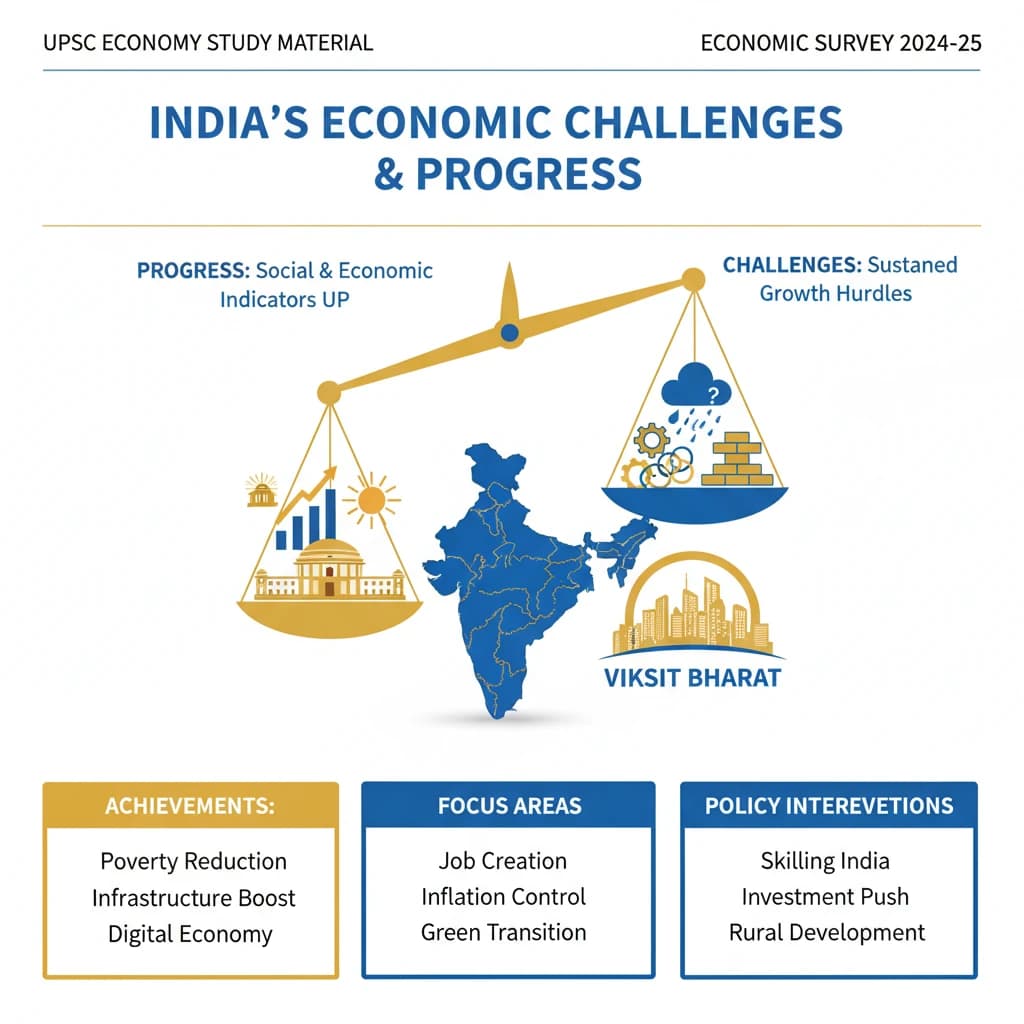
The Economic Survey 2024-25 highlights India's significant progress in various social and economic indicators, while also pointing out critical challenges that need addressing for sustained growth and the realization of Viksit Bharat goals.
The survey provides a comprehensive look at the nation's economic health, emphasizing both achievements and areas requiring focused policy interventions.
Social Sector Development
India has demonstrated robust growth in its social sector spending. This includes crucial investments in education, healthcare, and welfare programs.
Social Sector Spending Growth:
- Increased at a 15% CAGR from FY21 to FY25.
- Reached ₹25.7 lakh crore in FY25.
These investments are aimed at improving the quality of life and reducing disparities across the population.
Reducing Inequality: Gini Coefficient Trends
A key indicator of income inequality, the Gini coefficient, has shown positive trends, reflecting efforts to foster more equitable distribution of wealth.
Gini Coefficient Decline:
- Rural areas: Fell to 0.237 in 2023-24 from 0.266 in 2022-23.
- Urban areas: Decreased to 0.284 in 2023-24 from 0.314 in 2022-23.
This reduction suggests that fiscal policies and welfare schemes are having a tangible impact on the economic well-being of lower-income groups.
Progress in Education and Skill Development
The education sector has witnessed substantial investment and improved outcomes, crucial for building a skilled workforce.
Education Spending & Outcomes:
- Spending: Rose by 12% CAGR to ₹5.92 lakh crore.
- Dropout Rates: Reduced to 1.9% (primary) and 14.1% (secondary).
- Higher Education Enrolment: Increased by 26.5% (2014-2022).
- Gross Enrolment Ratio (GER): Reached 28.4%.
These figures underscore the government's commitment to enhancing educational access and quality from primary to higher education levels.
Healthcare and Social Security Initiatives
Significant strides have been made in healthcare, with flagship schemes providing financial relief and access to medical services.
Healthcare Spending & Impact:
- Spending: Surged by 18% to ₹8.61 lakh crore.
- Ayushman Bharat Pradhan Mantri Jan Arogya Yojana (AB-PM-JAY): Saved ₹1.25 lakh crore in medical expenses for beneficiaries.
AB-PM-JAY has been instrumental in protecting millions of households from catastrophic health expenditures, reinforcing social security nets.
Welfare Programs and Inequality Reduction
Government welfare programs have played a vital role in ensuring food security and reducing consumption inequality.
Welfare Program Impact:
- Pradhan Mantri Garib Kalyan Anna Yojana (PMGKAY): Provides free food grains to 80 crore people.
- Coverage: Reaches 84% of households via ration cards.
Fiscal policies have been effective in reducing inequality, with consumption among the bottom 5% of rural and urban populations rising significantly.
Consumption Growth (Bottom 5%):
- Rural: Increased by 22%.
- Urban: Increased by 19%.
This indicates an improved standard of living for the most vulnerable sections of society.
Employment and Labour Market Trends
India's labour market has shown positive trends, with a decline in unemployment and an increase in labour force participation.
Employment Statistics:
- Unemployment Rate: Declined from 6% (2017-18) to 3.2% (2023-24).
- Labour Force Participation Rate (LFPR): Rose to 60.1%.
These improvements reflect a growing economy and increased opportunities for employment across various sectors.
Leveraging the Demographic Dividend
India is poised to benefit from its large working-age population, presenting a significant demographic advantage.
Demographic Dividend Potential:
- Working-age population (15-59 years): Projected to reach 923.9 million by 2026.
- Youth (10-24 years): Constitute 26% of the population.
The demographic dividend offers a unique window for accelerated economic growth if the youth are adequately skilled and employed.
Rising Female Labour Force Participation
A notable trend is the significant increase in female participation in the labour force, especially in rural areas.
Female LFPR Growth:
- Increased from 23.3% (2017-18) to 37.7% (2023-24).
- Primarily driven by the increased participation of rural women.
This rise is crucial for inclusive growth and harnessing the full potential of India's human capital.
Employment Structure and Formalization
The nature of employment is evolving, with a growing emphasis on self-employment and formal sector jobs.
Employment Structure:
- Self-employment: Rose to 58.4%.
- Regular wage jobs: Remained at 21.7%.
The formal sector has seen substantial growth, indicating a shift towards more organized employment.
Formal Sector Job Growth:
- Employees’ Provident Fund Organisation (EPFO) net payroll additions doubled from 61 lakh (FY19) to 131 lakh (FY24).
This formalization provides greater social security and benefits to workers.
Skill Development and Job Creation Initiatives
Government initiatives are actively promoting entrepreneurship and skill enhancement to meet the demands of emerging sectors.
- Startup India: Supported 73,151 startups with women directors.
- Skill India and Mudra Yojana: Provided crucial support for entrepreneurship and vocational training.
The burgeoning digital economy and renewable energy sectors are identified as key drivers for job creation, essential for achieving Viksit Bharat.
The government is proactively enhancing skills to align with global trends such as Artificial Intelligence (AI) and climate change. Schemes like the PM-Internship Scheme are further boosting employment and self-employment opportunities.
Labour in the AI Era: Opportunities and Risks
The advent of Artificial Intelligence (AI) presents a dual landscape of opportunities and potential risks for global labour markets, including India.
Global AI Impact on Jobs:
- ILO 2024: Estimated 7 million global jobs at risk.
- Goldman Sachs: Projected 300 million full-time roles exposed to AI.
For India, adapting to this technological shift is paramount. The country's AI market is set for significant expansion.
India's AI Market Growth:
- Expected to grow at 25-35% CAGR by 2027 (NASSCOM).
To navigate this transition effectively, workforce upskilling, robust regulatory oversight, and fostering human-AI collaboration are critical for a balanced and inclusive future.
Investment & Infrastructure Bottlenecks
Despite significant public investment, challenges persist in attracting private capital and improving logistics efficiency.
Investment Trends:
- Public Capex: Grew at 38.8% CAGR (FY20-FY24).
- Private Investment: Remains cautious due to global uncertainties and regulatory concerns.
High logistics costs continue to hinder India's industrial competitiveness, impacting overall economic efficiency.
Logistics Costs:
- Remain high at 13-14% of GDP.
- Limits industrial competitiveness despite efforts under the National Logistics Policy.
UPSC aspirants should note that while public investment is driving growth, sustained private sector participation and efficient infrastructure are crucial for long-term economic stability and competitiveness (GS-III: Indian Economy).
💡 Key Takeaways
- •India's social sector spending grew at 15% CAGR (FY21-FY25), reaching ₹25.7 lakh crore in FY25, indicating significant welfare focus.
- •Gini coefficient declined for both rural (0.237) and urban (0.284) areas in 2023-24, suggesting reduced inequality due to fiscal policies.
- •Education spending rose 12% CAGR, with reduced dropout rates and increased higher education GER to 28.4%.
- •Healthcare spending surged 18% to ₹8.61 lakh crore, and Ayushman Bharat PM-JAY saved ₹1.25 lakh crore in medical expenses.
- •Unemployment rate fell to 3.2% (2023-24) and LFPR rose to 60.1%, with female LFPR significantly increasing to 37.7%.
- •Formal sector jobs, indicated by EPFO payroll additions, doubled from 61 lakh (FY19) to 131 lakh (FY24).
- •Key challenges include cautious private investment, high logistics costs (13-14% of GDP), and the need for workforce upskilling for the AI era.
🧠 Memory Techniques

95% Verified Content
📚 Reference Sources
•ILO 2024 Report
•Goldman Sachs Report
•NASSCOM Report