Loading page, please wait…
What are the Key Features of the Approved Industrial Smart Cities? - UPSC Economy
What is What are the Key Features of the Approved Industrial Smart Cities? in UPSC Economy?
What are the Key Features of the Approved Industrial Smart Cities? is a key topic under Economy for UPSC Civil Services Examination. Key points include: Designed to achieve $2 trillion exports by 2030.. Aligned with PM GatiShakti for multi-modal connectivity and logistics efficiency.. Part of a 'necklace of industrial cities' along the Golden Quadrilateral.. Understanding this topic is essential for both UPSC Prelims and Mains preparation.
Why is What are the Key Features of the Approved Industrial Smart Cities? important for UPSC exam?
What are the Key Features of the Approved Industrial Smart Cities? is a Medium-level topic in UPSC Economy. It is tested in both Prelims (factual MCQs) and Mains (analytical answer writing). Previous year UPSC questions have frequently covered aspects of What are the Key Features of the Approved Industrial Smart Cities?, making it essential for comprehensive IAS preparation.
How to prepare What are the Key Features of the Approved Industrial Smart Cities? for UPSC?
To prepare What are the Key Features of the Approved Industrial Smart Cities? for UPSC: (1) Study the comprehensive notes covering all key concepts on Vaidra. (2) Practice previous year questions on this topic. (3) Connect it with current affairs using daily updates. (4) Revise using key takeaways and mind maps available for Economy. (5) Write practice answers linking What are the Key Features of the Approved Industrial Smart Cities? to related GS Paper topics.
Key takeaways of What are the Key Features of the Approved Industrial Smart Cities? for UPSC
- Designed to achieve $2 trillion exports by 2030.
- Aligned with PM GatiShakti for multi-modal connectivity and logistics efficiency.
- Part of a 'necklace of industrial cities' along the Golden Quadrilateral.
- Aims to attract Rs 1.5 lakh crore investment and create 10 lakh direct, 30 lakh indirect jobs.
- Promotes sustainability through ICT and green technologies, strengthening global value chains.
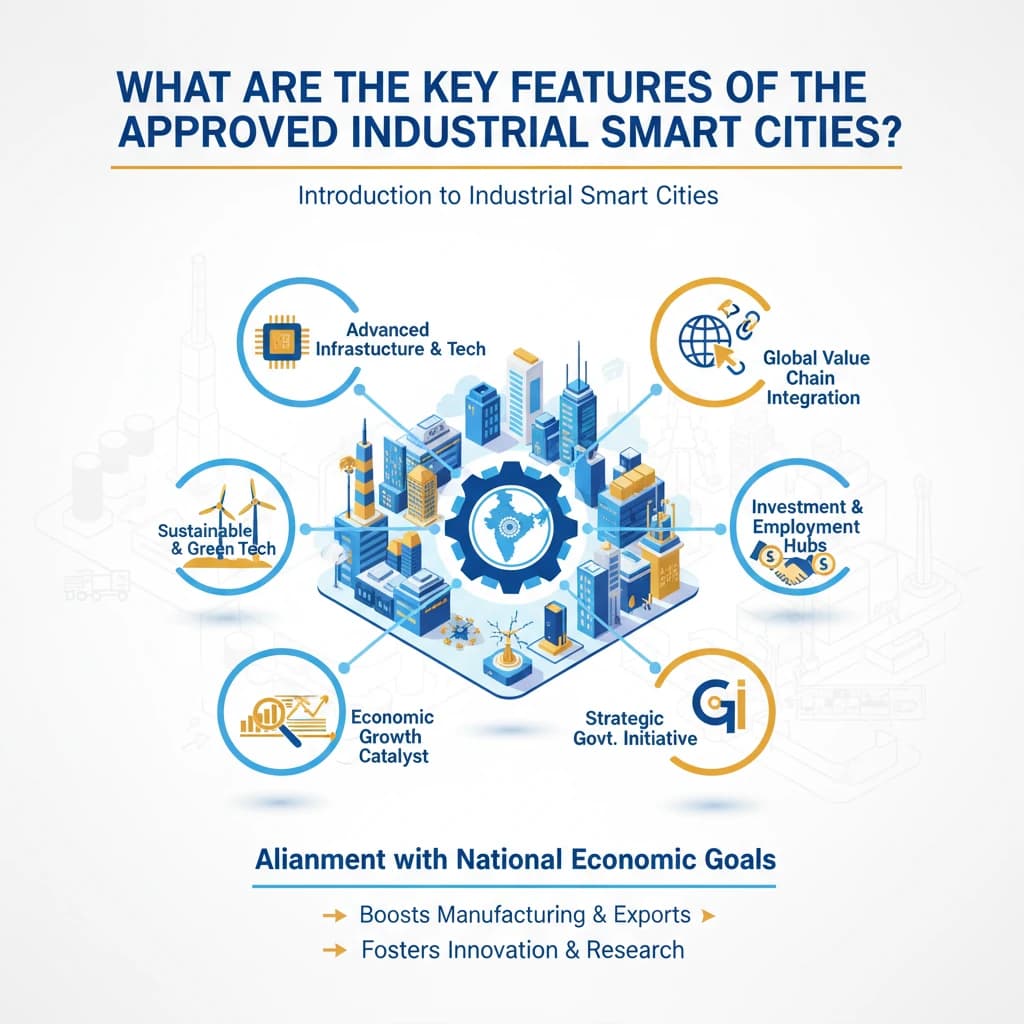
What are the Key Features of the Approved Industrial Smart Cities?
Medium⏱️ 8 min read
economy
📖 Introduction
Introduction to Industrial Smart Cities
The approved Industrial Smart Cities are a strategic initiative by the Government of India, designed to bolster the nation's economic prowess and integrate it more deeply into global value chains.
These cities are envisioned as modern industrial hubs, equipped with advanced infrastructure and sustainable practices to attract investment and foster employment.
Alignment with National Economic Goals
A primary objective of developing these smart cities is to align with India's ambitious national economic goals.
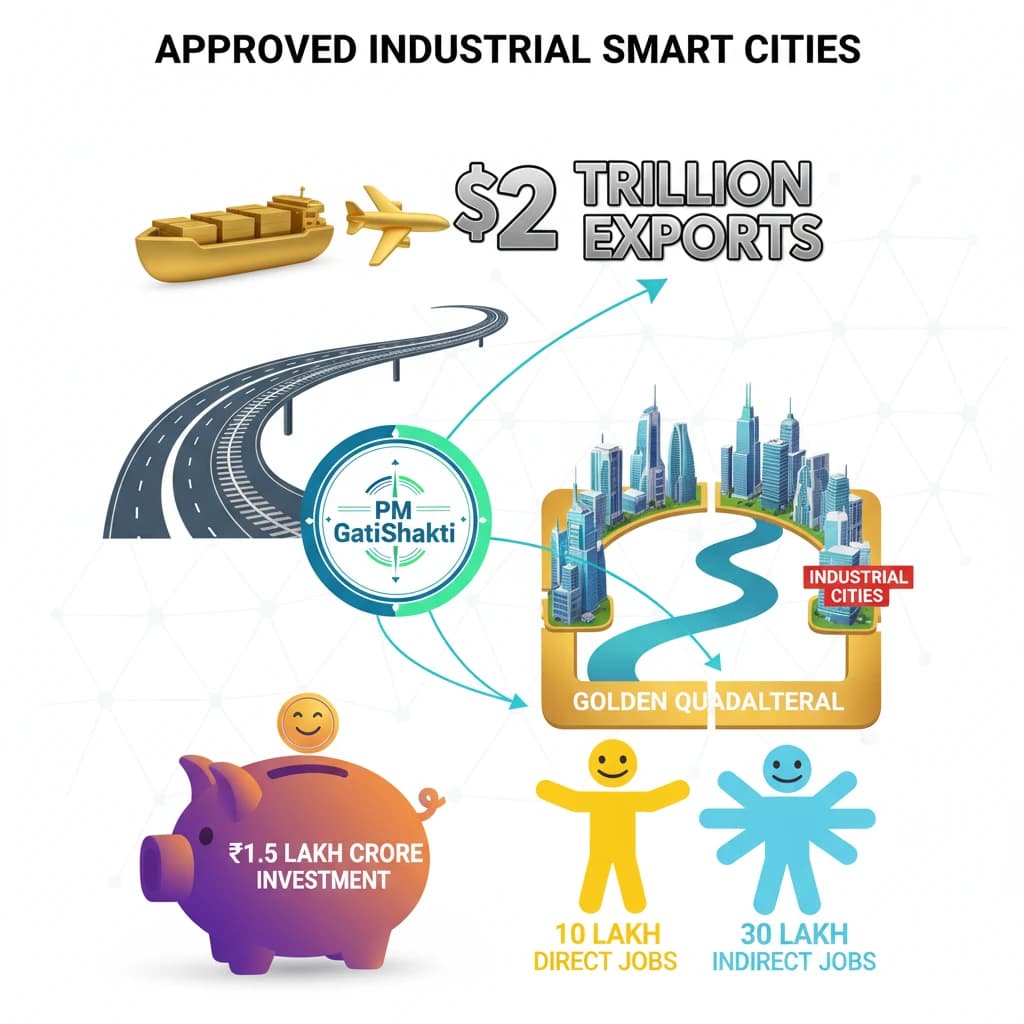
The government aims to achieve USD 2 trillion in exports by 2030, and these industrial cities are crucial facilitators for reaching this target.
Integration with PM GatiShakti National Master Plan
The development projects for these cities are meticulously aligned with the PM GatiShakti National Master Plan.
This alignment ensures the incorporation of robust multi-modal connectivity infrastructure, vital for efficient logistics.
The goal is to enable seamless movement of people, goods, and services, thereby enhancing logistical efficiency and streamlining supply chains across the country.
Strategic Location: Golden Quadrilateral
These industrial smart cities are strategically planned to form a 'necklace of industrial cities'.
Their location along the Golden Quadrilateral significantly enhances regional connectivity and stimulates industrial growth in key economic corridors.
The Golden Quadrilateral network is pivotal for connecting India's major industrial, agricultural, and cultural centers, facilitating trade and transport.
Attracting Foreign Direct Investment (FDI)
A significant feature is their design to actively attract Foreign Direct Investment (FDI).
Countries like Singapore and Switzerland are targeted sources for these crucial investments, boosting India's economic landscape.
Job Creation Potential
The projects are projected to be major engines for employment generation.
Estimates suggest the creation of approximately 10 lakh direct jobs and up to 30 lakh indirect jobs across various sectors.
Investment Potential
The development of these industrial smart cities holds substantial investment potential.
The anticipated investment is around Rs 1.5 lakh crore, indicating a massive economic stimulus.
Promoting Sustainability and Global Value Chains
Cities developed under the National Industrial Corridor Development Programme (NICDP) prioritize sustainability.
They integrate ICT-enabled utilities and green technologies to minimize environmental impact.
Furthermore, these cities offer ready-to-allot land parcels, making them highly attractive to both domestic and international investors.
This approach aims to strengthen India's position and role in global value chains, fostering a competitive industrial ecosystem.
Understanding the dual focus on economic growth and environmental sustainability is crucial for Mains answers, especially in GS Paper 3.
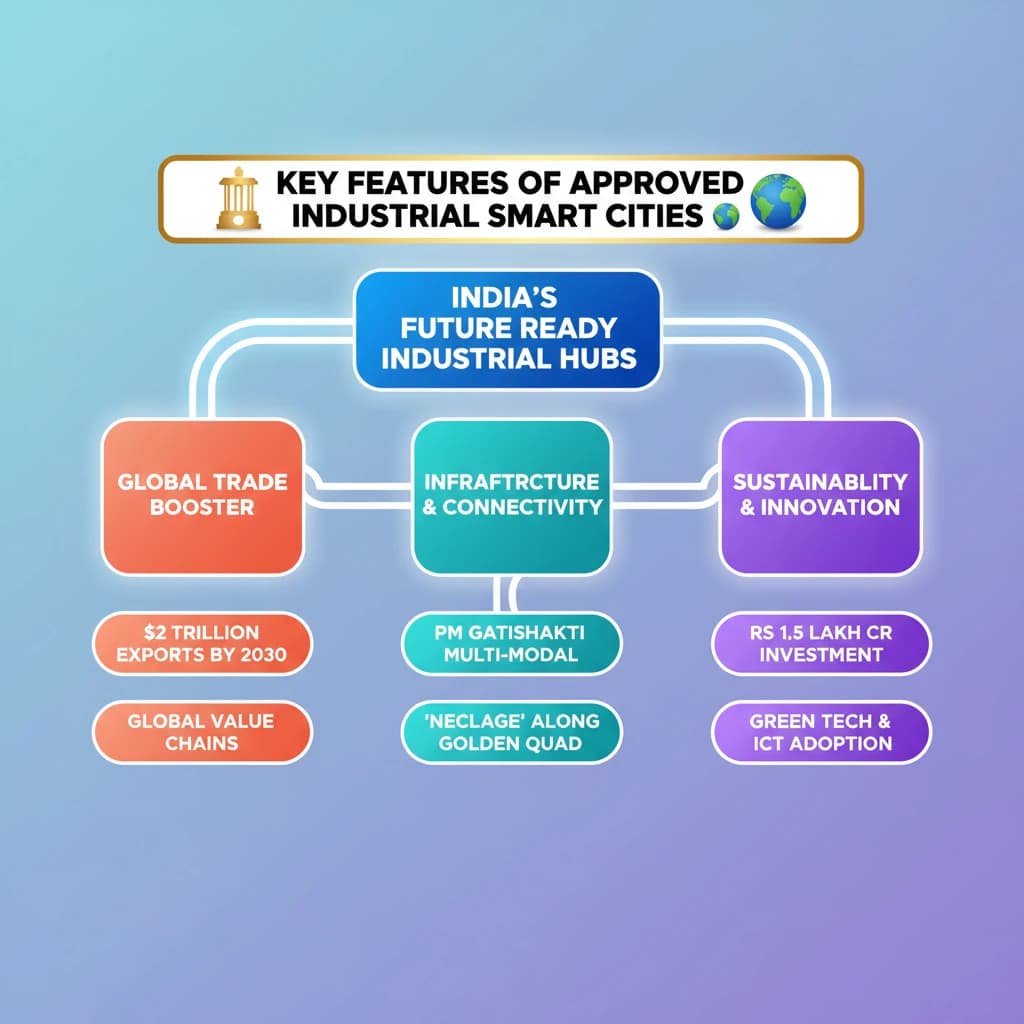
💡 Key Takeaways
- •Designed to achieve $2 trillion exports by 2030.
- •Aligned with PM GatiShakti for multi-modal connectivity and logistics efficiency.
- •Part of a 'necklace of industrial cities' along the Golden Quadrilateral.
- •Aims to attract Rs 1.5 lakh crore investment and create 10 lakh direct, 30 lakh indirect jobs.
- •Promotes sustainability through ICT and green technologies, strengthening global value chains.
🧠 Memory Techniques
95% Verified Content
📚 Reference Sources
•Ministry of Commerce & Industry, Government of India (for NICDP and export targets)
•PM GatiShakti National Master Plan official documentation