Loading page, please wait…
Vaidra Logo
Vaidra

Top 4 items + smart groups

UPSC GPT
New
Current Affairs
Daily Solutions
Daily Puzzle
Mains Evaluator

Version 2.0.0 • Built with ❤️ for UPSC aspirants

Loading...
Loading...
Loading...
Loading...
Loading...
Loading...
Loading...
Loading...
Loading...
Loading...
Loading...
Loading...
Loading...
Methane Emissions and Global Warming - UPSC Environment And Ecology
Back
All Subjects

Topics

0 topics • 0 completed

Loading topics...
Loading...
Loading...
Loading...
Loading...
Loading...
Overall Progress0%

Methane Emissions and Global Warming - UPSC Environment And Ecology

What is Methane Emissions and Global Warming in UPSC Environment And Ecology?

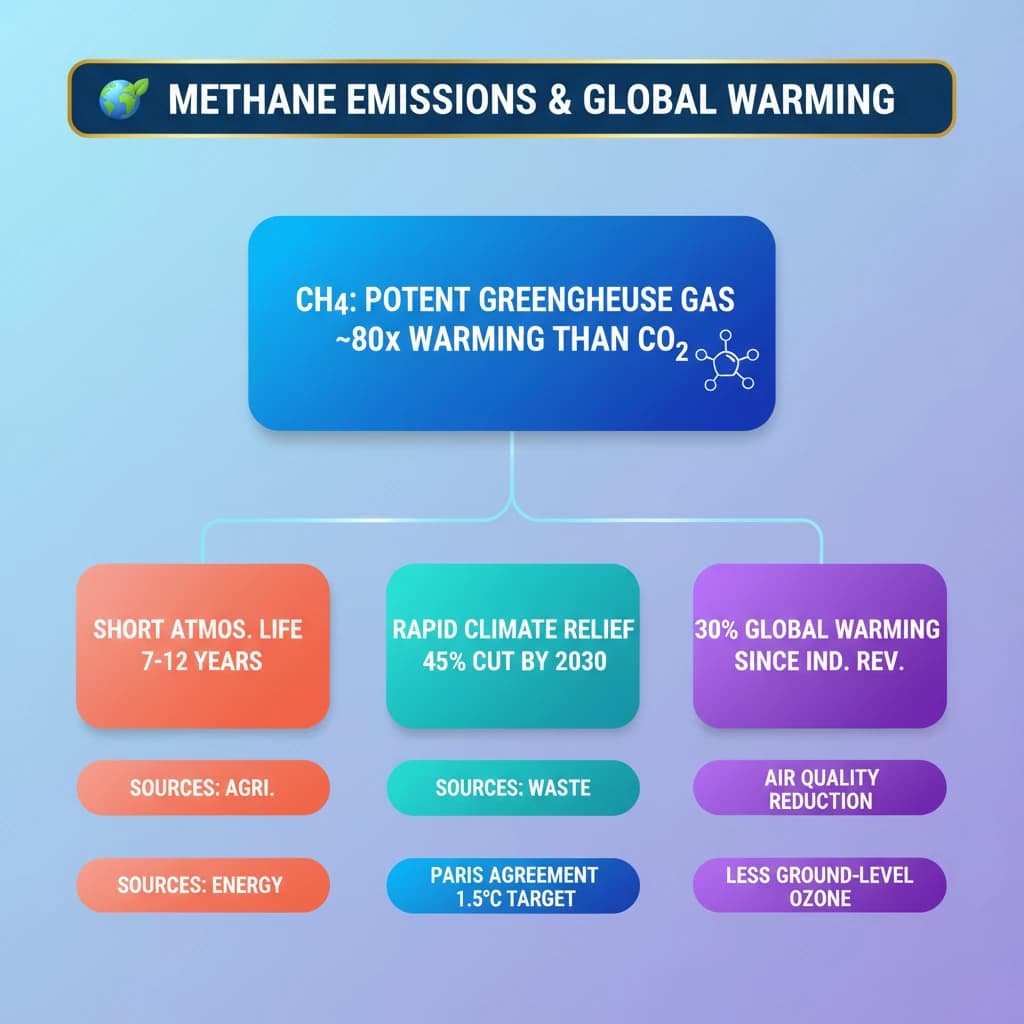
Methane Emissions and Global Warming is a key topic under Environment And Ecology for UPSC Civil Services Examination. Key points include: Methane (CH4) is a potent greenhouse gas, ~80 times more powerful than CO2 over 20 years, contributing 30% to global warming since the Industrial Revolution.. It has a short atmospheric lifespan (7-12 years), making its reduction a rapid and effective climate mitigation strategy.. Reducing methane by 45% by 2030 is crucial for achieving the Paris Agreement's 1.5°C target.. Understanding this topic is essential for both UPSC Prelims and Mains preparation.

Why is Methane Emissions and Global Warming important for UPSC exam?

Methane Emissions and Global Warming is a Medium-level topic in UPSC Environment And Ecology. It is tested in both Prelims (factual MCQs) and Mains (analytical answer writing). Previous year UPSC questions have frequently covered aspects of Methane Emissions and Global Warming, making it essential for comprehensive IAS preparation.

How to prepare Methane Emissions and Global Warming for UPSC?

To prepare Methane Emissions and Global Warming for UPSC: (1) Study the comprehensive notes covering all key concepts on Vaidra. (2) Practice previous year questions on this topic. (3) Connect it with current affairs using daily updates. (4) Revise using key takeaways and mind maps available for Environment And Ecology. (5) Write practice answers linking Methane Emissions and Global Warming to related GS Paper topics.

Key takeaways of Methane Emissions and Global Warming for UPSC

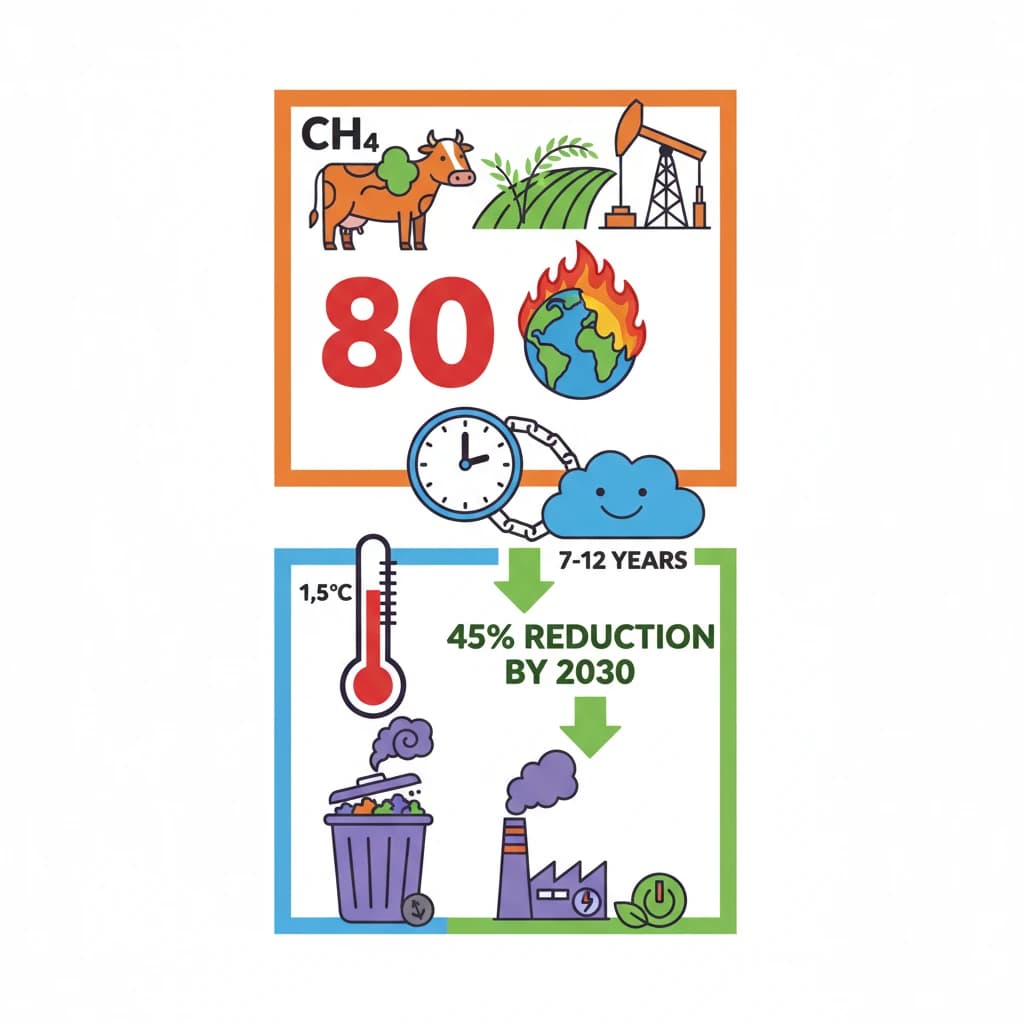
  • Methane (CH4) is a potent greenhouse gas, ~80 times more powerful than CO2 over 20 years, contributing 30% to global warming since the Industrial Revolution.
  • It has a short atmospheric lifespan (7-12 years), making its reduction a rapid and effective climate mitigation strategy.
  • Reducing methane by 45% by 2030 is crucial for achieving the Paris Agreement's 1.5°C target.
  • Major anthropogenic sources are agriculture (livestock, rice), energy (oil, gas, coal), and waste (landfills).
  • Methane abatement also improves air quality by reducing ground-level ozone.
  • Global initiatives like the Global Methane Pledge, UNEP's IMEO, and IEA's Methane Tracker aim to reduce emissions, though India has not signed the GMP.
Methane Emissions and Global Warming

Methane Emissions and Global Warming

Medium⏱️ 8 min read✓ 95% Verified
environment and ecology

📖 Introduction

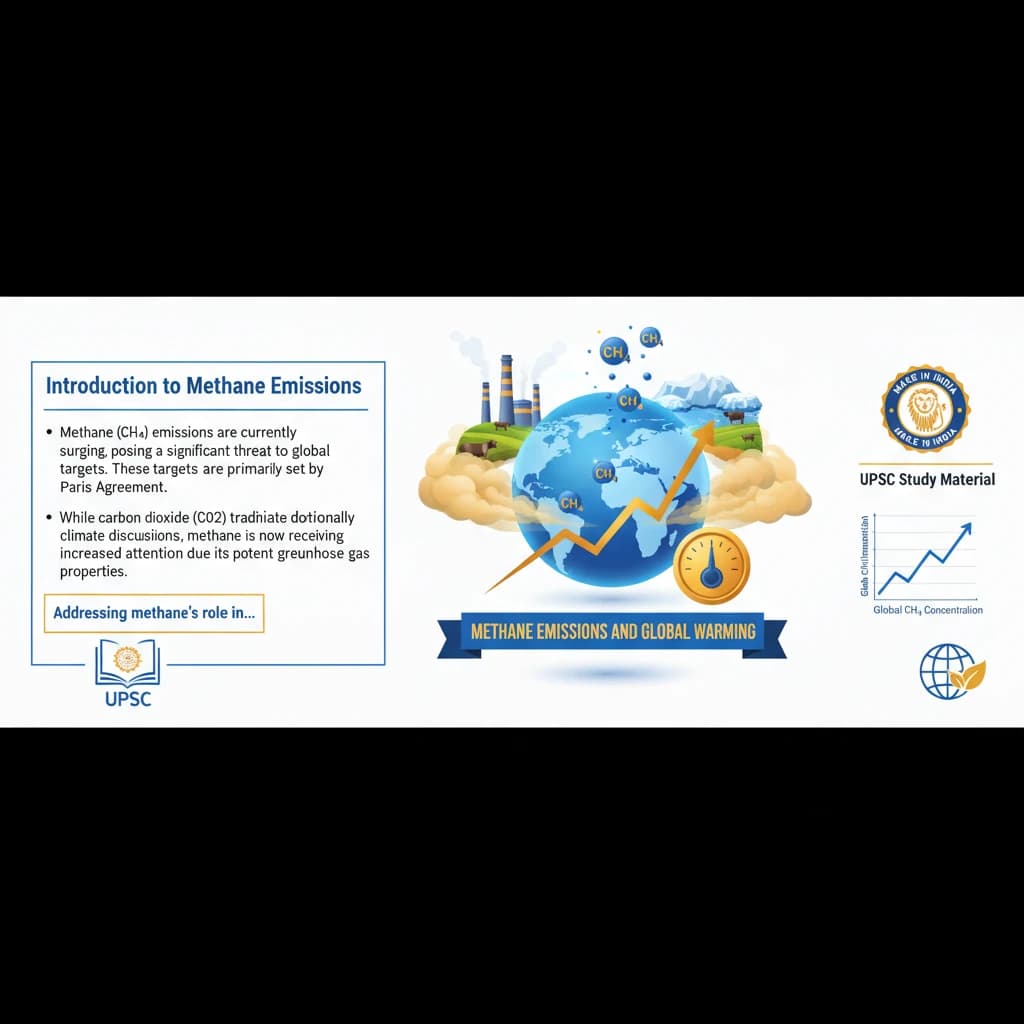
<h4>Introduction to Methane Emissions</h4><p><strong>Methane (CH4)</strong> emissions are currently surging, posing a significant threat to global climate targets. These targets are primarily set by the <strong>Paris Agreement</strong>.</p><p>While <strong>carbon dioxide (CO2)</strong> traditionally dominates climate discussions, <strong>methane</strong> is now receiving increased attention due to its potent greenhouse gas properties.</p><div class='key-point-box'><p>Addressing methane's role in global warming presents a crucial opportunity for achieving rapid progress in climate change mitigation.</p></div><h4>Defining Methane</h4><div class='info-box'><ul><li><strong>Methane</strong> is the simplest hydrocarbon, composed of <strong>one carbon atom</strong> and <strong>four hydrogen atoms (CH4)</strong>.</li><li>It is the primary component of <strong>natural gas</strong>.</li><li>Key characteristics include being an <strong>odourless, colourless, and tasteless gas</strong>, and it is <strong>lighter than air</strong>.</li><li>In complete combustion, it burns with a <strong>blue flame</strong>, producing <strong>carbon dioxide (CO2)</strong> and <strong>water (H2O)</strong>.</li></ul></div><h4>Climate Impact of Methane Emissions</h4><p><strong>Methane</strong> is an exceptionally potent <strong>greenhouse gas (GHG)</strong>, approximately <strong>80 times more potent than CO2</strong> over a 20-year period.</p><p>It has contributed to around <strong>30% of global warming</strong> since the <strong>Industrial Revolution</strong>, highlighting its significant role in climate change.</p><div class='info-box'><p>Despite its high potency, methane has a relatively short atmospheric lifespan, remaining in the atmosphere for only about <strong>7 to 12 years</strong>.</p></div><div class='key-point-box'><p>This shorter lifespan means that reducing <strong>methane emissions</strong> or enhancing its natural sinks can have a significant and rapid impact on mitigating climate change in the short term. This buys valuable time to address the more complex challenge of reducing reliance on fossil fuels and associated <strong>CO2 emissions</strong>.</p></div><p>A targeted reduction of <strong>methane emissions by 45% by 2030</strong> is projected to help achieve the <strong>Paris Agreement's goal</strong> of limiting global warming to <strong>1.5°C</strong>.</p><h4>Methane and Air Quality Issues</h4><p>Beyond its direct warming effect, controlling <strong>methane emissions</strong> is also vital for improving <strong>air quality</strong>.</p><p><strong>Methane</strong> contributes to the formation of <strong>ground-level (tropospheric) ozone</strong>, which is a harmful air pollutant.</p><div class='info-box'><p><strong>Ground-level ozone</strong> negatively impacts <strong>respiratory health</strong>, making methane abatement a dual-benefit strategy for both climate and public health.</p></div><h4>Sources of Methane Emissions</h4><p>Global methane emissions are estimated at approximately <strong>580 million tonnes annually</strong>.</p><p>These emissions are split between natural and human-induced sources:</p><ul><li>About <strong>40%</strong> originates from <strong>natural sources</strong>.</li><li>Approximately <strong>60%</strong> comes from <strong>human activities (anthropogenic emissions)</strong>.</li></ul><div class='key-point-box'><p>Mitigating anthropogenic methane emissions is considered a relatively achievable climate solution compared to other greenhouse gases.</p></div><p>Key sectors responsible for anthropogenic methane emissions include:</p><ul><li><strong>Agriculture:</strong> This is the largest anthropogenic source, accounting for about <strong>25% of emissions</strong>, primarily from <strong>livestock (enteric fermentation)</strong> and <strong>rice cultivation</strong>.</li><li><strong>Energy:</strong> Closely follows agriculture, encompassing emissions from <strong>oil, gas, and coal production</strong>, as well as <strong>biofuels</strong>.</li><li><strong>Waste Management:</strong> Emissions from <strong>landfills</strong> are a significant contributor.</li></ul><h4>Global Warming Potential (GWP) of Methane</h4><div class='info-box'><p><strong>Global Warming Potential (GWP)</strong> is a measure of how much energy the emissions of one tonne of a gas will absorb over a given period, relative to the emissions of one tonne of <strong>carbon dioxide</strong>.</p><p><strong>Methane</strong> has a GWP of <strong>28</strong>, meaning it is <strong>28 times more potent than carbon dioxide</strong> over a 100-year period.</p></div><div class='exam-tip-box'><p>UPSC often tests the difference in potency and atmospheric lifespan between <strong>methane</strong> and <strong>carbon dioxide</strong>. Understand that methane's short lifespan offers a quicker mitigation opportunity.</p></div>
Concept Diagram

💡 Key Takeaways

  • •Methane (CH4) is a potent greenhouse gas, ~80 times more powerful than CO2 over 20 years, contributing 30% to global warming since the Industrial Revolution.
  • •It has a short atmospheric lifespan (7-12 years), making its reduction a rapid and effective climate mitigation strategy.
  • •Reducing methane by 45% by 2030 is crucial for achieving the Paris Agreement's 1.5°C target.
  • •Major anthropogenic sources are agriculture (livestock, rice), energy (oil, gas, coal), and waste (landfills).
  • •Methane abatement also improves air quality by reducing ground-level ozone.
  • •Global initiatives like the Global Methane Pledge, UNEP's IMEO, and IEA's Methane Tracker aim to reduce emissions, though India has not signed the GMP.

🧠 Memory Techniques
Memory Aid
95% Verified Content

📚 Reference Sources

•Paris Agreement
•UN Environment Programme (UNEP)
•International Energy Agency (IEA)
•Intergovernmental Panel on Climate Change (IPCC)
•Climate and Clean Air Coalition (CCAC)

Related Topics

Loading related topics...
Explore:Environment And Ecology Topics·All Subjects·Daily Current Affairs·Editorial Analysis·Previous Year Questions·UPSC GPT