Loading page, please wait…
Vaidra Logo
Vaidra

Top 4 items + smart groups

UPSC GPT
New
Current Affairs
Daily Solutions
Daily Puzzle
Mains Evaluator

Version 2.0.0 • Built with ❤️ for UPSC aspirants

Loading...
Loading...
Loading...
Loading...
Loading...
Loading...
Loading...
Loading...
Loading...
Loading...
Loading...
Loading...
Loading...
Golden Langur: Distribution, Characteristics, and Conservation Status - UPSC Environment And Ecology
Back
All Subjects

Topics

0 topics • 0 completed

Loading topics...
Loading...
Loading...
Loading...
Loading...
Loading...
Overall Progress0%

Golden Langur: Distribution, Characteristics, and Conservation Status - UPSC Environment And Ecology

What is Golden Langur: Distribution, Characteristics, and Conservation Status in UPSC Environment And Ecology?

Golden Langur: Distribution, Characteristics, and Conservation Status is a key topic under Environment And Ecology for UPSC Civil Services Examination. Key points include: Golden Langur (Trachypithecus geei) is an endangered Old World Monkey.. Found exclusively in a restricted range in Assam, India, and Bhutan.. Discovered by E.P. Gee in 1953, formally described by Khajuria in 1956.. Understanding this topic is essential for both UPSC Prelims and Mains preparation.

Why is Golden Langur: Distribution, Characteristics, and Conservation Status important for UPSC exam?

Golden Langur: Distribution, Characteristics, and Conservation Status is a Medium-level topic in UPSC Environment And Ecology. It is tested in both Prelims (factual MCQs) and Mains (analytical answer writing). Previous year UPSC questions have frequently covered aspects of Golden Langur: Distribution, Characteristics, and Conservation Status, making it essential for comprehensive IAS preparation.

How to prepare Golden Langur: Distribution, Characteristics, and Conservation Status for UPSC?

To prepare Golden Langur: Distribution, Characteristics, and Conservation Status for UPSC: (1) Study the comprehensive notes covering all key concepts on Vaidra. (2) Practice previous year questions on this topic. (3) Connect it with current affairs using daily updates. (4) Revise using key takeaways and mind maps available for Environment And Ecology. (5) Write practice answers linking Golden Langur: Distribution, Characteristics, and Conservation Status to related GS Paper topics.

Key takeaways of Golden Langur: Distribution, Characteristics, and Conservation Status for UPSC

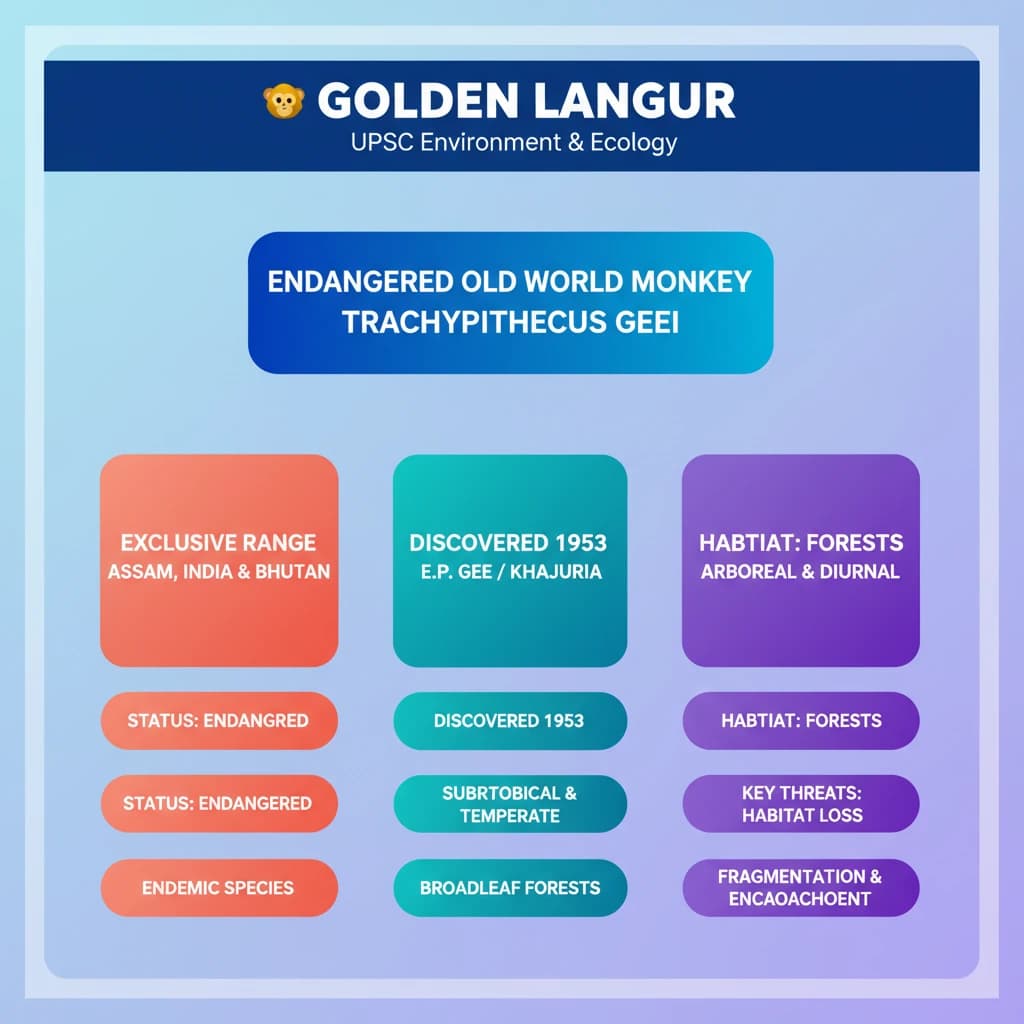
  • Golden Langur (Trachypithecus geei) is an endangered Old World Monkey.
  • Found exclusively in a restricted range in Assam, India, and Bhutan.
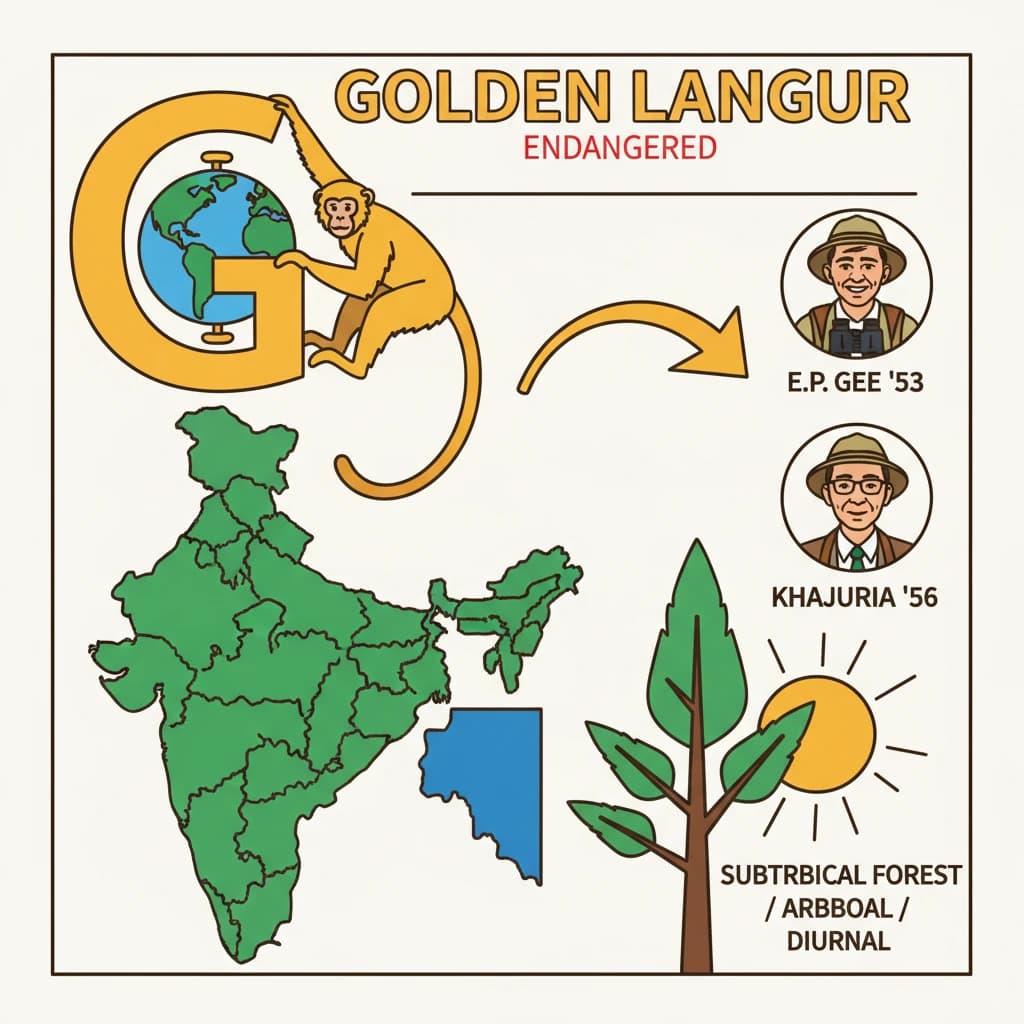
  • Discovered by E.P. Gee in 1953, formally described by Khajuria in 1956.
  • Habitat: Subtropical and temperate broadleaf forests; arboreal and diurnal.
  • Key threats include habitat fragmentation, deforestation, and human encroachment.
  • Conservation requires transboundary cooperation and effective implementation of wildlife protection laws.
Golden Langur: Distribution, Characteristics, and Conservation Status

Golden Langur: Distribution, Characteristics, and Conservation Status

Medium⏱️ 7 min read✓ 98% Verified
environment and ecology

📖 Introduction

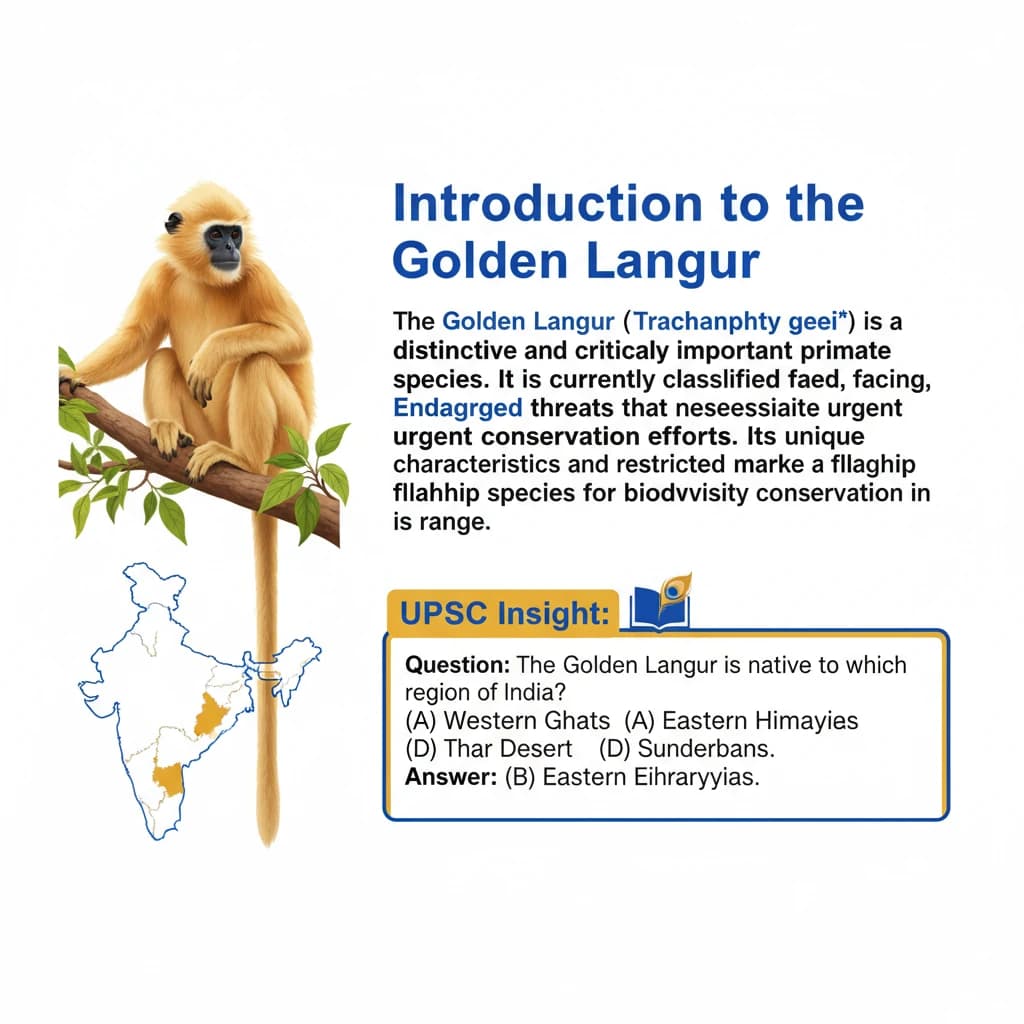
<h4>Introduction to the Golden Langur</h4><p>The <strong>Golden Langur</strong> (<em>Trachypithecus geei</em>) is a highly distinctive and critically important primate species. It is currently classified as <strong>Endangered</strong>, facing escalating threats that necessitate urgent conservation efforts. Its unique characteristics and restricted habitat make it a flagship species for biodiversity conservation in its range.</p><div class='exam-tip-box'><p><strong>UPSC Insight:</strong> Questions on <strong>endangered species</strong> often focus on their habitat, unique features, and conservation status. The <strong>Golden Langur</strong> is a prime example for <strong>GS3 Environment & Ecology</strong>.</p></div><h4>Taxonomy and Discovery</h4><p>The <strong>Golden Langur</strong> belongs to the family <strong>Cercopithecidae</strong>, commonly known as <strong>Old World Monkeys</strong>. Within this family, it falls under the subfamily <strong>Colobinae</strong>, which are typically <strong>leaf-eating monkeys</strong>.</p><div class='info-box'><p><strong>Species Name:</strong> <em><strong>Trachypithecus geei</strong></em><br><strong>Family:</strong> <strong>Cercopithecidae</strong> (Old World Monkeys)<br><strong>Subfamily:</strong> <strong>Colobinae</strong> (Leaf-eating monkeys)</p></div><p>The species was first brought to scientific attention by <strong>E.P. Gee</strong> in <strong>1953</strong>. It was subsequently formally described by <strong>Khajuria</strong> in <strong>1956</strong>, solidifying its place in the scientific record.</p><h4>Geographic Range</h4><p>The distribution of the <strong>Golden Langur</strong> is remarkably restricted. It is found exclusively in specific regions of <strong>Assam, India</strong>, and the neighboring country of <strong>Bhutan</strong>. This limited range makes it particularly vulnerable to habitat changes.</p><div class='info-box'><p><strong>Exclusive Range:</strong> Parts of <strong>Assam, India</strong> and <strong>Bhutan</strong>.<br><strong>Bordered by:</strong><br><ul><li><strong>North:</strong> Foothills of <strong>Bhutan</strong></li><li><strong>East:</strong> <strong>Manas River</strong></li><li><strong>West:</strong> <strong>Sankosh River</strong></li><li><strong>South:</strong> <strong>Brahmaputra River</strong></li></ul></p></div><h4>Habitat</h4><p>These primates thrive in specific forest types across a considerable elevation range. Their preferred habitat consists of <strong>subtropical and temperate broadleaf forests</strong>.</p><p>They can be found at various altitudes, from areas near sea level up to elevations exceeding <strong>3,000 meters</strong>. This adaptability to different elevations within their forest type is notable.</p><h4>Physical Characteristics</h4><p>The <strong>Golden Langur</strong> is easily recognizable by its striking appearance. Its most prominent feature is its distinctive fur color.</p><div class='info-box'><p><strong>Coat Color:</strong> Primarily <strong>golden-orange fur</strong>.<br><strong>Seasonal Variation:</strong> Fur color changes with seasons, appearing <strong>cream in summer</strong> and a darker <strong>golden in winter</strong>.<br><strong>Facial Features:</strong> A characteristic <strong>black hairless face</strong>, complemented by a <strong>pale beard</strong>. A unique <strong>protective hair whorl</strong> is present on the crown of its head.</p></div><p>The species also exhibits <strong>sexual dimorphism</strong>. <strong>Males</strong> are generally larger and possess a more robust build compared to <strong>females</strong>.</p><h4>Behavior</h4><p><strong>Golden Langurs</strong> display typical primate behaviors. They are <strong>diurnal</strong>, meaning they are active primarily during the daytime. Their lives are predominantly spent in trees, classifying them as highly <strong>arboreal</strong> species.</p>
Concept Diagram

💡 Key Takeaways

  • •Golden Langur (Trachypithecus geei) is an endangered Old World Monkey.
  • •Found exclusively in a restricted range in Assam, India, and Bhutan.
  • •Discovered by E.P. Gee in 1953, formally described by Khajuria in 1956.
  • •Habitat: Subtropical and temperate broadleaf forests; arboreal and diurnal.
  • •Key threats include habitat fragmentation, deforestation, and human encroachment.
  • •Conservation requires transboundary cooperation and effective implementation of wildlife protection laws.

🧠 Memory Techniques
Memory Aid
98% Verified Content

📚 Reference Sources

•IUCN Red List of Threatened Species (for conservation status)
•Wildlife Protection Act, 1972 (for legal protection in India)
•General knowledge on primate taxonomy and geographical distribution

Related Topics

Loading related topics...
Explore:Environment And Ecology Topics·All Subjects·Daily Current Affairs·Editorial Analysis·Previous Year Questions·UPSC GPT