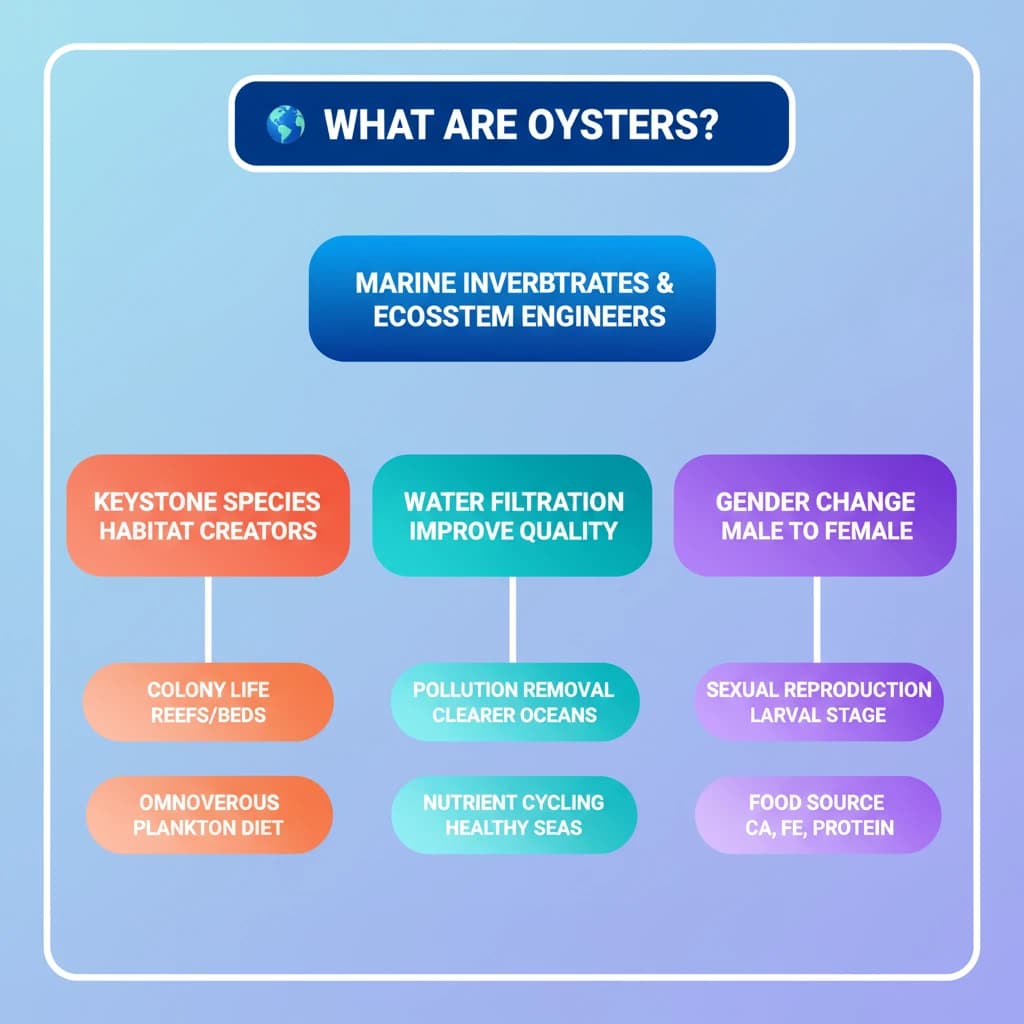
Loading page, please wait…
Vaidra Logo
Vaidra

Top 4 items + smart groups

UPSC GPT
New
Current Affairs
Daily Solutions
Daily Puzzle
Mains Evaluator

Version 2.0.0 • Built with ❤️ for UPSC aspirants

Loading...
Loading...
Loading...
Loading...
Loading...
Loading...
Loading...
Loading...
Loading...
Loading...
Loading...
Loading...
Loading...
Back
All Subjects

Topics

0 topics • 0 completed

Loading topics...
Loading...
Loading...
Loading...
Loading...
Loading...
Overall Progress0%

What are Oysters? - UPSC Environment And Ecology

What is What are Oysters? in UPSC Environment And Ecology?

What are Oysters? is a key topic under Environment And Ecology for UPSC Civil Services Examination. Key points include: Oysters are invertebrates, omnivorous filter feeders, forming vital marine habitats (colonies, beds, reefs).. They are a keystone species, providing critical habitat and protection for diverse marine organisms.. Oysters significantly improve water quality by filtering pollutants like nitrates, ammonia, and bacteria.. Understanding this topic is essential for both UPSC Prelims and Mains preparation.

Why is What are Oysters? important for UPSC exam?

What are Oysters? is a Medium-level topic in UPSC Environment And Ecology. It is tested in both Prelims (factual MCQs) and Mains (analytical answer writing). Previous year UPSC questions have frequently covered aspects of What are Oysters?, making it essential for comprehensive IAS preparation.

How to prepare What are Oysters? for UPSC?

To prepare What are Oysters? for UPSC: (1) Study the comprehensive notes covering all key concepts on Vaidra. (2) Practice previous year questions on this topic. (3) Connect it with current affairs using daily updates. (4) Revise using key takeaways and mind maps available for Environment And Ecology. (5) Write practice answers linking What are Oysters? to related GS Paper topics.

Key takeaways of What are Oysters? for UPSC

  • Oysters are invertebrates, omnivorous filter feeders, forming vital marine habitats (colonies, beds, reefs).
  • They are a keystone species, providing critical habitat and protection for diverse marine organisms.
  • Oysters significantly improve water quality by filtering pollutants like nitrates, ammonia, and bacteria.
  • They exhibit unique gender change, starting as males and often becoming females after about a year, sometimes changing multiple times.
  • Historically a human food source, oysters are currently crucial for ecosystem restoration and coastal protection.
What are Oysters?

What are Oysters?

Medium⏱️ 7 min read✓ 95% Verified
environment and ecology

📖 Introduction

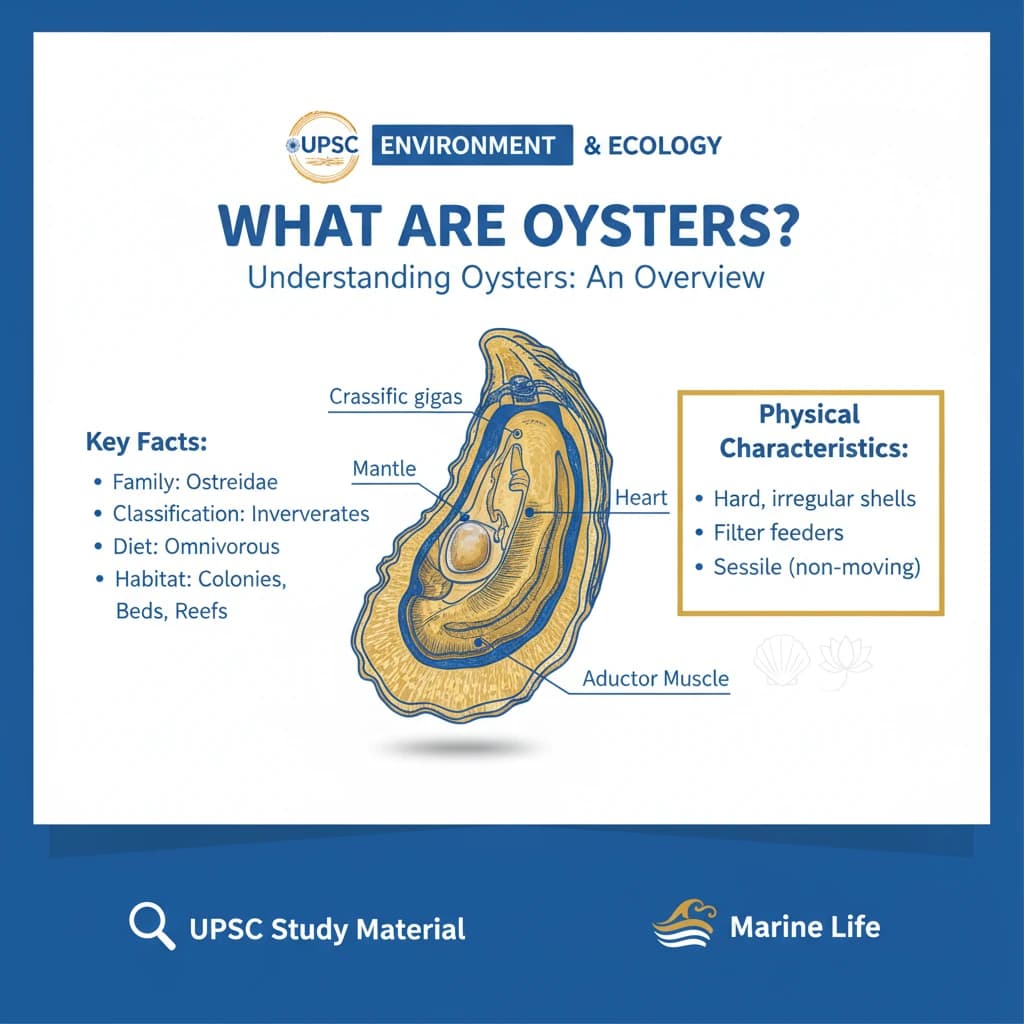
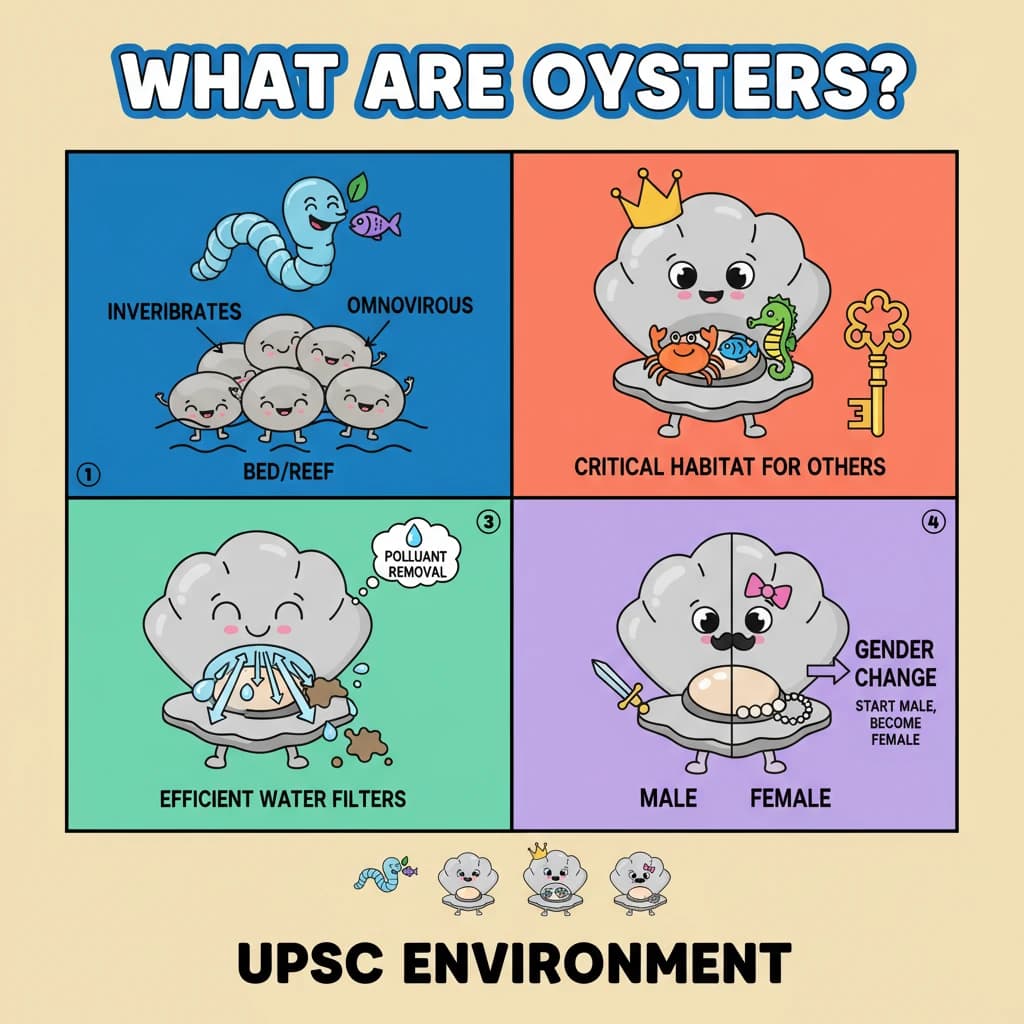
<h4>Introduction to Oysters</h4><p><strong>Oysters</strong> belong to the family <strong>Ostreidae</strong> and are classified as <strong>invertebrates</strong>.</p><p>They are <strong>omnivorous</strong> organisms that typically live in organized groups. These groups are known as <strong>colonies</strong>, <strong>beds</strong>, or <strong>reefs</strong>.</p><div class='info-box'><p>Oysters are characterized by their rough, rock-hard shells. These shells are usually <strong>oval or pear-shaped</strong>, providing robust protection.</p></div><h4>Habitat and Appearance</h4><p>Oysters are widely distributed, found primarily in <strong>shallow ocean waters worldwide</strong>.</p><p>They form dense aggregations, creating significant structures known as <strong>oyster beds</strong> or <strong>reefs</strong>, which are vital marine habitats.</p><div class='info-box'><p>While some edible oysters can occasionally produce <strong>pearls</strong>, they are distinct from <strong>pearl oysters</strong>. Pearl oysters belong to a different bivalve family and are specifically cultivated for pearl production.</p></div><h4>Ecological Role: Keystone Species</h4><div class='key-point-box'><p>Oysters are recognized as a <strong>keystone species</strong> within their ecosystems. This means they have a disproportionately large impact relative to their abundance.</p></div><p>Their physical structures, such as <strong>oyster beds</strong> and <strong>reefs</strong>, provide critical habitat and protection.</p><p>These complex structures support a diverse array of marine organisms, including <strong>sea anemones</strong>, <strong>barnacles</strong>, and <strong>mussels</strong>, fostering biodiversity.</p><div class='info-box'><p>Examples of other well-known <strong>keystone species</strong> include <strong>Tigers</strong> (predators maintaining prey populations) and <strong>Sea Otters</strong> (controlling sea urchin populations to protect kelp forests).</p></div><h4>Ecological Role: Water Filtration</h4><p>A remarkable ecological function of oysters is their ability to significantly improve <strong>water quality</strong>.</p><p>A single oyster possesses an impressive filtering capacity, capable of processing over <strong>two gallons of water per hour</strong>.</p><div class='info-box'><p>This translates to an astonishing filtration rate of up to <strong>50 gallons per day</strong> per oyster, effectively cleaning their surrounding environment.</p></div><p>Oysters actively remove various pollutants from the water, including <strong>nitrates</strong>, <strong>ammonia</strong>, <strong>phosphates</strong>, <strong>bacteria</strong>, and <strong>organic matter</strong>.</p><p>This filtration process leads to significantly improved <strong>water clarity</strong> and overall ecosystem health.</p><h4>Diet and Reproduction</h4><p>Oysters are <strong>filter feeders</strong>, obtaining their nutrition by drawing water over their gills.</p><p>They efficiently filter out <strong>algae</strong> and other microscopic <strong>food particles</strong> suspended in the water.</p><div class='key-point-box'><p>A fascinating aspect of oyster biology is their reproductive strategy: <strong>all oysters begin life as males</strong>.</p></div><p>Typically, after approximately <strong>one year</strong>, they undergo a permanent gender change to become <strong>females</strong>.</p><p>Furthermore, some oyster species exhibit the ability to <strong>change gender multiple times</strong> throughout their lifespan, adapting to environmental conditions.</p><h4>Oysters as Food</h4><p>Oysters have been a valuable food source for humans for <strong>thousands of years</strong>, consumed both <strong>raw and cooked</strong>.</p><div class='info-box'><p>They are highly nutritious, providing significant amounts of essential minerals and protein. Key nutrients include high levels of <strong>calcium</strong>, <strong>iron</strong>, and <strong>protein</strong>.</p></div>
Concept Diagram

💡 Key Takeaways

  • •Oysters are invertebrates, omnivorous filter feeders, forming vital marine habitats (colonies, beds, reefs).
  • •They are a keystone species, providing critical habitat and protection for diverse marine organisms.
  • •Oysters significantly improve water quality by filtering pollutants like nitrates, ammonia, and bacteria.
  • •They exhibit unique gender change, starting as males and often becoming females after about a year, sometimes changing multiple times.
  • •Historically a human food source, oysters are currently crucial for ecosystem restoration and coastal protection.

🧠 Memory Techniques
Memory Aid
95% Verified Content

📚 Reference Sources

•National Oceanic and Atmospheric Administration (NOAA) reports
•Marine biology textbooks (e.g., 'Marine Biology' by Peter Castro and Michael Huber)
•Environmental science journals and conservation organization reports

Related Topics

Loading related topics...
Explore:Environment And Ecology Topics·All Subjects·Daily Current Affairs·Editorial Analysis·Previous Year Questions·UPSC GPT
What are Oysters? - UPSC Environment And Ecology