Loading page, please wait…
Vaidra Logo
Vaidra

Top 4 items + smart groups

UPSC GPT
New
Current Affairs
Daily Solutions
Daily Puzzle
Mains Evaluator

Version 2.0.0 • Built with ❤️ for UPSC aspirants

Loading...
Loading...
Loading...
Loading...
Loading...
Loading...
Loading...
Loading...
Loading...
Loading...
Loading...
Loading...
Loading...
The Nine Planetary Boundaries - UPSC Environment And Ecology
Back
All Subjects

Topics

0 topics • 0 completed

Loading topics...
Loading...
Loading...
Loading...
Loading...
Loading...
Overall Progress0%

The Nine Planetary Boundaries - UPSC Environment And Ecology

What is The Nine Planetary Boundaries in UPSC Environment And Ecology?

The Nine Planetary Boundaries is a key topic under Environment And Ecology for UPSC Civil Services Examination. Key points include: Planetary Boundaries (PBs) define Earth's environmental limits for a stable, habitable planet.. Introduced in 2009 by Johan Rockström and 28 scientists.. Purpose: To establish a 'safe operating space' for humanity.. Understanding this topic is essential for both UPSC Prelims and Mains preparation.

Why is The Nine Planetary Boundaries important for UPSC exam?

The Nine Planetary Boundaries is a Medium-level topic in UPSC Environment And Ecology. It is tested in both Prelims (factual MCQs) and Mains (analytical answer writing). Previous year UPSC questions have frequently covered aspects of The Nine Planetary Boundaries, making it essential for comprehensive IAS preparation.

How to prepare The Nine Planetary Boundaries for UPSC?

To prepare The Nine Planetary Boundaries for UPSC: (1) Study the comprehensive notes covering all key concepts on Vaidra. (2) Practice previous year questions on this topic. (3) Connect it with current affairs using daily updates. (4) Revise using key takeaways and mind maps available for Environment And Ecology. (5) Write practice answers linking The Nine Planetary Boundaries to related GS Paper topics.

Key takeaways of The Nine Planetary Boundaries for UPSC

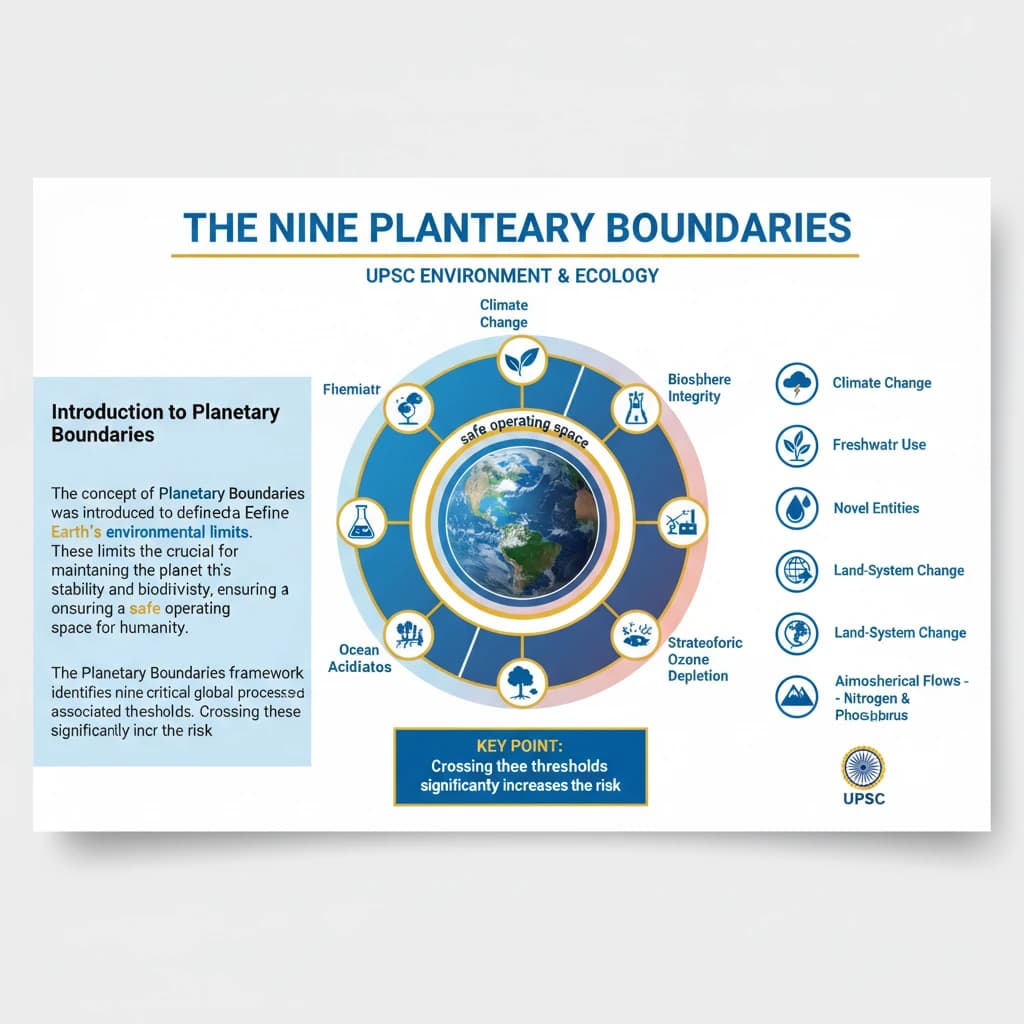
  • Planetary Boundaries (PBs) define Earth's environmental limits for a stable, habitable planet.
  • Introduced in 2009 by Johan Rockström and 28 scientists.
  • Purpose: To establish a 'safe operating space' for humanity.
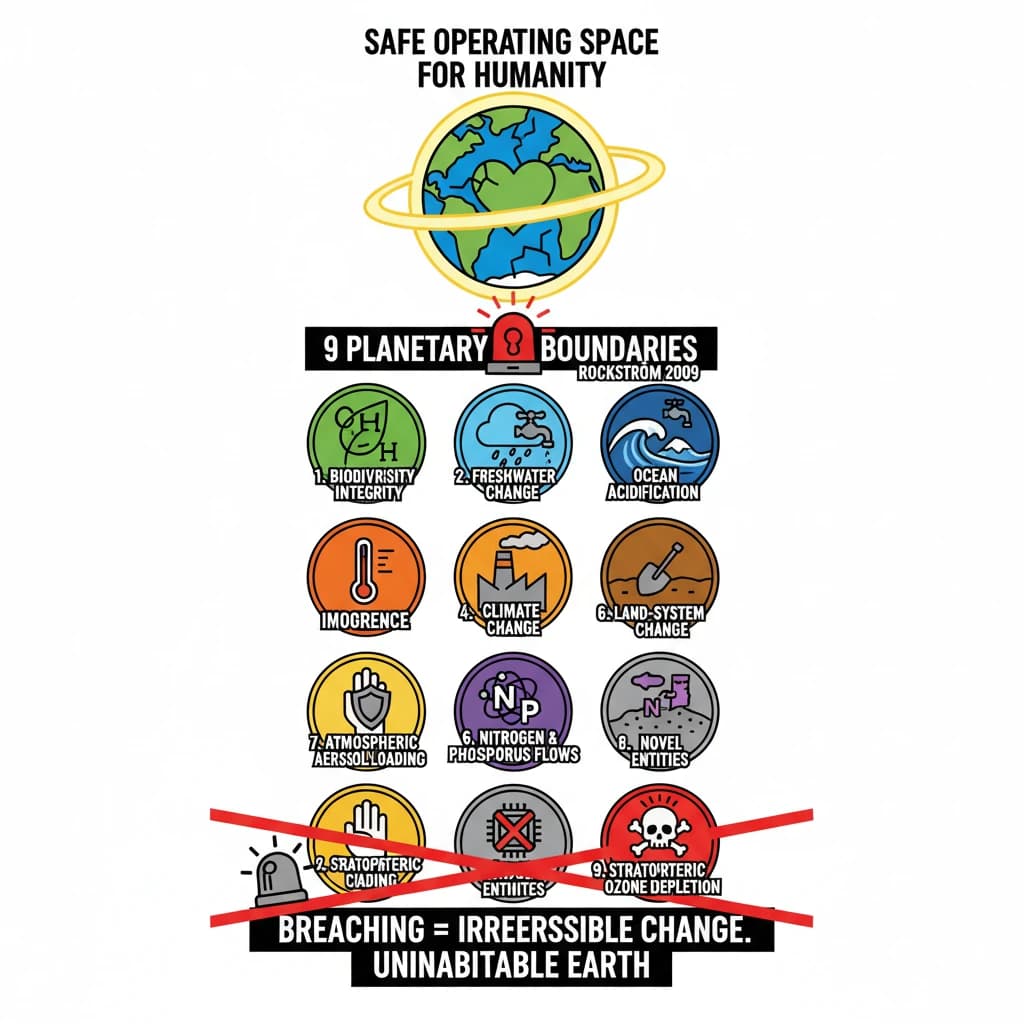
  • Breaching PBs risks irreversible environmental changes and threatens habitability.
  • Nine boundaries cover critical Earth system processes like climate, biodiversity, and biogeochemical flows.
  • The framework is crucial for guiding sustainable development and global policy.
The Nine Planetary Boundaries

The Nine Planetary Boundaries

Medium⏱️ 8 min read✓ 98% Verified
environment and ecology

📖 Introduction

<h4>Introduction to Planetary Boundaries</h4><p>The concept of <strong>Planetary Boundaries</strong> was introduced to define the Earth's environmental limits. These limits are crucial for maintaining the planet's stability and biodiversity, ensuring a safe operating space for humanity.</p><div class='key-point-box'><p>The <strong>Planetary Boundaries framework</strong> identifies nine critical global processes and associated thresholds. Crossing these thresholds significantly increases the risk of large-scale, abrupt, or irreversible environmental changes.</p></div><h4>Origin and Purpose of the Framework</h4><p>This groundbreaking framework was unveiled in <strong>2009</strong> by a team led by environmental scientist <strong>Johan Rockström</strong>, involving <strong>28 international scientists</strong>. Their collective work aimed to quantify the safe limits within which human activities can operate without destabilizing the Earth system.</p><div class='info-box'><p><strong>Key Objective:</strong> To define a 'safe operating space' for humanity by identifying critical biophysical processes that regulate Earth's stability.</p></div><h4>Consequences of Breaching Boundaries</h4><p>Breaching these <strong>planetary boundaries</strong> carries severe risks. It can trigger <strong>irreversible environmental changes</strong>, leading to widespread ecosystem collapse and threatening the Earth's capacity to support human life.</p><p>These irreversible changes can manifest as abrupt shifts in climate patterns, massive biodiversity loss, or fundamental alterations to ocean chemistry, ultimately jeopardizing global habitability.</p><div class='exam-tip-box'><p><strong>UPSC Insight:</strong> Understanding the <strong>Planetary Boundaries framework</strong> is vital for questions on environmental sustainability, climate change, and biodiversity loss in <strong>GS Paper III</strong>. Focus on the 'why' and 'what if' aspects.</p></div>
Concept Diagram

💡 Key Takeaways

  • •Planetary Boundaries (PBs) define Earth's environmental limits for a stable, habitable planet.
  • •Introduced in 2009 by Johan Rockström and 28 scientists.
  • •Purpose: To establish a 'safe operating space' for humanity.
  • •Breaching PBs risks irreversible environmental changes and threatens habitability.
  • •Nine boundaries cover critical Earth system processes like climate, biodiversity, and biogeochemical flows.
  • •The framework is crucial for guiding sustainable development and global policy.

🧠 Memory Techniques
Memory Aid
98% Verified Content

📚 Reference Sources

•Rockström, J., et al. (2009). A safe operating space for humanity. Nature, 461(7268), 472-475.
•Steffen, W., et al. (2015). Planetary boundaries: Guiding human development on a changing planet. Science, 347(6223), 1259855.

Related Topics

Loading related topics...
Explore:Environment And Ecology Topics·All Subjects·Daily Current Affairs·Editorial Analysis·Previous Year Questions·UPSC GPT