Loading page, please wait…
Vaidra Logo
Vaidra

Top 4 items + smart groups

UPSC GPT
New
Current Affairs
Daily Solutions
Daily Puzzle
Mains Evaluator

Version 2.0.0 • Built with ❤️ for UPSC aspirants

Loading...
Loading...
Loading...
Loading...
Loading...
Loading...
Loading...
Loading...
Loading...
Loading...
Loading...
Loading...
Loading...
Back
All Subjects

Topics

0 topics • 0 completed

Loading topics...
Loading...
Loading...
Loading...
Loading...
Loading...
Overall Progress0%

Conservation Breeding Programme - UPSC Environment And Ecology

What is Conservation Breeding Programme in UPSC Environment And Ecology?

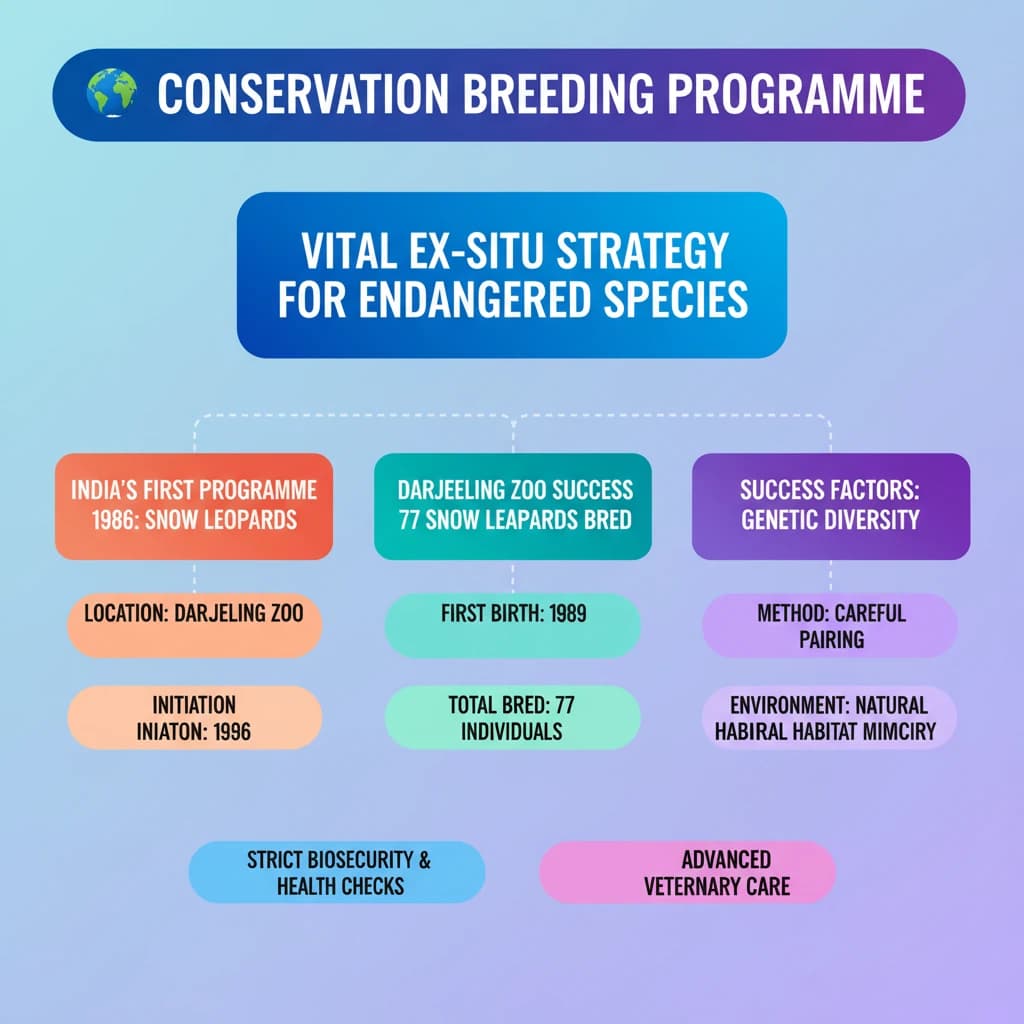
Conservation Breeding Programme is a key topic under Environment And Ecology for UPSC Civil Services Examination. Key points include: Conservation Breeding Programmes are vital ex-situ strategies for endangered species.. India's first programme began in 1986 for Snow Leopards at Darjeeling Zoo.. Darjeeling Zoo recorded the first Snow Leopard birth in 1989 and has since bred 77 individuals.. Understanding this topic is essential for both UPSC Prelims and Mains preparation.

Why is Conservation Breeding Programme important for UPSC exam?

Conservation Breeding Programme is a Medium-level topic in UPSC Environment And Ecology. It is tested in both Prelims (factual MCQs) and Mains (analytical answer writing). Previous year UPSC questions have frequently covered aspects of Conservation Breeding Programme, making it essential for comprehensive IAS preparation.

How to prepare Conservation Breeding Programme for UPSC?

To prepare Conservation Breeding Programme for UPSC: (1) Study the comprehensive notes covering all key concepts on Vaidra. (2) Practice previous year questions on this topic. (3) Connect it with current affairs using daily updates. (4) Revise using key takeaways and mind maps available for Environment And Ecology. (5) Write practice answers linking Conservation Breeding Programme to related GS Paper topics.

Key takeaways of Conservation Breeding Programme for UPSC

  • Conservation Breeding Programmes are vital ex-situ strategies for endangered species.
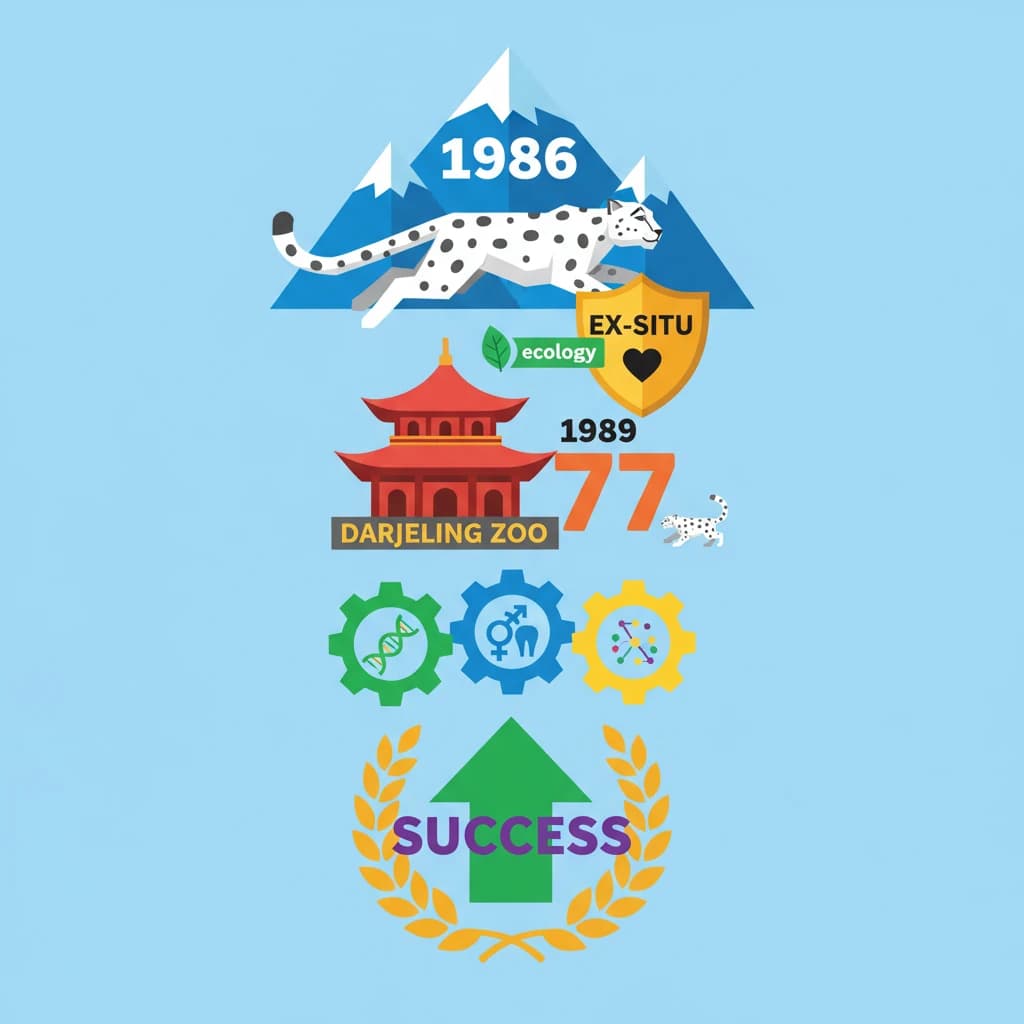
  • India's first programme began in 1986 for Snow Leopards at Darjeeling Zoo.
  • Darjeeling Zoo recorded the first Snow Leopard birth in 1989 and has since bred 77 individuals.
  • Success factors include careful pairing, natural environments, and maintaining a wide genetic pool.
  • Strict biosecurity, regular health checks, and advanced veterinary care are crucial for captive animals.
Conservation Breeding Programme

Conservation Breeding Programme

Medium⏱️ 7 min read✓ 95% Verified
environment and ecology

📖 Introduction

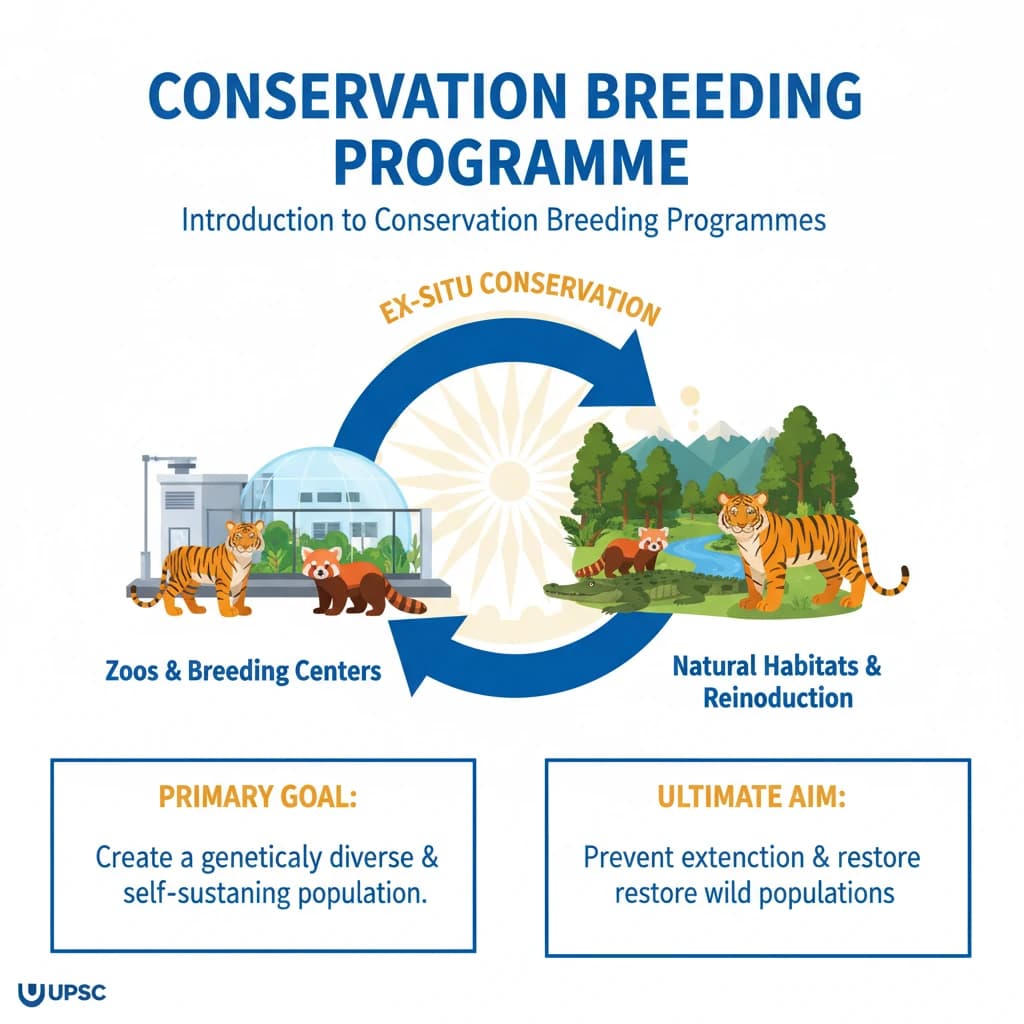
<h4>Introduction to Conservation Breeding Programmes</h4><p>A <strong>Conservation Breeding Programme</strong> is a crucial strategy within <strong>ex-situ conservation</strong>, focusing on maintaining and increasing populations of endangered species in controlled environments, such as zoos or specialized breeding centers.</p><p>The primary goal is to create a genetically diverse and self-sustaining population that can eventually be reintroduced into their natural habitats, thereby preventing extinction.</p><div class='key-point-box'><p><strong>Ex-situ conservation</strong> means 'off-site conservation', where species are protected outside their natural habitats. This complements <strong>in-situ conservation</strong> (on-site) efforts.</p></div><h4>Pioneering Efforts: Snow Leopard Conservation</h4><p>India's first <strong>ex-situ conservation breeding programme</strong> was initiated in <strong>1986</strong>. This landmark project focused on the majestic <strong>Snow Leopard</strong>.</p><div class='info-box'><p><strong>First Programme:</strong> <strong>Snow Leopard conservation breeding project</strong></p><p><strong>Initiation Year:</strong> <strong>1986</strong></p></div><p>The <strong>Conservation Breeding Centre (CBC)</strong> at the <strong>Padmaja Naidu Himalayan Zoological Park</strong>, commonly known as <strong>Darjeeling Zoo</strong>, played a pivotal role in this initiative.</p><h4>Milestones and Achievements at Darjeeling Zoo</h4><p>The <strong>Darjeeling Zoo</strong> achieved a significant milestone by recording the first birth of a <strong>Snow Leopard</strong> in <strong>1989</strong> under this programme.</p><div class='info-box'><p><strong>First Birth:</strong> <strong>Snow Leopard</strong> in <strong>1989</strong></p><p><strong>Total Births:</strong> <strong>77 Snow Leopards</strong> born at <strong>Darjeeling Zoo</strong> since 1989</p></div><p>This remarkable success highlights the effectiveness of dedicated conservation efforts and specialized breeding techniques. The programme stands as a testament to wildlife conservation achievements.</p><h4>Key Factors for Breeding Success</h4><p>The success of the <strong>Darjeeling Zoo's Snow Leopard</strong> breeding programme can be attributed to several carefully implemented strategies:</p><ul><li><strong>Careful Pairing:</strong> Meticulous selection and pairing of male and female <strong>Snow Leopards</strong> to ensure compatibility.</li><li><strong>Natural Environment:</strong> Creation of a simulated natural habitat within the enclosures to reduce stress and encourage natural behaviors.</li><li><strong>Genetic Diversity:</strong> Utilization of a wide <strong>genetic pool</strong> to prevent <strong>inbreeding</strong>, which is crucial for the long-term health and viability of the captive population.</li></ul><h4>Breeding Protocols and Animal Care</h4><p>Specific protocols are followed to ensure successful breeding and the well-being of the animals:</p><ol><li><strong>Courtship Development:</strong> Before pairing, <strong>Snow Leopards</strong> are kept in adjoining enclosures, allowing them to develop courtship behaviors and assess compatibility.</li><li><strong>Pairing:</strong> Once compatibility is observed, the male and female are paired and housed in the same enclosure.</li><li><strong>Maternity Care:</strong> Pregnant female <strong>Snow Leopards</strong> are separated and kept under <strong>24x7 CCTV surveillance</strong>.</li><li><strong>Health Monitoring:</strong> Regular <strong>blood tests</strong> and monitoring of <strong>body weight</strong> are conducted for pregnant females to ensure their health and the health of their offspring.</li></ol><h4>Advanced Biosecurity and Veterinary Facilities</h4><p>The <strong>Darjeeling Zoo</strong> maintains the highest <strong>biosecurity protocols</strong> for all its captive animals. This is vital for preventing disease outbreaks and ensuring animal health.</p><ul><li><strong>Regular Screening:</strong> All animals undergo regular screening for <strong>parasites</strong>.</li><li><strong>Deworming:</strong> Consistent <strong>deworming</strong> schedules are followed.</li><li><strong>Veterinary Facilities:</strong> The zoo is equipped with advanced <strong>veterinary facilities</strong> to provide prompt and effective medical care.</li></ul><div class='exam-tip-box'><p>For <strong>UPSC Prelims</strong>, remember key facts like the year of the first programme (<strong>1986</strong>) and the first birth (<strong>1989</strong>). For <strong>UPSC Mains (GS-III)</strong>, this programme serves as an excellent case study for <strong>ex-situ conservation</strong> and the role of zoos.</p></div>
Concept Diagram

💡 Key Takeaways

  • •Conservation Breeding Programmes are vital ex-situ strategies for endangered species.
  • •India's first programme began in 1986 for Snow Leopards at Darjeeling Zoo.
  • •Darjeeling Zoo recorded the first Snow Leopard birth in 1989 and has since bred 77 individuals.
  • •Success factors include careful pairing, natural environments, and maintaining a wide genetic pool.
  • •Strict biosecurity, regular health checks, and advanced veterinary care are crucial for captive animals.

🧠 Memory Techniques
Memory Aid
95% Verified Content

📚 Reference Sources

•Official reports and publications of Padmaja Naidu Himalayan Zoological Park (Darjeeling Zoo)
•Ministry of Environment, Forest and Climate Change (MoEFCC) documents on ex-situ conservation
•Wildlife Institute of India (WII) publications on conservation breeding

Related Topics

Loading related topics...
Explore:Environment And Ecology Topics·All Subjects·Daily Current Affairs·Editorial Analysis·Previous Year Questions·UPSC GPT
Conservation Breeding Programme - UPSC Environment And Ecology