Loading page, please wait…
Vaidra Logo
Vaidra

Top 4 items + smart groups

UPSC GPT
New
Current Affairs
Daily Solutions
Daily Puzzle
Mains Evaluator

Version 2.0.0 • Built with ❤️ for UPSC aspirants

Loading...
Loading...
Loading...
Loading...
Loading...
Loading...
Loading...
Loading...
Loading...
Loading...
Loading...
Loading...
Loading...
Tool-Using Fish Species Found in the Laccadive Sea - UPSC Environment And Ecology

Tool-Using Fish Species Found in the Laccadive Sea - UPSC Environment And Ecology

What is Tool-Using Fish Species Found in the Laccadive Sea in UPSC Environment And Ecology?

Tool-Using Fish Species Found in the Laccadive Sea is a key topic under Environment And Ecology for UPSC Civil Services Examination. Key points include: Three wrasse species (Jansen’s, Checkerboard, Moon) in the Laccadive Sea use coral as tools.. They use coral as anvils to crack open hard-shelled sea urchins for food.. This is the first documented tool-use for Jansen's and Checkerboard wrasses, and the first wild documentation for Moon wrasse.. Understanding this topic is essential for both UPSC Prelims and Mains preparation.

Why is Tool-Using Fish Species Found in the Laccadive Sea important for UPSC exam?

Tool-Using Fish Species Found in the Laccadive Sea is a Medium-level topic in UPSC Environment And Ecology. It is tested in both Prelims (factual MCQs) and Mains (analytical answer writing). Previous year UPSC questions have frequently covered aspects of Tool-Using Fish Species Found in the Laccadive Sea, making it essential for comprehensive IAS preparation.

How to prepare Tool-Using Fish Species Found in the Laccadive Sea for UPSC?

To prepare Tool-Using Fish Species Found in the Laccadive Sea for UPSC: (1) Study the comprehensive notes covering all key concepts on Vaidra. (2) Practice previous year questions on this topic. (3) Connect it with current affairs using daily updates. (4) Revise using key takeaways and mind maps available for Environment And Ecology. (5) Write practice answers linking Tool-Using Fish Species Found in the Laccadive Sea to related GS Paper topics.

Key takeaways of Tool-Using Fish Species Found in the Laccadive Sea for UPSC

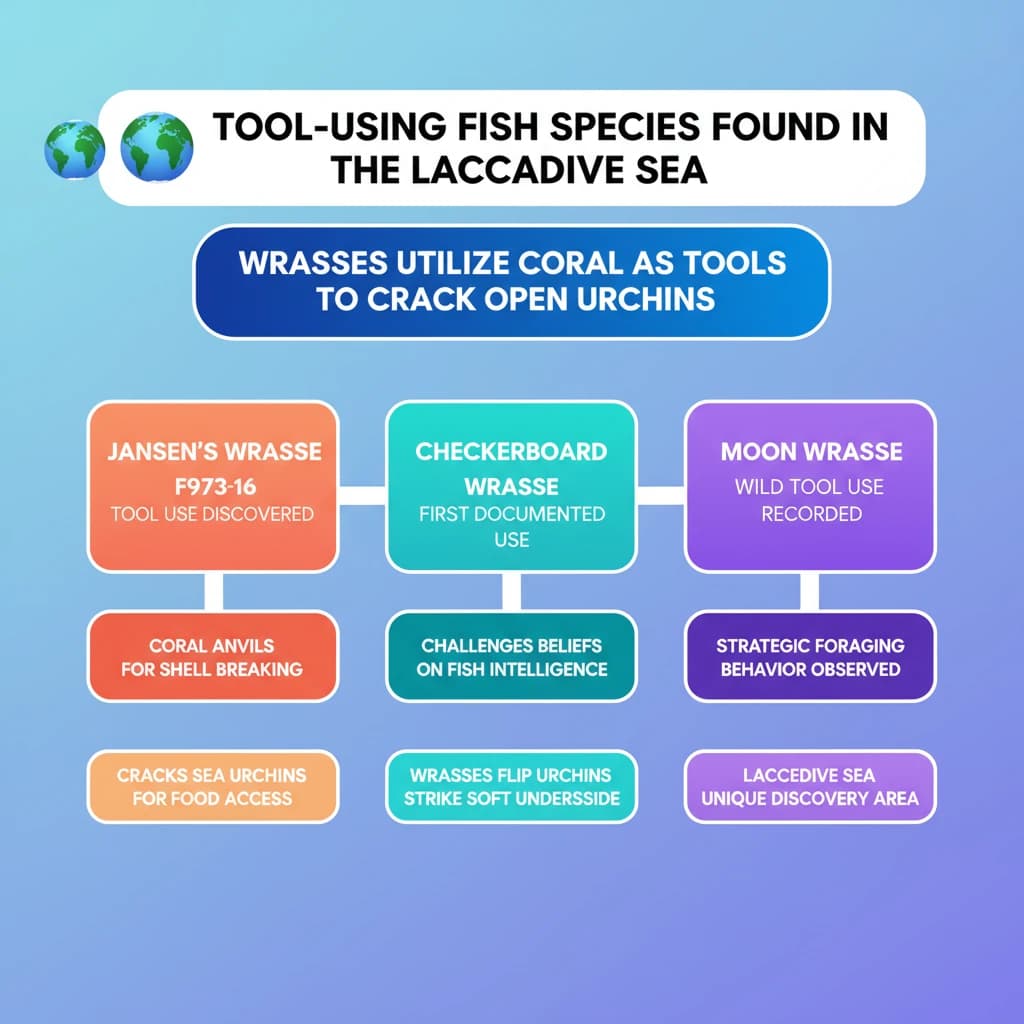
  • Three wrasse species (Jansen’s, Checkerboard, Moon) in the Laccadive Sea use coral as tools.
  • They use coral as anvils to crack open hard-shelled sea urchins for food.
  • This is the first documented tool-use for Jansen's and Checkerboard wrasses, and the first wild documentation for Moon wrasse.
  • The discovery challenges previous beliefs about fish intelligence and tool-use capabilities.
  • Wrasses strategically flip urchins to expose soft undersides before striking them against coral.
Tool-Using Fish Species Found in the Laccadive Sea

Tool-Using Fish Species Found in the Laccadive Sea

Medium⏱️ 7 min read✓ 90% Verified
environment and ecology

📖 Introduction

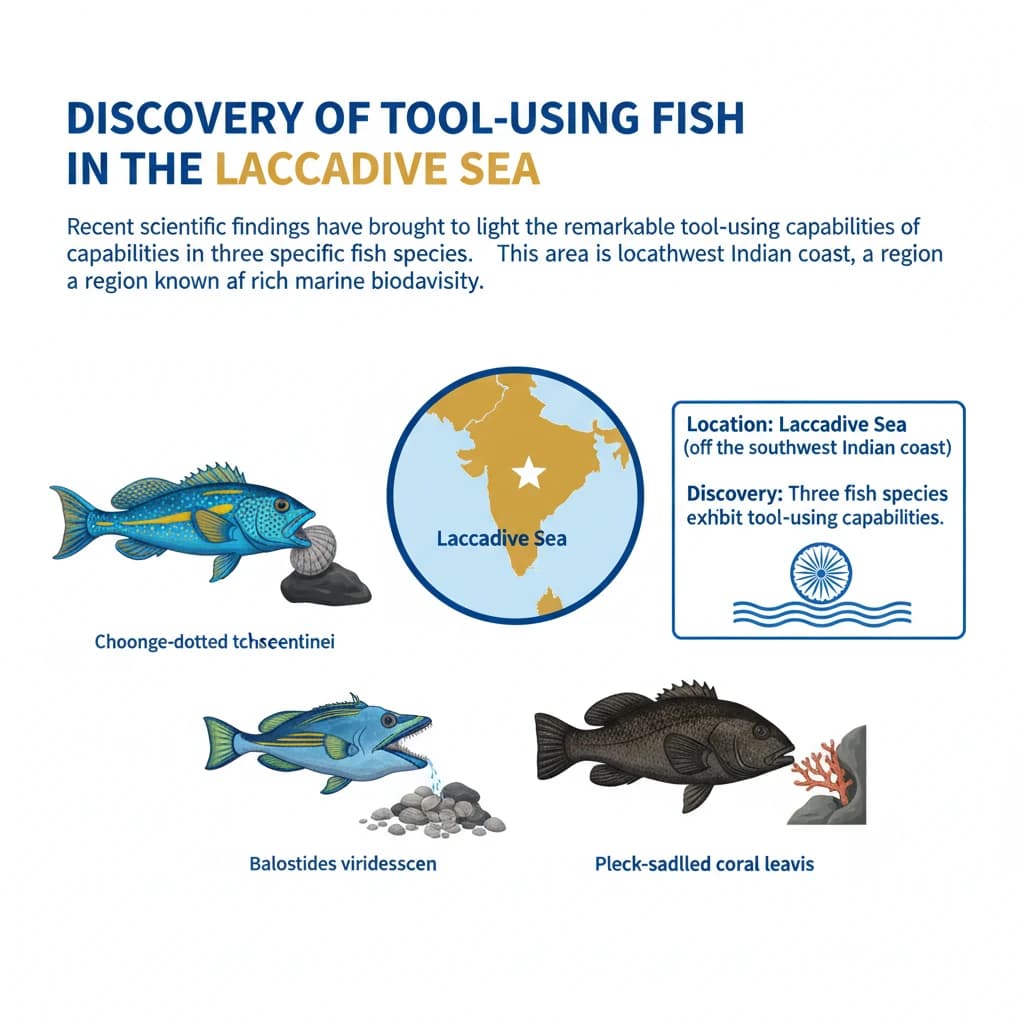
<h4>Discovery of Tool-Using Fish in the Laccadive Sea</h4><p>Recent scientific findings have brought to light the remarkable tool-using capabilities of three specific fish species in the <strong>Laccadive Sea</strong>. This area is located off the <strong>southwest Indian coast</strong>, a region known for its rich marine biodiversity.</p><div class='info-box'><p><strong>Location:</strong> Laccadive Sea (off the southwest Indian coast)</p><p><strong>Discovery:</strong> Three fish species exhibiting tool-use.</p></div><h4>Previously Known Tool-Users in the Animal Kingdom</h4><p>The concept of <strong>tool-use</strong> is well-established across various animal groups. Many species are recognized for their ability to manipulate objects to achieve a goal.</p><ul><li><strong>Primates:</strong> Widely known for using sticks, stones, and leaves.</li><li><strong>Birds:</strong> Certain species, like crows, employ twigs to extract insects.</li><li><strong>Otters:</strong> Use rocks to crack open shellfish.</li><li><strong>Octopuses:</strong> Known to use shells as shelters or to open prey.</li></ul><h4>The Novelty of Tool-Use in Fish</h4><p>Traditionally, <strong>tool-use by fish</strong> was considered highly improbable. This perception stemmed from their anatomical limitations, specifically the absence of hands, claws, or tentacles for grasping and manipulating objects effectively.</p><div class='key-point-box'><p><strong>Key Challenge:</strong> Fish lack specialized appendages for object manipulation, making tool-use a surprising discovery.</p></div><h4>The Three Tool-Using Fish Species Identified</h4><p>The groundbreaking research identified three distinct wrasse species demonstrating this complex behavior. These species are now recognized for their innovative feeding strategies.</p><ul><li><strong>Jansen’s Wrasse</strong> (<em>Thalassoma jansenii</em>)</li><li><strong>Checkerboard Wrasse</strong> (<em>Halichoeres hortulanus</em>)</li><li><strong>Moon Wrasse</strong> (<em>Thalassoma lunare</em>)</li></ul><h4>Mechanism of Tool-Use: Cracking Sea Urchins</h4><p>These wrasses utilize their environment creatively to access food. They specifically target <strong>sea urchins</strong>, which possess spiny, hard shells that are difficult to penetrate.</p><p>The fish employ <strong>live or dead coral structures</strong> as natural <strong>anvils</strong>. They repeatedly strike the sea urchins against these hard surfaces to break open their protective shells.</p><div class='info-box'><p><strong>Tool:</strong> Live or dead coral structures</p><p><strong>Prey:</strong> Sea urchins (specifically <em>E. molaris</em>)</p><p><strong>Method:</strong> Striking urchins against coral anvils to access edible soft parts.</p></div><h4>Significance of the Findings for Each Species</h4><p>The discovery holds different levels of significance for each of the identified wrasse species, marking important milestones in marine biology.</p><ul><li>For <strong>Jansen’s Wrasse</strong> and <strong>Checkerboard Wrasse</strong>, this is the <strong>first-ever reported instance</strong> of tool-use.</li><li>For the <strong>Moon Wrasse</strong>, while tool-use might have been suspected, this marks the <strong>first documented instance in the wild</strong>.</li></ul><h4>Detailed Feeding Behavior of Wrasses</h4><p>Wrasses demonstrate a sophisticated sequence of actions to overcome the challenges posed by sea urchins. Unlike other tool-using fish like <strong>archerfish</strong>, wrasses do not possess specialized mouthparts for this task.</p><ol><li>They carefully <strong>turn the urchin over</strong> to expose its softer, more vulnerable underside.</li><li>They then transport the urchin to a suitable <strong>hard coral structure</strong>.</li><li>The urchin is repeatedly <strong>cracked against the coral</strong> until its skeleton breaks.</li><li>This allows the wrasses to consume the soft, edible parts inside.</li></ol><div class='exam-tip-box'><p><strong>UPSC Insight:</strong> This discovery challenges previous assumptions about fish intelligence and adaptability. It can be cited in questions related to <strong>animal behavior</strong>, <strong>marine biodiversity</strong>, and <strong>ecosystem dynamics</strong>.</p></div>
Concept Diagram

💡 Key Takeaways

  • •Three wrasse species (Jansen’s, Checkerboard, Moon) in the Laccadive Sea use coral as tools.
  • •They use coral as anvils to crack open hard-shelled sea urchins for food.
  • •This is the first documented tool-use for Jansen's and Checkerboard wrasses, and the first wild documentation for Moon wrasse.
  • •The discovery challenges previous beliefs about fish intelligence and tool-use capabilities.
  • •Wrasses strategically flip urchins to expose soft undersides before striking them against coral.

🧠 Memory Techniques
Memory Aid
90% Verified Content

Related Topics

Loading related topics...
Explore:Environment And Ecology Topics·All Subjects·Daily Current Affairs·Editorial Analysis·Previous Year Questions·UPSC GPT
Back
All Subjects

Topics

0 topics • 0 completed

Loading topics...
Loading...
Loading...
Loading...
Loading...
Loading...
Overall Progress0%