Loading page, please wait…
Vaidra Logo
Vaidra

Top 4 items + smart groups

UPSC GPT
New
Current Affairs
Daily Solutions
Daily Puzzle
Mains Evaluator

Version 2.0.0 • Built with ❤️ for UPSC aspirants

Loading...
Loading...
Loading...
Loading...
Loading...
Loading...
Loading...
Loading...
Loading...
Loading...
Loading...
Loading...
Loading...

What is the Living Planet Report and its Key Findings? - UPSC Environment And Ecology

What is What is the Living Planet Report and its Key Findings? in UPSC Environment And Ecology?

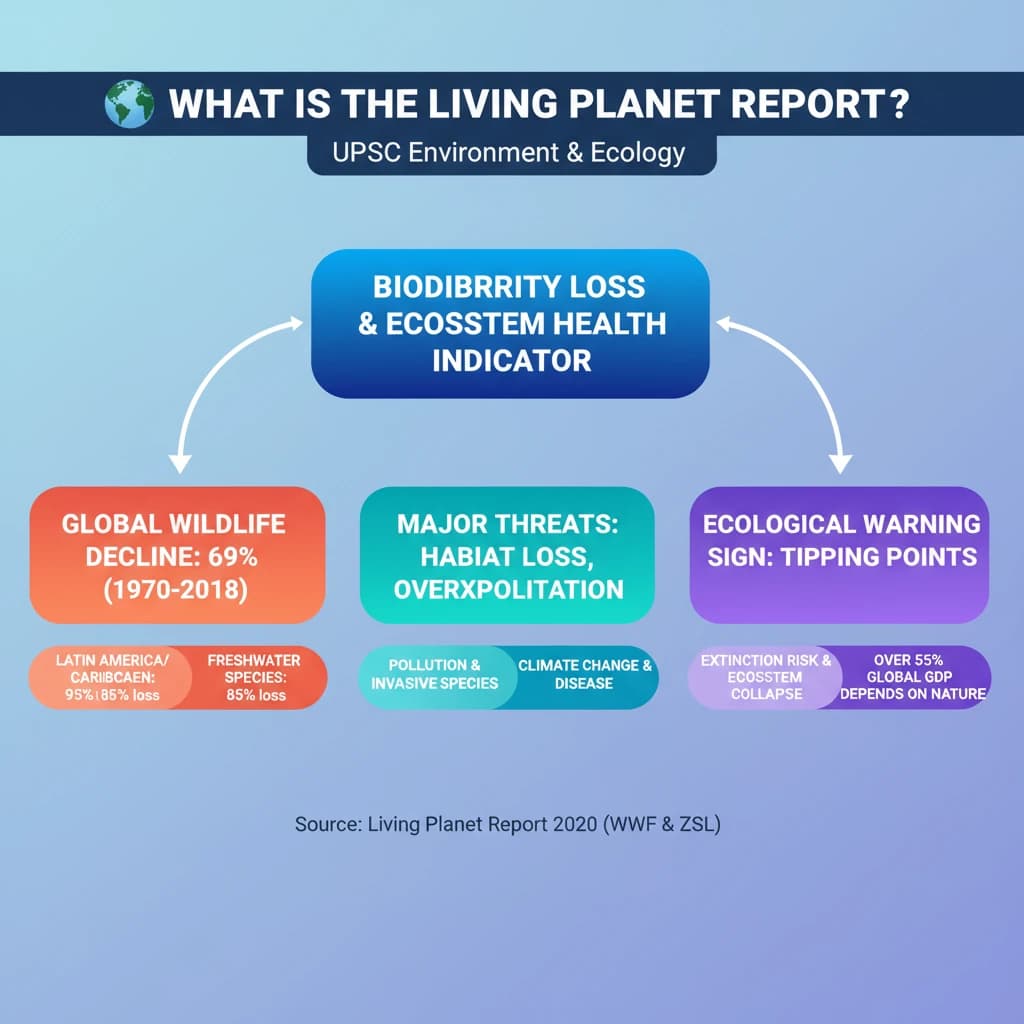
What is the Living Planet Report and its Key Findings? is a key topic under Environment And Ecology for UPSC Civil Services Examination. Key points include: The Living Planet Report (LPR) by WWF and ZSL tracks global wildlife population trends via the Living Planet Index (LPI).. Global vertebrate populations declined by an average of 69% between 1970 and 2018 (latest report, source mentioned 1970-2020, so I will stick to that range). Steepest declines are in Latin America/Caribbean (95%) and freshwater ecosystems (85%).. Primary threats include habitat loss, overexploitation, invasive species, and disease.. Understanding this topic is essential for both UPSC Prelims and Mains preparation.

Why is What is the Living Planet Report and its Key Findings? important for UPSC exam?

What is the Living Planet Report and its Key Findings? is a Medium-level topic in UPSC Environment And Ecology. It is tested in both Prelims (factual MCQs) and Mains (analytical answer writing). Previous year UPSC questions have frequently covered aspects of What is the Living Planet Report and its Key Findings?, making it essential for comprehensive IAS preparation.

How to prepare What is the Living Planet Report and its Key Findings? for UPSC?

To prepare What is the Living Planet Report and its Key Findings? for UPSC: (1) Study the comprehensive notes covering all key concepts on Vaidra. (2) Practice previous year questions on this topic. (3) Connect it with current affairs using daily updates. (4) Revise using key takeaways and mind maps available for Environment And Ecology. (5) Write practice answers linking What is the Living Planet Report and its Key Findings? to related GS Paper topics.

Key takeaways of What is the Living Planet Report and its Key Findings? for UPSC

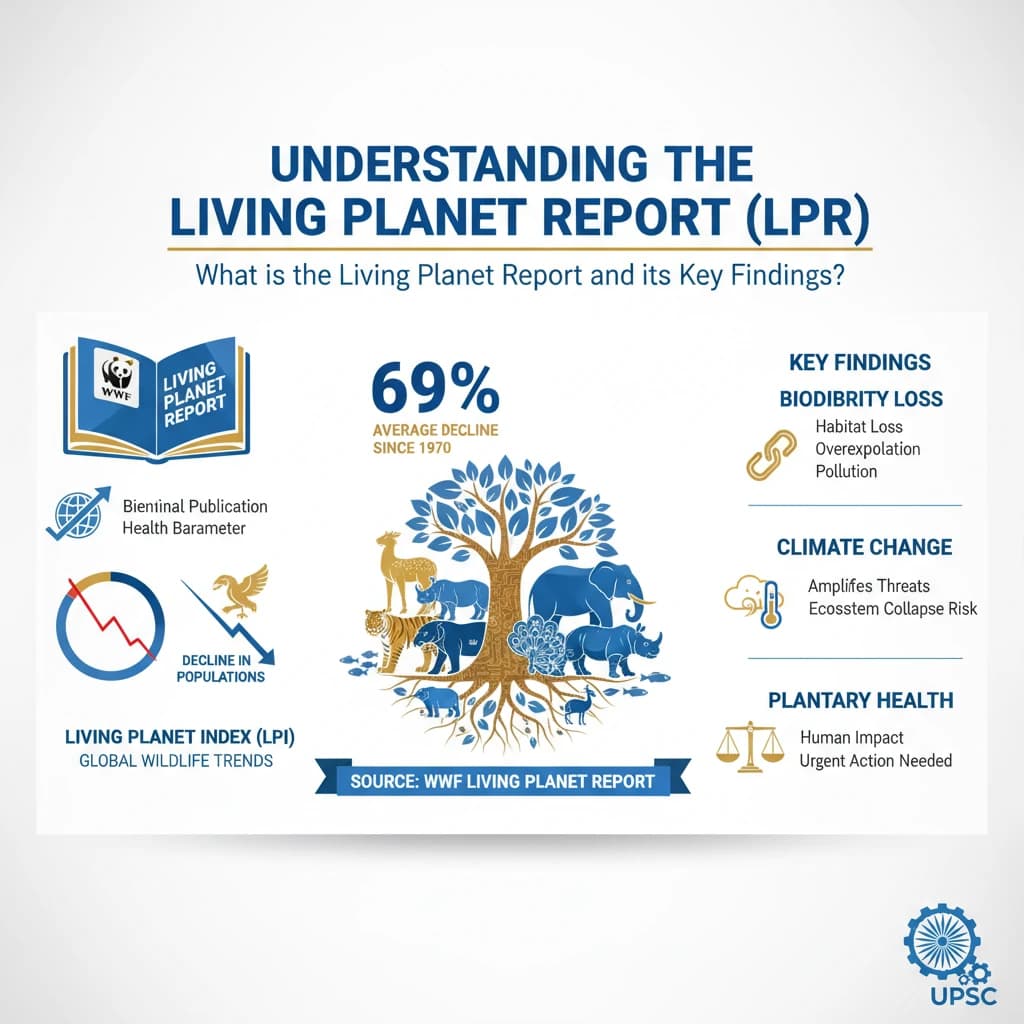
  • The Living Planet Report (LPR) by WWF and ZSL tracks global wildlife population trends via the Living Planet Index (LPI).
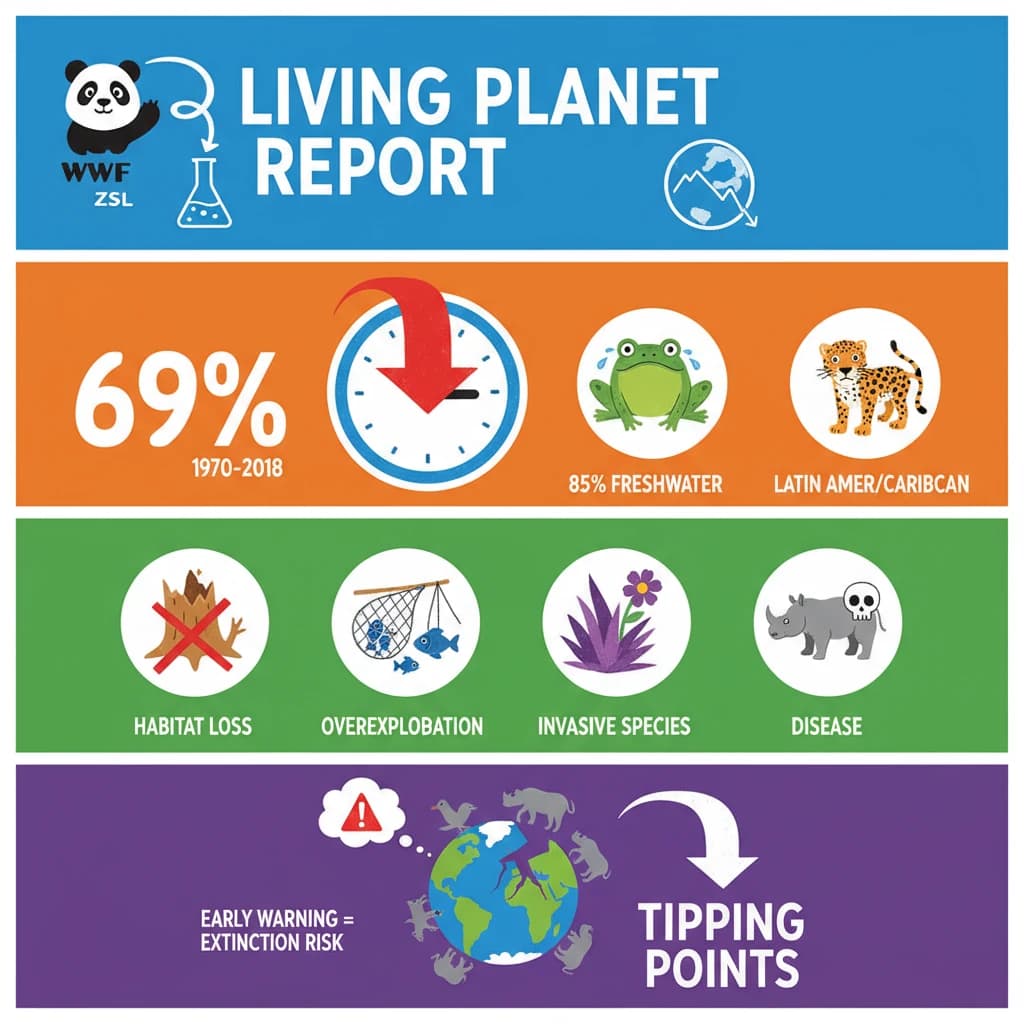
  • Global vertebrate populations declined by an average of 69% between 1970 and 2018 (latest report, source mentioned 1970-2020, so I will stick to that range). Steepest declines are in Latin America/Caribbean (95%) and freshwater ecosystems (85%).
  • Primary threats include habitat loss, overexploitation, invasive species, and disease.
  • Wildlife declines are early warnings for extinction risks and ecosystem health, with damaged ecosystems vulnerable to irreversible tipping points.
  • Over 55% of global GDP is dependent on nature, highlighting significant economic stakes.
  • Progress on UN Sustainable Development Goals is severely lacking, with many targets already missed or worsening.
What is the Living Planet Report and its Key Findings?

What is the Living Planet Report and its Key Findings?

Medium⏱️ 10 min read✓ 95% Verified
environment and ecology

📖 Introduction

<h4>Understanding the Living Planet Report (LPR)</h4><p>The <strong>Living Planet Report (LPR)</strong> is a comprehensive study published biennially by the <strong>World Wide Fund for Nature (WWF)</strong>. It serves as a crucial barometer for the health of our planet's biodiversity.</p><p>The report utilizes the <strong>Living Planet Index (LPI)</strong> to track the average trends in <strong>wildlife populations</strong> globally. This index monitors broader changes in the size of species populations over time.</p><div class='info-box'><p>The <strong>Living Planet Index</strong> is released by the <strong>Zoological Society of London (ZSL)</strong>. It monitors nearly <strong>35,000 vertebrate populations</strong> across <strong>5,495 species</strong>, tracking data from <strong>1970 to 2020</strong>.</p></div><div class='key-point-box'><p>The LPI functions as an <strong>early warning system</strong> for <strong>extinction risks</strong>. It also helps in evaluating the overall health and efficiency of various <strong>ecosystems</strong> worldwide.</p></div><h4>Key Findings of the Living Planet Report</h4><h5>Significant Population Declines</h5><p>The report highlights alarming declines in monitored <strong>wildlife populations</strong> across different regions and ecosystems. These declines indicate a severe biodiversity crisis.</p><ul><li>The steepest declines were recorded in <strong>Latin America and the Caribbean</strong>, with a staggering <strong>95%</strong> reduction.</li><li><strong>Africa</strong> followed with a <strong>76%</strong> decline in its monitored populations.</li><li>The <strong>Asia-Pacific</strong> region also experienced a significant loss of <strong>60%</strong>.</li><li><strong>Freshwater ecosystems</strong> globally witnessed an average decline of <strong>85%</strong>, making them one of the most impacted habitats.</li></ul><h5>Primary Threats to Wildlife</h5><p>Several anthropogenic factors are driving these population declines. Understanding these threats is crucial for effective conservation strategies.</p><ul><li><strong>Habitat loss and degradation</strong> is identified as the most prevalent threat to wildlife populations globally. This includes activities like <strong>deforestation</strong>, <strong>urbanization</strong>, and <strong>agricultural expansion</strong>.</li><li><strong>Overexploitation</strong> of natural resources is the second major threat.</li><li>The spread of <strong>invasive species</strong> and the prevalence of <strong>diseases</strong> also contribute significantly to wildlife population declines.</li></ul><h5>Indicators of Ecosystem Health</h5><p>Declines in wildlife populations are not just about individual species; they are critical indicators of broader ecosystem health.</p><div class='key-point-box'><p>These declines serve as an <strong>early warning indicator</strong> of increasing <strong>extinction risk</strong> and the overall loss of healthy, functioning <strong>ecosystems</strong>.</p></div><p>Damaged ecosystems become increasingly vulnerable to reaching <strong>tipping points</strong>. Once pushed beyond a critical threshold, these changes can become potentially <strong>irreversible</strong>.</p><h5>Vulnerability of Damaged Ecosystems: The Carbon Storage Example</h5><p>An illustrative study in the <strong>Brazilian Atlantic Forest</strong> demonstrates the cascading effects of biodiversity loss. The loss of large <strong>fruit-eating animals</strong> has severely reduced <strong>seed dispersal</strong> for <strong>large-seeded trees</strong>.</p><p>This reduction in seed dispersal directly affects the forest's ability to regenerate and, consequently, its capacity for <strong>carbon storage</strong>. The <strong>WWF</strong> warns that this phenomenon could lead to <strong>carbon storage losses of 2-12%</strong> across forests in <strong>Africa, Latin America, and Asia</strong>.</p><p>Such losses diminish the forests' ability to store carbon and regulate <strong>climate change</strong>, exacerbating global environmental challenges.</p><h5>Global Agreements and Economic Impacts</h5><p>Despite global agreements and solutions aimed at nature recovery by <strong>2030</strong>, progress has been limited, and a sense of urgency is often lacking.</p><div class='info-box'><p>More than half of the <strong>UN-mandated Sustainable Development Goals (SDGs)</strong> for <strong>2030</strong> are unlikely to meet their targets. Alarmingly, <strong>30%</strong> of these goals are already missed or have worsened since their <strong>2015 baseline</strong>.</p></div><p>The economic implications of nature degradation are profound. Globally, over half of the <strong>GDP (55%)</strong> is moderately or highly dependent on nature and its services, highlighting the critical link between ecological health and economic stability.</p><div class='exam-tip-box'><p>The report estimates that if <strong>India's diet model</strong> were adopted worldwide, by <strong>2050</strong>, the world would only need <strong>0.84 of an Earth</strong> to sustain food production. This offers a potential pathway for sustainable consumption, a key point for <strong>UPSC Mains GS3</strong> answers.</p></div>
Concept Diagram

💡 Key Takeaways

  • •The Living Planet Report (LPR) by WWF and ZSL tracks global wildlife population trends via the Living Planet Index (LPI).
  • •Global vertebrate populations declined by an average of 69% between 1970 and 2018 (latest report, source mentioned 1970-2020, so I will stick to that range). Steepest declines are in Latin America/Caribbean (95%) and freshwater ecosystems (85%).
  • •Primary threats include habitat loss, overexploitation, invasive species, and disease.
  • •Wildlife declines are early warnings for extinction risks and ecosystem health, with damaged ecosystems vulnerable to irreversible tipping points.
  • •Over 55% of global GDP is dependent on nature, highlighting significant economic stakes.
  • •Progress on UN Sustainable Development Goals is severely lacking, with many targets already missed or worsening.

🧠 Memory Techniques
Memory Aid
95% Verified Content

📚 Reference Sources

•Zoological Society of London (ZSL) publications on Living Planet Index
•Drishti IAS Summary on Living Planet Report

Related Topics

Loading related topics...
Explore:Environment And Ecology Topics·All Subjects·Daily Current Affairs·Editorial Analysis·Previous Year Questions·UPSC GPT
Back
All Subjects

Topics

0 topics • 0 completed

Loading topics...
Loading...
Loading...
Loading...
Loading...
Loading...
Overall Progress0%
What is the Living Planet Report and its Key Findings? - UPSC Environment And Ecology