Loading page, please wait…
Vaidra Logo
Vaidra

Top 4 items + smart groups

UPSC GPT
New
Current Affairs
Daily Solutions
Daily Puzzle
Mains Evaluator

Version 2.0.0 • Built with ❤️ for UPSC aspirants

Loading...
Loading...
Loading...
Loading...
Loading...
Loading...
Loading...
Loading...
Loading...
Loading...
Loading...
Loading...
Loading...
Forms of Acid Rain/Deposition - UPSC Environment And Ecology
Back
All Subjects

Topics

0 topics • 0 completed

Loading topics...
Loading...
Loading...
Loading...
Loading...
Loading...
Overall Progress0%

Forms of Acid Rain/Deposition - UPSC Environment And Ecology

What is Forms of Acid Rain/Deposition in UPSC Environment And Ecology?

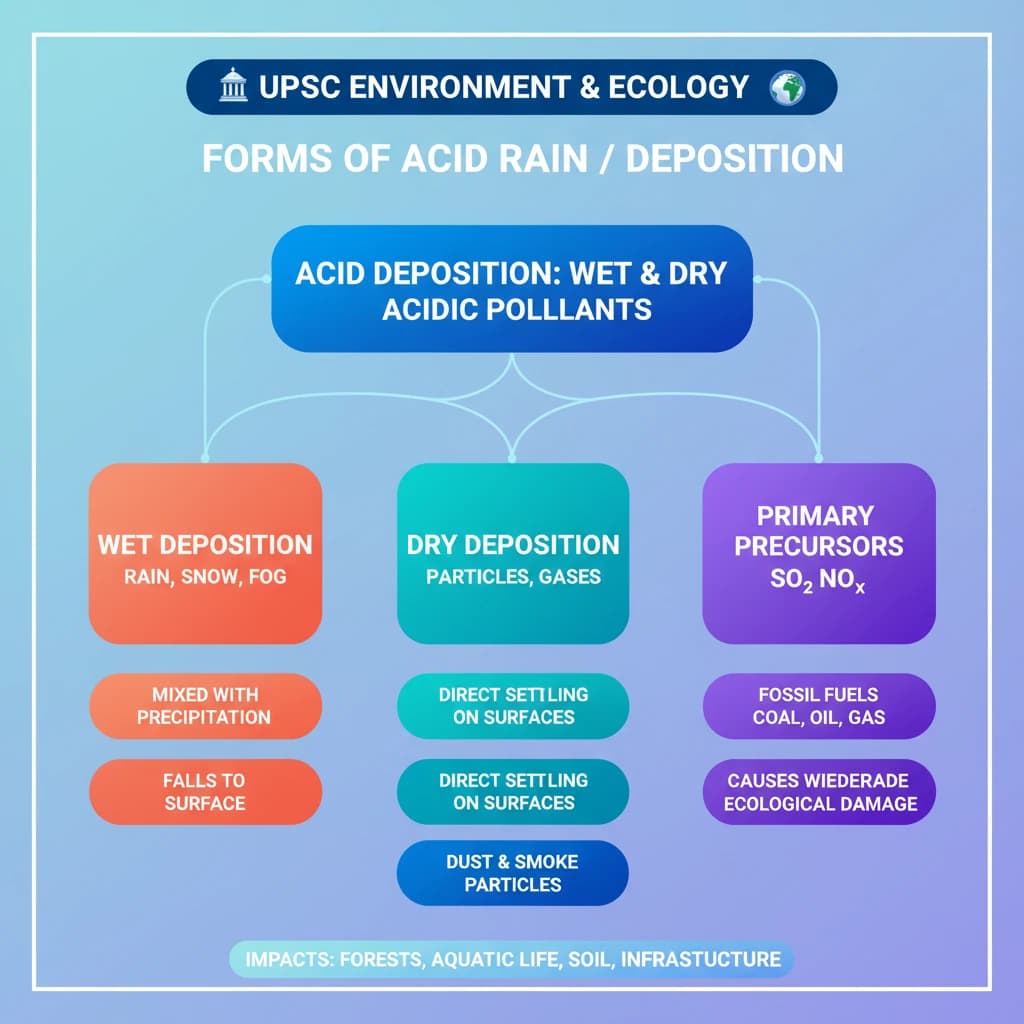
Forms of Acid Rain/Deposition is a key topic under Environment And Ecology for UPSC Civil Services Examination. Key points include: Acid deposition (acid rain) includes both wet and dry forms of acidic pollutants.. Wet deposition involves acidic compounds mixed with rain, snow, fog, or hail.. Dry deposition is the direct settling of acidic particles and gases on surfaces.. Understanding this topic is essential for both UPSC Prelims and Mains preparation.

Why is Forms of Acid Rain/Deposition important for UPSC exam?

Forms of Acid Rain/Deposition is a Medium-level topic in UPSC Environment And Ecology. It is tested in both Prelims (factual MCQs) and Mains (analytical answer writing). Previous year UPSC questions have frequently covered aspects of Forms of Acid Rain/Deposition, making it essential for comprehensive IAS preparation.

How to prepare Forms of Acid Rain/Deposition for UPSC?

To prepare Forms of Acid Rain/Deposition for UPSC: (1) Study the comprehensive notes covering all key concepts on Vaidra. (2) Practice previous year questions on this topic. (3) Connect it with current affairs using daily updates. (4) Revise using key takeaways and mind maps available for Environment And Ecology. (5) Write practice answers linking Forms of Acid Rain/Deposition to related GS Paper topics.

Key takeaways of Forms of Acid Rain/Deposition for UPSC

  • Acid deposition (acid rain) includes both wet and dry forms of acidic pollutants.
  • Wet deposition involves acidic compounds mixed with rain, snow, fog, or hail.
  • Dry deposition is the direct settling of acidic particles and gases on surfaces.
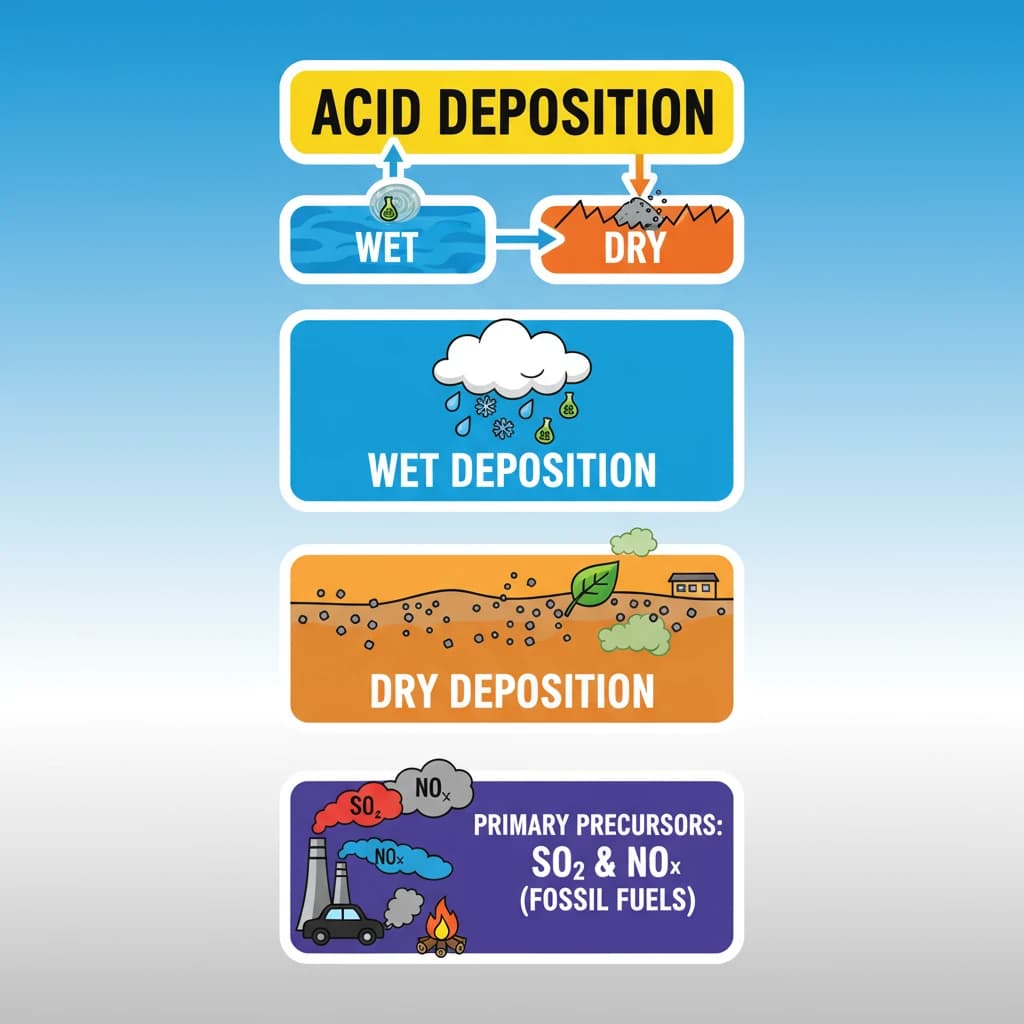
  • Primary precursors are sulfur dioxide (SO₂) and nitrogen oxides (NOₓ), mainly from burning fossil fuels.
  • Acid rain causes widespread environmental damage to forests, aquatic ecosystems, soil, and infrastructure.
  • Mitigation involves emission controls, renewable energy transition, and international cooperation.
Forms of Acid Rain/Deposition

Forms of Acid Rain/Deposition

Medium⏱️ 8 min read✓ 95% Verified
environment and ecology

📖 Introduction

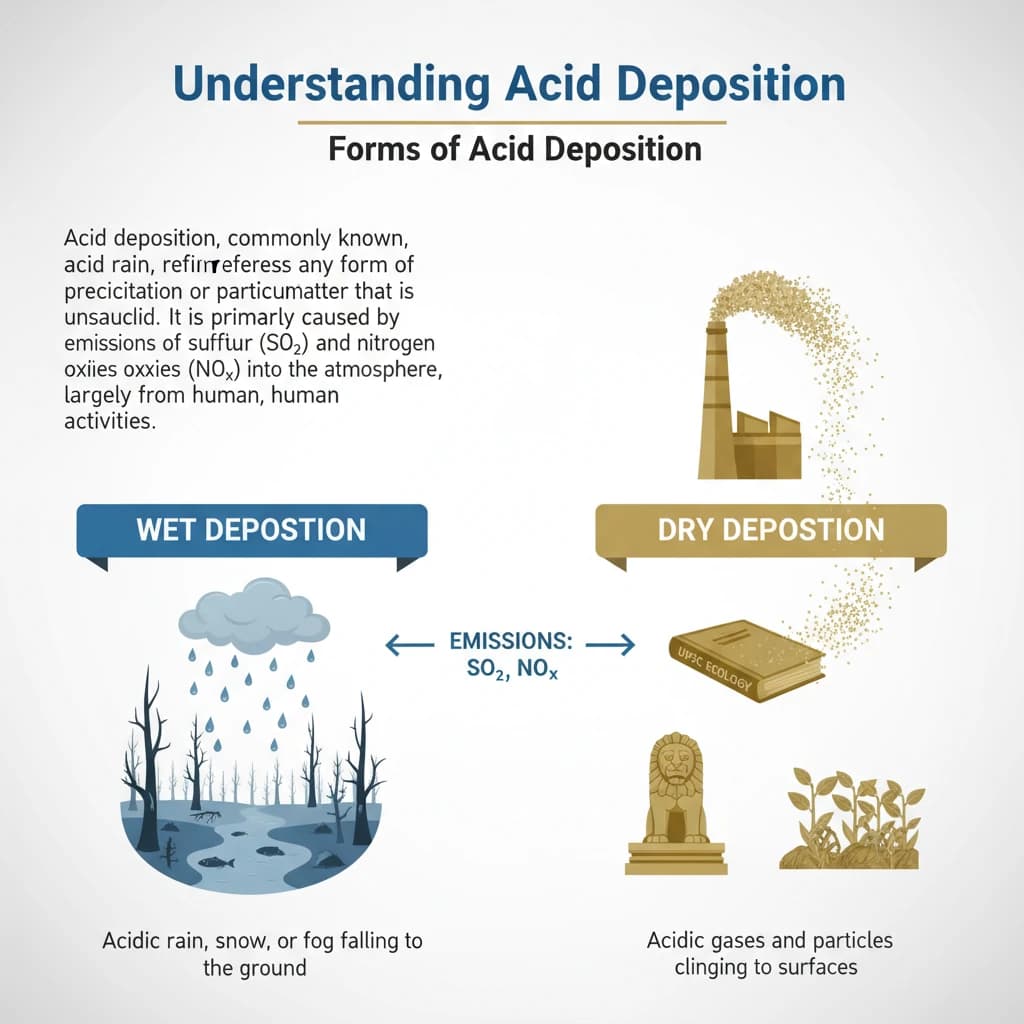
<h4>Understanding Acid Deposition</h4><p><strong>Acid deposition</strong>, commonly known as <strong>acid rain</strong>, refers to any form of precipitation or particulate matter that is unusually acidic.</p><p>It is primarily caused by emissions of <strong>sulfur dioxide (SO₂)</strong> and <strong>nitrogen oxides (NOₓ)</strong> into the atmosphere, largely from human activities.</p><h4>Forms of Acid Deposition</h4><p>Acid deposition occurs in two primary forms: <strong>wet deposition</strong> and <strong>dry deposition</strong>. Both forms contribute significantly to environmental degradation.</p><div class='key-point-box'><p>Understanding these distinct forms is crucial for comprehending the full scope of acid rain's environmental and health impacts.</p></div><h4>Wet Deposition</h4><p><strong>Wet deposition</strong> occurs when acidic compounds are dissolved or suspended in atmospheric moisture and then fall to the Earth's surface.</p><div class='info-box'><p>This form includes <strong>rain</strong>, <strong>snow</strong>, <strong>fog</strong>, and <strong>hail</strong> that have become acidic due to the presence of <strong>sulfuric acid</strong> and <strong>nitric acid</strong>.</p></div><p>These acids are formed in the atmosphere from the reaction of sulfur dioxide and nitrogen oxides with water, oxygen, and other chemicals.</p><div class='exam-tip-box'><p>UPSC often asks about the specific forms of precipitation involved in <strong>wet deposition</strong>. Remember it's not just rain, but also snow, fog, and hail!</p></div><h4>Dry Deposition</h4><p><strong>Dry deposition</strong> refers to the direct deposition of acidic particles and gases from the atmosphere onto surfaces without the involvement of moisture.</p><div class='info-box'><p>This includes <strong>acidic particles</strong> (like sulfates and nitrates) and <strong>acidic gases</strong> (such as <strong>sulfur dioxide</strong> and <strong>nitrogen oxides</strong>) settling directly on surfaces.</p></div><p>These acidic substances can deposit on various surfaces, including <strong>water bodies</strong>, <strong>vegetation</strong>, and <strong>buildings</strong>.</p><p>The particles and gases may deposit quickly or react further during atmospheric transport to form larger particles that can be harmful to <strong>human health</strong>.</p><h4>Combined Impact</h4><p>Both <strong>wet</strong> and <strong>dry deposition</strong> contribute to the overall phenomenon of acid rain, leading to widespread environmental degradation.</p><p>The effects range from acidification of lakes and soil to damage to forests, crops, and man-made infrastructure.</p>
Concept Diagram

💡 Key Takeaways

  • •Acid deposition (acid rain) includes both wet and dry forms of acidic pollutants.
  • •Wet deposition involves acidic compounds mixed with rain, snow, fog, or hail.
  • •Dry deposition is the direct settling of acidic particles and gases on surfaces.
  • •Primary precursors are sulfur dioxide (SO₂) and nitrogen oxides (NOₓ), mainly from burning fossil fuels.
  • •Acid rain causes widespread environmental damage to forests, aquatic ecosystems, soil, and infrastructure.
  • •Mitigation involves emission controls, renewable energy transition, and international cooperation.

🧠 Memory Techniques
Memory Aid
95% Verified Content

📚 Reference Sources

•NCERT Class 11/12 Environmental Chemistry
•United States Environmental Protection Agency (EPA) resources on Acid Rain
•United Nations Environment Programme (UNEP) reports on Air Pollution
•Britannica - Acid Rain

Related Topics

Loading related topics...
Explore:Environment And Ecology Topics·All Subjects·Daily Current Affairs·Editorial Analysis·Previous Year Questions·UPSC GPT