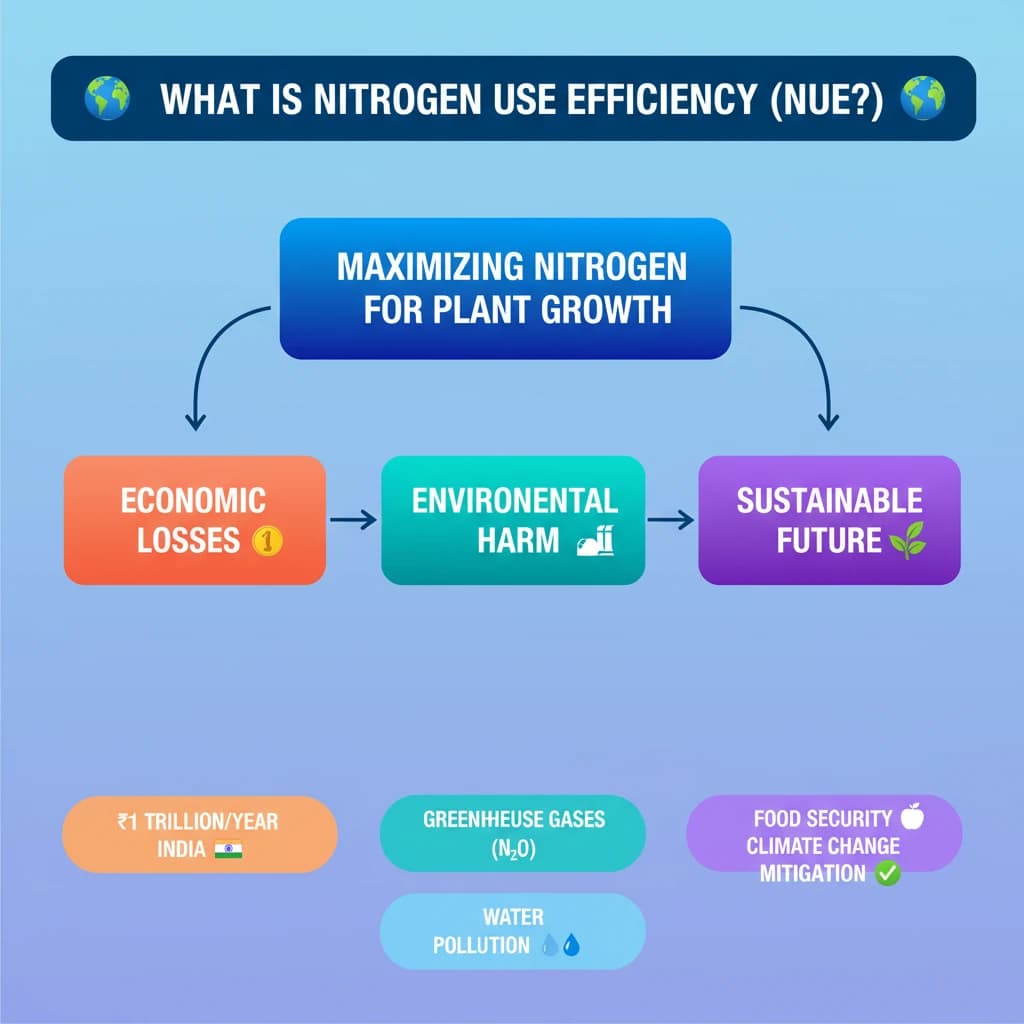
Loading page, please wait…
Vaidra Logo
Vaidra

Top 4 items + smart groups

UPSC GPT
New
Current Affairs
Daily Solutions
Daily Puzzle
Mains Evaluator

Version 2.0.0 • Built with ❤️ for UPSC aspirants

Loading...
Loading...
Loading...
Loading...
Loading...
Loading...
Loading...
Loading...
Loading...
Loading...
Loading...
Loading...
Loading...
What is Nitrogen Use Efficiency (NUE)? - UPSC Environment And Ecology
Back
All Subjects

Topics

0 topics • 0 completed

Loading topics...
Loading...
Loading...
Loading...
Loading...
Loading...
Overall Progress0%

What is Nitrogen Use Efficiency (NUE)? - UPSC Environment And Ecology

What is What is Nitrogen Use Efficiency (NUE)? in UPSC Environment And Ecology?

What is Nitrogen Use Efficiency (NUE)? is a key topic under Environment And Ecology for UPSC Civil Services Examination. Key points include: Nitrogen Use Efficiency (NUE) measures how effectively plants convert applied/fixed nitrogen into biomass.. Poor NUE leads to significant economic losses (Rs 1 trillion/year in India, $170 billion/year globally) due to wasted fertilizers.. India is the largest anthropogenic source of nitrous oxide (N₂O), a potent greenhouse gas, contributing 11% of global emissions in 2020.. Understanding this topic is essential for both UPSC Prelims and Mains preparation.

Why is What is Nitrogen Use Efficiency (NUE)? important for UPSC exam?

What is Nitrogen Use Efficiency (NUE)? is a Medium-level topic in UPSC Environment And Ecology. It is tested in both Prelims (factual MCQs) and Mains (analytical answer writing). Previous year UPSC questions have frequently covered aspects of What is Nitrogen Use Efficiency (NUE)?, making it essential for comprehensive IAS preparation.

How to prepare What is Nitrogen Use Efficiency (NUE)? for UPSC?

To prepare What is Nitrogen Use Efficiency (NUE)? for UPSC: (1) Study the comprehensive notes covering all key concepts on Vaidra. (2) Practice previous year questions on this topic. (3) Connect it with current affairs using daily updates. (4) Revise using key takeaways and mind maps available for Environment And Ecology. (5) Write practice answers linking What is Nitrogen Use Efficiency (NUE)? to related GS Paper topics.

Key takeaways of What is Nitrogen Use Efficiency (NUE)? for UPSC

  • Nitrogen Use Efficiency (NUE) measures how effectively plants convert applied/fixed nitrogen into biomass.
  • Poor NUE leads to significant economic losses (Rs 1 trillion/year in India, $170 billion/year globally) due to wasted fertilizers.
  • India is the largest anthropogenic source of nitrous oxide (N₂O), a potent greenhouse gas, contributing 11% of global emissions in 2020.
  • Inefficient nitrogen use causes environmental pollution, including water contamination and increased greenhouse gas emissions.
  • Improving NUE is crucial for sustainable agriculture, climate change mitigation, and enhancing food security.
  • Initiatives like Neem-Coated Urea and Soil Health Cards aim to improve NUE in India.
What is Nitrogen Use Efficiency (NUE)?

What is Nitrogen Use Efficiency (NUE)?

Medium⏱️ 8 min read✓ 95% Verified
environment and ecology

📖 Introduction

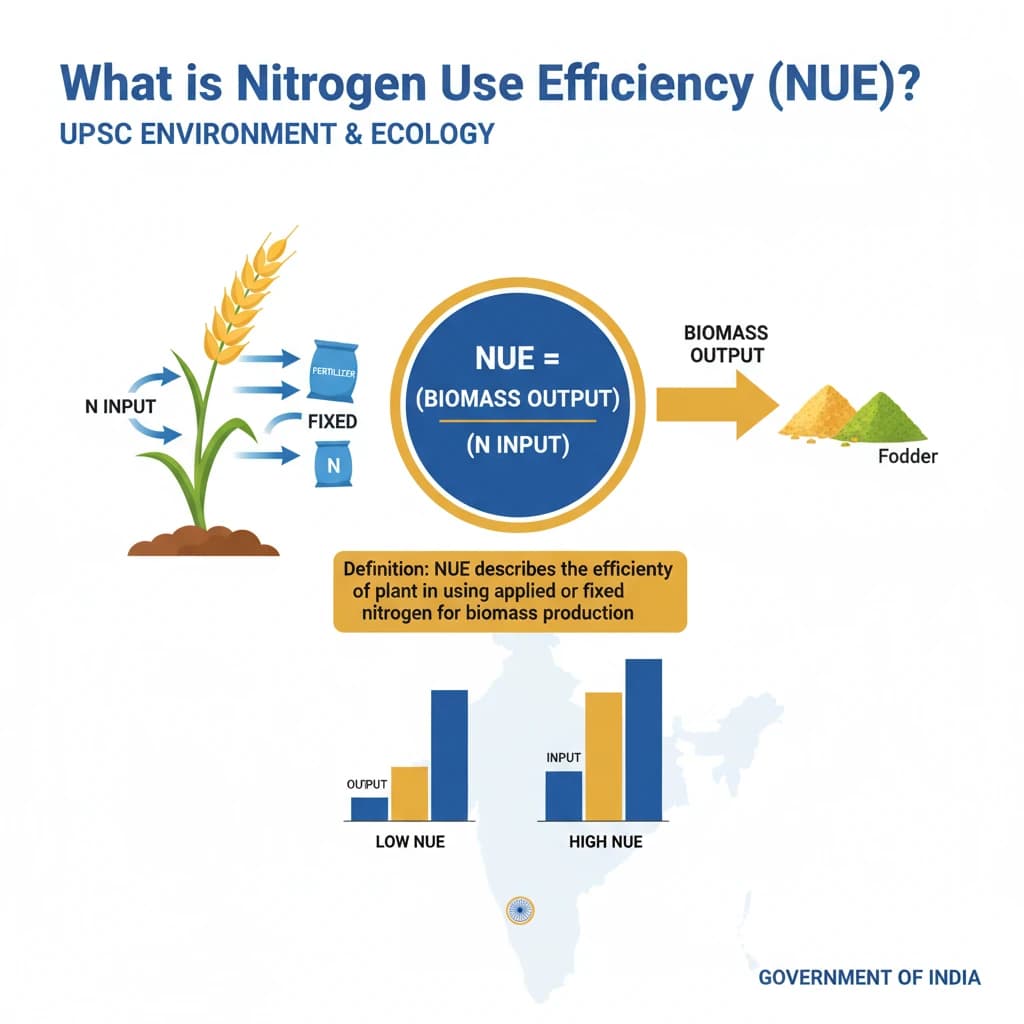
<h4>What is Nitrogen Use Efficiency (NUE)?</h4><p><strong>Nitrogen Use Efficiency (NUE)</strong> is a critical metric in agriculture. It quantifies how effectively a plant utilizes available nitrogen for producing biomass, such as grain, fodder, or other plant material.</p><div class='info-box'><p><strong>Definition:</strong> <strong>NUE</strong> describes the efficiency of a plant in using applied or fixed nitrogen for <strong>biomass production</strong>.</p></div><p>Essentially, NUE is a ratio. It measures the amount of crop yield produced relative to the nitrogen absorbed from the soil or fixed by beneficial bacteria in the plant's root system.</p><div class='info-box'><p><strong>Formula:</strong> <strong>NUE</strong> = Crop Yield / Nitrogen Absorbed (or Fixed)</p></div><h4>Understanding Poor NUE</h4><p><strong>Poor NUE</strong> signifies an inefficient use of nitrogen in agricultural systems. This inefficiency leads to a significant portion of applied nitrogen being lost from the farm, rather than being taken up by crops.</p><div class='key-point-box'><p><strong>Key Characteristic:</strong> In <strong>poor NUE</strong> scenarios, much of the nitrogen is lost to the environment, resulting in both environmental pollution and reduced agricultural productivity.</p></div><h4>Impacts of Poor NUE</h4><p>The inefficient use of nitrogen has substantial economic and environmental consequences. These impacts are felt globally and particularly acutely in countries with large agricultural sectors.</p><ul><li><strong>Economic Loss:</strong> <strong>Poor NUE</strong> leads to a massive wastage of nitrogen fertilizers. In India, this amounts to approximately <strong>Rs 1 trillion annually</strong>. Globally, the economic loss exceeds <strong>USD 170 billion per year</strong>.</li><li><strong>Environmental Pollution:</strong> Lost nitrogen can leach into groundwater, causing eutrophication of water bodies. It can also volatilize into the atmosphere as various nitrogenous gases.</li><li><strong>Greenhouse Gas Emissions:</strong> A major concern is the emission of <strong>nitrous oxide (N₂O)</strong>. This gas is a potent greenhouse gas, warming the atmosphere significantly more than carbon dioxide.</li></ul><div class='info-box'><p><strong>India's Contribution to N₂O Emissions:</strong></p><ul><li>India is the <strong>largest source of nitrous oxide (N₂O)</strong> emissions from anthropogenic activities.</li><li>In <strong>2020</strong>, India contributed nearly <strong>11% of global anthropogenic N₂O emissions</strong>.</li><li>This placed India second only to <strong>China</strong>, which accounted for <strong>16%</strong> of global emissions in the same year.</li></ul></div><div class='exam-tip-box'><p><strong>UPSC Insight:</strong> Understanding <strong>NUE</strong> is crucial for topics like <strong>sustainable agriculture</strong>, <strong>climate change mitigation</strong>, and <strong>environmental pollution</strong> in <strong>GS-III</strong>. Data points on economic loss and N₂O emissions are valuable for enriching answers.</p></div>
Concept Diagram

💡 Key Takeaways

  • •Nitrogen Use Efficiency (NUE) measures how effectively plants convert applied/fixed nitrogen into biomass.
  • •Poor NUE leads to significant economic losses (Rs 1 trillion/year in India, $170 billion/year globally) due to wasted fertilizers.
  • •India is the largest anthropogenic source of nitrous oxide (N₂O), a potent greenhouse gas, contributing 11% of global emissions in 2020.
  • •Inefficient nitrogen use causes environmental pollution, including water contamination and increased greenhouse gas emissions.
  • •Improving NUE is crucial for sustainable agriculture, climate change mitigation, and enhancing food security.
  • •Initiatives like Neem-Coated Urea and Soil Health Cards aim to improve NUE in India.

🧠 Memory Techniques
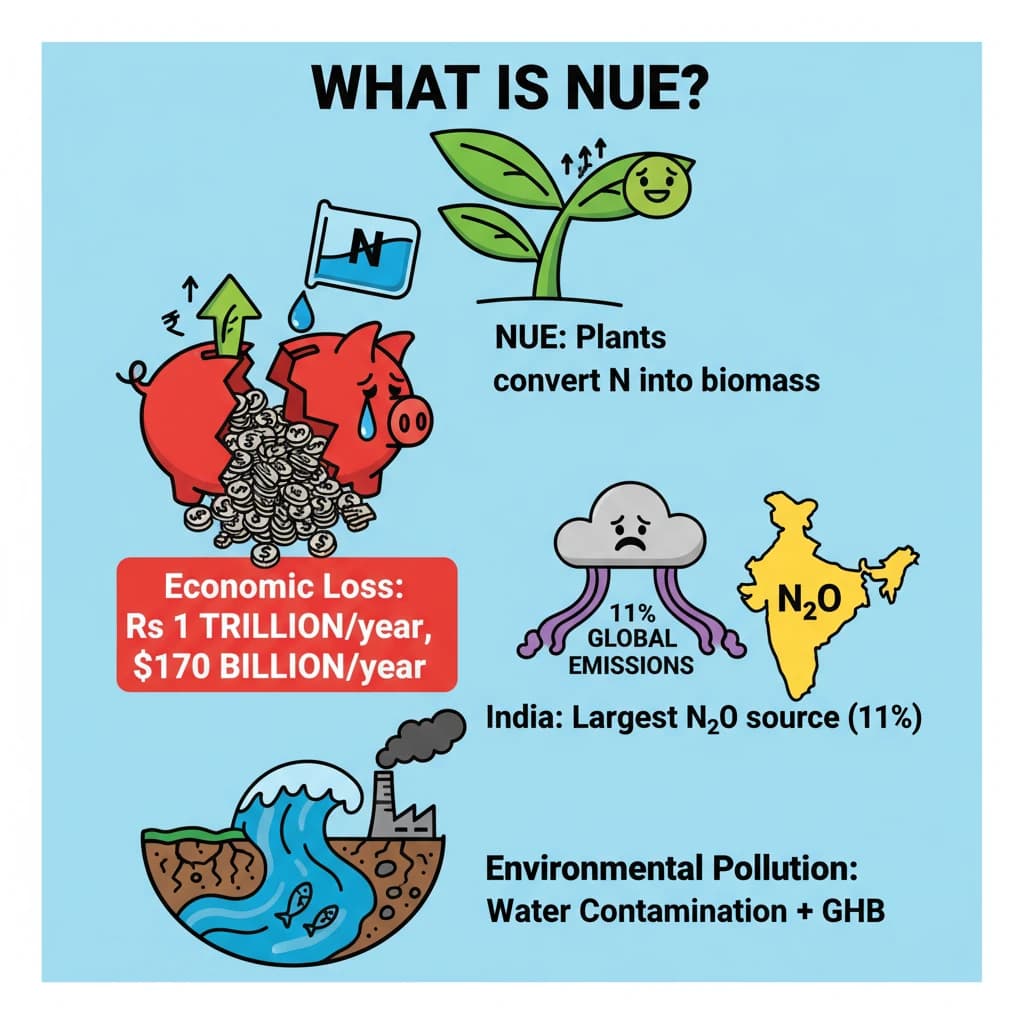
Memory Aid
95% Verified Content

Related Topics

Loading related topics...
Explore:Environment And Ecology Topics·All Subjects·Daily Current Affairs·Editorial Analysis·Previous Year Questions·UPSC GPT