Loading page, please wait…
Vaidra Logo
Vaidra

Top 4 items + smart groups

UPSC GPT
New
Current Affairs
Daily Solutions
Daily Puzzle
Mains Evaluator

Version 2.0.0 • Built with ❤️ for UPSC aspirants

Loading...
Loading...
Loading...
Loading...
Loading...
Loading...
Loading...
Loading...
Loading...
Loading...
Loading...
Loading...
Loading...
Back
All Subjects

Topics

0 topics • 0 completed

Loading topics...
Loading...
Loading...
Loading...
Loading...
Loading...
Overall Progress0%

Decrease in Ice Cover - UPSC Environment And Ecology

What is Decrease in Ice Cover in UPSC Environment And Ecology?

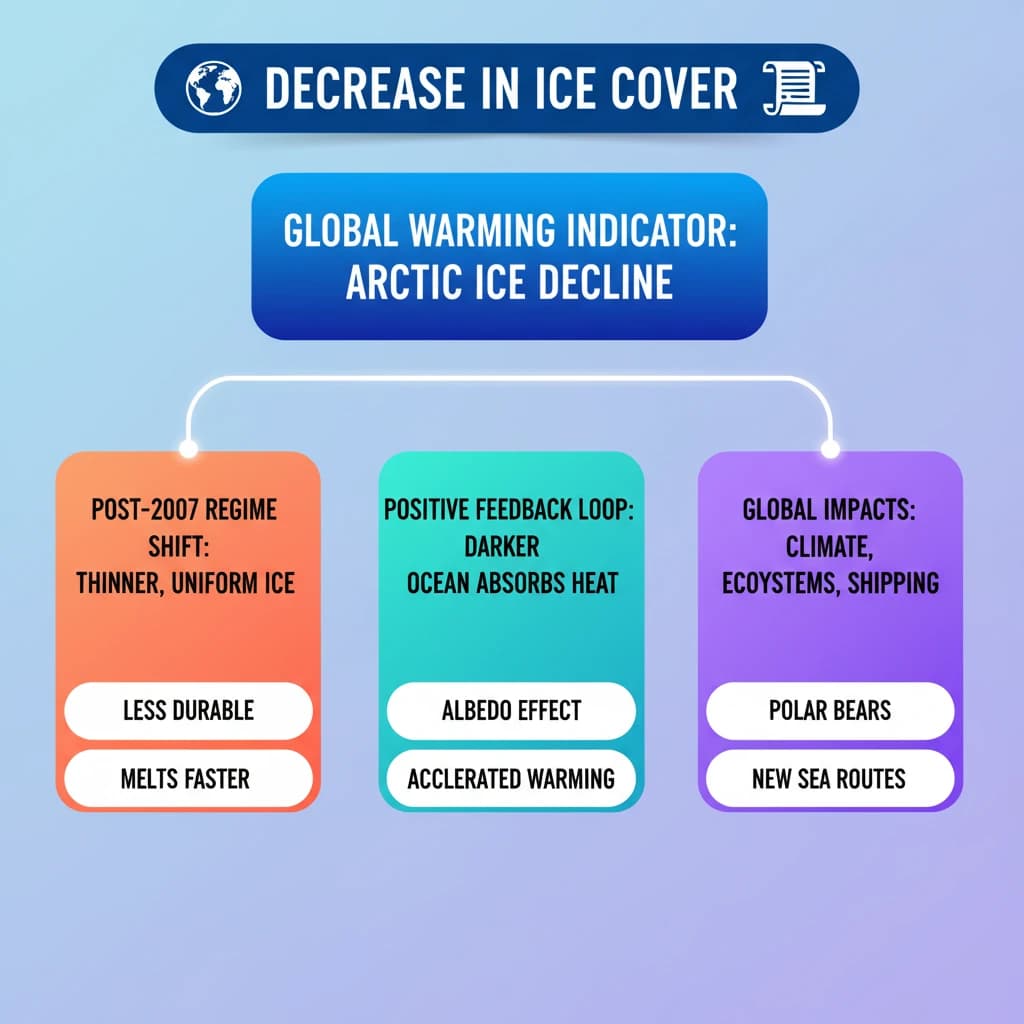
Decrease in Ice Cover is a key topic under Environment And Ecology for UPSC Civil Services Examination. Key points include: Arctic perennial sea ice has seen a marked decrease in both summer and winter since the mid-1990s.. A significant 'regime shift' occurred post-2007, transitioning from thicker, deformed ice to thinner, more uniform ice.. Thinner ice is less durable, melts faster, and exposes the darker ocean, leading to increased absorption of solar radiation and accelerated warming (positive feedback loop).. Understanding this topic is essential for both UPSC Prelims and Mains preparation.

Why is Decrease in Ice Cover important for UPSC exam?

Decrease in Ice Cover is a Medium-level topic in UPSC Environment And Ecology. It is tested in both Prelims (factual MCQs) and Mains (analytical answer writing). Previous year UPSC questions have frequently covered aspects of Decrease in Ice Cover, making it essential for comprehensive IAS preparation.

How to prepare Decrease in Ice Cover for UPSC?

To prepare Decrease in Ice Cover for UPSC: (1) Study the comprehensive notes covering all key concepts on Vaidra. (2) Practice previous year questions on this topic. (3) Connect it with current affairs using daily updates. (4) Revise using key takeaways and mind maps available for Environment And Ecology. (5) Write practice answers linking Decrease in Ice Cover to related GS Paper topics.

Key takeaways of Decrease in Ice Cover for UPSC

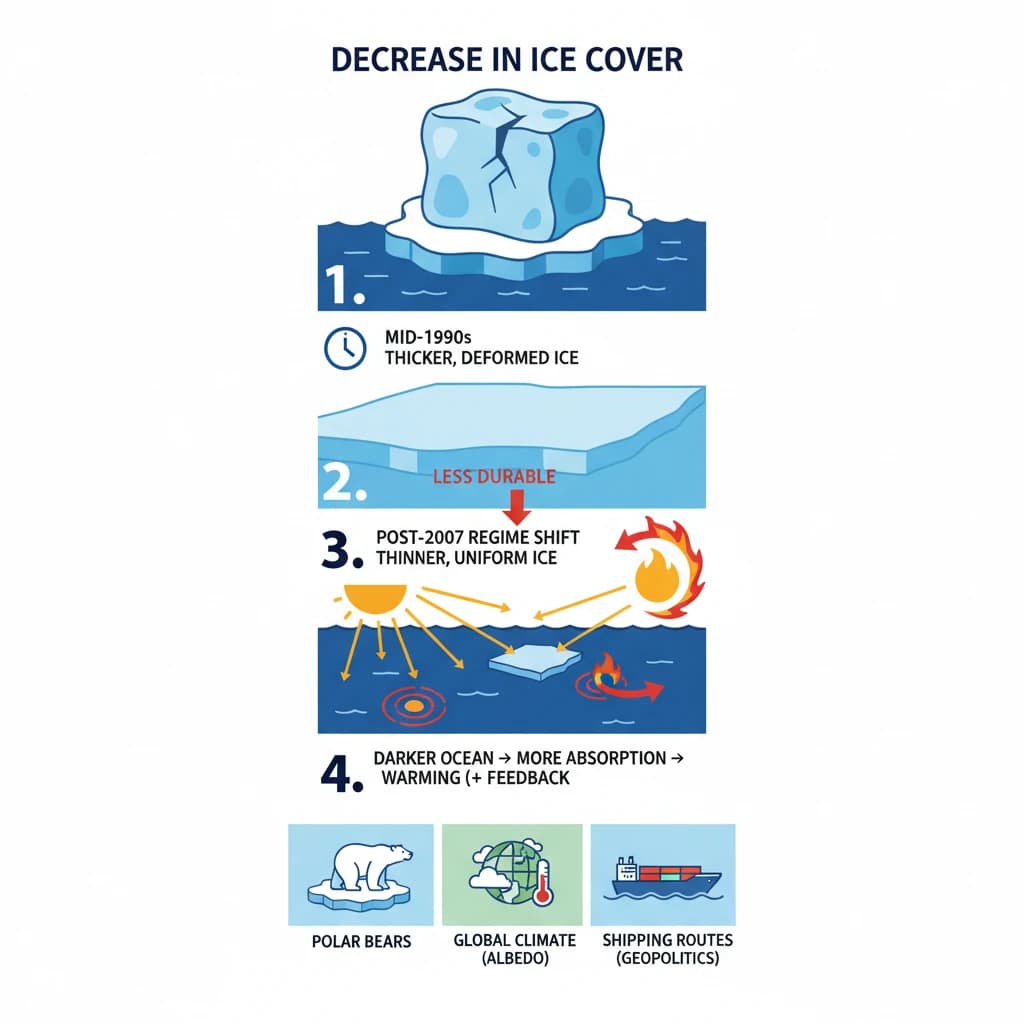
  • Arctic perennial sea ice has seen a marked decrease in both summer and winter since the mid-1990s.
  • A significant 'regime shift' occurred post-2007, transitioning from thicker, deformed ice to thinner, more uniform ice.
  • Thinner ice is less durable, melts faster, and exposes the darker ocean, leading to increased absorption of solar radiation and accelerated warming (positive feedback loop).
  • This decline has critical implications for global climate regulation (albedo effect), Arctic ecosystems (e.g., polar bears), and international geopolitics (e.g., shipping routes).
  • The decrease in ice cover is a key indicator of global warming and a central concern for climate change studies and policy.
Decrease in Ice Cover

Decrease in Ice Cover

Medium⏱️ 8 min read✓ 95% Verified
environment and ecology

📖 Introduction

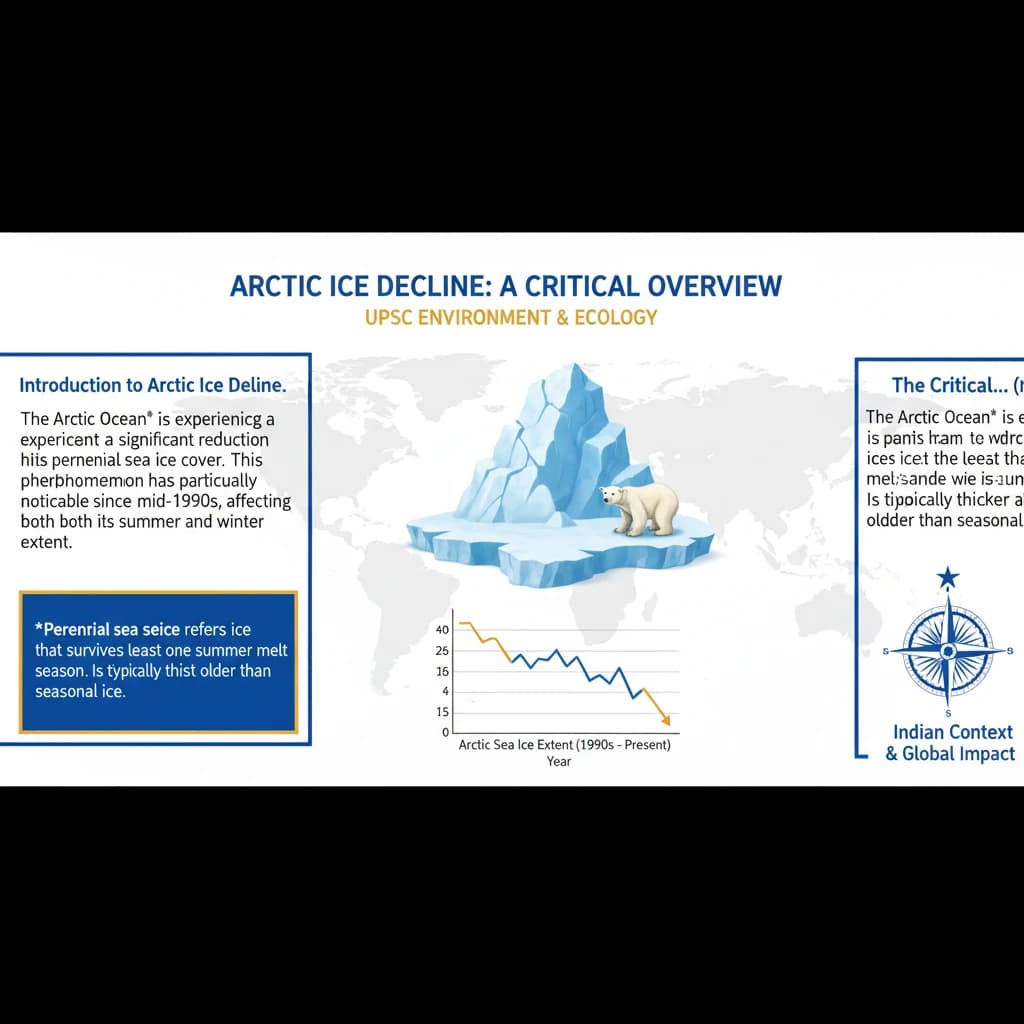
<h4>Introduction to Arctic Ice Decline</h4><p>The <strong>Arctic Ocean</strong> is experiencing a significant reduction in its <strong>perennial sea ice cover</strong>. This phenomenon has been particularly noticeable since the <strong>mid-1990s</strong>, affecting both its summer and winter extent.</p><div class='info-box'><p><strong>Perennial sea ice</strong> refers to ice that survives at least one summer melt season. It is typically thicker and older than seasonal ice.</p></div><h4>The Critical Role of Arctic Sea Ice</h4><p><strong>Arctic sea ice</strong> plays a crucial role in regulating Earth's climate. Its bright, white surface is highly effective at reflecting incoming <strong>solar radiation</strong> back into space, a process known as the <strong>albedo effect</strong>.</p><div class='key-point-box'><p>The <strong>albedo effect</strong> helps to keep the polar regions cool and influences global weather patterns. A decrease in ice cover means less reflection and more absorption of heat.</p></div><h4>Timeline and Magnitude of Decrease</h4><p>A marked decrease in ice cover has been observed consistently since the <strong>mid-1990s</strong>. This decline is evident across all seasons, highlighting a systemic change in the Arctic environment.</p><p>The rate and characteristics of this decline underwent a significant shift around <strong>2007</strong>, indicating an acceleration of the melting process.</p><h4>Pronounced Regime Shift</h4><p>Since <strong>2007</strong>, the Arctic has witnessed a profound <strong>regime shift</strong> in its sea ice characteristics. The ice cover has transitioned from being predominantly <strong>thicker and deformed</strong> to becoming <strong>thinner and more uniform</strong>.</p><div class='info-box'><p>A <strong>regime shift</strong> in ecology refers to a large, persistent, and often abrupt change in the structure and function of an ecosystem.</p></div><h4>Consequences of Thinner Ice</h4><p>The emergence of <strong>thinner ice</strong> has critical implications for the Arctic environment. Such ice is inherently <strong>less durable</strong> and therefore more susceptible to rapid melting.</p><p>When this thinner ice melts, it exposes the darker ocean surface beneath. This darker water then absorbs significantly more <strong>incoming solar radiation</strong>, leading to further warming of the water and accelerating the overall melting process.</p><div class='exam-tip-box'><p>This positive feedback loop (less ice -> darker ocean -> more heat absorption -> more melt) is a critical concept for <strong>UPSC Mains GS-III</strong>, particularly in questions related to <strong>climate change impacts</strong> and <strong>feedback mechanisms</strong>.</p></div>
Concept Diagram

💡 Key Takeaways

  • •Arctic perennial sea ice has seen a marked decrease in both summer and winter since the mid-1990s.
  • •A significant 'regime shift' occurred post-2007, transitioning from thicker, deformed ice to thinner, more uniform ice.
  • •Thinner ice is less durable, melts faster, and exposes the darker ocean, leading to increased absorption of solar radiation and accelerated warming (positive feedback loop).
  • •This decline has critical implications for global climate regulation (albedo effect), Arctic ecosystems (e.g., polar bears), and international geopolitics (e.g., shipping routes).
  • •The decrease in ice cover is a key indicator of global warming and a central concern for climate change studies and policy.

🧠 Memory Techniques
Memory Aid
95% Verified Content

📚 Reference Sources

•Intergovernmental Panel on Climate Change (IPCC) Assessment Reports
•National Aeronautics and Space Administration (NASA) – Arctic Sea Ice Data
•National Oceanic and Atmospheric Administration (NOAA) – Arctic Program
•Arctic Council publications and reports

Related Topics

Loading related topics...
Explore:Environment And Ecology Topics·All Subjects·Daily Current Affairs·Editorial Analysis·Previous Year Questions·UPSC GPT
Decrease in Ice Cover - UPSC Environment And Ecology