Loading page, please wait…
Vaidra Logo
Vaidra

Top 4 items + smart groups

UPSC GPT
New
Current Affairs
Daily Solutions
Daily Puzzle
Mains Evaluator

Version 2.0.0 • Built with ❤️ for UPSC aspirants

Loading...
Loading...
Loading...
Loading...
Loading...
Loading...
Loading...
Loading...
Loading...
Loading...
Loading...
Loading...
Loading...
Back
All Subjects

Topics

0 topics • 0 completed

Loading topics...
Loading...
Loading...
Loading...
Loading...
Loading...
Overall Progress0%

Living Fossils: Definition, Significance, and Examples - UPSC Environment And Ecology

What is Living Fossils: Definition, Significance, and Examples in UPSC Environment And Ecology?

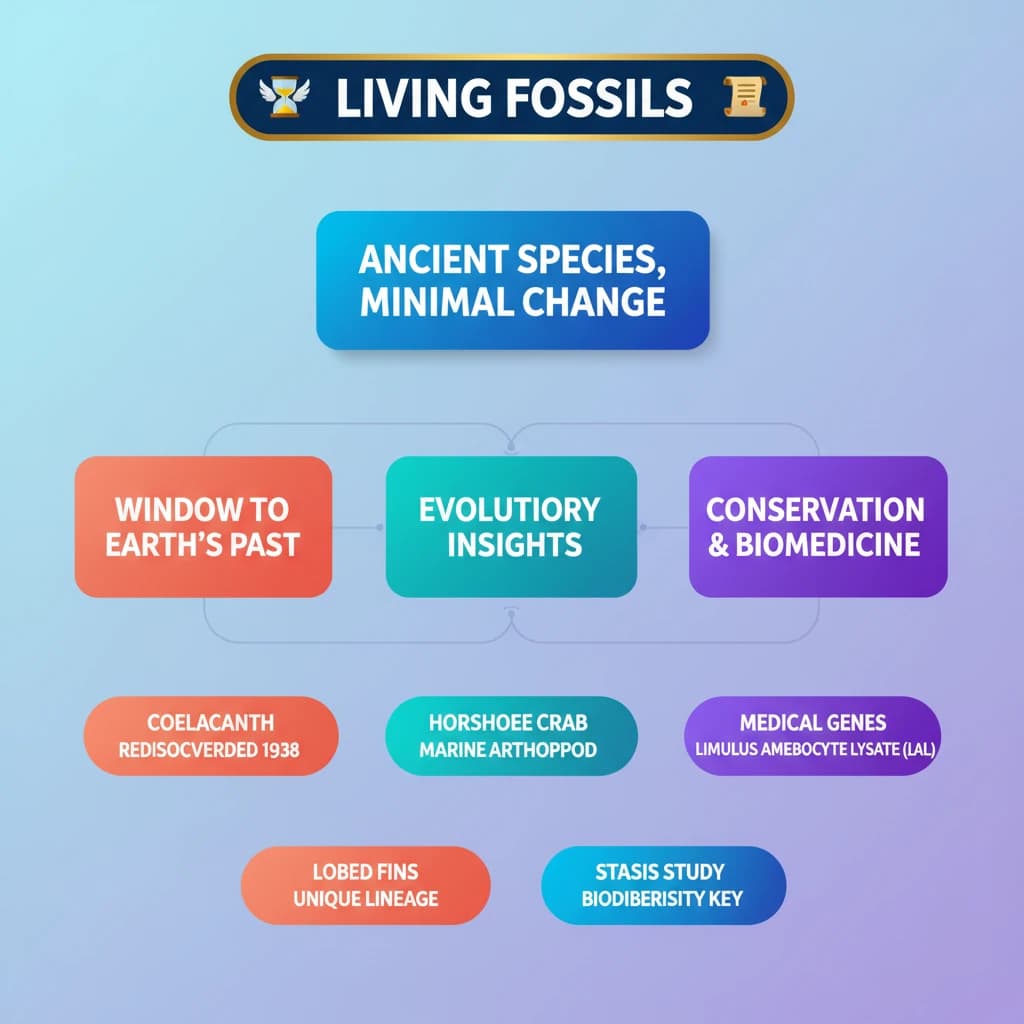
Living Fossils: Definition, Significance, and Examples is a key topic under Environment And Ecology for UPSC Civil Services Examination. Key points include: Living fossils are species with ancient origins that have undergone minimal evolutionary change.. They provide vital insights into Earth's evolutionary history and ancient ecosystems.. Coelacanth, rediscovered in 1938, is a prime example, known for its distinctive lobed fins.. Understanding this topic is essential for both UPSC Prelims and Mains preparation.

Why is Living Fossils: Definition, Significance, and Examples important for UPSC exam?

Living Fossils: Definition, Significance, and Examples is a Medium-level topic in UPSC Environment And Ecology. It is tested in both Prelims (factual MCQs) and Mains (analytical answer writing). Previous year UPSC questions have frequently covered aspects of Living Fossils: Definition, Significance, and Examples, making it essential for comprehensive IAS preparation.

How to prepare Living Fossils: Definition, Significance, and Examples for UPSC?

To prepare Living Fossils: Definition, Significance, and Examples for UPSC: (1) Study the comprehensive notes covering all key concepts on Vaidra. (2) Practice previous year questions on this topic. (3) Connect it with current affairs using daily updates. (4) Revise using key takeaways and mind maps available for Environment And Ecology. (5) Write practice answers linking Living Fossils: Definition, Significance, and Examples to related GS Paper topics.

Key takeaways of Living Fossils: Definition, Significance, and Examples for UPSC

  • Living fossils are species with ancient origins that have undergone minimal evolutionary change.
  • They provide vital insights into Earth's evolutionary history and ancient ecosystems.
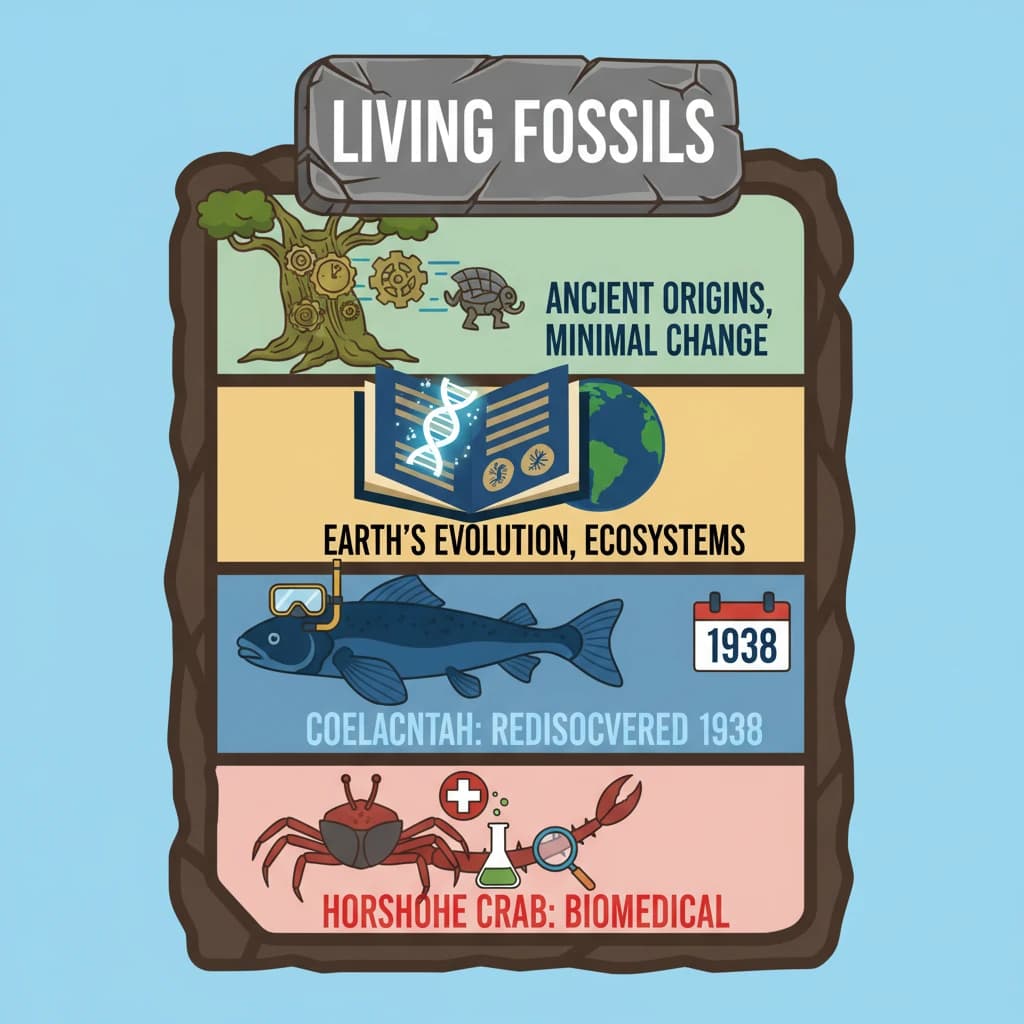
  • Coelacanth, rediscovered in 1938, is a prime example, known for its distinctive lobed fins.
  • Horseshoe crabs are another example, significant for both evolutionary study and biomedical applications.
  • Their study helps understand evolutionary stasis and informs conservation strategies for unique lineages.
Living Fossils: Definition, Significance, and Examples

Living Fossils: Definition, Significance, and Examples

Medium⏱️ 5 min read✓ 95% Verified
environment and ecology

📖 Introduction

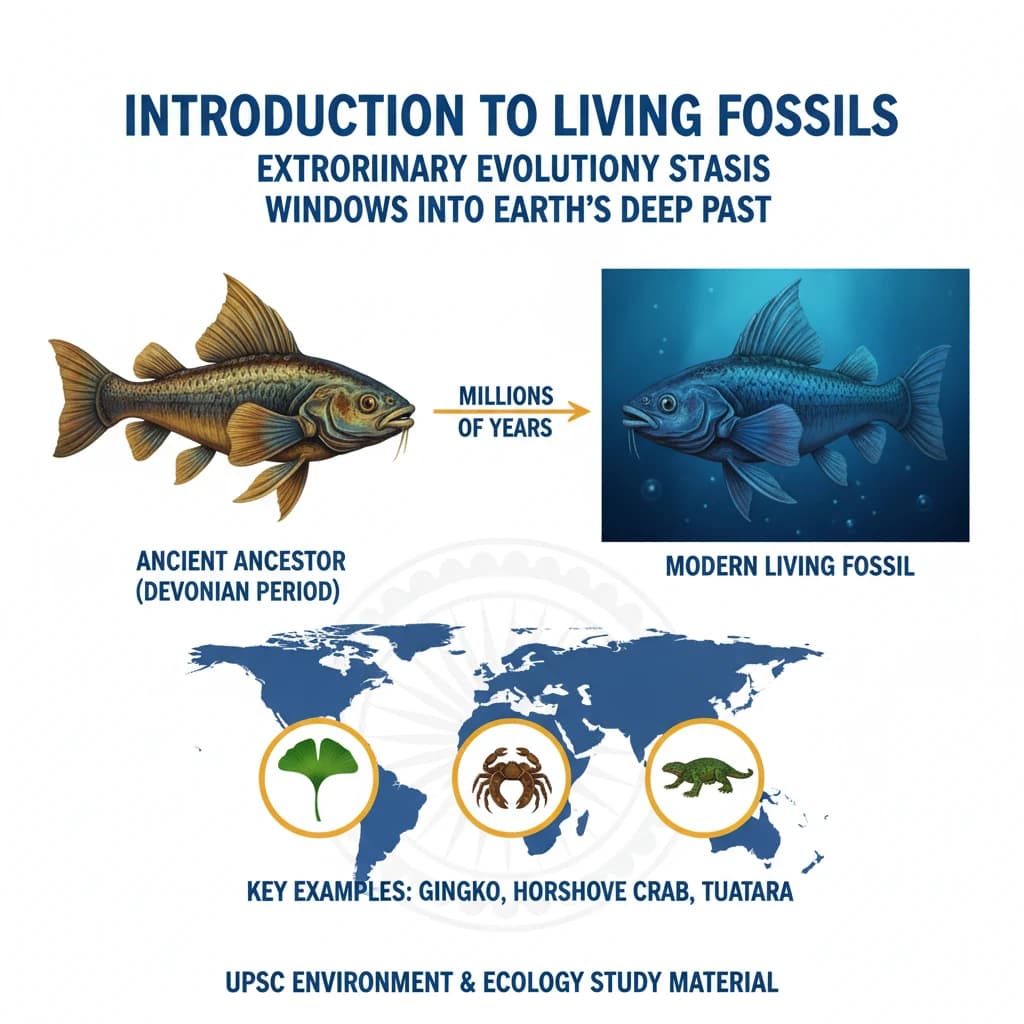
<h4>Introduction to Living Fossils</h4><p><strong>Living fossils</strong> are a remarkable category of species that have persisted for millions of years. They exhibit extraordinary <strong>evolutionary stasis</strong>, meaning they have maintained nearly identical traits to their ancient ancestors.</p><p>These organisms offer unique windows into Earth's deep past. They provide invaluable insights into <strong>evolutionary history</strong> and the characteristics of <strong>ancient ecological landscapes</strong>.</p><h4>Characteristics of Living Fossils</h4><div class='key-point-box'><p>The defining feature of a <strong>living fossil</strong> is its long-term survival with minimal morphological change. They represent lineages that have largely escaped significant evolutionary pressures that drive diversification in other groups.</p></div><p>Their existence challenges the perception of constant, rapid evolution. Instead, they highlight periods of stasis and the success of certain adaptive strategies over geological timescales.</p><h4>The Coelacanth: A Prime Example</h4><p>One of the most famous examples of a <strong>living fossil</strong> is the <strong>Coelacanth</strong>. This deep-sea fish was believed to be extinct for millions of years until its rediscovery.</p><div class='info-box'><ul><li><strong>Rediscovery Date:</strong> <strong>1938</strong></li><li><strong>Location:</strong> Off the coast of <strong>South Africa</strong></li><li><strong>Key Feature:</strong> Notable for its <strong>lobed fins</strong>, which function similarly to limbs.</li></ul></div><p>The <strong>lobed fins</strong> of the <strong>Coelacanth</strong> are particularly significant. They are considered homologous to the limbs of terrestrial vertebrates, offering clues about the transition from water to land.</p>
Concept Diagram

💡 Key Takeaways

  • •Living fossils are species with ancient origins that have undergone minimal evolutionary change.
  • •They provide vital insights into Earth's evolutionary history and ancient ecosystems.
  • •Coelacanth, rediscovered in 1938, is a prime example, known for its distinctive lobed fins.
  • •Horseshoe crabs are another example, significant for both evolutionary study and biomedical applications.
  • •Their study helps understand evolutionary stasis and informs conservation strategies for unique lineages.

🧠 Memory Techniques
Memory Aid
95% Verified Content

📚 Reference Sources

•National Geographic (for Coelacanth details)
•Smithsonian Magazine (for Horseshoe Crab details)
•University of California Museum of Paleontology

Related Topics

Loading related topics...
Explore:Environment And Ecology Topics·All Subjects·Daily Current Affairs·Editorial Analysis·Previous Year Questions·UPSC GPT
Living Fossils: Definition, Significance, and Examples - UPSC Environment And Ecology