Loading page, please wait…
Vaidra Logo
Vaidra

Top 4 items + smart groups

UPSC GPT
New
Current Affairs
Daily Solutions
Daily Puzzle
Mains Evaluator

Version 2.0.0 • Built with ❤️ for UPSC aspirants

Loading...
Loading...
Loading...
Loading...
Loading...
Loading...
Loading...
Loading...
Loading...
Loading...
Loading...
Loading...
Loading...
Back
All Subjects

Topics

0 topics • 0 completed

Loading topics...
Loading...
Loading...
Loading...
Loading...
Loading...
Overall Progress0%

Oil Drilling in Assam’s Hoollongapar Gibbon Sanctuary - UPSC Environment And Ecology

What is Oil Drilling in Assam’s Hoollongapar Gibbon Sanctuary in UPSC Environment And Ecology?

Oil Drilling in Assam’s Hoollongapar Gibbon Sanctuary is a key topic under Environment And Ecology for UPSC Civil Services Examination. Key points include: Oil drilling in Hoollongapar Gibbon Sanctuary's ESZ threatens the endangered hoolock gibbon.. Hoollongapar is India's first primate-dedicated sanctuary, protecting the only ape species.. Genetic research (CCMB 2021) suggests only one hoolock gibbon species in India, despite IUCN's two-species listing.. Understanding this topic is essential for both UPSC Prelims and Mains preparation.

Why is Oil Drilling in Assam’s Hoollongapar Gibbon Sanctuary important for UPSC exam?

Oil Drilling in Assam’s Hoollongapar Gibbon Sanctuary is a Medium-level topic in UPSC Environment And Ecology. It is tested in both Prelims (factual MCQs) and Mains (analytical answer writing). Previous year UPSC questions have frequently covered aspects of Oil Drilling in Assam’s Hoollongapar Gibbon Sanctuary, making it essential for comprehensive IAS preparation.

How to prepare Oil Drilling in Assam’s Hoollongapar Gibbon Sanctuary for UPSC?

To prepare Oil Drilling in Assam’s Hoollongapar Gibbon Sanctuary for UPSC: (1) Study the comprehensive notes covering all key concepts on Vaidra. (2) Practice previous year questions on this topic. (3) Connect it with current affairs using daily updates. (4) Revise using key takeaways and mind maps available for Environment And Ecology. (5) Write practice answers linking Oil Drilling in Assam’s Hoollongapar Gibbon Sanctuary to related GS Paper topics.

Key takeaways of Oil Drilling in Assam’s Hoollongapar Gibbon Sanctuary for UPSC

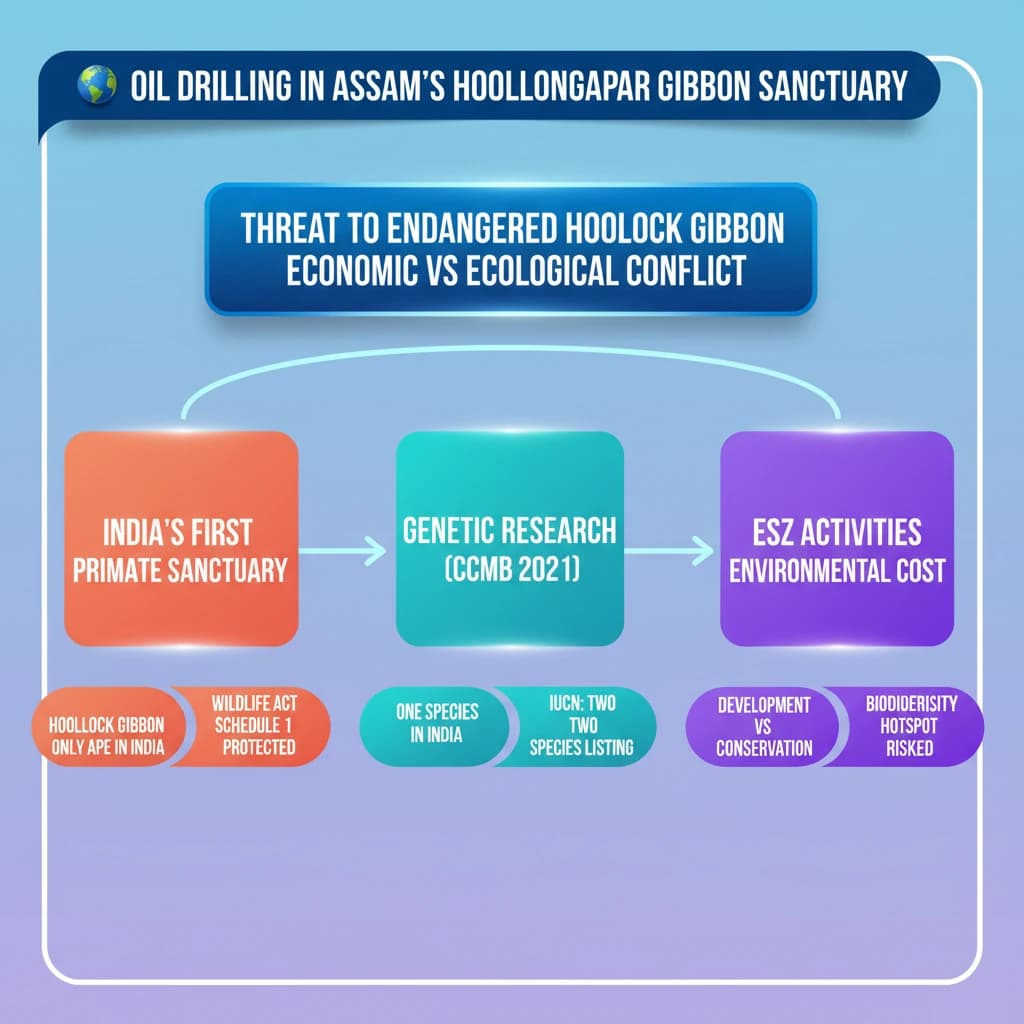
  • Oil drilling in Hoollongapar Gibbon Sanctuary's ESZ threatens the endangered hoolock gibbon.
  • Hoollongapar is India's first primate-dedicated sanctuary, protecting the only ape species.
  • Genetic research (CCMB 2021) suggests only one hoolock gibbon species in India, despite IUCN's two-species listing.
  • Hoolock gibbons are protected under Schedule 1 of the Wildlife Protection Act 1972.
  • The issue highlights the conflict between economic development and biodiversity conservation in India.
Oil Drilling in Assam’s Hoollongapar Gibbon Sanctuary

Oil Drilling in Assam’s Hoollongapar Gibbon Sanctuary

Medium⏱️ 9 min read✓ 95% Verified
environment and ecology

📖 Introduction

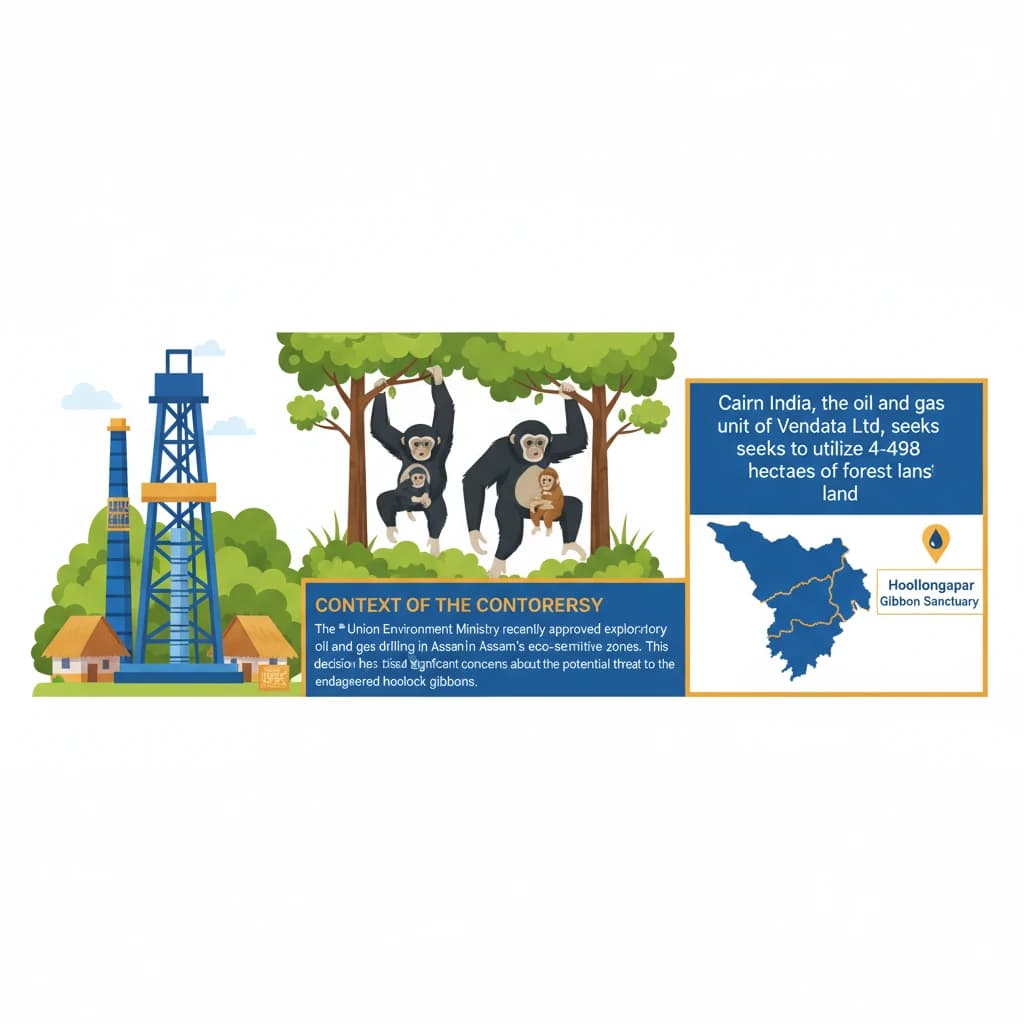
<h4>Context of the Controversy</h4><p>The <strong>Union Environment Ministry</strong> recently approved <strong>exploratory oil and gas drilling</strong> in <strong>Assam's eco-sensitive zones</strong>.</p><p>This decision has raised significant concerns about the potential threat to the <strong>endangered hoolock gibbons</strong>.</p><div class='info-box'><p><strong>Cairn India</strong>, the oil and gas unit of <strong>Vedanta Ltd</strong>, seeks to utilize <strong>4-498 hectares</strong> of <strong>reserved forest land</strong> for exploration.</p><p>This land is located within the <strong>eco-sensitive zone</strong> of the <strong>Hoollongapar Gibbon Wildlife Sanctuary</strong>.</p></div><h4>About Hoollongapar Gibbon Wildlife Sanctuary</h4><p>The <strong>Hoollongapar Reserve Forest</strong> was upgraded to a <strong>Gibbon Wildlife Sanctuary</strong> by the <strong>Government of Assam</strong> in <strong>1997</strong>.</p><div class='key-point-box'><p>It holds the distinction of being the <strong>first protected area in India</strong> specifically dedicated to a <strong>primate species</strong>.</p></div><h4>Key Facts About the Hoolock Gibbon</h4><p><strong>Gibbons</strong> are the <strong>smallest and fastest apes</strong>, naturally inhabiting <strong>Asia's tropical and subtropical forests</strong>.</p><p>The <strong>hoolock gibbon</strong> is particularly unique as it is <strong>endemic to India's northeast</strong> region.</p><div class='info-box'><ul><li>There are approximately <strong>20 gibbon species</strong> globally.</li><li>The estimated population of hoolock gibbons in India is around <strong>12,000</strong>.</li><li>All 20 gibbon species face a <strong>high risk of extinction</strong> due to population and distribution decline since <strong>1900</strong>.</li></ul></div><p>The primary threat to the <strong>hoolock gibbon</strong> is <strong>deforestation</strong>, largely driven by <strong>infrastructure projects</strong>.</p><h4>Hoolock Gibbon Species in India: A Genetic Perspective</h4><p>Historically, two distinct hoolock gibbon species were believed to exist in India's northeastern region: the <strong>eastern hoolock gibbon (<em>Hoolock leuconedys</em>)</strong> and the <strong>western hoolock gibbon (<em>Hoolock hoolock</em>)</strong>.</p><div class='info-box'><p>A <strong>2021 study</strong> by the <strong>Hyderabad-based Centre for Cellular and Molecular Biology (CCMB)</strong> provided new insights.</p><p>Through <strong>genetic analysis</strong>, the study concluded that there is <strong>only one species of ape in India</strong>, effectively debunking earlier research.</p></div><p>The <strong>CCMB study</strong> indicated that the two populations diverged approximately <strong>1.48 million years ago</strong>, while gibbons separated from a common ancestor around <strong>8.39 million years ago</strong>.</p><div class='key-point-box'><p>Despite the genetic findings, the <strong>IUCN Red List</strong> currently categorizes the <strong>western hoolock gibbon</strong> as <strong>Endangered</strong> and the <strong>eastern hoolock gibbon</strong> as <strong>Vulnerable</strong>.</p></div><h4>Conservation Status and Measures</h4><p>In India, the hoolock gibbon species receives protection under <strong>Schedule 1</strong> of the <strong>Indian (Wildlife) Protection Act 1972</strong>.</p><div class='exam-tip-box'><p>Understanding the <strong>IUCN status</strong> and <strong>legal protection</strong> under the <strong>Wildlife Protection Act</strong> is crucial for <strong>UPSC Prelims</strong> and <strong>Mains</strong> questions on biodiversity and conservation.</p></div>
Concept Diagram

💡 Key Takeaways

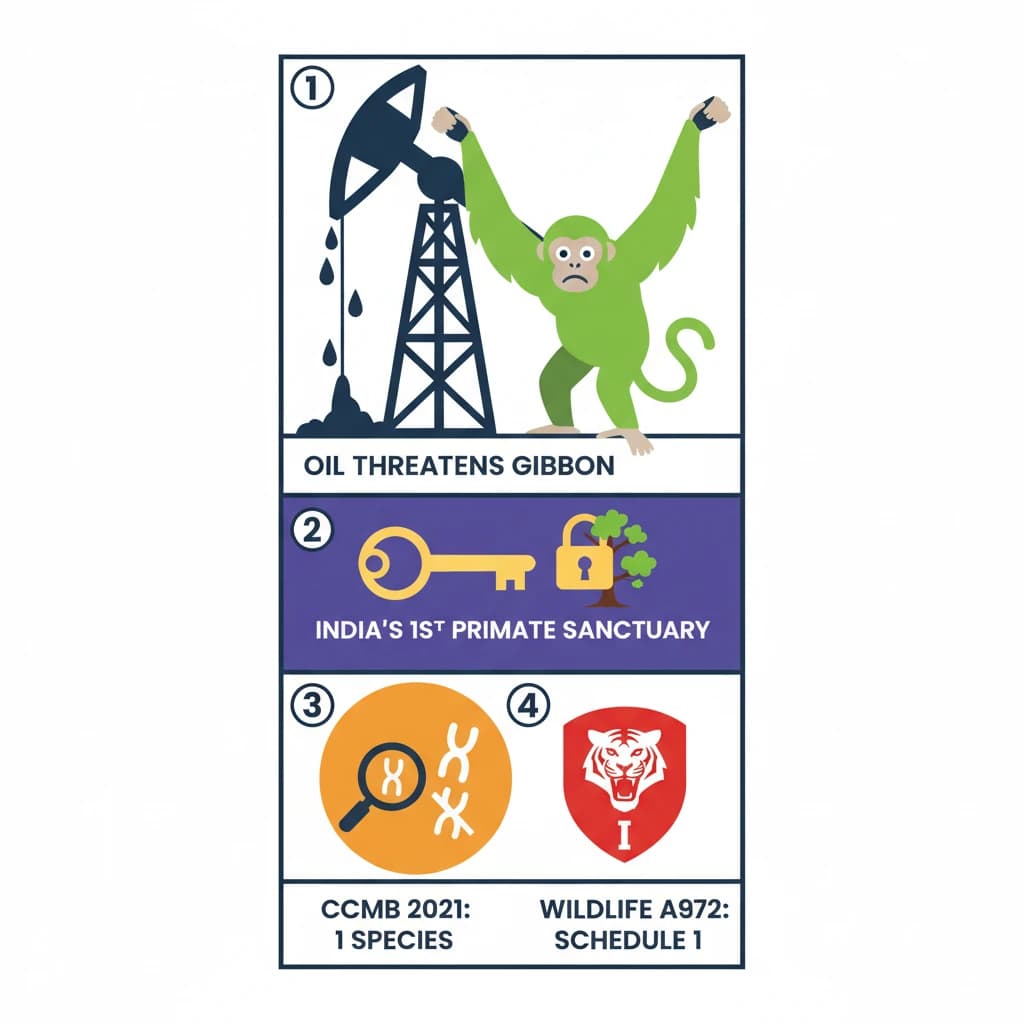
  • •Oil drilling in Hoollongapar Gibbon Sanctuary's ESZ threatens the endangered hoolock gibbon.
  • •Hoollongapar is India's first primate-dedicated sanctuary, protecting the only ape species.
  • •Genetic research (CCMB 2021) suggests only one hoolock gibbon species in India, despite IUCN's two-species listing.
  • •Hoolock gibbons are protected under Schedule 1 of the Wildlife Protection Act 1972.
  • •The issue highlights the conflict between economic development and biodiversity conservation in India.

🧠 Memory Techniques
Memory Aid
95% Verified Content

📚 Reference Sources

•IUCN Red List (for species status)
•Indian (Wildlife) Protection Act 1972
•Centre for Cellular and Molecular Biology (CCMB) 2021 study on Hoolock Gibbon genetics

Related Topics

Loading related topics...
Explore:Environment And Ecology Topics·All Subjects·Daily Current Affairs·Editorial Analysis·Previous Year Questions·UPSC GPT
Oil Drilling in Assam’s Hoollongapar Gibbon Sanctuary - UPSC Environment And Ecology