Loading page, please wait…
Vaidra Logo
Vaidra

Top 4 items + smart groups

UPSC GPT
New
Current Affairs
Daily Solutions
Daily Puzzle
Mains Evaluator

Version 2.0.0 • Built with ❤️ for UPSC aspirants

Loading...
Loading...
Loading...
Loading...
Loading...
Loading...
Loading...
Loading...
Loading...
Loading...
Loading...
Loading...
Loading...

WMO’s Greenhouse Gas Bulletin 2023 - UPSC Environment And Ecology

What is WMO’s Greenhouse Gas Bulletin 2023 in UPSC Environment And Ecology?

WMO’s Greenhouse Gas Bulletin 2023 is a key topic under Environment And Ecology for UPSC Civil Services Examination. Key points include: WMO's 2023 GHG Bulletin reports record-high atmospheric concentrations of CO₂, CH₄, and N₂O.. The warming effect from GHGs has surged by 51.5% since 1990, with 2023 being the hottest year on record (1.48°C above pre-industrial levels).. Current CO₂ levels (420 ppm) are comparable to those 3-5 million years ago, indicating unprecedented human impact.. Understanding this topic is essential for both UPSC Prelims and Mains preparation.

Why is WMO’s Greenhouse Gas Bulletin 2023 important for UPSC exam?

WMO’s Greenhouse Gas Bulletin 2023 is a Medium-level topic in UPSC Environment And Ecology. It is tested in both Prelims (factual MCQs) and Mains (analytical answer writing). Previous year UPSC questions have frequently covered aspects of WMO’s Greenhouse Gas Bulletin 2023, making it essential for comprehensive IAS preparation.

How to prepare WMO’s Greenhouse Gas Bulletin 2023 for UPSC?

To prepare WMO’s Greenhouse Gas Bulletin 2023 for UPSC: (1) Study the comprehensive notes covering all key concepts on Vaidra. (2) Practice previous year questions on this topic. (3) Connect it with current affairs using daily updates. (4) Revise using key takeaways and mind maps available for Environment And Ecology. (5) Write practice answers linking WMO’s Greenhouse Gas Bulletin 2023 to related GS Paper topics.

Key takeaways of WMO’s Greenhouse Gas Bulletin 2023 for UPSC

  • WMO's 2023 GHG Bulletin reports record-high atmospheric concentrations of CO₂, CH₄, and N₂O.
  • The warming effect from GHGs has surged by 51.5% since 1990, with 2023 being the hottest year on record (1.48°C above pre-industrial levels).
  • Current CO₂ levels (420 ppm) are comparable to those 3-5 million years ago, indicating unprecedented human impact.
  • Human activities like fossil fuel burning, deforestation, and agriculture are the primary drivers of increased GHG emissions.
  • The Global Atmosphere Watch (GAW) program is crucial for global monitoring of atmospheric composition and climate change trends.
WMO’s Greenhouse Gas Bulletin 2023

WMO’s Greenhouse Gas Bulletin 2023

Medium⏱️ 8 min read✓ 95% Verified
environment and ecology

📖 Introduction

<h4>Introduction to WMO's Greenhouse Gas Bulletin 2023</h4><p>The <strong>World Meteorological Organisation (WMO)</strong> recently released its annual <strong>Greenhouse Gas (GHG) Bulletin</strong> for the year <strong>2023</strong>. This bulletin provides a critical analysis of atmospheric concentrations of <strong>Greenhouse Gases (GHGs)</strong>.</p><p>It compiles the latest data from the <strong>WMO Global Atmosphere Watch (GAW)</strong> programme. This ensures a comprehensive overview of global atmospheric composition changes.</p><h4>Understanding Greenhouse Gases (GHGs)</h4><p><strong>Greenhouse Gases (GHGs)</strong> are atmospheric gases that possess the ability to <strong>trap heat</strong> from the sun. This natural process is essential for keeping Earth’s surface warm enough to sustain life.</p><div class='info-box'><p><strong>Definition:</strong> <strong>Greenhouse Gases (GHGs)</strong> are gases that absorb and emit radiant energy within the thermal infrared range, causing the <strong>greenhouse effect</strong>.</p></div><p>However, human activities have significantly increased the concentration of these gases. Activities such as burning <strong>fossil fuels</strong>, extensive <strong>deforestation</strong>, and various <strong>industrial processes</strong> are major contributors.</p><p>This amplification of the natural greenhouse effect leads to <strong>global warming</strong> and subsequent <strong>climate change</strong>, posing a significant threat to global ecosystems.</p><h4>Key Greenhouse Gases and Their Characteristics</h4><ul><li><p><strong>Carbon Dioxide (CO₂)</strong>: This is a primary GHG, entering the atmosphere mainly through the burning of <strong>fossil fuels</strong> (coal, natural gas, oil) and solid waste. It is the most significant anthropogenic GHG.</p></li><li><p><strong>Methane (CH₄)</strong>: Human activities are largely responsible for increased methane levels. Key sources include <strong>cattle farming</strong>, waste in <strong>landfills</strong>, <strong>rice farming</strong>, and the extraction of <strong>fossil fuels</strong>.</p></li><li><p><strong>Nitrous Oxide (N₂O)</strong>: Emissions of N₂O occur during <strong>agricultural activities</strong>, changes in <strong>land use</strong>, and various <strong>industrial processes</strong>. It also results from the combustion of fossil fuels and solid waste.</p></li><li><p><strong>Water Vapour (H₂O)</strong>: This is the <strong>most abundant GHG</strong> in the atmosphere. Unlike other GHGs, it exists for only a few days before condensing, but it plays a crucial role in the climate system.</p></li><li><p><strong>Industrial Fluorinated Gases</strong>: These include <strong>hydrofluorocarbons (HFCs)</strong>, <strong>perfluorocarbons (PFCs)</strong>, and <strong>sulphur hexafluoride (SF₆)</strong>. They are known for their exceptionally high <strong>Global Warming Potential (GWP)</strong>.</p></li></ul><div class='info-box'><p><strong>Global Warming Potential (GWP):</strong> <strong>GWP</strong> indicates how much heat a <strong>Greenhouse Gas (GHG)</strong> traps in the atmosphere over a specific period (e.g., 100 years) relative to <strong>Carbon Dioxide (CO₂)</strong>. For example, <strong>SF₆</strong> has a GWP <strong>23,000 times greater</strong> than CO₂, making it an extremely potent contributor to global warming.</p></div><h4>Key Findings of the WMO GHG Bulletin 2023</h4><p>The <strong>2023 Greenhouse Gas Bulletin</strong> highlighted several concerning trends in atmospheric concentrations.</p><ul><li><p><strong>GHG Impact Since 1990</strong>: The overall warming effect from <strong>greenhouse gases</strong> has surged by a significant <strong>51.5%</strong> since <strong>1990</strong>. <strong>Carbon Dioxide (CO₂)</strong> alone contributed a staggering <strong>81%</strong> of this rise.</p></li><li><p><strong>Record Highs in 2023</strong>: Concentrations of <strong>CO₂</strong>, <strong>CH₄</strong>, and <strong>N₂O</strong> all reached unprecedented levels in <strong>2023</strong>. Specifically, <strong>CO₂</strong> increased by <strong>2.3 ppm</strong>, reaching <strong>420 ppm</strong> in the atmosphere.</p></li><li><p><strong>Hottest Year on Record</strong>: The year <strong>2023</strong> surpassed <strong>2016</strong> to become the <strong>hottest year on record</strong>. Global temperatures were recorded at <strong>1.48°C above pre-industrial levels</strong>, primarily due to record-high <strong>radiative forcing</strong> from GHGs.</p></li><li><p><strong>Historical Comparison</strong>: Current <strong>CO₂ levels</strong> are comparable to those observed <strong>3-5 million years ago</strong>. During that period, global temperatures were <strong>2-3°C higher</strong>, and sea levels were <strong>10-20 metres above today’s levels</strong>.</p></li><li><p><strong>Continuous Rise</strong>: This marks the <strong>12th consecutive year</strong> where the annual growth of <strong>CO₂</strong> has exceeded <strong>2 ppm</strong>, indicating a persistent upward trend.</p></li></ul><h4>Global Atmosphere Watch (GAW)</h4><div class='info-box'><p><strong>About GAW:</strong> The <strong>Global Atmosphere Watch (GAW)</strong> is a collaborative programme involving <strong>100 countries</strong>. It provides crucial scientific data on <strong>atmospheric composition</strong> and changes influenced by both natural and human factors. This network is vital for monitoring long-term trends in GHGs.</p></div><div class='exam-tip-box'><p><strong>UPSC Insight:</strong> Understanding the <strong>WMO GHG Bulletin</strong> and the role of <strong>GAW</strong> is crucial for <strong>GS-III Environment and Ecology</strong>. Be prepared to discuss the findings and their implications for climate policy and sustainable development.</p></div>
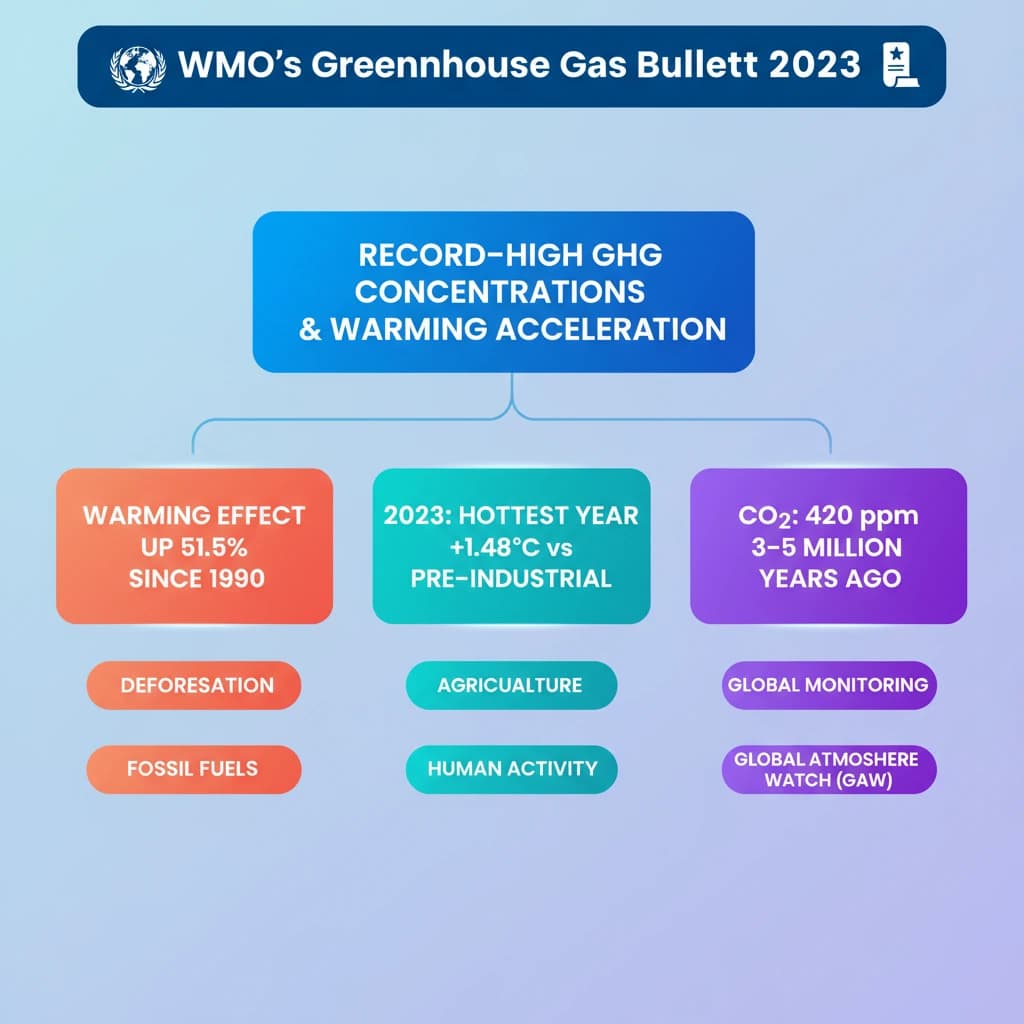
Concept Diagram

💡 Key Takeaways

  • •WMO's 2023 GHG Bulletin reports record-high atmospheric concentrations of CO₂, CH₄, and N₂O.
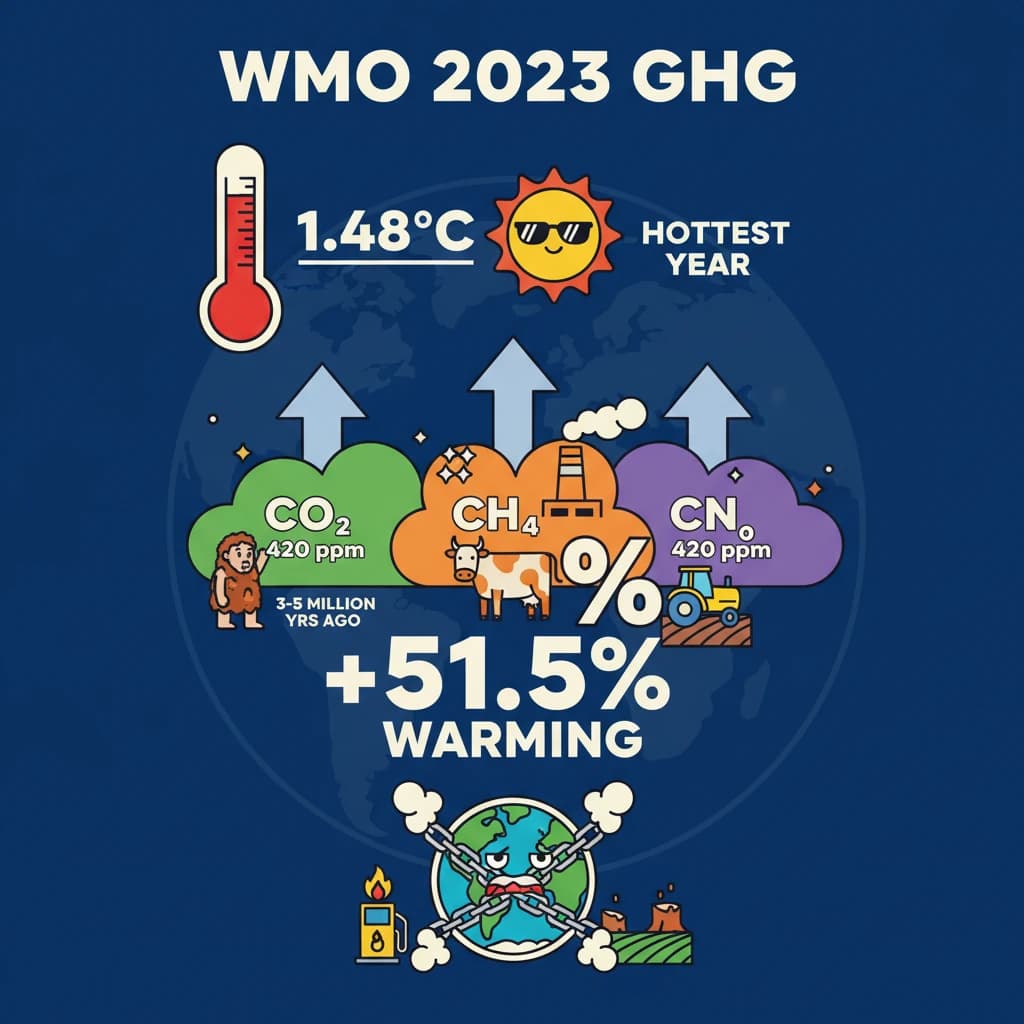
  • •The warming effect from GHGs has surged by 51.5% since 1990, with 2023 being the hottest year on record (1.48°C above pre-industrial levels).
  • •Current CO₂ levels (420 ppm) are comparable to those 3-5 million years ago, indicating unprecedented human impact.
  • •Human activities like fossil fuel burning, deforestation, and agriculture are the primary drivers of increased GHG emissions.
  • •The Global Atmosphere Watch (GAW) program is crucial for global monitoring of atmospheric composition and climate change trends.

🧠 Memory Techniques
Memory Aid
95% Verified Content

📚 Reference Sources

•World Meteorological Organisation (WMO) official publications (implied)

Related Topics

Loading related topics...
Explore:Environment And Ecology Topics·All Subjects·Daily Current Affairs·Editorial Analysis·Previous Year Questions·UPSC GPT
Back
All Subjects

Topics

0 topics • 0 completed

Loading topics...
Loading...
Loading...
Loading...
Loading...
Loading...
Overall Progress0%
WMO’s Greenhouse Gas Bulletin 2023 - UPSC Environment And Ecology