Loading page, please wait…
Vaidra Logo
Vaidra

Top 4 items + smart groups

UPSC GPT
New
Current Affairs
Daily Solutions
Daily Puzzle
Mains Evaluator

Version 2.0.0 • Built with ❤️ for UPSC aspirants

Loading...
Loading...
Loading...
Loading...
Loading...
Loading...
Loading...
Loading...
Loading...
Loading...
Loading...
Loading...
Loading...
Drivers of Arctic MHWs - UPSC Environment And Ecology
Back
All Subjects

Topics

0 topics • 0 completed

Loading topics...
Loading...
Loading...
Loading...
Loading...
Loading...
Overall Progress0%

Drivers of Arctic MHWs - UPSC Environment And Ecology

What is Drivers of Arctic MHWs in UPSC Environment And Ecology?

Drivers of Arctic MHWs is a key topic under Environment And Ecology for UPSC Civil Services Examination. Key points include: Arctic Marine Heatwaves (MHWs) primarily occur in marginal seas like Kara, Laptev, East Siberian, and Chukchi.. Shallow mixed-layer depths and dominant first-year ice cover are key conditions conducive to MHW development.. First-year ice melts completely each summer, making the ocean surface vulnerable to solar warming.. Understanding this topic is essential for both UPSC Prelims and Mains preparation.

Why is Drivers of Arctic MHWs important for UPSC exam?

Drivers of Arctic MHWs is a Medium-level topic in UPSC Environment And Ecology. It is tested in both Prelims (factual MCQs) and Mains (analytical answer writing). Previous year UPSC questions have frequently covered aspects of Drivers of Arctic MHWs, making it essential for comprehensive IAS preparation.

How to prepare Drivers of Arctic MHWs for UPSC?

To prepare Drivers of Arctic MHWs for UPSC: (1) Study the comprehensive notes covering all key concepts on Vaidra. (2) Practice previous year questions on this topic. (3) Connect it with current affairs using daily updates. (4) Revise using key takeaways and mind maps available for Environment And Ecology. (5) Write practice answers linking Drivers of Arctic MHWs to related GS Paper topics.

Key takeaways of Drivers of Arctic MHWs for UPSC

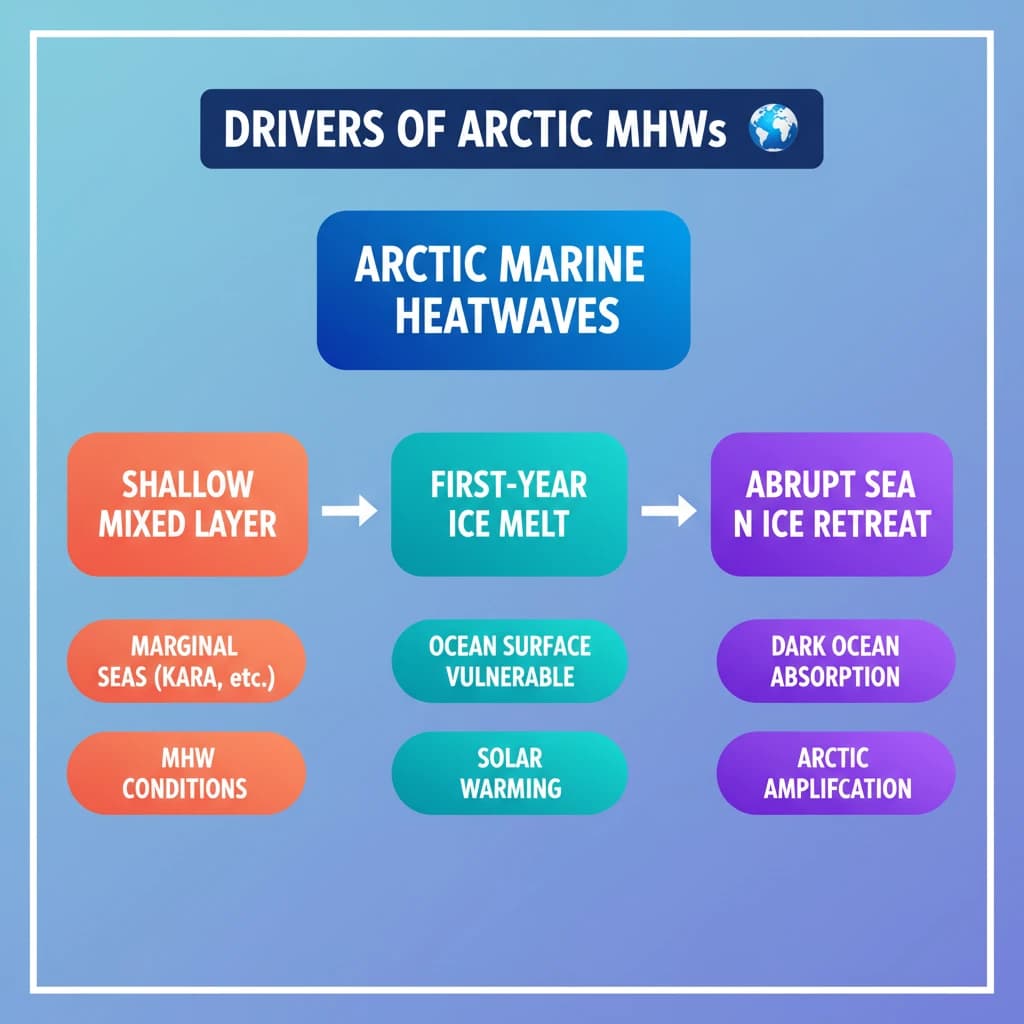
  • Arctic Marine Heatwaves (MHWs) primarily occur in marginal seas like Kara, Laptev, East Siberian, and Chukchi.
  • Shallow mixed-layer depths and dominant first-year ice cover are key conditions conducive to MHW development.
  • First-year ice melts completely each summer, making the ocean surface vulnerable to solar warming.
  • Abrupt sea ice retreat is a major trigger, exposing dark ocean and increasing heat absorption.
  • MHWs contribute to Arctic Amplification and have significant ecological, climatic, and geopolitical impacts.
Drivers of Arctic MHWs

Drivers of Arctic MHWs

Medium⏱️ 7 min read✓ 95% Verified
environment and ecology

📖 Introduction

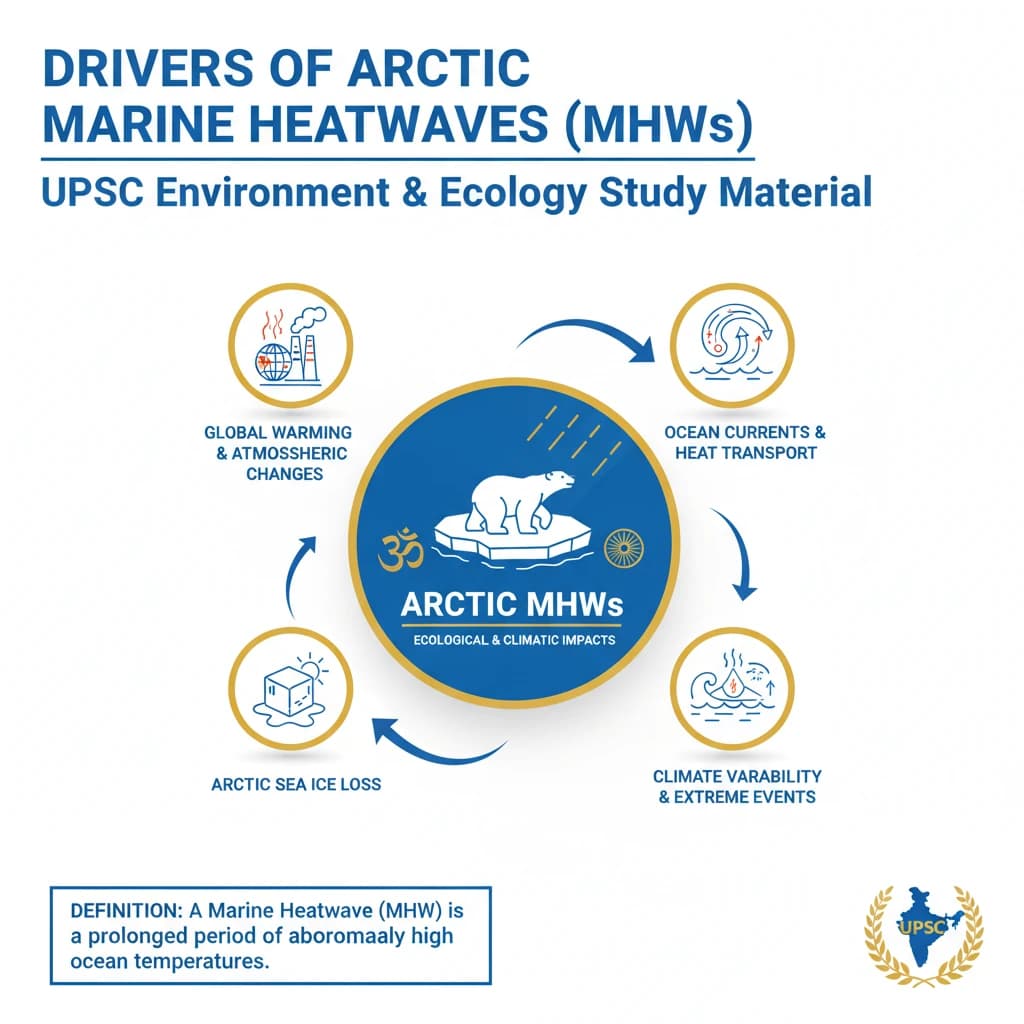
<h4>Introduction to Arctic Marine Heatwaves (MHWs)</h4><p><strong>Arctic Marine Heatwaves (MHWs)</strong> are periods of anomalously warm ocean temperatures in the Arctic region. These events are a growing concern due to their significant ecological and climatic impacts.</p><div class='info-box'><p><strong>Definition:</strong> A <strong>Marine Heatwave (MHW)</strong> is defined as a prolonged period of abnormally high ocean temperatures in a particular region. In the Arctic, these events are intensifying.</p></div><h4>Primary Occurrence Zones</h4><p>Arctic MHWs primarily manifest over specific <strong>marginal seas</strong> within the Arctic Ocean. These regions are particularly susceptible to warming trends and associated phenomena.</p><ul><li>The <strong>Kara Sea</strong></li><li>The <strong>Laptev Sea</strong></li><li>The <strong>East Siberian Sea</strong></li><li>The <strong>Chukchi Sea</strong></li></ul><div class='exam-tip-box'><p><strong>UPSC Insight:</strong> Remember the specific marginal seas mentioned, as they could be points of inquiry in <strong>Prelims (Geography)</strong> questions regarding Arctic phenomena.</p></div><h4>Conducive Regional Characteristics</h4><p>The aforementioned marginal seas possess unique characteristics that create favorable conditions for the development and intensification of <strong>Arctic MHWs</strong>.</p><div class='key-point-box'><p><strong>Key Conditions:</strong> Two primary characteristics make these regions prone to MHWs:</p><ul><li><strong>Shallow mixed-layer depths:</strong> This allows for quicker warming of the upper ocean layer.</li><li>Predominantly <strong>first-year ice cover:</strong> This type of ice is less resilient and melts more easily, exposing the ocean surface.</li></ul></div><h4>Understanding First-Year Ice</h4><p>The presence of <strong>first-year ice</strong> is a critical factor in the dynamics of Arctic MHWs. Its properties directly influence how ocean temperatures respond to atmospheric forcing.</p><div class='info-box'><p><strong>Definition:</strong> <strong>First-year ice</strong> refers to <strong>sea ice</strong> that forms and grows during a single winter season. Crucially, it typically melts away completely during the following summer melt season, unlike multi-year ice.</p></div><h4>Abrupt Sea Ice Retreat as a Trigger</h4><p>Beyond the inherent regional conditions, the phenomenon of <strong>abrupt sea ice retreat</strong> is a significant trigger for marine heatwave events in the Arctic.</p><p>When sea ice retreats rapidly, it exposes large areas of the dark ocean surface to solar radiation. This leads to increased absorption of heat, contributing directly to the formation and intensification of <strong>MHWs</strong>.</p><div class='key-point-box'><p><strong>Positive Feedback Loop:</strong> <strong>Abrupt sea ice retreat</strong> reduces the albedo effect, leading to more solar absorption, which further warms the ocean and can accelerate ice melt, creating a feedback loop.</p></div>
Concept Diagram

💡 Key Takeaways

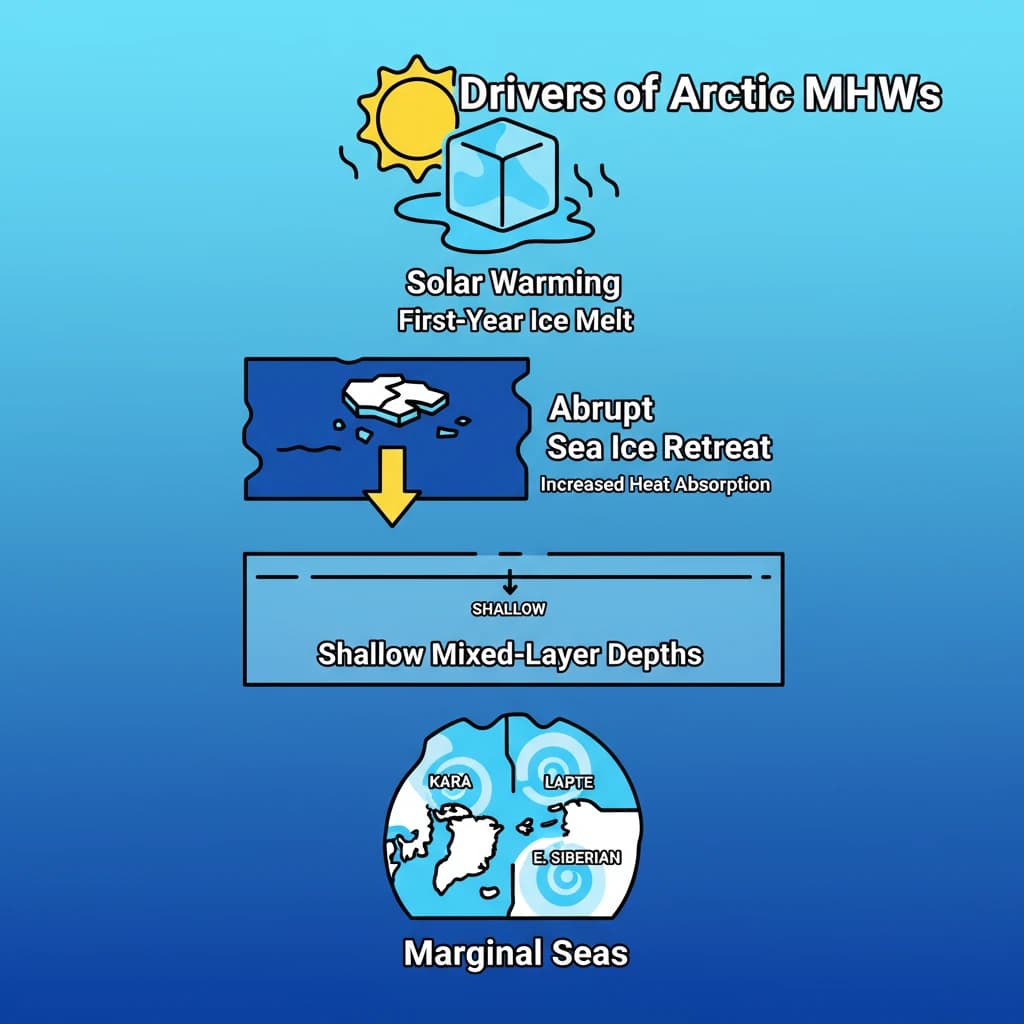
  • •Arctic Marine Heatwaves (MHWs) primarily occur in marginal seas like Kara, Laptev, East Siberian, and Chukchi.
  • •Shallow mixed-layer depths and dominant first-year ice cover are key conditions conducive to MHW development.
  • •First-year ice melts completely each summer, making the ocean surface vulnerable to solar warming.
  • •Abrupt sea ice retreat is a major trigger, exposing dark ocean and increasing heat absorption.
  • •MHWs contribute to Arctic Amplification and have significant ecological, climatic, and geopolitical impacts.

🧠 Memory Techniques
Memory Aid
95% Verified Content

📚 Reference Sources

•Arctic Council reports and scientific assessments
•Peer-reviewed scientific literature (e.g., Nature, Science, Geophysical Research Letters) on Arctic marine heatwaves and sea ice dynamics.
•National Snow and Ice Data Center (NSIDC) publications.

Related Topics

Loading related topics...
Explore:Environment And Ecology Topics·All Subjects·Daily Current Affairs·Editorial Analysis·Previous Year Questions·UPSC GPT