Loading page, please wait…
Vaidra Logo
Vaidra

Top 4 items + smart groups

UPSC GPT
New
Current Affairs
Daily Solutions
Daily Puzzle
Mains Evaluator

Version 2.0.0 • Built with ❤️ for UPSC aspirants

Loading...
Loading...
Loading...
Loading...
Loading...
Loading...
Loading...
Loading...
Loading...
Loading...
Loading...
Loading...
Loading...

Coral Bleaching in Great Barrier Reef - UPSC Environment And Ecology

What is Coral Bleaching in Great Barrier Reef in UPSC Environment And Ecology?

Coral Bleaching in Great Barrier Reef is a key topic under Environment And Ecology for UPSC Civil Services Examination. Key points include: Widespread coral bleaching detected across two-thirds of the Great Barrier Reef (GBR).. Coral bleaching is primarily caused by rising ocean temperatures due to climate change.. It involves corals expelling symbiotic algae (zooxanthellae), leading to loss of color and potential death.. Understanding this topic is essential for both UPSC Prelims and Mains preparation.

Why is Coral Bleaching in Great Barrier Reef important for UPSC exam?

Coral Bleaching in Great Barrier Reef is a Medium-level topic in UPSC Environment And Ecology. It is tested in both Prelims (factual MCQs) and Mains (analytical answer writing). Previous year UPSC questions have frequently covered aspects of Coral Bleaching in Great Barrier Reef, making it essential for comprehensive IAS preparation.

How to prepare Coral Bleaching in Great Barrier Reef for UPSC?

To prepare Coral Bleaching in Great Barrier Reef for UPSC: (1) Study the comprehensive notes covering all key concepts on Vaidra. (2) Practice previous year questions on this topic. (3) Connect it with current affairs using daily updates. (4) Revise using key takeaways and mind maps available for Environment And Ecology. (5) Write practice answers linking Coral Bleaching in Great Barrier Reef to related GS Paper topics.

Key takeaways of Coral Bleaching in Great Barrier Reef for UPSC

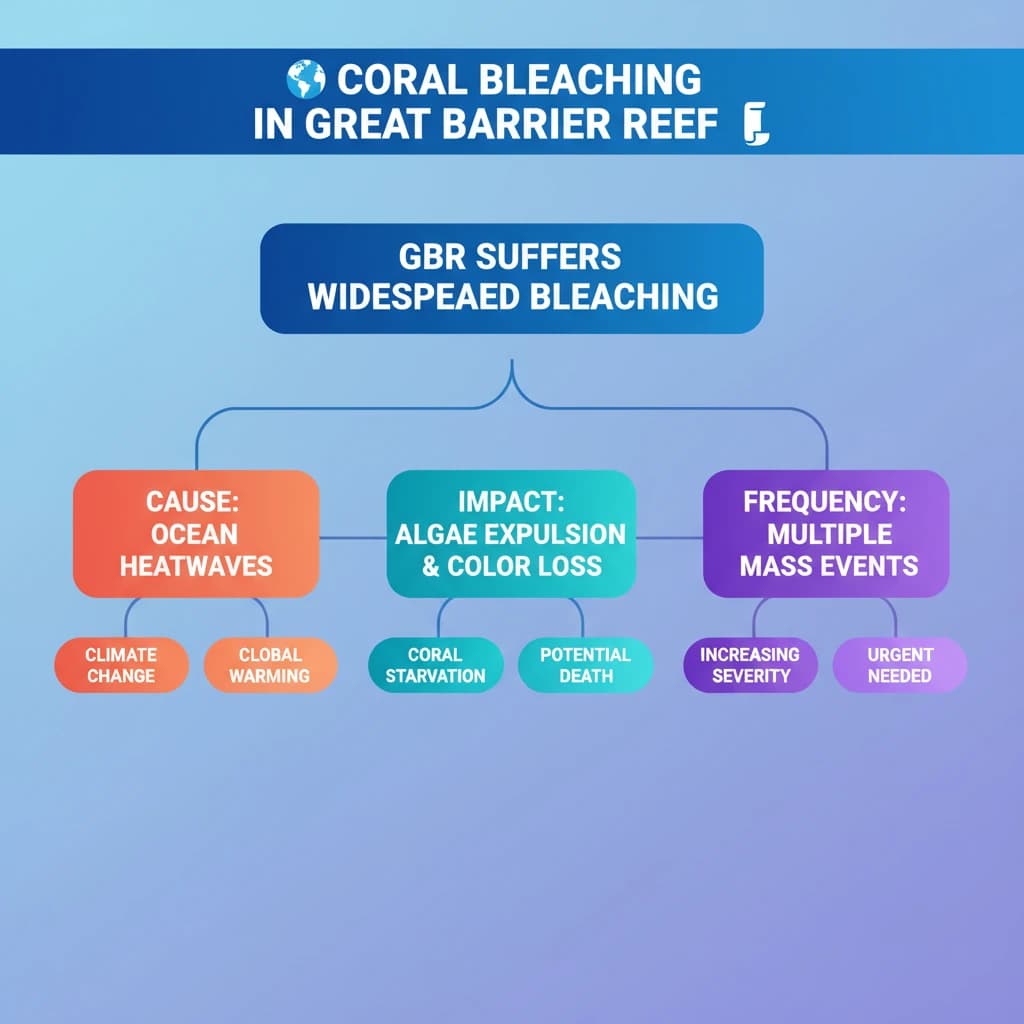
  • Widespread coral bleaching detected across two-thirds of the Great Barrier Reef (GBR).
  • Coral bleaching is primarily caused by rising ocean temperatures due to climate change.
  • It involves corals expelling symbiotic algae (zooxanthellae), leading to loss of color and potential death.
  • The GBR has experienced multiple mass bleaching events, increasing in frequency and severity.
  • Urgent global and local actions are needed to reduce emissions and manage local stressors for reef survival.
Coral Bleaching
in Great Barrier Reef

Coral Bleaching in Great Barrier Reef

Medium⏱️ 6 min read✓ 95% Verified
environment and ecology

📖 Introduction

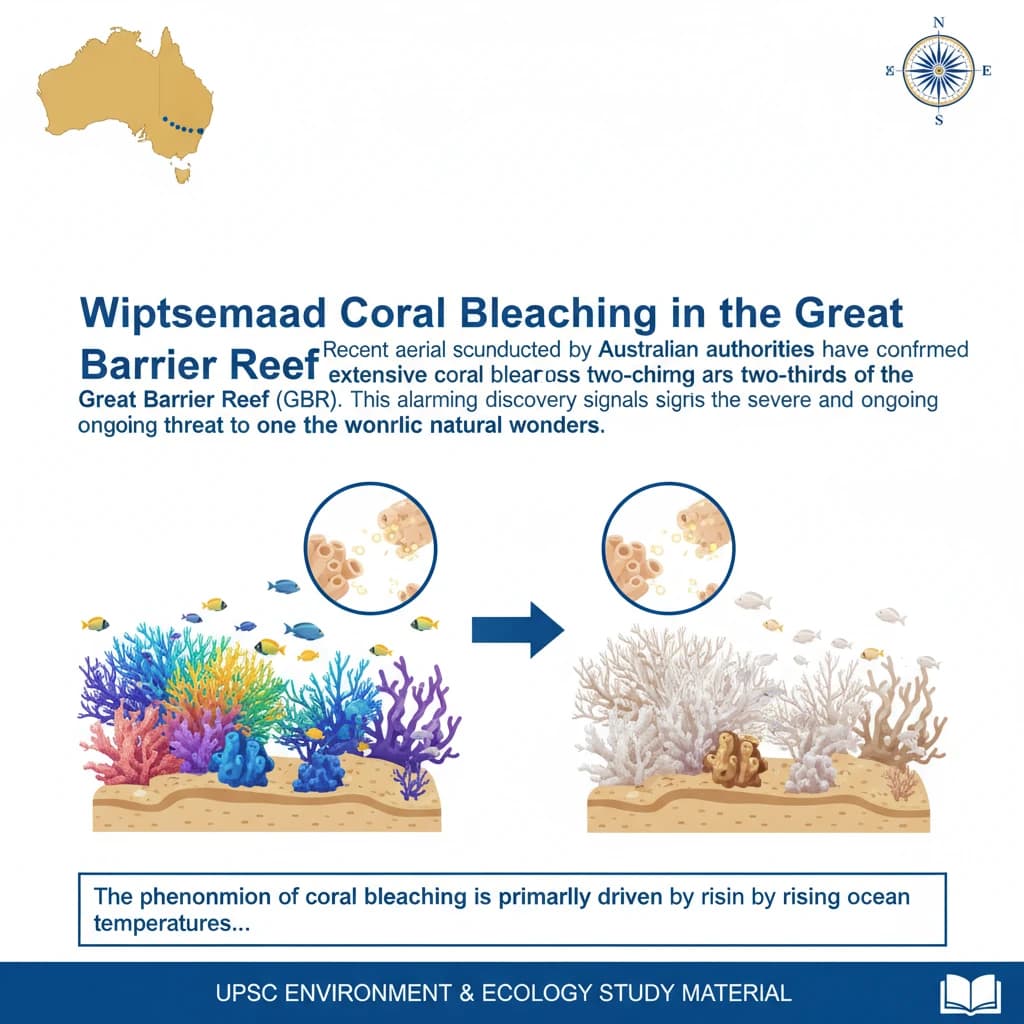
<h4>Widespread Coral Bleaching in the Great Barrier Reef</h4><p>Recent <strong>aerial surveys</strong> conducted by <strong>Australian authorities</strong> have confirmed extensive <strong>coral bleaching</strong> across <strong>two-thirds</strong> of the <strong>Great Barrier Reef (GBR)</strong>. This alarming discovery signals a severe and ongoing threat to one of the world's most iconic natural wonders.</p><p>The phenomenon of <strong>coral bleaching</strong> is primarily driven by rising ocean temperatures, which are directly linked to <strong>climate change</strong>. These elevated temperatures stress the corals, causing them to expel the symbiotic algae crucial for their survival.</p><div class='key-point-box'><p>The current widespread bleaching event underscores the urgent need for global action. Without significant reductions in <strong>greenhouse gas emissions</strong>, the long-term viability of the GBR and other coral ecosystems remains critically endangered.</p></div><h4>Understanding Coral Bleaching</h4><p><strong>Coral bleaching</strong> occurs when corals expel the colorful algae, known as <strong>zooxanthellae</strong>, that live within their tissues. These algae provide corals with most of their food through photosynthesis and give them their vibrant colors.</p><p>When stressed by factors like increased water temperature, pollution, or extreme low tides, corals expel these algae. The coral then turns white, revealing its calcium carbonate skeleton, hence the term 'bleaching'.</p><div class='info-box'><p><strong>Zooxanthellae:</strong> Microscopic algae that live in a <strong>symbiotic relationship</strong> with coral polyps, providing nutrients and color.</p></div><h4>Impacts on the Great Barrier Reef</h4><p>The <strong>Great Barrier Reef</strong> is a UNESCO World Heritage site and a vital ecosystem supporting immense biodiversity. Widespread bleaching events devastate coral colonies, leading to significant coral mortality if conditions do not improve.</p><p>This degradation impacts the entire marine food web, affecting fish populations, sea turtles, and other species that rely on the reef for habitat and food. It also has profound economic implications for industries like tourism and fisheries.</p><div class='exam-tip-box'><p>For <strong>UPSC Mains GS-III (Environment)</strong>, understanding the causes and consequences of coral bleaching, especially in the context of global warming, is crucial. Be prepared to discuss mitigation and adaptation strategies.</p></div>
Concept Diagram

💡 Key Takeaways

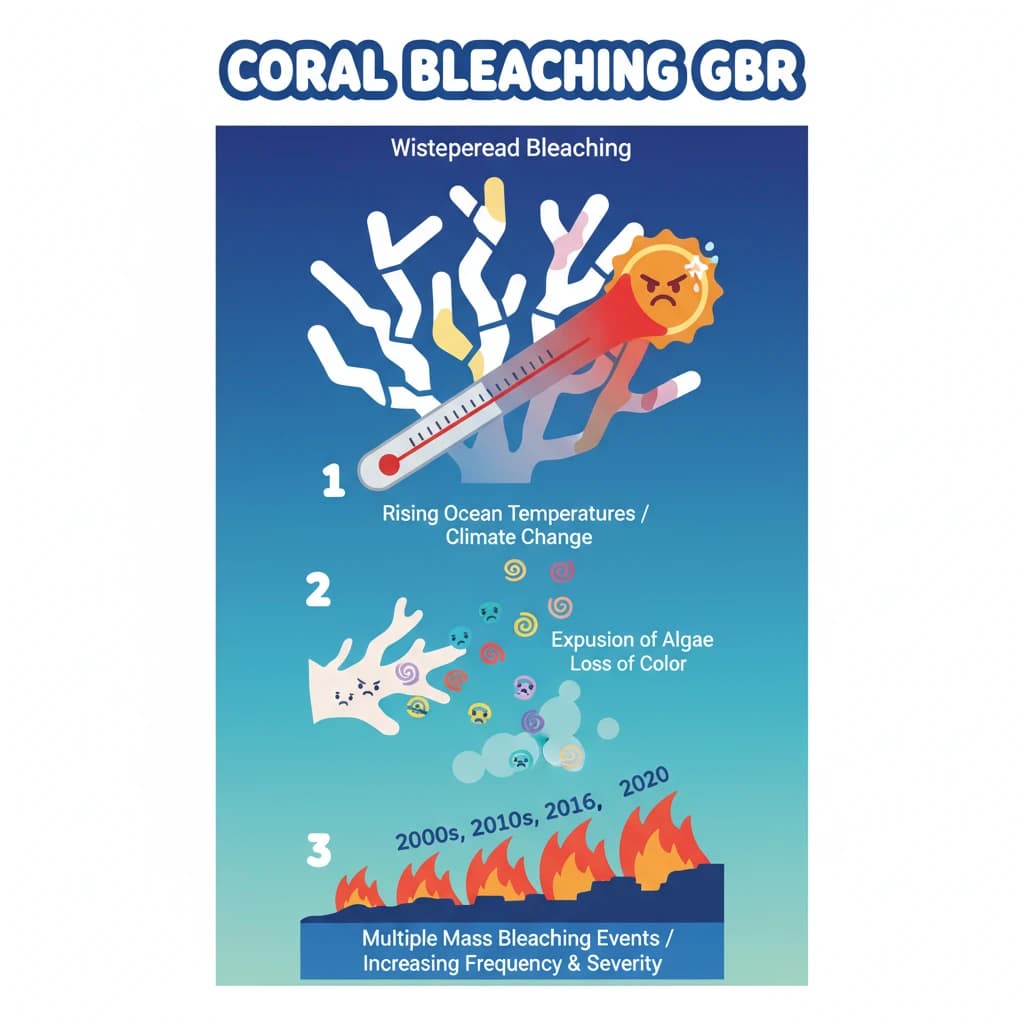
  • •Widespread coral bleaching detected across two-thirds of the Great Barrier Reef (GBR).
  • •Coral bleaching is primarily caused by rising ocean temperatures due to climate change.
  • •It involves corals expelling symbiotic algae (zooxanthellae), leading to loss of color and potential death.
  • •The GBR has experienced multiple mass bleaching events, increasing in frequency and severity.
  • •Urgent global and local actions are needed to reduce emissions and manage local stressors for reef survival.

🧠 Memory Techniques
Memory Aid
95% Verified Content

📚 Reference Sources

•National Oceanic and Atmospheric Administration (NOAA) - Coral Bleaching information
•Great Barrier Reef Marine Park Authority (GBRMPA) official reports
•UNESCO World Heritage Centre - Great Barrier Reef information

Related Topics

Loading related topics...
Explore:Environment And Ecology Topics·All Subjects·Daily Current Affairs·Editorial Analysis·Previous Year Questions·UPSC GPT
Back
All Subjects

Topics

0 topics • 0 completed

Loading topics...
Loading...
Loading...
Loading...
Loading...
Loading...
Overall Progress0%
Coral Bleaching in Great Barrier Reef - UPSC Environment And Ecology