Loading page, please wait…
Vaidra Logo
Vaidra

Top 4 items + smart groups

UPSC GPT
New
Current Affairs
Daily Solutions
Daily Puzzle
Mains Evaluator

Version 2.0.0 • Built with ❤️ for UPSC aspirants

Loading...
Loading...
Loading...
Loading...
Loading...
Loading...
Loading...
Loading...
Loading...
Loading...
Loading...
Loading...
Loading...
Back
All Subjects

Topics

0 topics • 0 completed

Loading topics...
Loading...
Loading...
Loading...
Loading...
Loading...
Overall Progress0%

Great Indian Bustards - UPSC Environment And Ecology

What is Great Indian Bustards in UPSC Environment And Ecology?

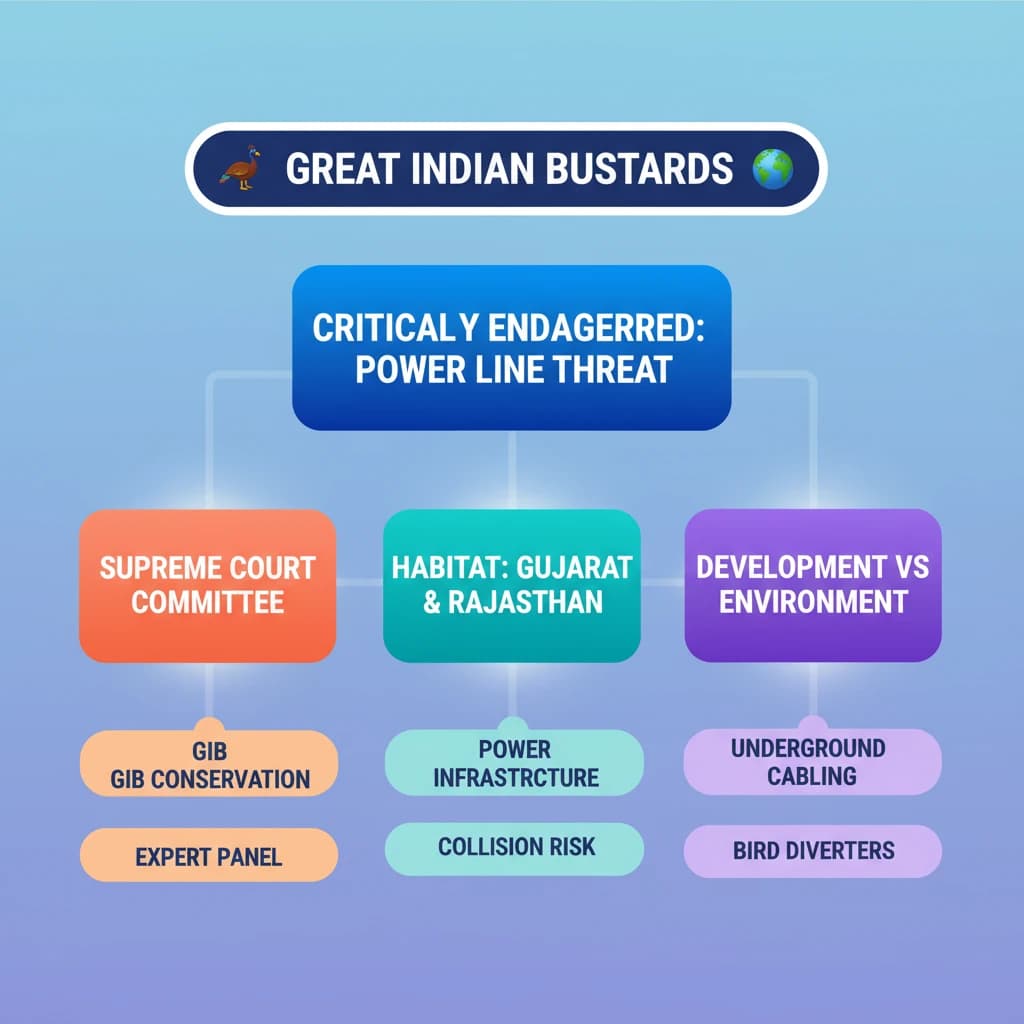
Great Indian Bustards is a key topic under Environment And Ecology for UPSC Civil Services Examination. Key points include: Great Indian Bustard (GIB) is critically endangered, primarily due to collisions with high-tension power lines.. The Supreme Court has formed an expert committee to balance GIB conservation with renewable energy development.. GIB habitats in Gujarat and Rajasthan are particularly affected by power infrastructure.. Understanding this topic is essential for both UPSC Prelims and Mains preparation.

Why is Great Indian Bustards important for UPSC exam?

Great Indian Bustards is a Medium-level topic in UPSC Environment And Ecology. It is tested in both Prelims (factual MCQs) and Mains (analytical answer writing). Previous year UPSC questions have frequently covered aspects of Great Indian Bustards, making it essential for comprehensive IAS preparation.

How to prepare Great Indian Bustards for UPSC?

To prepare Great Indian Bustards for UPSC: (1) Study the comprehensive notes covering all key concepts on Vaidra. (2) Practice previous year questions on this topic. (3) Connect it with current affairs using daily updates. (4) Revise using key takeaways and mind maps available for Environment And Ecology. (5) Write practice answers linking Great Indian Bustards to related GS Paper topics.

Key takeaways of Great Indian Bustards for UPSC

  • Great Indian Bustard (GIB) is critically endangered, primarily due to collisions with high-tension power lines.
  • The Supreme Court has formed an expert committee to balance GIB conservation with renewable energy development.
  • GIB habitats in Gujarat and Rajasthan are particularly affected by power infrastructure.
  • This case highlights the 'development vs. environment' dilemma in India's sustainable growth strategy.
  • Solutions like underground cabling and bird diverters are being explored to mitigate threats.
Great Indian Bustards

Great Indian Bustards

Medium⏱️ 6 min read✓ 95% Verified
environment and ecology

📖 Introduction

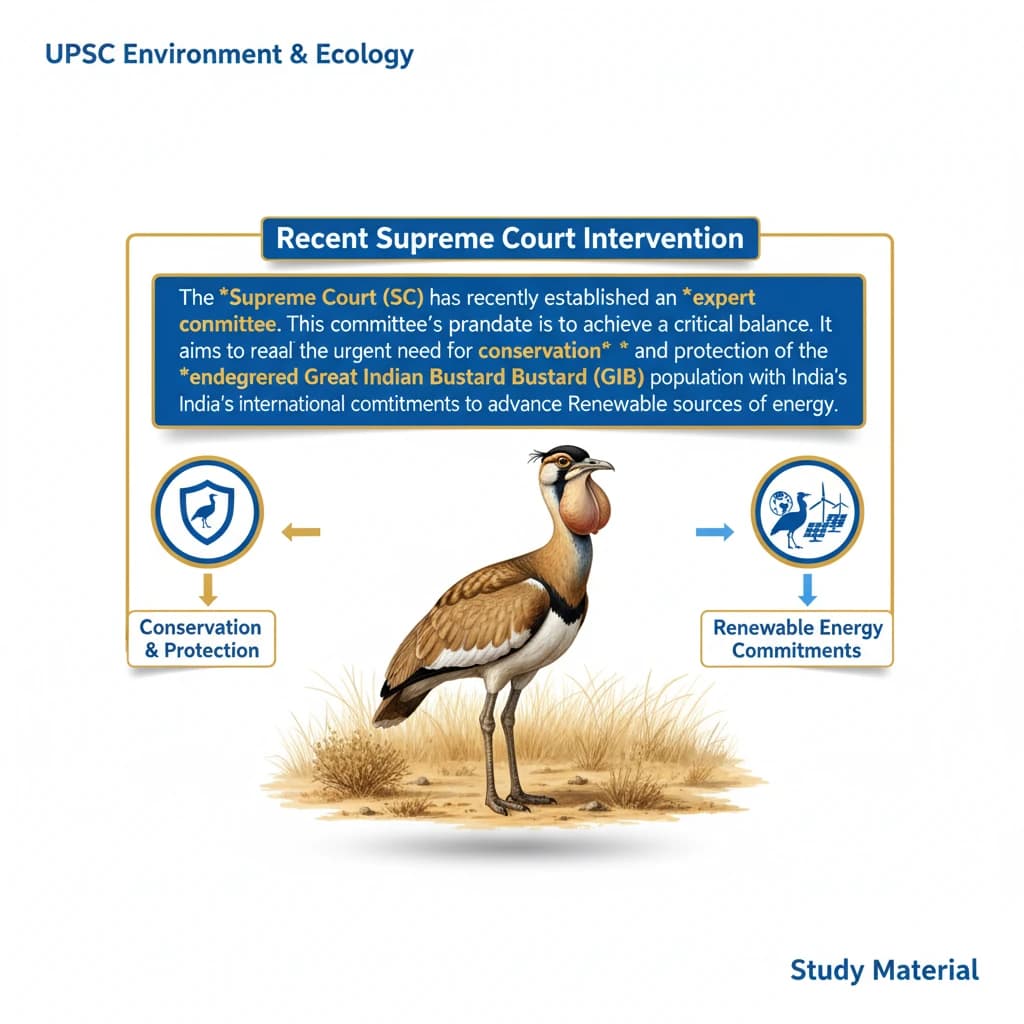
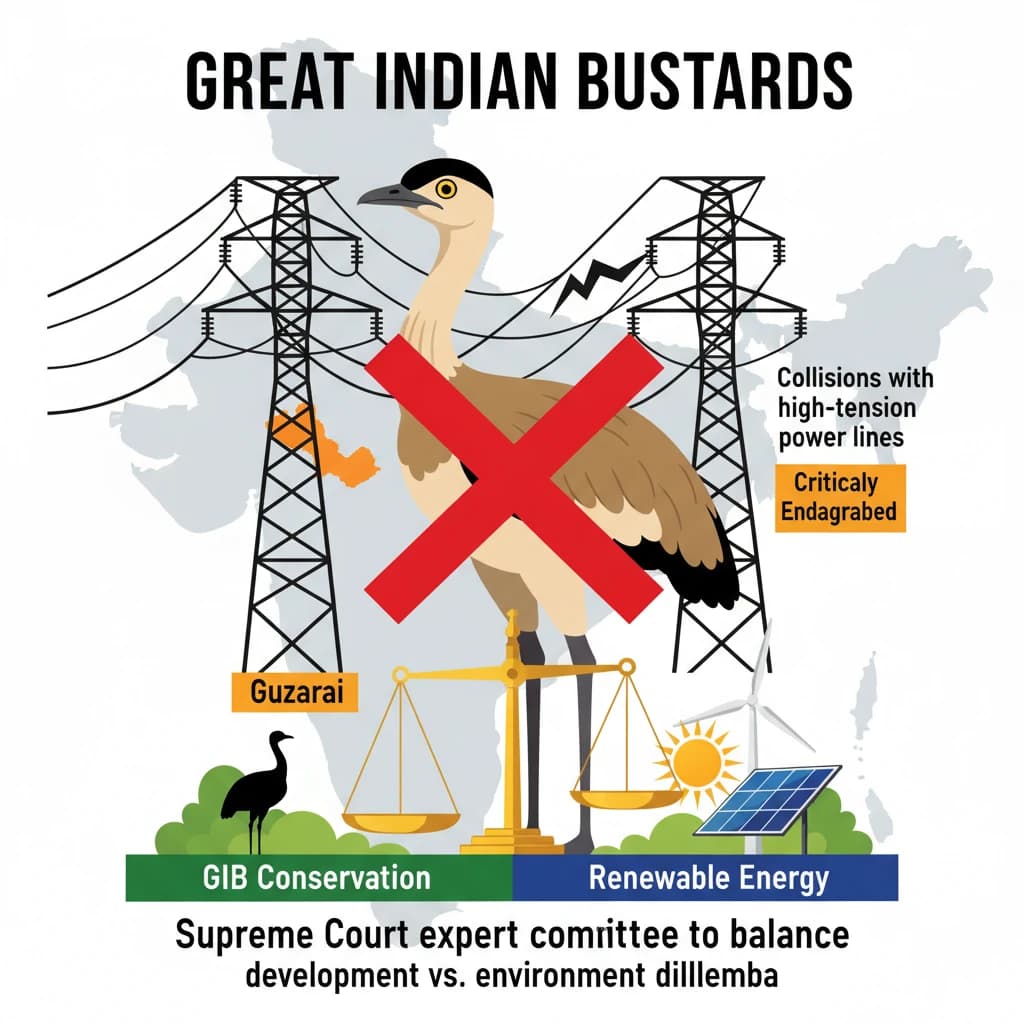
<h4>Recent Supreme Court Intervention</h4><p>The <strong>Supreme Court (SC)</strong> has recently established an <strong>expert committee</strong>. This committee's primary mandate is to achieve a critical balance.</p><p>It aims to reconcile the urgent need for <strong>conservation</strong> and <strong>protection</strong> of the <strong>endangered Great Indian Bustard (GIB)</strong> population with India's <strong>international commitments</strong> to advance <strong>Renewable sources of energy</strong>.</p><div class='key-point-box'><p><strong>Key Conflict:</strong> The expansion of renewable energy infrastructure often overlaps with critical wildlife habitats, leading to conservation challenges.</p></div><h4>Status and Threats to Great Indian Bustards</h4><p>The <strong>Great Indian Bustard</strong>, a magnificent large-winged bird, is currently on the <strong>brink of extinction</strong>. Its population has dwindled significantly over the years.</p><p>A major contributing factor to their declining numbers is frequent <strong>collisions</strong>. These occur with <strong>high-powered power cables</strong>, which traverse areas adjacent to their core habitats.</p><div class='info-box'><p><strong>Primary Habitats Affected:</strong> The regions most impacted by these power cable collisions are the core GIB habitats in <strong>Gujarat</strong> and <strong>Rajasthan</strong>.</p></div><div class='exam-tip-box'><p><strong>UPSC Insight:</strong> Questions on <strong>endangered species</strong> often focus on threats, conservation efforts, and policy conflicts. Understanding the GIB case provides a concrete example of the <strong>development vs. environment</strong> dilemma.</p></div>
Concept Diagram

💡 Key Takeaways

  • •Great Indian Bustard (GIB) is critically endangered, primarily due to collisions with high-tension power lines.
  • •The Supreme Court has formed an expert committee to balance GIB conservation with renewable energy development.
  • •GIB habitats in Gujarat and Rajasthan are particularly affected by power infrastructure.
  • •This case highlights the 'development vs. environment' dilemma in India's sustainable growth strategy.
  • •Solutions like underground cabling and bird diverters are being explored to mitigate threats.

🧠 Memory Techniques
Memory Aid
95% Verified Content

📚 Reference Sources

•IUCN Red List for Great Indian Bustard
•Reports on Supreme Court directives regarding GIB conservation
•Ministry of Environment, Forest and Climate Change (MoEFCC) documents on GIB

Related Topics

Loading related topics...
Explore:Environment And Ecology Topics·All Subjects·Daily Current Affairs·Editorial Analysis·Previous Year Questions·UPSC GPT
Great Indian Bustards - UPSC Environment And Ecology