Loading page, please wait…
Vaidra Logo
Vaidra

Top 4 items + smart groups

UPSC GPT
New
Current Affairs
Daily Solutions
Daily Puzzle
Mains Evaluator

Version 2.0.0 • Built with ❤️ for UPSC aspirants

Loading...
Loading...
Loading...
Loading...
Loading...
Loading...
Loading...
Loading...
Loading...
Loading...
Loading...
Loading...
Loading...
Reptile Census at Bhitarkanika National Park - UPSC Environment And Ecology
Back
All Subjects

Topics

0 topics • 0 completed

Loading topics...
Loading...
Loading...
Loading...
Loading...
Loading...
Overall Progress0%

Reptile Census at Bhitarkanika National Park - UPSC Environment And Ecology

What is Reptile Census at Bhitarkanika National Park in UPSC Environment And Ecology?

Reptile Census at Bhitarkanika National Park is a key topic under Environment And Ecology for UPSC Civil Services Examination. Key points include: Bhitarkanika National Park conducted its annual reptile census in 2023.. The census recorded 1,826 saltwater crocodiles, including 18 rare albino crocodiles.. The survey utilized the Timestamp Camera App for improved accuracy and data integrity.. Understanding this topic is essential for both UPSC Prelims and Mains preparation.

Why is Reptile Census at Bhitarkanika National Park important for UPSC exam?

Reptile Census at Bhitarkanika National Park is a Medium-level topic in UPSC Environment And Ecology. It is tested in both Prelims (factual MCQs) and Mains (analytical answer writing). Previous year UPSC questions have frequently covered aspects of Reptile Census at Bhitarkanika National Park, making it essential for comprehensive IAS preparation.

How to prepare Reptile Census at Bhitarkanika National Park for UPSC?

To prepare Reptile Census at Bhitarkanika National Park for UPSC: (1) Study the comprehensive notes covering all key concepts on Vaidra. (2) Practice previous year questions on this topic. (3) Connect it with current affairs using daily updates. (4) Revise using key takeaways and mind maps available for Environment And Ecology. (5) Write practice answers linking Reptile Census at Bhitarkanika National Park to related GS Paper topics.

Key takeaways of Reptile Census at Bhitarkanika National Park for UPSC

  • Bhitarkanika National Park conducted its annual reptile census in 2023.
  • The census recorded 1,826 saltwater crocodiles, including 18 rare albino crocodiles.
  • The survey utilized the Timestamp Camera App for improved accuracy and data integrity.
  • The Crocodile Conservation Project, launched in 1975 at Bhitarkanika, aimed to protect Mugger, Gharial, and Saltwater Crocodiles.
  • The project's goal was to increase crocodile populations to 5-6 sightings per kilometer of water.
  • Bhitarkanika is a key site for saltwater crocodile conservation in India.
Reptile Census at Bhitarkanika National Park

Reptile Census at Bhitarkanika National Park

Medium⏱️ 6 min read✓ 98% Verified
environment and ecology

📖 Introduction

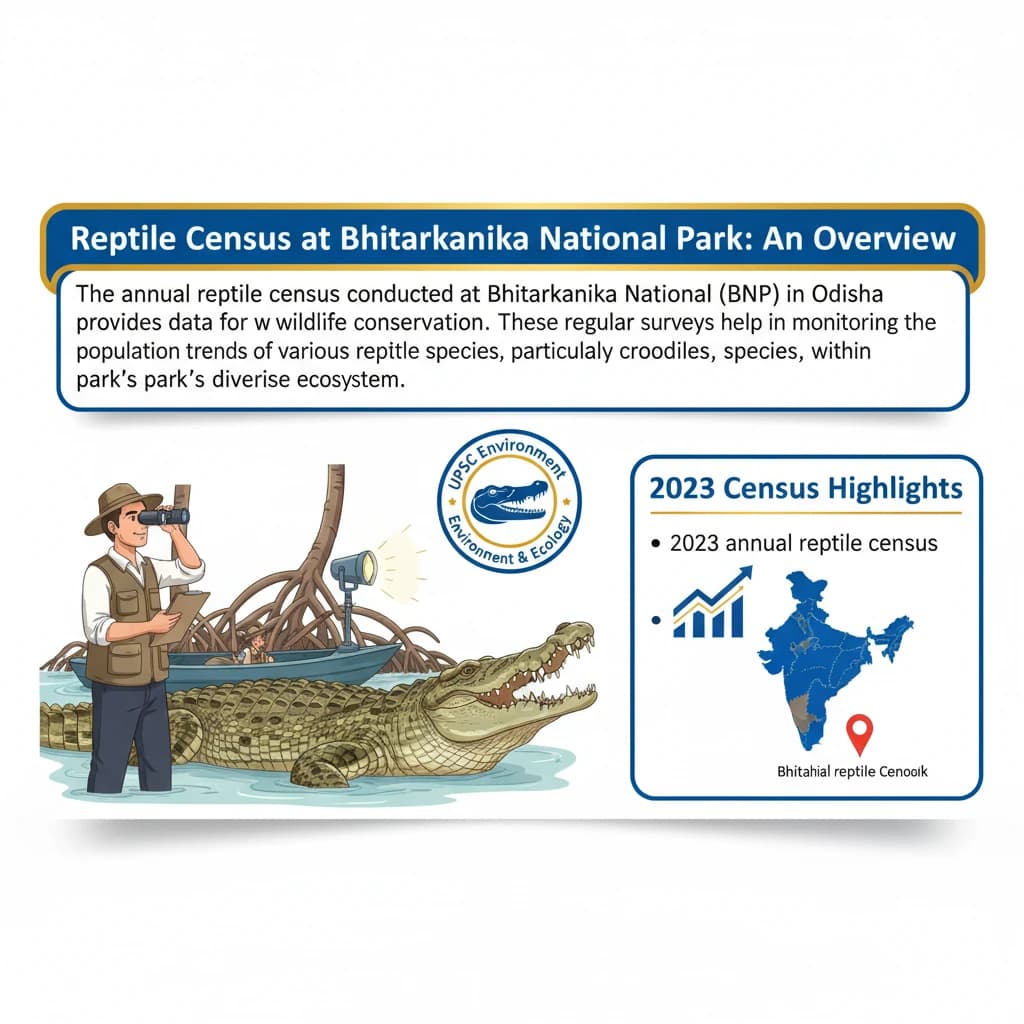
<h4>Reptile Census at Bhitarkanika National Park: An Overview</h4><p>The <strong>annual reptile census</strong> conducted at <strong>Bhitarkanika National Park (BNP)</strong> in <strong>Odisha</strong> provides crucial data for wildlife conservation.</p><p>These regular surveys help in monitoring the health and population trends of various reptile species, particularly crocodiles, within the park's diverse ecosystem.</p><h4>2023 Census Highlights</h4><p>The <strong>2023 annual reptile census</strong> revealed a significant population of <strong>saltwater crocodiles</strong> in <strong>Bhitarkanika National Park</strong>.</p><p>The total count for saltwater crocodiles stood at <strong>1,826 individuals</strong>, indicating a robust population within the park's protected areas.</p><div class='info-box'><p><strong>Key Finding:</strong> The 2023 census recorded <strong>1,826 saltwater crocodiles</strong> in <strong>Bhitarkanika National Park</strong>.</p><p>This count also included a rare sighting of <strong>18 albino crocodiles</strong>, which are white-colored crocodiles due to a genetic condition, highlighting the park's unique biodiversity.</p></div><h4>Advanced Census Methodology</h4><p>The <strong>2023 census</strong> employed modern technology to enhance accuracy and minimize human error in data collection.</p><p>This innovative approach ensures reliable population estimates, which are vital for effective conservation planning.</p><div class='info-box'><p><strong>Technology Used:</strong> The census was conducted using the <strong>Timestamp Camera App</strong>.</p><p>This application records video with integrated <strong>time watermarks</strong> and <strong>GPS coordinates</strong>, providing precise location and time data for each sighting.</p></div><h4>The Crocodile Conservation Project: A Historical Initiative</h4><p>The success seen in Bhitarkanika's crocodile population is largely attributed to a long-standing conservation effort.</p><p>This project was a pioneering initiative in India for the protection of endangered crocodile species.</p><div class='key-point-box'><p><strong>Project Start:</strong> The <strong>Crocodile Conservation Project</strong> was initiated in <strong>1975</strong>.</p><p>It was launched specifically at <strong>Bhitarkanika National Park</strong>, recognizing its importance as a critical habitat for crocodiles.</p></div><h4>Goals of the Crocodile Conservation Project</h4><p>The primary objective of the project was to protect and help recover the populations of three critically endangered crocodile species found in India.</p><p>This ambitious goal aimed to restore these apex predators to healthy numbers within their natural habitats.</p><ul><li><strong>Target Species:</strong> The project focused on conserving the <strong>Mugger crocodile</strong>, <strong>Gharial</strong>, and <strong>Saltwater Crocodile</strong>.</li><li><strong>Population Goal:</strong> A key aim was to increase the population density to a point where <strong>5 to 6 crocodiles</strong> could be sighted per kilometer of water body, indicating a thriving ecosystem.</li></ul>
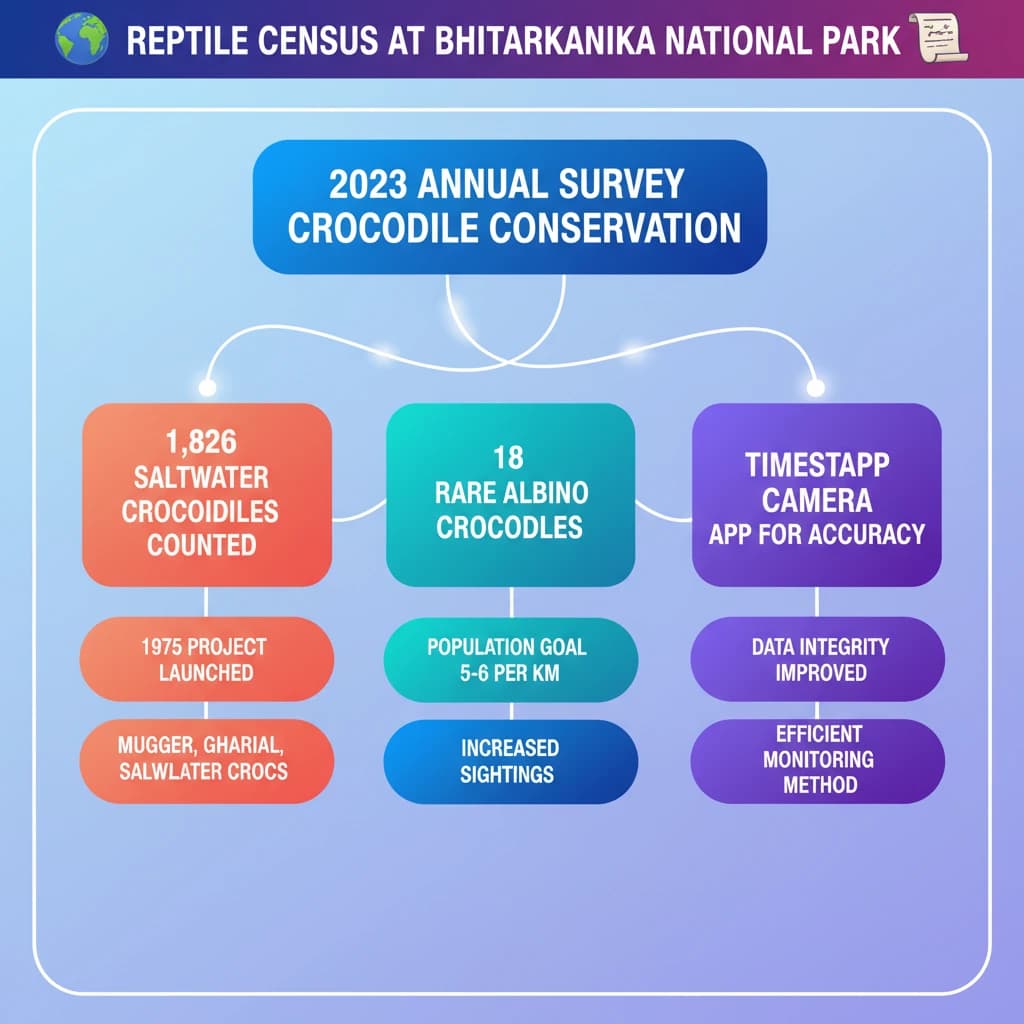
Concept Diagram

💡 Key Takeaways

  • •Bhitarkanika National Park conducted its annual reptile census in 2023.
  • •The census recorded 1,826 saltwater crocodiles, including 18 rare albino crocodiles.
  • •The survey utilized the Timestamp Camera App for improved accuracy and data integrity.
  • •The Crocodile Conservation Project, launched in 1975 at Bhitarkanika, aimed to protect Mugger, Gharial, and Saltwater Crocodiles.
  • •The project's goal was to increase crocodile populations to 5-6 sightings per kilometer of water.
  • •Bhitarkanika is a key site for saltwater crocodile conservation in India.

🧠 Memory Techniques
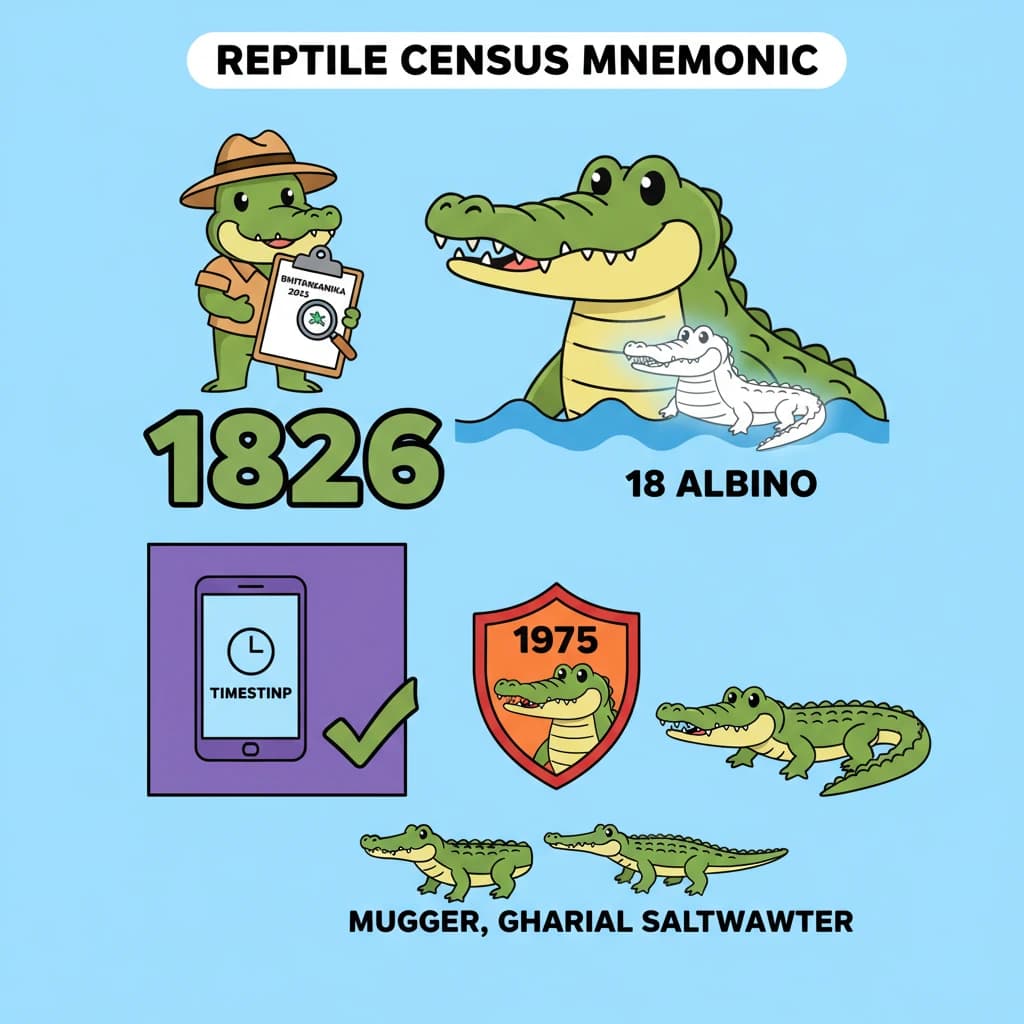
Memory Aid
98% Verified Content

📚 Reference Sources

•General knowledge on Bhitarkanika National Park and Crocodile Conservation Project in India.

Related Topics

Loading related topics...
Explore:Environment And Ecology Topics·All Subjects·Daily Current Affairs·Editorial Analysis·Previous Year Questions·UPSC GPT