Loading page, please wait…
Vaidra Logo
Vaidra

Top 4 items + smart groups

UPSC GPT
New
Current Affairs
Daily Solutions
Daily Puzzle
Mains Evaluator

Version 2.0.0 • Built with ❤️ for UPSC aspirants

Loading...
Loading...
Loading...
Loading...
Loading...
Loading...
Loading...
Loading...
Loading...
Loading...
Loading...
Loading...
Loading...
Back
All Subjects

Topics

0 topics • 0 completed

Loading topics...
Loading...
Loading...
Loading...
Loading...
Loading...
Overall Progress0%

What are the Key Findings of the GHG Bulletin? - UPSC Environment And Ecology

What is What are the Key Findings of the GHG Bulletin? in UPSC Environment And Ecology?

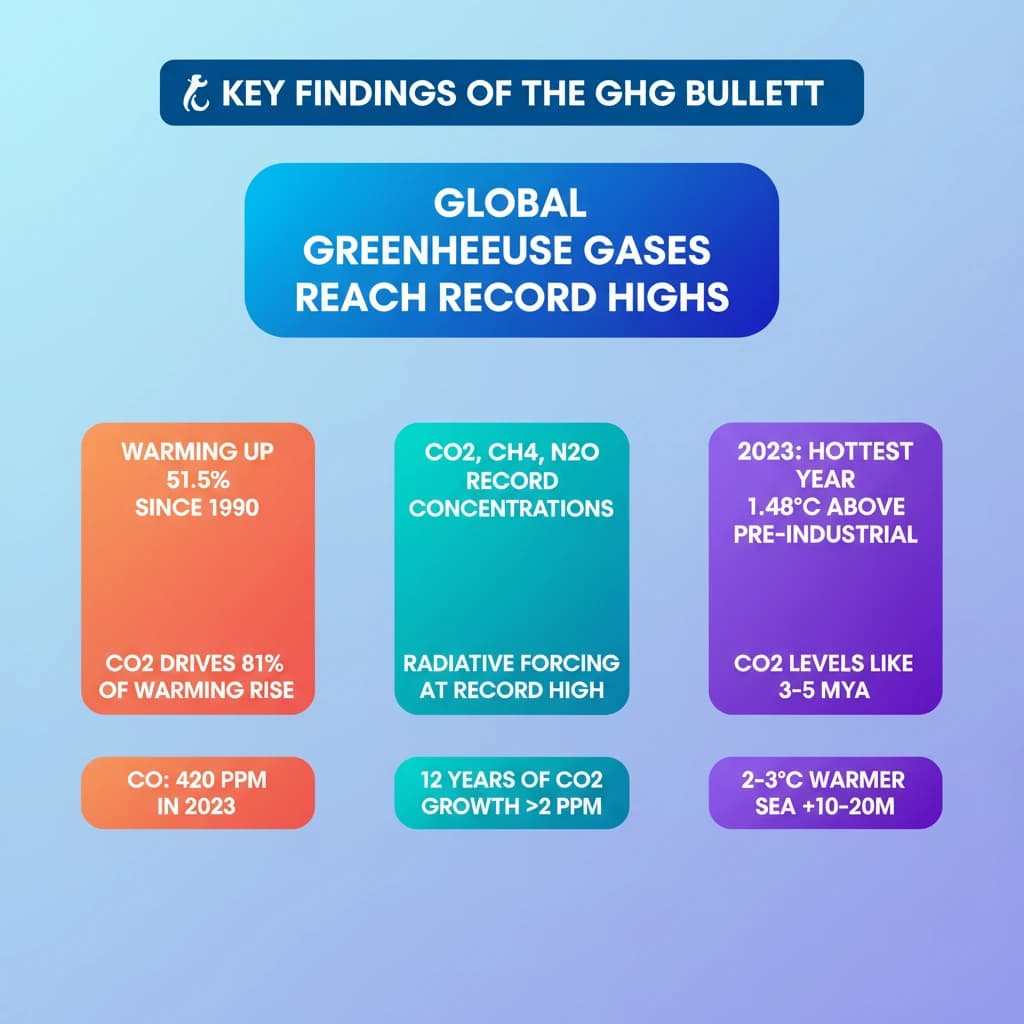
What are the Key Findings of the GHG Bulletin? is a key topic under Environment And Ecology for UPSC Civil Services Examination. Key points include: Greenhouse gas warming effect up 51.5% since 1990, with CO2 contributing 81% of this rise.. CO2, CH4, and N2O reached record high concentrations in 2023; CO2 hit 420 ppm.. 2023 was the hottest year on record, 1.48°C above pre-industrial levels, driven by record radiative forcing.. Understanding this topic is essential for both UPSC Prelims and Mains preparation.

Why is What are the Key Findings of the GHG Bulletin? important for UPSC exam?

What are the Key Findings of the GHG Bulletin? is a Medium-level topic in UPSC Environment And Ecology. It is tested in both Prelims (factual MCQs) and Mains (analytical answer writing). Previous year UPSC questions have frequently covered aspects of What are the Key Findings of the GHG Bulletin?, making it essential for comprehensive IAS preparation.

How to prepare What are the Key Findings of the GHG Bulletin? for UPSC?

To prepare What are the Key Findings of the GHG Bulletin? for UPSC: (1) Study the comprehensive notes covering all key concepts on Vaidra. (2) Practice previous year questions on this topic. (3) Connect it with current affairs using daily updates. (4) Revise using key takeaways and mind maps available for Environment And Ecology. (5) Write practice answers linking What are the Key Findings of the GHG Bulletin? to related GS Paper topics.

Key takeaways of What are the Key Findings of the GHG Bulletin? for UPSC

  • Greenhouse gas warming effect up 51.5% since 1990, with CO2 contributing 81% of this rise.
  • CO2, CH4, and N2O reached record high concentrations in 2023; CO2 hit 420 ppm.
  • 2023 was the hottest year on record, 1.48°C above pre-industrial levels, driven by record radiative forcing.
  • Current CO2 levels resemble those 3-5 million years ago, when global temperatures were 2-3°C higher and sea levels 10-20m higher.
  • 2023 marked the 12th consecutive year with annual CO2 growth exceeding 2 ppm, indicating a persistent upward trend.
What are the Key Findings of the GHG Bulletin?

What are the Key Findings of the GHG Bulletin?

Medium⏱️ 8 min read✓ 98% Verified
environment and ecology

📖 Introduction

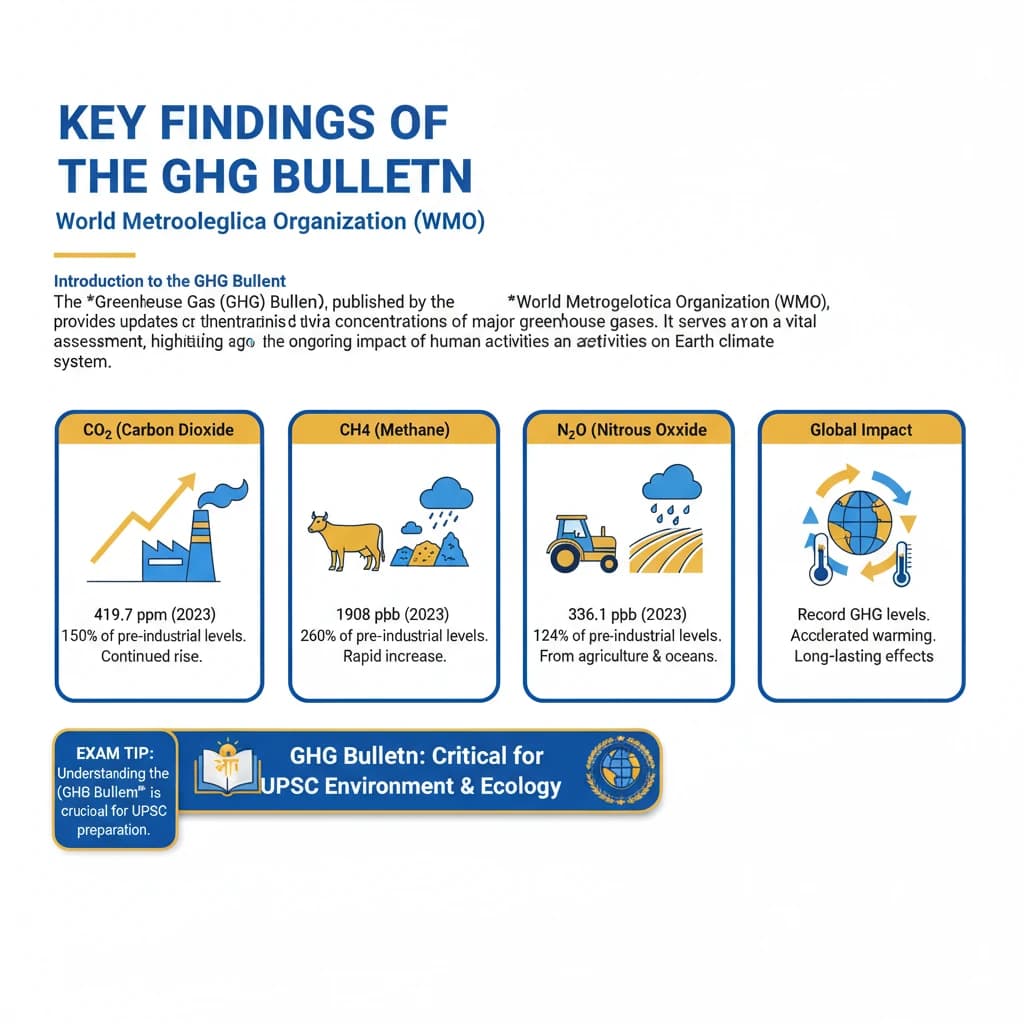
<h4>Introduction to the GHG Bulletin</h4><p>The <strong>Greenhouse Gas (GHG) Bulletin</strong>, published by the <strong>World Meteorological Organization (WMO)</strong>, provides critical updates on the atmospheric concentrations of major greenhouse gases.</p><p>It serves as a vital scientific assessment, highlighting the ongoing and accelerating impact of human activities on Earth's climate system.</p><div class='exam-tip-box'>Understanding the <strong>GHG Bulletin</strong> is crucial for <strong>UPSC Mains GS-III</strong> (Environment) and <strong>Prelims</strong>, as it provides authoritative data for climate change discussions.</div><h4>Overall Warming Effect Increase</h4><p>Since <strong>1990</strong>, the warming effect on our planet, primarily driven by <strong>greenhouse gases</strong>, has seen a significant surge.</p><p>This increase, known as <strong>radiative forcing</strong>, quantifies the energy imbalance caused by these gases.</p><div class='info-box'>The warming effect from <strong>greenhouse gases</strong> has surged by <strong>51.5%</strong> since <strong>1990</strong>. <strong>Carbon Dioxide (CO2)</strong> alone contributed a substantial <strong>81%</strong> of this overall rise.</div><div class='key-point-box'>This data underscores the dominant role of <strong>CO2 emissions</strong> in driving global warming over the past few decades.</div><h4>Record High Greenhouse Gas Concentrations in 2023</h4><p>The year <strong>2023</strong> marked a concerning milestone, with the concentrations of key <strong>greenhouse gases</strong> reaching unprecedented levels in the atmosphere.</p><p>These gases include <strong>Carbon Dioxide (CO2)</strong>, <strong>Methane (CH4)</strong>, and <strong>Nitrous Oxide (N2O)</strong>, all critical contributors to the enhanced greenhouse effect.</p><div class='info-box'>In <strong>2023</strong>:<ul><li><strong>CO2</strong> reached <strong>420 ppm</strong> (parts per million), increasing by <strong>2.3 ppm</strong>.</li><li><strong>CH4</strong> and <strong>N2O</strong> also recorded <strong>unprecedented highs</strong>.</li></ul></div><div class='key-point-box'>The continuous rise in these concentrations indicates a failure to curb emissions effectively, despite international climate commitments.</div><h4>2023: The Hottest Year on Record</h4><p>Consistent with the rising <strong>GHG concentrations</strong>, <strong>2023</strong> was officially declared the <strong>hottest year on record</strong>, surpassing previous benchmarks.</p><p>This record-breaking temperature was a direct consequence of the elevated <strong>radiative forcing</strong> caused by the accumulated greenhouse gases.</p><div class='info-box'>Global temperatures in <strong>2023</strong> were approximately <strong>1.48°C</strong> above <strong>pre-industrial levels</strong>. This surpassed the previous record set in <strong>2016</strong>.</div><div class='exam-tip-box'>Cite <strong>2023</strong> as the <strong>hottest year on record</strong> in answers related to climate change impacts, global warming, and the urgency of mitigation strategies.</div><h4>Historical Context of CO2 Levels</h4><p>The current atmospheric <strong>CO2 levels</strong> are not just record highs in recent human history but also in geological timescales.</p><p>Comparing today's concentrations to past geological epochs provides a stark warning about potential future climate scenarios.</p><div class='info-box'>Current <strong>CO2 levels</strong> (around <strong>420 ppm</strong>) are comparable to those observed approximately <strong>3-5 million years ago</strong>. During that period, global temperatures were <strong>2-3°C higher</strong>, and sea levels were <strong>10-20 metres above today’s levels</strong>.</div><div class='key-point-box'>This historical comparison highlights the potential long-term consequences, including significant sea-level rise and altered climate patterns, if current trends persist.</div><h4>Persistent Rise in CO2 Concentrations</h4><p>The increase in <strong>atmospheric CO2</strong> is not an isolated event but part of a sustained and worrying trend.</p><p>Annual growth rates continue to exceed critical thresholds, indicating a persistent imbalance in the carbon cycle.</p><div class='info-box'><strong>2023</strong> marked the <strong>12th consecutive year</strong> where the annual growth in <strong>CO2 concentration</strong> exceeded <strong>2 ppm</strong>.</div><div class='exam-tip-box'>Mentioning the "<strong>12th consecutive year</strong>" statistic can add weight to arguments about the sustained nature of climate change and the need for long-term solutions in <strong>UPSC Mains</strong> answers.</div>
Concept Diagram

💡 Key Takeaways

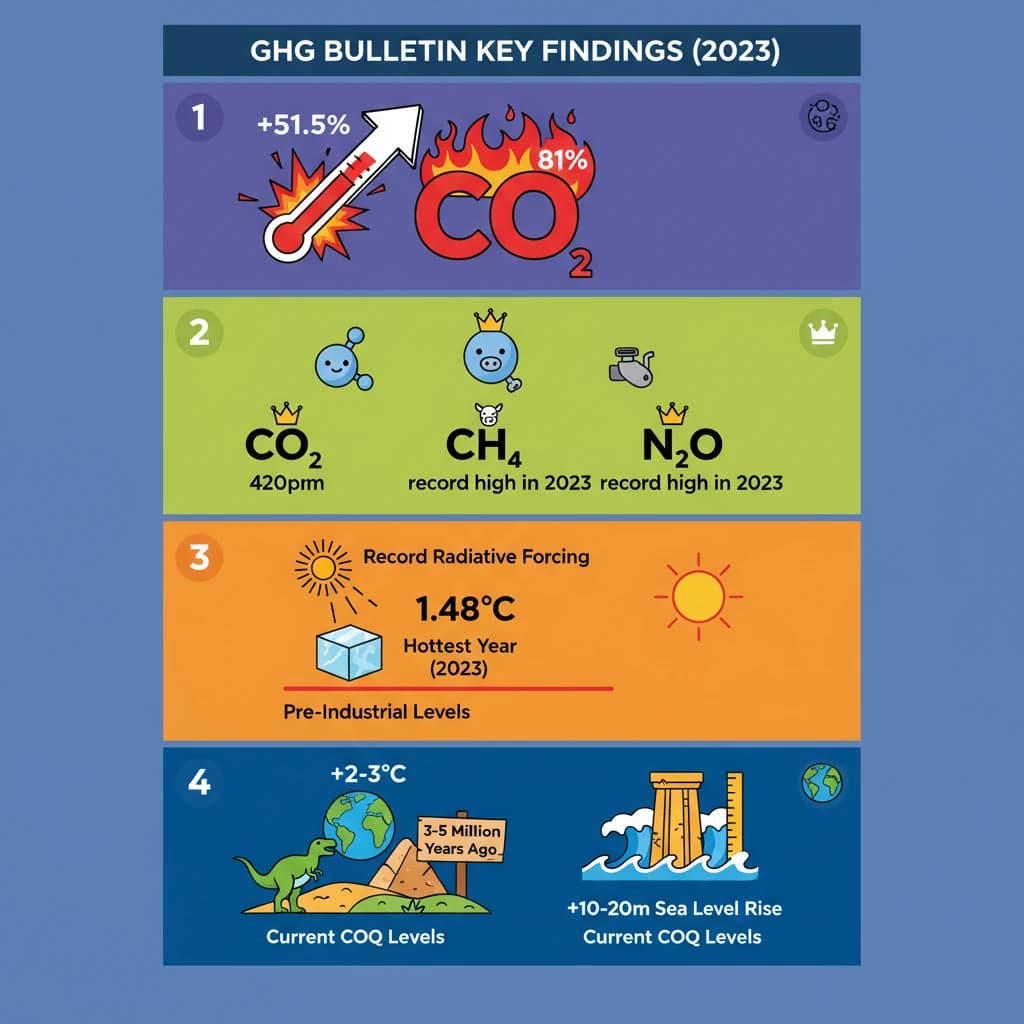
  • •Greenhouse gas warming effect up 51.5% since 1990, with CO2 contributing 81% of this rise.
  • •CO2, CH4, and N2O reached record high concentrations in 2023; CO2 hit 420 ppm.
  • •2023 was the hottest year on record, 1.48°C above pre-industrial levels, driven by record radiative forcing.
  • •Current CO2 levels resemble those 3-5 million years ago, when global temperatures were 2-3°C higher and sea levels 10-20m higher.
  • •2023 marked the 12th consecutive year with annual CO2 growth exceeding 2 ppm, indicating a persistent upward trend.

🧠 Memory Techniques
Memory Aid
98% Verified Content

📚 Reference Sources

•Intergovernmental Panel on Climate Change (IPCC) Assessment Reports
•UN Environment Programme (UNEP) Emissions Gap Report

Related Topics

Loading related topics...
Explore:Environment And Ecology Topics·All Subjects·Daily Current Affairs·Editorial Analysis·Previous Year Questions·UPSC GPT
What are the Key Findings of the GHG Bulletin? - UPSC Environment And Ecology