Loading page, please wait…
Vaidra Logo
Vaidra

Top 4 items + smart groups

UPSC GPT
New
Current Affairs
Daily Solutions
Daily Puzzle
Mains Evaluator

Version 2.0.0 • Built with ❤️ for UPSC aspirants

Loading...
Loading...
Loading...
Loading...
Loading...
Loading...
Loading...
Loading...
Loading...
Loading...
Loading...
Loading...
Loading...
What are the Key Facts about Buxa Tiger Reserve? - UPSC Environment And Ecology

What are the Key Facts about Buxa Tiger Reserve? - UPSC Environment And Ecology

What is What are the Key Facts about Buxa Tiger Reserve? in UPSC Environment And Ecology?

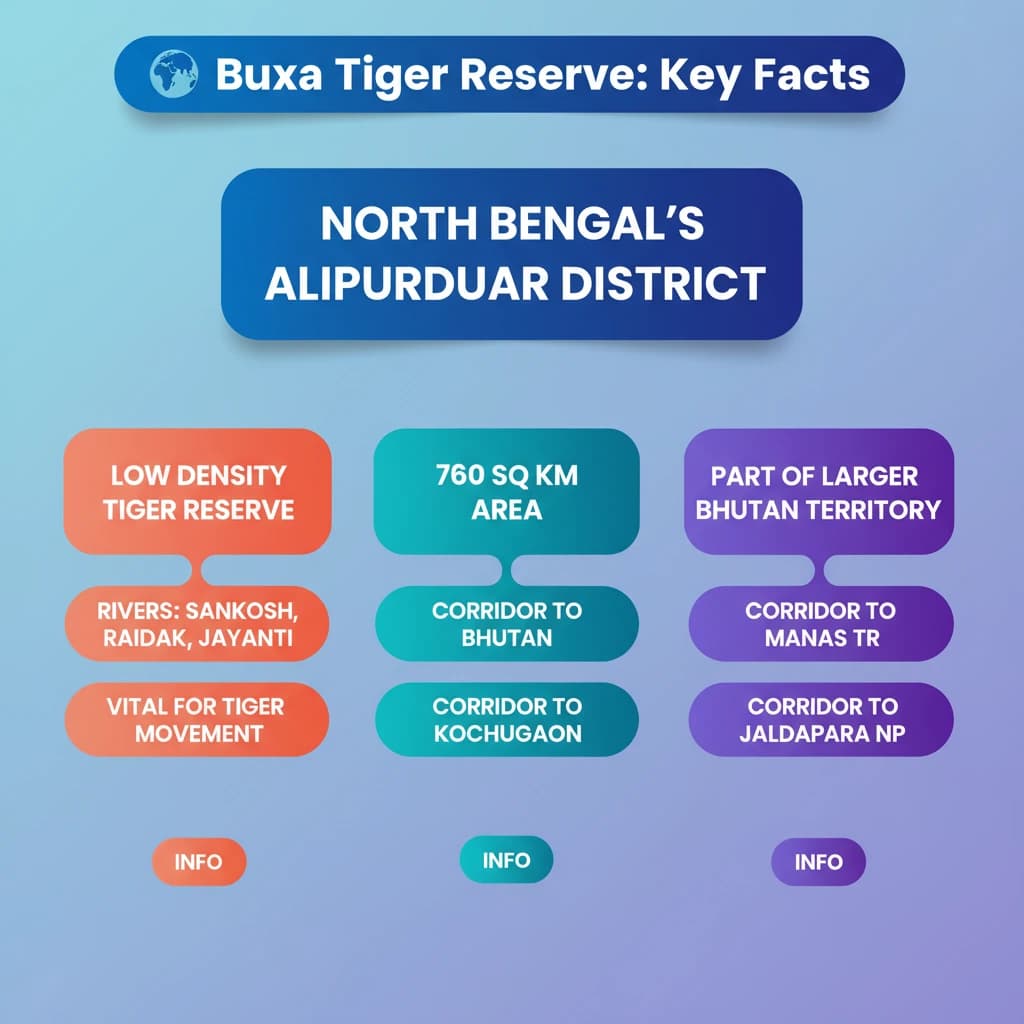
What are the Key Facts about Buxa Tiger Reserve? is a key topic under Environment And Ecology for UPSC Civil Services Examination. Key points include: Buxa Tiger Reserve is in North Bengal's Alipurduar district, covering 760 sq km.. It's a 'low density' tiger reserve, part of a larger territory extending to Bhutan.. Key rivers flowing through it include Sankosh, Raidak, and Jayanti.. Understanding this topic is essential for both UPSC Prelims and Mains preparation.

Why is What are the Key Facts about Buxa Tiger Reserve? important for UPSC exam?

What are the Key Facts about Buxa Tiger Reserve? is a Easy-level topic in UPSC Environment And Ecology. It is tested in both Prelims (factual MCQs) and Mains (analytical answer writing). Previous year UPSC questions have frequently covered aspects of What are the Key Facts about Buxa Tiger Reserve?, making it essential for comprehensive IAS preparation.

How to prepare What are the Key Facts about Buxa Tiger Reserve? for UPSC?

To prepare What are the Key Facts about Buxa Tiger Reserve? for UPSC: (1) Study the comprehensive notes covering all key concepts on Vaidra. (2) Practice previous year questions on this topic. (3) Connect it with current affairs using daily updates. (4) Revise using key takeaways and mind maps available for Environment And Ecology. (5) Write practice answers linking What are the Key Facts about Buxa Tiger Reserve? to related GS Paper topics.

Key takeaways of What are the Key Facts about Buxa Tiger Reserve? for UPSC

  • Buxa Tiger Reserve is in North Bengal's Alipurduar district, covering 760 sq km.
  • It's a 'low density' tiger reserve, part of a larger territory extending to Bhutan.
  • Key rivers flowing through it include Sankosh, Raidak, and Jayanti.
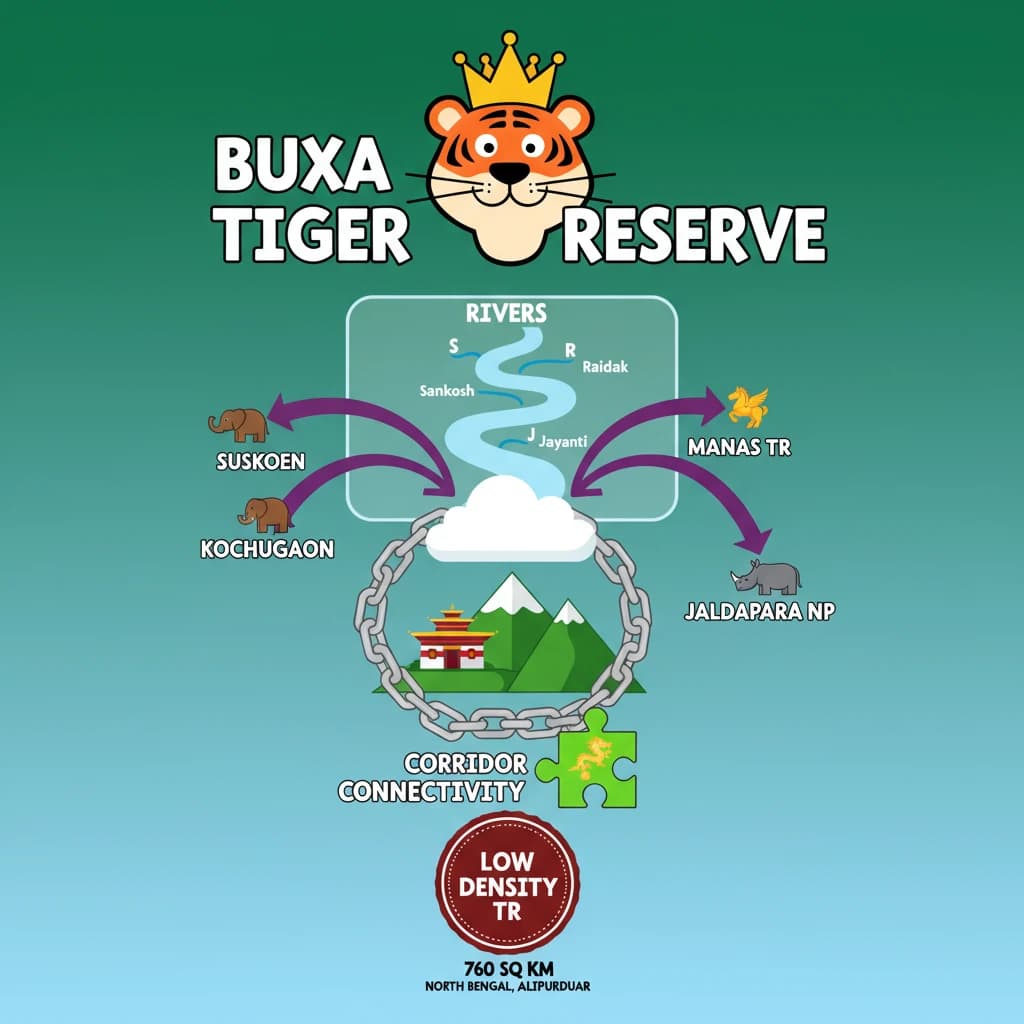
  • It has critical corridor connectivity with Bhutan, Kochugaon forests, Manas Tiger Reserve, and Jaldapara National Park.
  • These corridors are vital for tiger movement and genetic exchange.
What are the Key Facts about Buxa Tiger Reserve?

What are the Key Facts about Buxa Tiger Reserve?

Easy⏱️ 5 min read✓ 95% Verified
environment and ecology

📖 Introduction

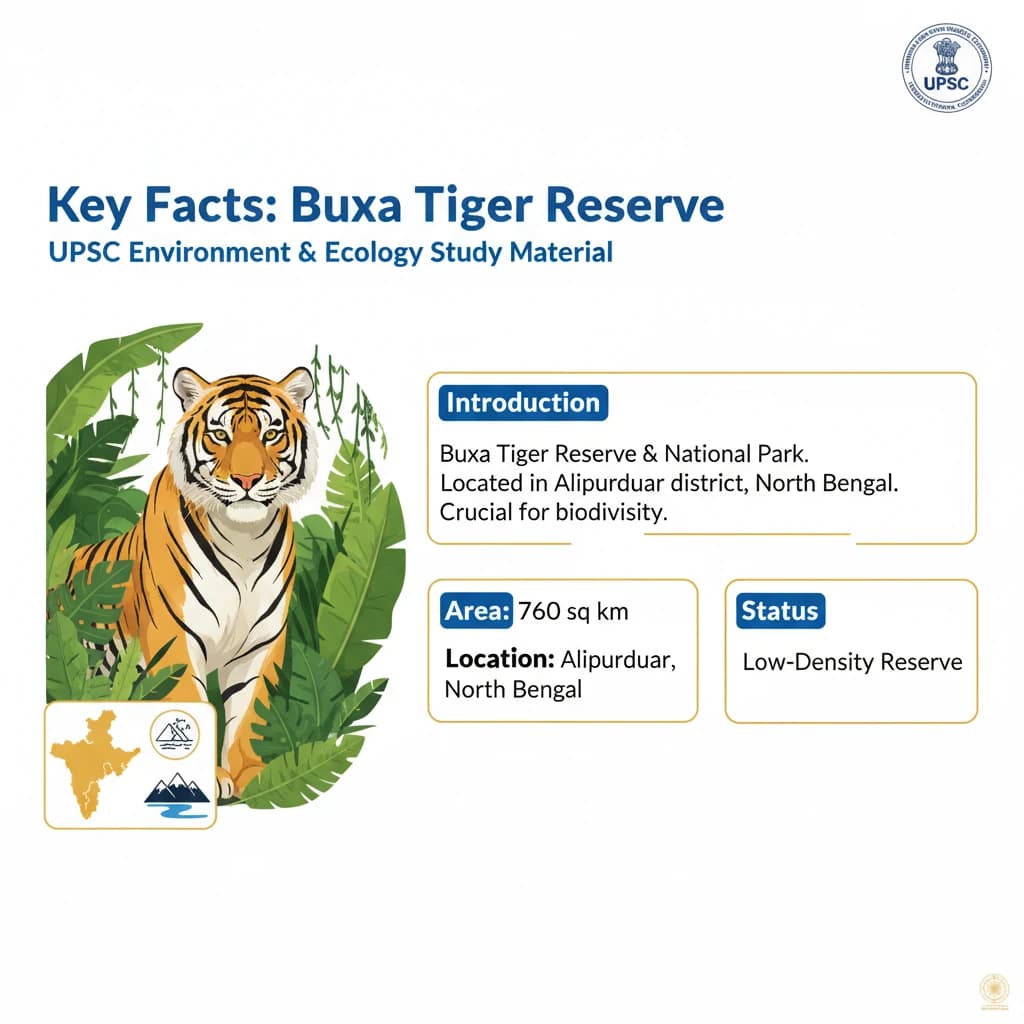
<h4>Introduction to Buxa Tiger Reserve</h4><p>The <strong>Buxa Tiger Reserve</strong> and <strong>National Park</strong> is a significant protected area located in <strong>North Bengal's Alipurduar district</strong>. It plays a crucial role in regional biodiversity conservation.</p><div class='info-box'><p><strong>Area:</strong> 760 square kilometers</p><p><strong>Location:</strong> Alipurduar district, North Bengal</p></div><h4>Status as a Low-Density Reserve</h4><p><strong>Buxa</strong> is characterized as a <strong>"low density" reserve</strong>. This indicates that while it is a designated tiger habitat, its tiger population density is relatively lower compared to some other reserves.</p><div class='key-point-box'><p>Being a <strong>low-density reserve</strong> highlights the importance of its conservation efforts and the need to support its tiger population recovery.</p></div><h4>Geographical Significance and River Systems</h4><p>The reserve is an integral part of a larger <strong>tiger territory</strong> that extends beyond India's borders into <strong>Bhutan</strong>. This cross-border connectivity is vital for genetic exchange and population viability.</p><p>Several important rivers flow through the <strong>Buxa National Park</strong>, contributing to its rich ecosystem and providing essential water sources for its flora and fauna.</p><ul><li><strong>Sankosh</strong></li><li><strong>Raidak</strong></li><li><strong>Jayanti</strong></li><li><strong>Churnia</strong></li><li><strong>Turturi</strong></li><li><strong>Phashkhawa</strong></li><li><strong>Dima</strong></li><li><strong>Nonani</strong></li></ul><h4>Critical Corridor Connectivity</h4><p>According to the <strong>National Tiger Conservation Authority (NTCA)</strong>, <strong>Buxa Tiger Reserve</strong> boasts vital corridor connectivity with several other significant forest areas. These corridors are essential for the movement of wildlife, especially tigers, between protected zones.</p><div class='info-box'><p><strong>Northern Linkage:</strong> Forests of <strong>Bhutan</strong> (across the border)</p><p><strong>Eastern Linkages:</strong> <strong>Kochugaon forests (Assam)</strong> and <strong>Manas Tiger Reserve (Assam)</strong></p><p><strong>Western Linkage:</strong> <strong>Jaldapara National Park</strong></p></div><div class='exam-tip-box'><p>Understanding <strong>corridor connectivity</strong> is crucial for UPSC. It's a key concept in wildlife conservation, habitat fragmentation, and mitigating human-wildlife conflict. Questions often revolve around the importance of such linkages for genetic diversity and species survival.</p></div>
Concept Diagram

💡 Key Takeaways

  • •Buxa Tiger Reserve is in North Bengal's Alipurduar district, covering 760 sq km.
  • •It's a 'low density' tiger reserve, part of a larger territory extending to Bhutan.
  • •Key rivers flowing through it include Sankosh, Raidak, and Jayanti.
  • •It has critical corridor connectivity with Bhutan, Kochugaon forests, Manas Tiger Reserve, and Jaldapara National Park.
  • •These corridors are vital for tiger movement and genetic exchange.

🧠 Memory Techniques
Memory Aid
95% Verified Content

Related Topics

Loading related topics...
Explore:Environment And Ecology Topics·All Subjects·Daily Current Affairs·Editorial Analysis·Previous Year Questions·UPSC GPT
Back
All Subjects

Topics

0 topics • 0 completed

Loading topics...
Loading...
Loading...
Loading...
Loading...
Loading...
Overall Progress0%